
Table of Contents (15)
My First Reaction to “Ryzen 9 9950X3D2”: Wait, They’re Actually Doing the Crazy One?
The first time I saw “Ryzen 9 9950X3D2” in a leak, I honestly assumed it was a typo. AMD already has the Ryzen 9 9950X3D on everyone’s radar, and the naming is confusing enough. Slapping a “2” on the end looked more like a marketing intern mashing the keyboard than a real product name.
But then it kept showing up. ComputerBase mentioned it after a briefing. Alienware briefly name‑dropped it in promo text. Sytronix listed it in workstation specs as using an “X3D2 architecture.” Three different places in a couple of days? That’s when it stopped feeling like noise and started looking like a pattern.
And if the rumor is true, this isn’t just another high‑end chip. This is the one AMD told us wasn’t worth building: a full‑fat, 16‑core Zen 5 CPU with 3D V‑Cache on both CCDs. In other words, every single core gets the extra cache treatment, instead of just half the chip like on previous X3D flagships.
It took me a while to understand why AMD originally brushed off this idea. On paper it sounds like the obvious “max everything out” move: more cache, more cores, more money. But once you dig into how 3D V‑Cache actually works, the picture gets more nuanced – and you start to see why AMD’s own marketing guy called the likely performance gain “only a couple of percent.”
And yet, if you’re the sort of person who looks at a Ryzen 7 9850X3D and thinks “cute mid‑range chip,” this rumored 9950X3D2 is exactly the kind of ridiculous you’ve been waiting for.
Where the Ryzen 9 9950X3D2 Rumor Came From
Let’s pin down what we actually know – or, more accurately, what’s been hinted at.
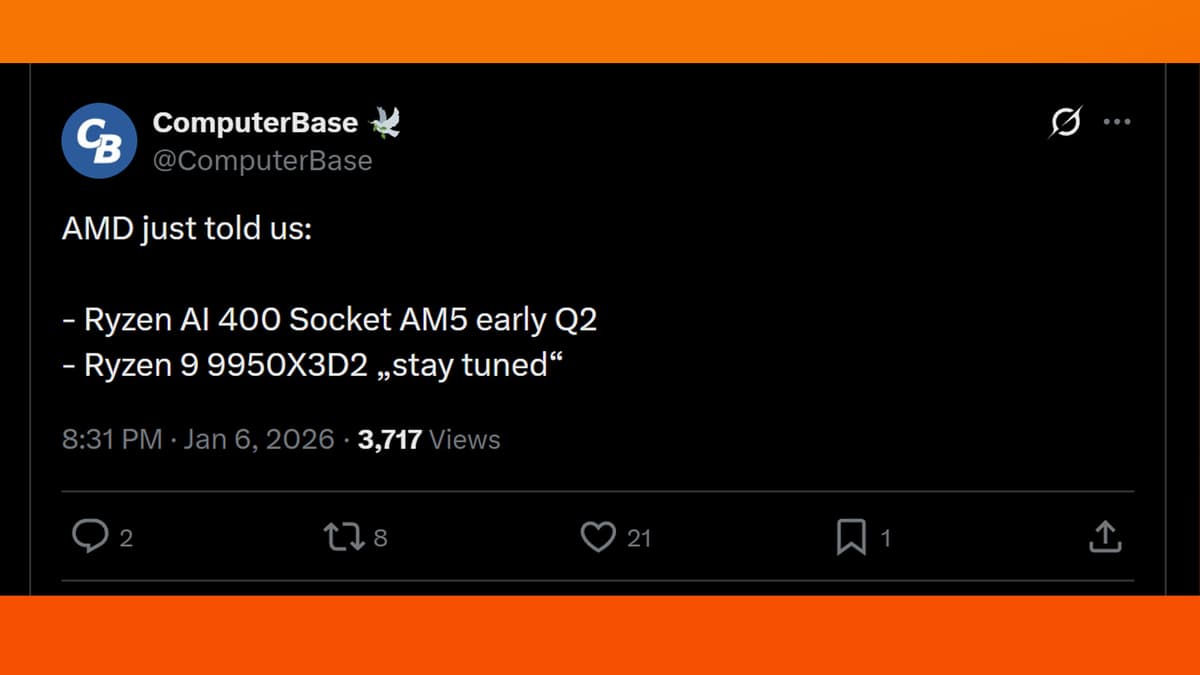
The most interesting breadcrumb came from German outlet ComputerBase. After a briefing with AMD, they posted on X that AMD had told them, in effect, “Ryzen 9 9950X3D2 – stay tuned.” That’s not an official product announcement, but it’s also not the kind of phrase you throw around if the idea is completely dead internally.
At almost the same time, two OEMs accidentally gave the rumor some teeth:
Alienware briefly mentioned the Ryzen 9 9950X3D2 in a Weibo description for its new Area‑51 desktop with AMD CPUs. The CPU name vanished later, replaced by a more generic “latest AMD Ryzen processors and second‑generation 3D V‑Cache.” But the original text was up long enough for enthusiasts to grab screenshots.
Sytronix, a system integrator, did something similar on its website. It listed a Ryzen 9 9950X3D2 with 16 cores and “X3D2 architecture” in its workstation spec sheets, then quietly swapped that entry to the regular 9950X3D soon after.
If it was just one of these, I’d write it off as a copy‑paste fail. But ComputerBase’s “stay tuned” plus two separate OEMs independently typing the same oddly specific SKU? That’s the kind of cluster of mistakes that usually means there’s at least a real internal code name floating around under NDA.
To be clear: AMD has not officially announced the Ryzen 9 9950X3D2. Everything right now is pre‑launch noise. But as pre‑launch noise goes, this is stronger than the usual anonymous “my uncle works at AMD” forum post.
AMD Already Told Us Why This Chip Didn’t Make Sense… Until Now
Almost a year ago, when AMD first started talking publicly about Zen 5 X3D plans, we asked the obvious question: are you going to make a 16‑core chip where all cores get 3D V‑Cache?
The answer was basically, “We could, but we’re not convinced it’s worth it.” AMD representatives said they didn’t see a “massive market” for such a part, and they’d need to “do some internal analysis” on whether the cost and yield hit would justify the performance uplift.
More recently, AMD’s senior technical marketing manager for consumer CPUs, Donny Woligroski, was even blunter about the performance side. Talking about the idea of putting cache stacks under both CCDs, he said they knew it was only going to be “a couple of percent difference” versus the one‑stack design. In other words: you’d be paying a lot of money in silicon and engineering to chase very small gains.
So what changed? Most likely, nothing fundamental. This still doesn’t look like a sane mainstream product. It looks like a halo part – the kind of thing AMD can wheel out to say “we own the gaming crown” and give OEM partners a headliner for ultra‑premium builds.
That’s why I’m not expecting shelves packed with 9950X3D2 boxes at your local retailer. If it exists, it’s more likely to be a limited‑volume, high‑margin, “because we can” flex for boutique pre‑builds and the top 1% of home builders who always pick the most expensive SKU just to know they have it.
Quick 3D V‑Cache Refresher: Why Extra Cache Is Such a Big Deal for Games
To understand why people are so obsessed with this rumored chip, you have to understand why 3D V‑Cache matters at all.
Normal Ryzen CPUs already have a big slab of L3 cache sitting next to each core complex on the CCD. What AMD did with 3D V‑Cache, starting with the Ryzen 7 5800X3D, was literally stack another chunk of cache on top of that, using a vertical connection process (TSV – through‑silicon vias). Think of it as bolting a second story onto the house instead of trying to sprawl out a bigger one‑floor footprint.
That extra 64 MB of cache per CCD sounds boringly technical until you see what it does in real games. Titles that are very memory‑latency‑sensitive or have massive working sets – think big open worlds, complex sim games, or heavily modded titles – can suddenly keep far more of their “working brain” close to the cores. Less bouncing out to main memory. Fewer stalls. More frames.
That’s why chips like the 5800X3D and 7950X3D punched way above their weight in gaming compared to vanilla Ryzens with similar core counts. They weren’t clocked insanely high. They just wasted less time waiting on RAM.
But there’s a trade‑off: stacking extra silicon on top of the CCD complicates thermals and voltage. You can’t just crank frequency and voltage the same way. That’s why AMD’s strategy for high‑end X3D chips like the 7950X3D was to stack V‑Cache on one CCD, leaving the other CCD “clean” and able to boost higher. You got an 8‑core cache monster plus 8 high‑clocked cores, and the Windows scheduler tried to put games on the cache CCD.
The rumored 9950X3D2 would throw that compromise out the window and say: both CCDs get the tall cache stack. All 16 cores are cache‑heavy cores. No split personality.
What the Ryzen 9 9950X3D2 Likely Looks Like on Paper
None of the leaks give us a full spec sheet, so everything here is informed speculation based on AMD’s patterns and what we know about Zen 5 and existing 9000‑series chips.
Still, if you line up the dots, the “most probable” configuration looks something like this.
Specifications
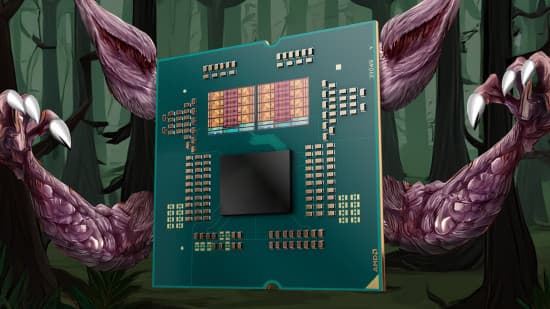
If you’ve looked at an AM5 X3D CPU before, the physical layout won’t shock you: one IO die in the middle, and two CCDs flanking it. The difference is just that, instead of one CCD wearing the big 3D V‑Cache hat, both CCDs would be stacked.
So visually, you still get that three‑chiplet “AM5 classic” look – just with two slightly thicker CCDs stuffed with more cache than most people’s L3 dreams.
How Much Faster Could a Dual‑Stack X3D2 Design Actually Be?
This is where fantasy meets math. The temptation is to think “twice the V‑Cache stacks = way more performance,” but that’s not how this works in practice.
On the current split designs (like a hypothetical 9950X3D), your games prefer to run on the cache CCD. That’s where the big uplift comes from. In many current titles, you don’t need more than 8 really fast, cache‑heavy cores for pure gaming – the rest can sit there handling background tasks, streaming, or high‑thread workloads.
The dual‑stack X3D2 approach removes that split personality and gives you 16 identical, cache‑rich cores. The benefits are real, but they’re nuanced:
Best‑case gaming uplift comes in scenarios where more than 8 cores are being hammered and the game is heavily cache‑sensitive. Some big sim or strategy workloads, some ridiculous modded setups, or next‑gen engines that can genuinely scale past 8 cores could see extra gains by not having to spill into a “non‑cache” CCD.
Scheduling simplification is underrated too. With 7950X3D‑style designs, Windows has to be clever about which CCD gets what. Dual‑cache CCDs turn the whole thing into a “dumb but effective” setup: every core is the right core for gaming. That doesn’t show up as a big FPS bar on a chart, but it cuts weird edge‑cases where the OS occasionally gets it wrong.
The flip side is what Donny Woligroski pointed out: once you already have one big cache CCD, stacking the second one doesn’t unlock double the magic. You’re deep into diminishing returns. AMD’s own internal modeling apparently suggested you’d only see a couple of percent extra performance in most gaming scenarios over a single‑stacked design.
In practical numbers, if a Ryzen 9 9950X3D averaged, say, 250 fps in a given esports title, the 9950X3D2 might be flirting with 255–260 fps in the same test. You only start to feel that upgrade in “this is nice” territory, not “this is a generational leap.”
But here’s the key: for a certain segment of enthusiasts, that is enough. The same crowd that water‑cools a GPU just to shave off 3–5 °C and pick up 3% more overclock is exactly the audience this chip is for.
Thermals, Clocks, and the Hidden Cost of Cache Stacking Everything
I’ve built several X3D rigs over the last few generations, and the pattern is always the same: these chips love staying cool, and they don’t scale voltage and frequency as aggressively as their non‑3D siblings. That’s the physical price of strapping extra silicon on top of your cores.
By stacking both CCDs, AMD would be fully committing to that trade‑off. There’s no “fast” bare CCD left to push really high boost clocks. I’d expect the 9950X3D2, if it exists, to run at slightly lower peak clocks than a 9950X3D, which itself sits below the plain 9950X in raw MHz.
The good news is Zen 5’s IPC bump helps mask that. You don’t need outrageous clocks when each cycle does more work. The bad news is that for some heavily multithreaded, cache‑indifferent workloads – pure rendering, certain compute tasks – a non‑X3D 9950X might still be the better hammer.
Cooling‑wise, if you’re thinking about a 9950X3D2 for a gaming build, just accept that a cheap 240 mm AIO is not where you stop. This is a “360 mm AIO or a serious air tower” tier of CPU, probably with a BIOS that ships tuned right up to whatever AMD considers safe for long‑term silicon health.
From a silicon manufacturing perspective, AMD is also taking on yield risk. Those 3D V‑Cache dies aren’t free, and every fully stacked CCD consumes one. Doing that twice on a single package creates a top‑tier bin – you need two good CCDs and two good cache stacks. That’s another reason this thing screams “limited halo part” rather than “volume gaming chip.”
Forget the Ryzen 7 9850X3D? Not So Fast
The ironic part of all this is that the rumored 9950X3D2 has completely hijacked the conversation from what should have been the obvious gaming darling: the Ryzen 7 9850X3D.
An 8‑core Zen 5 X3D is, on paper, the sweet spot for actual gamers. You get enough cores for modern titles and background stuff, huge cache for the uplift, friendlier thermals, and usually a much saner price point than the 16‑core flagships. For most people building high‑end rigs, that’s the chip that will offer the best mix of cost and stupidly high FPS.
But PC hardware culture loves an “ultimate” SKU. As soon as whispers of a 16‑core, dual‑stacked 9950X3D2 surfaced, the 9850X3D instantly started looking like the sensible choice rather than the fantasy card. It’s like how nobody talks about the reasonably priced RTX anymore once a “Ti Super Special Edition” leaks.
If you’re the sort of builder who’s staring at a 9850X3D and a 9950X3D and wondering what’s actually worth it, the answer is brutally unsexy: the 9850X3D (or the 12‑core option if AMD offers one) will almost certainly be the better buy unless you’re doing heavy workstation workloads on the same machine.
The 9950X3D2, if it launches, is absolutely not about rational value. It’s about putting the absolute maximum the socket can reasonably do into a single SKU and letting high‑end OEMs write “fastest gaming CPU in the world” on their product pages.
Real‑World Use Cases Where 9950X3D2 Actually Makes Sense
So who genuinely benefits from a fully stacked, 16‑core Zen 5 X3D2 chip, beyond synthetic benchmark chasers?

There are a few setups where this could be legitimately compelling:
1. High‑FPS gaming + heavy background workloads on one machine. If you’re playing at 360 Hz while streaming, recording, running Discord, a browser with 40 tabs, and maybe a capture card or some AI upscaling/filters, having 16 identical cache‑rich cores gives Windows more freedom to juggle heavy threads without pushing your game off the “good” CCD. On current split designs, once you spill past 8 gaming‑favored cores, you’re in a weird mixed mode.
2. Simulation and strategy games that genuinely chew on 12–16 threads. Some sims, grand strategy monsters, or city‑builder sandboxes can scale surprisingly far with threads, especially with big mods. Those workloads tend to be cache‑sensitive too, so extra L3 across the full core set isn’t wasted.
3. Workstation‑by‑day, high‑end gaming rig by night. If you’re doing CPU‑bound production tasks that don’t hate cache – compilers, some code builds, certain rendering pipelines – while also wanting top‑tier gaming performance on the same box, a dogmatically cache‑maxed 16‑core can feel nicer than juggling “gaming cores” and “work cores” mentally and in BIOS.
Even in these cases, though, a regular 9950X3D (single‑stack) might get you 95–98% of the way there once we see real benchmarks. That’s the hard truth: this is about chasing the final few percent and eliminating awkward edge‑cases, not unlocking a whole new tier of gaming performance out of nowhere.
Platform, Compatibility, and the Boring Stuff That Still Matters
One reason this whole saga is even interesting is that AM5 is finally in that mature phase where slamming a monster chip into your existing board isn’t a logistical nightmare.
If AMD keeps its usual pattern, a 9950X3D2 would slot into the same AM5 socket as all the other Ryzen 7000/8000/9000‑series chips. X670E, X670, B650E, and B650 boards should support it with a BIOS update. Of course, you’d want a higher‑end VRM setup if you’re feeding 16 cache‑stacked cores, but that’s true of the 9950X and 9950X3D as well.
Memory‑wise, I’d expect the same DDR5 sweet spots as other Zen 5 parts – something like DDR5‑6000 to 6400 with decent timings is usually the sane target for 1:1 memory controller ratios on AM5. X3D chips in the past have tended to care a bit less about raw memory speed once the cache is in play, but sloppy RAM can still hurt 1% lows, which is what you’re really paying this much money to avoid.
One thing I always watch for with X3D launches is BIOS maturity. The early X3D era had some rough patches with Windows’ scheduler, game mode, and which CCD got used when. If AMD is really going all‑in on a “no split personality” X3D2 design, in a way that might actually simplify tuning: there’s no “wrong” CCD to park your game threads on. That’s a subtle, but real quality‑of‑life win.
From my own builds, the biggest practical concern with these top‑end AM5 chips is heat soak. In a mid‑tower with mediocre airflow, a 16‑core X3D can nudge your whole system into “everything is warmer” territory: GPU temps, VRM temps, even SSDs. If I were planning around a hypothetical 9950X3D2, I’d be budgeting not just for a better cooler, but for a case and fan setup that can actually dump 250–300 W of CPU heat out without cooking everything else.
Pros and Cons of a Ryzen 9 9950X3D2 – If It Launches Like This
This is where I land after looking at the leaks, AMD’s own comments, and how previous X3D chips behaved in real rigs.
✓ PROS
+
Potentially the absolute fastest gaming CPU on AM5
+
3D V‑Cache on all 16 cores removes “good CCD / bad CCD” juggling
+
Cleaner scheduling behavior and fewer edge‑case stutters
+
Great for mixed gaming + heavy multitasking or content creation on one box
+
Huge bragging rights for no‑compromise, money‑no‑object builds
✗ CONS
–
Likely eye‑watering price well above 9950X3D
–
AMD’s own modeling suggests only a few percent gain over single‑stack X3D in many games
–
Lower peak clocks than non‑X3D parts could hurt some workstation loads
–
Extreme cooling and strong motherboard VRMs effectively mandatory
–
Vast overkill versus a Ryzen 7 9850X3D or similar for most gamers
The short version: as a product for normal people, this probably makes very little sense. As a tech flex and a way to lock down the “fastest gaming CPU” headline for a generation, it makes a lot more sense.
My Take: Why This Rumor Still Gets Me Weirdly Excited
I’ve spent enough time around PC hardware to know that “rational” and “exciting” are rarely the same thing. The moment it clicked for me with the 9950X3D2 rumor was when I realized AMD had already done the math, decided it wasn’t worth it – and then the market seemingly dragged them back to the idea anyway.
There’s something kind of pure about a company building a product that doesn’t exist because it needs to, but because a subset of us absolutely will buy the most absurd version of a thing if you just give us the option. Nobody needs a dual‑stack, 16‑core, max‑cache gaming CPU. That’s exactly why it’s fun that it might exist.
From a nerdy engineering angle, I also just like the cleanliness of it. The 7950X3D‑style split CCD design is clever, but slightly inelegant; you’re always thinking about which CCD is doing what. A 9950X3D2‑style approach says: every core is a “gaming core,” every CCD is stacked, no special casing. It’s straightforwardly excessive.
Would I personally daily‑drive one? In my main gaming rig, probably not. I’d almost certainly pick the Ryzen 7 9850X3D (or the closest 8–12‑core X3D equivalent) for the mix of performance, heat, and price. But in the absurd “money is fake” build in my head – the custom loop, the giant case, the pair of flagship GPUs – the CPU in that loop is absolutely something like a 9950X3D2.
Because that’s the real role of a chip like this: it’s not the default recommendation; it’s the wild endgame item for people who’ve already maxed everything else.
Pending (Rumored Product)
VERDICT
If the Ryzen 9 9950X3D2 is real, it’s shaping up to be a dual‑stack 3D V‑Cache monster: 16 Zen 5 cores, both CCDs fully cached, and a tiny but real lead over the regular 9950X3D in the most demanding gaming and hybrid workloads. AMD itself has basically admitted the performance delta is only a few percent in many cases, and the cost – in silicon, thermals, and likely retail price – will be high. For almost everyone, a Ryzen 7 9850X3D‑class chip or a standard 9950X will make far more sense. But as a halo CPU to crown the AM5 platform and give OEMs something outrageous to brag about, a 9950X3D2 would be gloriously unnecessary in exactly the way hardware enthusiasts secretly love.
FinalBoss // Gear
Level up your setup
01Top-rated gaming headsetson Amazon→02High-refresh gaming monitorson Amazon→03Gaming chairson Amazon→04Discounted game keyson Kinguin→Affiliate links · As an Amazon Associate, FinalBoss earns from qualifying purchases.