
You queue up a new AAA release through Game Pass instead of buying it, and the subscription immediately earns its keep. I like that bargain. I’m less comfortable with the assumption that a great deal for the player must also be a great deal for the people who spent years making the game.
That tension gives Shawn Layden’s argument its bite. The former PlayStation executive is right to separate Microsoft’s financial interests from a developer’s rewards. But calling developer profit “impossible” turns a serious criticism of subscription economics into an absolute claim that cannot survive the simplest counterexample: a sufficiently generous contract.
My position is straightforward. Day-one Game Pass can support profitable games. The harder issue is whether it rewards a successful studio enough to justify its next expensive project. Subscriber growth alone cannot answer that.
Table of Contents (6)
“Impossible” overlooks the deal that pays for the game
Speaking on The Expansion Pass, Layden argued that putting games into a subscription on release day undermines the traditional route to breaking even and then earning additional profit. His concern centres on the developer’s ability to participate in the upside: the extra money a breakout release can generate after recovering its costs.
A conventional $69.99 release gives each additional purchase a direct commercial purpose. Sales help recover development and launch costs, then continue generating revenue. That retail price is not the developer’s take-home amount; platform fees, distribution arrangements and other deductions matter. Nevertheless, demand has a relatively clear route into the project’s accounts.
A subscription contract changes that relationship. A developer might receive a fixed licensing payment, staged payments or a guarantee with performance bonuses. If the payment covers the agreed costs and leaves a surplus, the developer can profit. Sales outside the subscription can also remain part of the business. Day-one inclusion does not automatically erase every other source of revenue.
That is enough to defeat “impossible” as a literal verdict. It does very little to defeat Layden’s better argument: a hit can create substantially more value for the platform than its contract returns to the studio.
The platform can win without sharing the jackpot
Layden’s casino comparison — “the house always wins” — captures the imbalance neatly. Microsoft collects recurring subscription revenue across a library. One release might attract a new subscriber; another might persuade an existing subscriber to stay. Their value extends beyond purchases of those individual games.
Now consider an independent studio on a fixed-fee deal. Its game could become the release everyone recommends, help retain subscribers and strengthen the service’s reputation. Unless the agreement includes meaningful performance payments, that success does not automatically increase the studio’s cheque. Popularity and financial reward can drift apart.

Microsoft-owned studios require a different analysis. Their funding sits within the parent company’s broader business, rather than depending solely on an outside licensing agreement. Microsoft can decide that a game’s contribution to subscriptions and the Xbox ecosystem justifies its cost. That still leaves the studio dependent on how management values that contribution and whether it funds another project.
This is why I find declarations that “Game Pass is profitable” inadequate as answers to developer concerns. Service-level profit does not reveal a project’s budget, its compensation or the return available to its creators. Those are different accounts.
Layden’s approximately 500 million-subscriber figure should not become a supposed break-even target, either. He described it as hyperbole rather than a precise forecast. A useful calculation would need subscription revenue, licensing costs, operating expenses and the allocation of those costs. One enormous subscriber number supplies none of that.
A guaranteed payment can be worth surrendering some upside
The strongest defence of Game Pass is risk sharing. A full-price launch offers potentially large rewards, but nobody guarantees the audience will turn up. Years of development and a substantial launch campaign can end in disappointing sales. Protecting the possibility of a jackpot has limited value to a studio that cannot survive a miss.
For a smaller independent project, guaranteed subscription income can make the difference between a viable release and a frightening financial gamble. Discovery through the library can also reach players who would never have bought the game outright. A deal can reduce dependence on an expensive marketing push while giving the team a larger audience.
I would not dismiss that security as developers being cheated out of imaginary sales. Every subscriber who downloads a game is not a displaced $69.99 customer. Some were never prospective buyers. Others may discover a studio through the service and buy its work later.
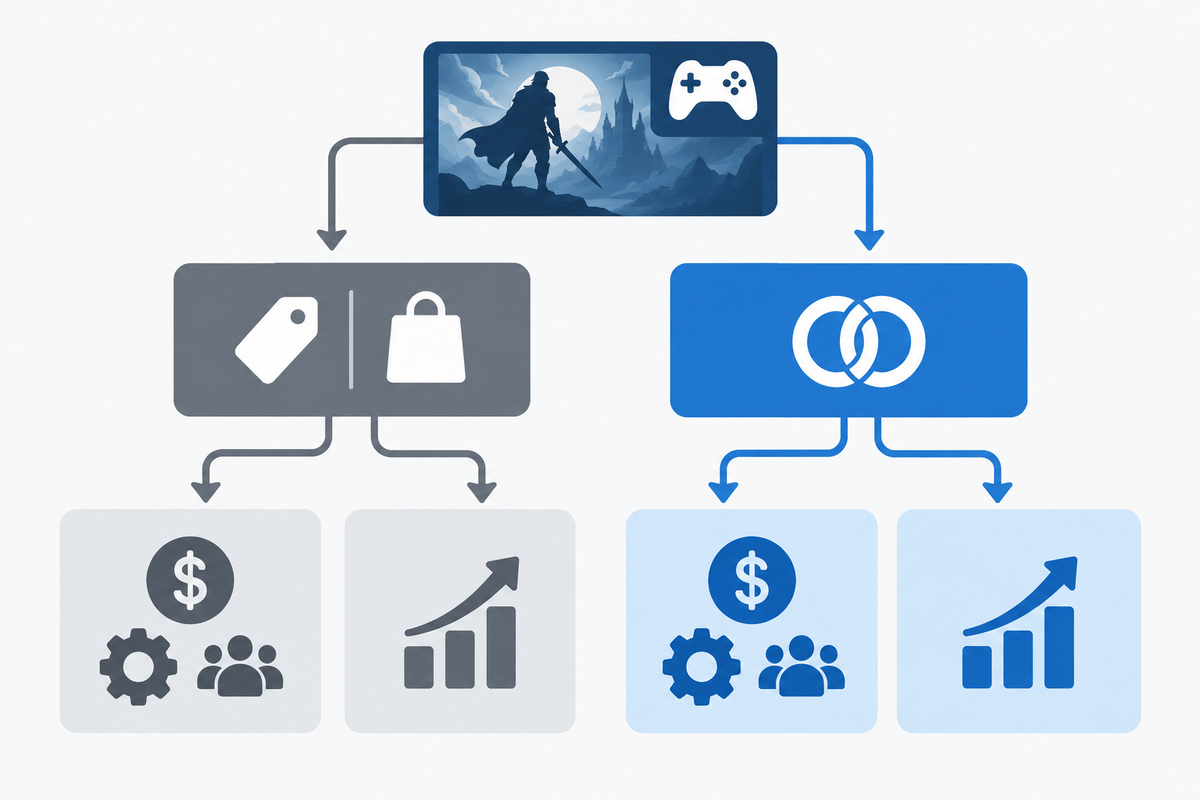
Large-budget AAA development makes the negotiation harder. Several years of work by hundreds of employees creates a much larger bill, before marketing and launch support. A guarantee that is attractive for a smaller production may be nowhere near sufficient here. The sensible contract protects the downside while leaving a meaningful reward for exceptional performance. The balance depends on the actual payment terms, not the subscription label.
PlayStation protects the launch window — and charges players for it
Sony has generally kept major first-party releases out of PlayStation Plus on launch day, preserving premium sales before later catalogue inclusion. Xbox has made day-one access to many first-party releases a central part of Game Pass’s appeal.
PlayStation’s approach gives a successful game more opportunity to turn early enthusiasm into individual purchases. Later subscription access can then reach a second audience. I think that is a more legible commercial structure for an expensive game whose strongest selling point is a substantial, finite experience.
Players bear the trade-off. Someone who wants a new PlayStation release immediately generally faces a separate purchase rather than treating their subscription as the ticket. Protecting a studio’s potential return does not make that arrangement better value for the player at launch.
Nor does Sony’s approach guarantee success. A premium release can underperform, and a protected sales window cannot rescue an oversized budget by itself. What it preserves is the direct connection between a hit and additional sales revenue. Xbox asks its ecosystem and funding arrangements to carry more of that weight.
The pressure will show up in timing and design
If subscription payments fail to keep pace with AAA production costs, I expect publishers to become more selective about day-one inclusion. Games with strong premium demand have a reason to protect their initial sales window. Subscription access can follow later, once those purchases have done more of the work.
For players, that means the exact access promise matters more than a broad “on Game Pass” announcement. A release date for Xbox or PC does not, by itself, tell you when a game enters the subscription or which tier includes it. Game Pass Ultimate’s launch access is a specific benefit to evaluate, rather than a promise to assume across every membership.

Contract incentives can also influence the game itself. Payments tied heavily to playtime would reward different design decisions from payments tied to subscriber acquisition or a fixed delivery fee. A compelling experience that ends cleanly might contribute less measured engagement than one designed to keep people returning.
I value games that respect an ending. A funding system that rewards prolonged engagement more generously could put pressure on that kind of project. That is a conditional risk, not an explanation for every repetitive feature or rough launch. Subscription access neither proves a game was rushed nor guarantees the financial stability needed to finish it properly.
Profitability still leaves studio stability unresolved
Double Fine’s Tim Schafer has challenged the industry’s logic around hiring, layoffs and studio stability, describing a downturn lasting roughly four years despite people continuing to play games and businesses making money. That frustration matters here: a successful service and a healthy development workforce are separate outcomes, too.
Xbox’s restructuring does not establish that Game Pass caused job losses. It does make the promise of subscription-backed security less satisfying on its own. A guarantee can reduce a project’s launch risk without protecting its team from a later corporate decision.
I reject Layden’s “impossible” verdict because contracts can fund profitable games, and guaranteed income has real value. I take his warning seriously because the rewards of a breakout release can remain disproportionately with the platform. Meaningful performance-linked compensation would address that problem more directly than another impressive engagement total.
I want to keep the player’s bargain without treating the developer’s future as someone else’s concern. The unresolved tension is that the same day-one access making Game Pass attractive can weaken a studio’s leverage over its biggest success. Until the financial reward follows that success, a thriving subscription service leaves the people building its library with a less comfortable bargain.
FinalBoss // Gear
Level up your setup
01Best-selling Xbox Series X|S gameson Amazon→02Xbox controllerson Amazon→03Top-rated gaming headsetson Amazon→04Discounted game keyson Kinguin→Affiliate links · As an Amazon Associate, FinalBoss earns from qualifying purchases.
Want to Level Up Your Gaming?
Get access to exclusive strategies, hidden tips, and pro-level insights that we don't share publicly.
Ultimate Gaming Strategy Guide + Weekly Pro Tips