
Table of Contents (11)
GameSir G7 Pro Wuchang Edition Review: When a “Budget” Pad Starts Feeling High-End
The first time I picked up the original GameSir G7 Pro last year, it immediately felt like one of those rare “oh wow” moments in controller land. It had the specs, the feel, the performance… and yet it still missed one thing that kept it from being my default pick on Xbox: proper wireless support for the console.
The G7 Pro Wuchang Fallen Feathers Edition is where that story finally comes together. GameSir has taken an already excellent 2025 pro controller and finished the job: a low-latency 2.4GHz dongle for Xbox and PC, the same fantastic TMR sticks, clicky mechanical D-pad, and a surprisingly classy blue-and-gold Wuchang-themed design – all at a price that undercuts most of the big-name competitors.
I’ve been using this pad across Xbox Series X and PC, bouncing between Overwatch matches and a pile of Game Pass titles, and it’s the first non-Microsoft controller that’s genuinely tempted me to retire my Elite for good… with one important caveat around audio latency you need to know about.
Key Takeaways
- New 2.4GHz dongle finally gives the G7 Pro proper wireless on Xbox, while also working seamlessly on PC.
- TMR analogue sticks feel sensational – ultra-responsive, drift-resistant and closer in feel to classic sticks than most Hall Effect designs.
- Mechanical microswitch D-pad is one of the best available right now: sharp, defined and seriously fast.
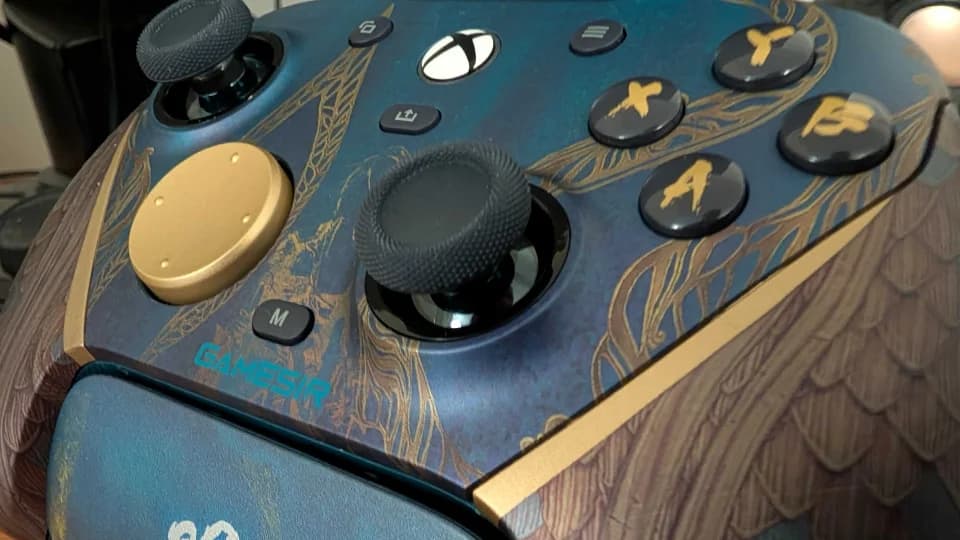
- Wuchang blue-and-gold aesthetic actually feels like a true collaboration, not a lazy paint job, with tasteful Chinese motifs and textured feather grips.
- There is still some wireless audio latency when using wired headphones via the controller’s jack on Xbox in wireless mode, even after a firmware update.
- Price-to-performance is outstanding, undercutting rival “pro” controllers by a large margin while keeping the important features.
- Best suited to Xbox and PC players who want pro-level controls and inputs without paying Elite-level money, and who can live with (or bypass) the audio lag quirk.
First Impressions: From “Interesting” to “I Might Actually Main This”
My relationship with GameSir has been a bit of a rollercoaster. Years ago, they were the brand I’d buy when I needed a spare pad for guests and didn’t want to spend real money – functional, sure, but nothing I’d choose for myself. Over the last few generations though, they’ve clearly been on a self-improvement kick, and the original G7 Pro was the point where I went, “Okay, they’re officially playing in the big leagues now.”
The Wuchang Edition builds on that foundation instead of reinventing it. Out of the box, the first thing that hit me wasn’t the features list, but the look. I’ve tested countless “special edition” controllers that amount to a new sticker or a splash of color. This one actually feels curated.
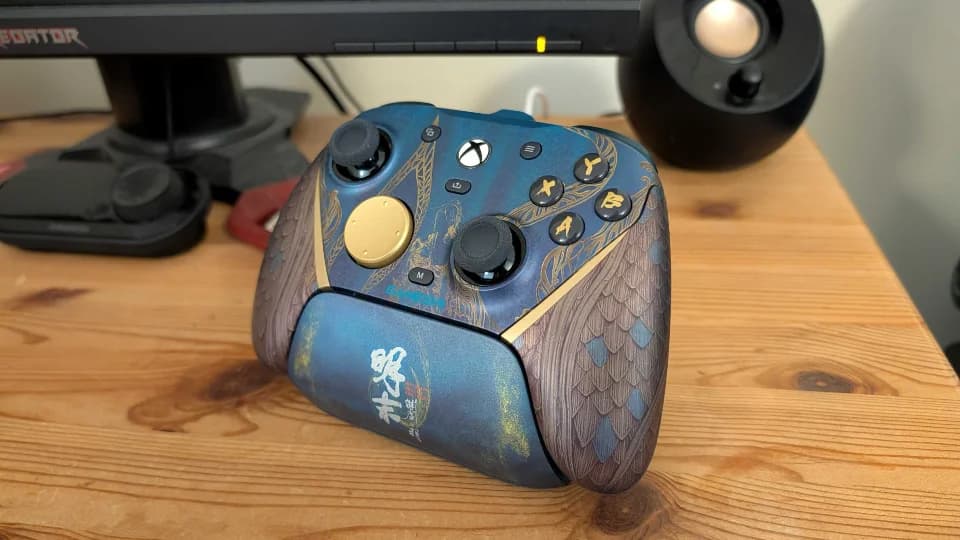
It ships in a rich blue and gold theme that matches the Wuchang: Fallen Feathers aesthetic. The Chinese-inspired patterns and brush-stroke accents flow cleanly from the controller to the matching charging base, and the gold feathering that runs along the controller “feet” doubles as a textured grip. Every time I grabbed it off the dock, there was a little sense of occasion — more “limited collab” than “cheap reskin.”
At 272g, it sits in a particularly nice sweet spot. It’s heavy enough to feel substantial and premium, but nowhere near as hand-fatiguing as the Xbox Elite line can feel after a long evening session. After a couple of three-hour stretches with Overwatch and some single-player stuff, my hands were still perfectly happy.
Design & Build: Thoughtful Details, Not Just Fancy Paint
In the hand, the G7 Pro Wuchang Edition lands closer to the official Xbox pad than any of the chunkier “pro” bricks out there. The contours are familiar, but there are small tweaks that give it a more locked-in feel, especially thanks to those feather-textured grips along the front legs.
What really stands out is how cohesive the whole package feels. The colorway carries cleanly across the controller and the charging base, and the gold accents are limited and controlled, so it never crosses into gaudy territory. It looks expensive without shouting about it, which is not something I can say about every licensed or themed controller I’ve used.
Button feel is equally solid. The face buttons and shoulders sit in that sweet spot between “fast and crisp” and “not so hair-trigger that you get accidental presses.” You can tell GameSir has spent a few hardware generations learning what works rather than just copying Microsoft’s plastics.
Most importantly for a pro-style pad, there are extra inputs and trigger lockouts on offer, giving you more control over how you approach shooters and competitive play. You’re getting a serious feature set here, not just a pretty shell.

TMR Sticks & Mechanical D-Pad: Where It Really Feels “Pro”
The G7 Pro line leans heavily on two things to justify the “pro” label: its TMR analogue sticks and its mechanical microswitch D-pad. They’re not marketing fluff — they make a real difference in actual play.
TMR (tunnelling magnetoresistance) sticks are the evolutionary step beyond Hall Effect. Like Hall Effect designs, they ditch the old-school potentiometer components that physically rub together, which in turn all but eliminates the classic horror story of stick drift appearing six months in. No physical wear on the sensing mechanism, no gradual dead zone creep.
Where TMR really earns its keep is in precision and feel. The way GameSir has tuned them here, they feel much closer to a “normal” analogue stick than some of the very floaty Hall Effect implementations I’ve tried, but they track tiny movements more tightly. In Overwatch, I could feel that in micro-adjustments to tracking on hitscan heroes; those last few millimetres of motion are clean and consistent rather than mushy.
Over several evenings on Xbox Series X and PC, the sticks were consistently responsive and predictable. Flick shots, small strafing corrections, gradual camera pans — it all felt smooth and controlled. After a while I forgot I was “testing” the sticks at all, which is the best compliment I can give them.
The mechanical D-pad might actually be my favourite part of the whole controller. It’s built around microswitches, so every press has a firm, tactile click that you can both hear and feel. If you’re coming from a standard rubber-dome D-pad, it’s night and day.
In fighters and action RPGs, that definition makes a huge difference. Quick quarter-circles and diagonals register exactly how you expect, and I never had that “did it actually input?” moment that still happens on a lot of stock pads. I’d comfortably put it up there with the best D-pads available right now.
2.4GHz Wireless Dongle: The Missing Piece for Xbox and PC
The one thing that held the original G7 Pro back as an Xbox recommendation was its lack of proper wireless operation with the console. You could enjoy its fancy internals, sure — but only tethered. On PC that was easy to forgive, on a living room Xbox setup it was much harder.
The Wuchang Edition fixes that in the most straightforward way: it ships with a dedicated 2.4GHz dongle. Plug it into your Xbox Series X|S (or your PC), tap the pairing buttons, and you’re off. No fiddly Bluetooth menus, no weird connection workarounds. It just turns on and works.
In terms of responsiveness, the 2.4GHz link feels essentially indistinguishable from wired for gameplay. Inputs land as fast as I can react, and across my testing I didn’t experience any dropped connections or weird desyncs, even when I deliberately crowded my setup with other 2.4GHz devices. From a control perspective, this finally puts the G7 Pro on even footing with the big-name wireless pads.
Wired mode is still there, of course, and if you’re absolutely sweating every frame in a tournament-style setting, you’ll probably default to the cable anyway. But for everyday play, the dongle is the upgrade that makes this controller make sense on Xbox in a way the original never quite did.
Wireless Audio Latency: The One Annoying Quirk
There is one blemish on an otherwise extremely polished experience, and it’s important if you rely on the controller’s 3.5mm jack for audio on Xbox.
Early on, using wired headphones plugged into the G7 Pro while the controller itself was connected wirelessly to an Xbox Series X|S came with very noticeable audio lag. It was the sort of delay you notice instantly: shots firing on-screen and the sound reaching your ears just a beat too late.
Since then, a firmware update has clearly improved things. On the Wuchang Edition with up-to-date firmware, the gap is smaller — small enough that I could mostly ignore it in slower games. But it’s still there. If you’re sensitive to audio timing or you play anything where sound cues matter (competitive shooters, rhythm games, even some action games), you’ll pick up on that slight offset.
For many players, especially if you’re mostly using your TV or a separate wireless headset, this won’t matter at all. And if you’re the kind of hyper-competitive player who notices this stuff instantly, you’re almost certainly going to plug the controller in via USB anyway, which eliminates the issue.
Still, it’s worth calling out: wireless controller + wired headphones via the pad’s jack on Xbox still isn’t perfect. I really hope GameSir continues to refine the firmware here, because if they can shave that latency down just a bit further, there won’t be much left to criticise.
Value: Pro Features Without the “Pro Tax”
There are plenty of fantastic pro controllers already on the market, but a lot of them expect you to pay what I can only describe as a “brand tax” for the privilege.
The G7 Pro Wuchang Edition undercuts many of its direct rivals by a serious margin. Take something like the Nacon Revolution X Unlimited: it’s a great controller in its own right, but its list price sits around £70 higher than the G7 Pro. Yes, you get bells and whistles like an OLED information screen, but in day-to-day use, that kind of extra rarely changes how you actually play.
With the G7 Pro, the money is clearly spent on feel and fundamentals: TMR sticks instead of standard potentiometers, a genuinely top-tier mechanical D-pad, solid build quality, extra inputs and trigger locks, and now a proper 2.4GHz dongle for wireless Xbox and PC use. It’s all the stuff that affects every moment of gameplay, without much fluff.
Add to that the fact that GameSir gear frequently dips below its already-aggressive list price at certain retailers, and you’re looking at a controller that punches way above its price bracket. If you care more about input quality and reliability than gimmicks, it’s a bit of a no-brainer.
Who the G7 Pro Wuchang Edition Is (and Isn’t) For
After living with the Wuchang Edition for a while, a clear picture of its ideal audience emerged.
- Perfect for: Xbox Series X|S and PC players who want pro-level sticks, a fantastic mechanical D-pad, extra inputs and trigger locks, but don’t want to pay premium-brand prices.
- Great for: People who appreciate a more artistic, themed design that still looks grown-up on a desk or TV stand, and who like the idea of a matching base.
- Acceptable for: Players who occasionally plug headphones into the controller and won’t be thrown by a bit of extra audio latency in casual play.
- Not ideal for: Ultra-competitive players who absolutely rely on frame-accurate sound cues while using the controller wirelessly as their audio passthrough on Xbox. For that very specific use case, you’ll want to play wired or use a separate audio path.
Bottom Line: A Pro Controller That Finally Feels “Complete”
GameSir’s G7 Pro Wuchang Edition feels like the payoff to a multi-year glow-up. The company that used to be the “cheap spare pad” option has now built a controller that, in most of the ways that matter, can stand shoulder to shoulder with (and sometimes surpass) the big players in the Xbox and PC space.
The addition of the 2.4GHz dongle is the final puzzle piece that the original G7 Pro was missing. Combined with the excellent TMR sticks, that stellar mechanical D-pad, the tasteful Wuchang-inspired design and the very aggressive pricing, it’s hard not to see this as one of the best-value pro controllers you can buy right now for Xbox and PC.
The lingering wireless audio latency with wired headsets on Xbox is genuinely frustrating because it’s the only thing keeping this from being an almost flawless recommendation. But it’s also a problem many players will never run into — and one that completely disappears if you’re willing to run the controller via USB or route your audio elsewhere.
Rating: 9/10. If you’re an Xbox or PC player looking for a premium-feeling pro controller without paying a premium price, the G7 Pro Wuchang Edition should be at the very top of your shortlist.
TL;DR
- What it is: A special Wuchang Fallen Feathers Edition of the GameSir G7 Pro — an Xbox and PC-focused pro controller with a 2.4GHz dongle, TMR sticks and a mechanical microswitch D-pad.
- What it does well: Delivers superb stick precision, a fantastic clicky D-pad, extra pro inputs and a striking blue-and-gold design, all at a much lower price than many rival pro pads.
- The main downside: There’s still a small but noticeable amount of wireless audio latency when using wired headphones through the controller’s jack on Xbox, even after firmware updates.
- Who should buy it: Xbox Series X|S and PC players who want top-tier controls and strong value — and who can either live with the audio caveat or avoid it by using wired mode or separate audio.
- Overall verdict: A brilliantly executed evolution of the G7 Pro that finally feels feature-complete for Xbox and PC, and one of the best value pro controllers available right now.
FinalBoss // Gear
Level up your setup
01Best-selling Xbox Series X|S gameson Amazon→02Xbox controllerson Amazon→03Top-rated gaming headsetson Amazon→04Discounted game keyson Kinguin→Affiliate links · As an Amazon Associate, FinalBoss earns from qualifying purchases.
Want to Level Up Your Gaming?
Get access to exclusive strategies, hidden tips, and pro-level insights that we don't share publicly.
Ultimate Reviews Strategy Guide + Weekly Pro Tips