

Tiny games do not need to apologize for being tiny. Gecko Gods seems to understand that better than most. Across the current review coverage, the pitch is wonderfully direct: you play as a small gecko exploring a forgotten archipelago, sticking to walls and ceilings, sailing from island to island, and solving environmental puzzles in a world that cares more about calm curiosity than danger.
That clarity is the game’s biggest strength and the reason the verdict lands pretty clean. Critics consistently praise the art direction, the atmosphere, the gentle pace, and the basic pleasure of moving through these spaces like a tiny climbing creature instead of a standard action hero. The warning label is just as consistent. When a game builds its entire identity around movement, floaty controls and a camera that gets awkward in tight spaces are not small complaints. This verdict is based on the available review coverage rather than a personal playthrough, but the shape of the response is unusually steady: Gecko Gods is a charming, low-stress puzzle adventure with a real sense of place, held back by friction in the one area it most needed to nail.
Table of Contents (9)
Key takeaways
- Gecko Gods is a serene puzzle-exploration game built around wall-climbing, environmental puzzles, and boat travel between islands.
- Its strongest qualities are its cozy tone, lovely art direction, and the novelty of exploring spaces as a gecko that can cling to nearly any surface.
- Its biggest weaknesses are floaty movement and a camera that can make close, vertical spaces harder to read than they should be.
- This looks best suited to players who want a short, relaxing palate cleanser, not a demanding platformer or a deep systems-heavy puzzle box.
- Score: 7.5/10
A cozy game that actually commits to being cozy
There are plenty of games that market themselves as relaxing and then sneak in busywork, grind, or low-grade stress. Gecko Gods sounds like the real thing. Reviewers repeatedly frame it as calm, kid-friendly, and intentionally low-pressure. There is no loud combat loop demanding mastery, no punishing failure state hanging over every jump, no desperate attempt to turn every quiet stretch into content. That matters. A lot of “cozy” games are cozy in art style only. This one, by most accounts, is cozy in structure.
The setup helps. Exploring forgotten islands as a tiny lizard already puts the scale in an interesting place. You are not dominating the environment; you are reading it. A wall is not scenery. It is a path. A ceiling is not background. It is a route. Boat travel between islands also sounds like more than a simple loading screen in disguise. In coverage, it comes across as a pacing tool, a way to let the player breathe between puzzle spaces and keep the adventure from feeling like one long corridor of brainteasers.
That is why the “palate cleanser” description fits so well. Gecko Gods does not appear to be chasing epic scale or endless complexity. It wants to be a compact, handcrafted detour with enough mystery to keep you moving and enough charm to make you linger. For a certain slice of players, that pitch is not a compromise. It is the point.
The gecko fantasy is the whole hook, and it sounds genuinely fresh
The most persuasive thing in the game’s favor is that traversal is not just a way to get from puzzle A to puzzle B. Traversal is the fantasy. Several reviews highlight how much of the appeal comes from simply moving through the world as a creature that can cling to walls and ceilings, poke into hidden corners, and treat architecture like a vertical playground. That is a smart foundation for a puzzle-adventure because it gives exploration its own identity. You are not walking through levels built for a person-sized avatar. You are reinterpreting them from a smaller, stranger angle.
That also makes the environmental puzzle design easier to appreciate. Coverage points to enough variety to keep the game from feeling like a single repeated trick. Reviewers mention things like gong-hitting sequences, navigation-based puzzles, and water-level manipulation, which suggests the islands are not just pretty climbing gyms. They are interactive spaces that ask you to observe, route-plan, and occasionally think sideways. That is the right kind of puzzle design for a game like this. It keeps the focus on place and movement instead of dropping abstract logic problems into an otherwise tactile world.
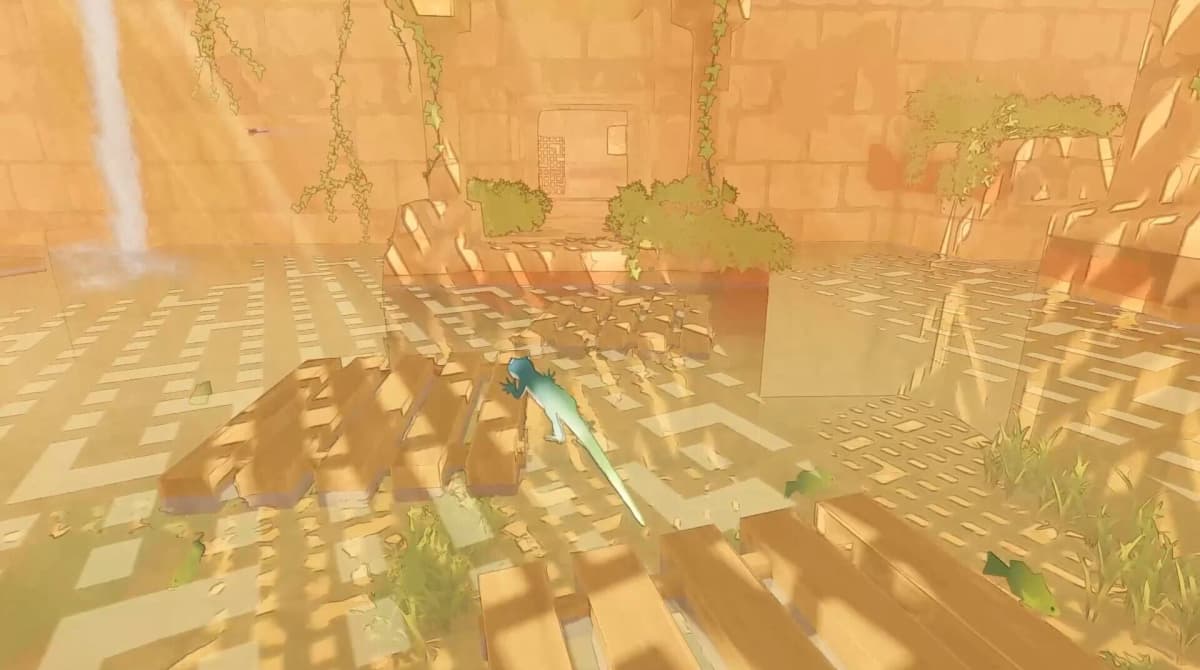
The atmosphere seems to seal the deal. Critics keep coming back to the art direction and mellow presentation, and that is not fluff. In a small exploration game, style is not decorative; it is structural. If the islands feel inviting, if the ruins have enough mythic texture, if the soundtrack supports that quiet sense of wonder, the whole experience gains weight without needing more mechanics. Gecko Gods appears to understand that mood can do real design work when the scope is modest.
Here’s the problem: movement and camera issues hit this game harder than usual
The recurring criticism is easy to summarize and hard to shrug off. Movement can feel floaty. The camera can get messy. In many games, that would be annoying but survivable. Here, it cuts closer to the bone because wall-crawling precision is the entire sales pitch. If the joy of being a gecko is supposed to carry the adventure, any looseness in control feel is going to stand out immediately.
This is where Gecko Gods seems to slide from “easy recommendation” to “know what you are buying.” A character that can traverse walls and ceilings asks more from a camera than a standard third-person explorer does. Spatial relationships have to stay readable when up and down stop behaving normally. Tight spaces cannot become visual wrestling matches. Routes need to feel understandable at a glance. The available reviews suggest the camera does not always keep up with that demand, especially when the game gets close, cramped, or vertical in a complicated way.
That friction matters even more because the game is otherwise so gentle. There is no intense combat system to distract from it, no huge narrative fireworks to overpower it, no loot treadmill to keep you pushing through annoyance. In a focused little game like this, the basics are exposed. When those basics sing, the whole thing sings. When they wobble, you feel every wobble.
The lightness is a feature, but it also sets a hard ceiling
If you want dense, escalating puzzle architecture in the style of a heavyweight brain-burner, this probably is not it. The critical picture suggests that Gecko Gods keeps things accessible and relatively simple. That should not be mistaken for laziness. There is a difference between shallow design and deliberately breezy design, and this game sounds much closer to the latter. The puzzle variety seems real. The world seems thoughtfully assembled. The challenge level just does not appear interested in pushing players into frustration.
For the right audience, that is exactly why the game works. Not every puzzle adventure needs to be a three-night obsession that leaves a notebook full of diagrams on your desk. There is room for a short game that lets you chip away in relaxed sessions, admire the scenery, solve a few environmental riddles, and step away satisfied. Reviewers who clicked with Gecko Gods seem to value it precisely because it does not overreach.
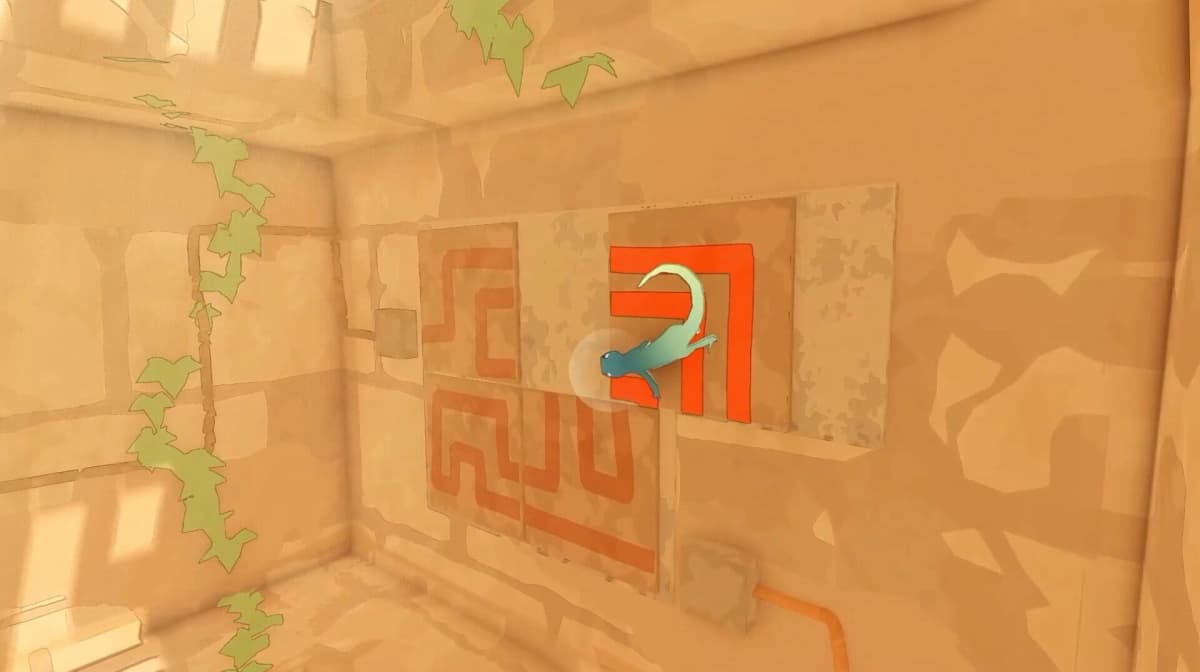
The flip side is obvious. Players chasing tight platforming, high stakes, or elaborate mechanical layering may hit the end credits and feel underfed. A low-stress structure can read as elegant restraint to one person and as thinness to another. The game’s cozy identity is not a neutral trait. It is a filter. If you know you usually need challenge or depth to stay engaged, that filter may push you right out.
What the current coverage says about platforms and value
The available reporting places Gecko Gods on PC, Switch, and PS5, with one review citing an $18 price point. That context matters because it frames the game correctly. This is not trying to be a giant premium adventure with blockbuster expectations attached. It is a lower-priced indie release built around one strong movement idea, a tranquil mood, and compact puzzle exploration. Judged on those terms, the praise makes sense.
Just as telling is what critics keep repeating across outlets. The conversation is less about raw performance panic and more about design friction: camera behavior, floaty control feel, and the limits of a purposely lightweight experience. That suggests the major tradeoffs are not really about horsepower. They are about whether you can live with a slightly slippery movement model in exchange for a pretty, relaxed little world.
Who should play it, and who should skip it
- Play it if: you like cozy puzzle adventures, environmental exploration, low-pressure pacing, and games that treat atmosphere as a real reward.
- Play it if: the idea of wall-climbing and ceiling-crawling through a handcrafted archipelago sounds more appealing than combat, grinding, or checklist bloat.
- Play it if: you want a smaller game to slot between bigger releases without feeling like you are signing up for homework.
- Skip it if: you need precise platforming feel and get irritated fast by floaty movement.
- Skip it if: camera friction in 3D spaces is a dealbreaker, especially in games built around vertical navigation.
- Skip it if: you want complex puzzle chains, long-form progression systems, or anything remotely punishing.
The shortest way to put it is this: Gecko Gods sounds best for players who value mood, movement novelty, and gentle discovery over difficulty and depth. If that is your lane, the game seems easy to like. If it is not, the same traits that others find soothing may feel slight.
Bottom line
Gecko Gods appears to be a good small game, not a secretly great big one. The praise for its atmosphere, art direction, traversal concept, and relaxed puzzle design is too consistent to ignore. So are the complaints about control feel and camera behavior. That leaves it in a very specific sweet spot: a stylish, memorable palate cleanser that succeeds more through mood and curiosity than through precision or complexity.
Verdict: 7.5/10. Recommended for cozy-game fans, exploration players, and anyone hungry for a short, low-stress adventure with a strong sense of place. Harder to recommend for challenge hunters or players who demand snap-tight platforming.
TL;DR
- Gecko Gods stands out because climbing walls and ceilings as a tiny gecko gives exploration a distinct identity.
- The art direction, atmosphere, and quiet pacing are the main reasons critics are into it.
- Floaty movement and a fussy camera keep it from being a slam dunk.
- If you want a cozy puzzle-exploration game instead of a demanding platformer, this looks like a smart pick.
FinalBoss // Gear
Level up your setup
01Top-rated gaming headsetson Amazon→02High-refresh gaming monitorson Amazon→03Gaming chairson Amazon→04Discounted game keyson Kinguin→
Affiliate links · As an Amazon Associate, FinalBoss earns from qualifying purchases.
Want to Level Up Your Gaming?
Get access to exclusive strategies, hidden tips, and pro-level insights that we don't share publicly.
Ultimate Reviews Strategy Guide + Weekly Pro Tips