
Table of Contents (10)
The cellar that ate my playthrough
Going Medieval has finally hit 1.0 after years in early access, and somehow my defining memory of this big, crunchy colony sim isn’t a grand siege, a heroic last stand, or even the castle I set out to build. It’s a hole. A stupid, cursed, endlessly problematic hole in the ground that started life as a practical cellar and slowly became the main character of my run.
On paper, Going Medieval is a familiar pitch: post-plague medieval world, handful of survivors, build a settlement, research tech, fend off raids, and try not to starve. It sits somewhere between RimWorld’s story generator and Dwarf Fortress’s vertical, freeform construction, with a friendlier 3D interface layered on top. I bounced off it a bit in very early access, found it “promising but thin”, and parked it to wait for 1.0.
Coming back now, with the full release’s revamped progression, better tutorial, and all the systems that arrived over the last few years (especially water), I ended up playing for “just one more season” until 3am more times than I’m willing to admit. And almost all of that time, directly or indirectly, came back to that cellar.
Starting small: a castle dream, a shovel, and four idiots
My plan going in was very reasonable. No megaprojects, no weird challenge runs. Just a sturdy little castle: stone walls, a couple of towers, maybe a moat once I’d researched waterworks. The kind of fort that, if you stumbled across it on the world map, you’d nod and go, “Yep, that’s a perfectly respectable medieval fortification.”
Then summer hit, my raw meat started decomposing in the stockpile, and practicality steamrolled vanity. Food here actually rots depending on temperature and exposure, and it rots fast. So before walls, before towers, before moats, I decided to dig a cellar. Cool underground storage, job done. How hard could it be?
The answer, with a newborn settlement of four people, is “stupidly hard.” I picked out a big rectangle and ordered my settlers to dig like their lives depended on it… which they kind of did. Except they also depended on planting crops, cooking meals, sewing summer clothes, butchering carcasses, and defending the place from raiders. My over-ambitious pit was at the bottom of a very long to-do list.
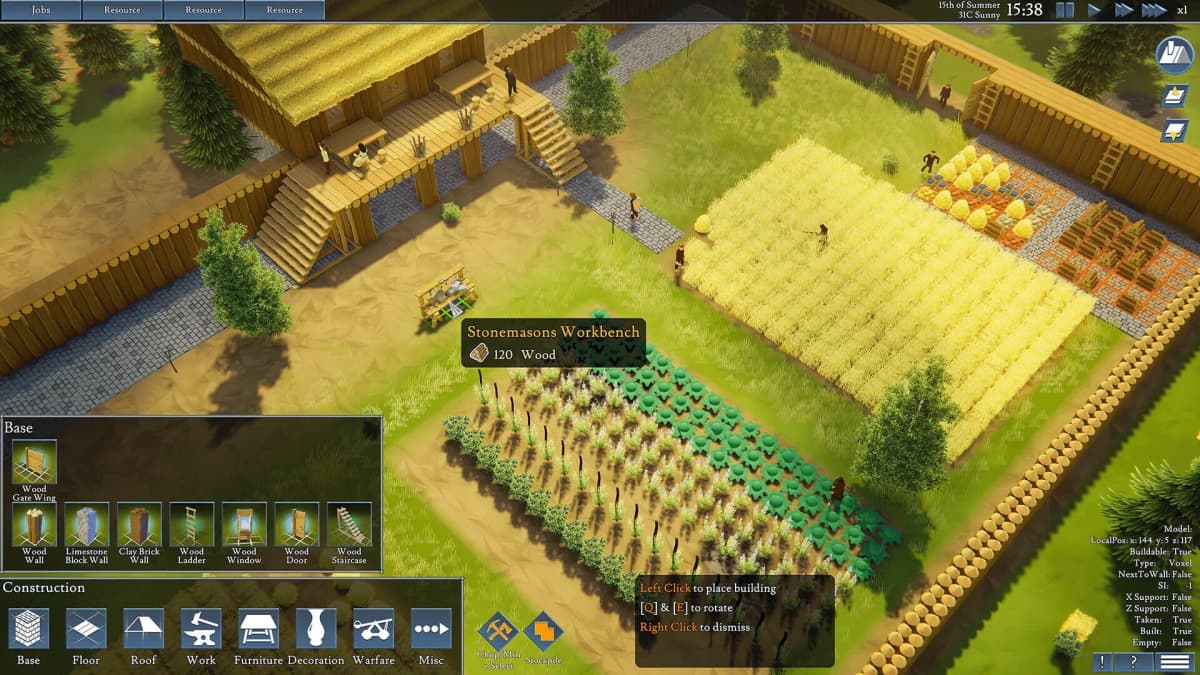
Going Medieval leans heavily on task priorities and schedules instead of constant micromanagement. If you’ve played RimWorld, the vibe will be very familiar: you flag jobs, set per-colonist priority levels for stuff like construction, research, animal care, and hauling, then watch the little guys try to make sense of your plans. The twist here is verticality and freeform building; even in these first hours I was already panning the camera up and down between my fledgling hut and this yawning, half-dug scar in the dirt.
After about five in-game days of watching my people scramble between fields and the pit, I had a moment of humility. I canceled half the dig area, shrank the cellar, and felt like I’d just negotiated a peace treaty with my own impatience. The hole that remained was still sizable, still future-proofed for expansion, and crucially, finishable before everyone dropped dead from exhaustion. In Going Medieval, cowardice absolutely pays.
Research you can actually burn (or drown)
While three settlers chipped away at the earth, my fourth, Redmund, was banished to a research desk. I figured I’d invest early in tech so future projects would be easier. In most colony sims that means watching a bar fill while a “scientist” waves their hands over a table. Here, it’s a lot more material-and a lot more fragile.
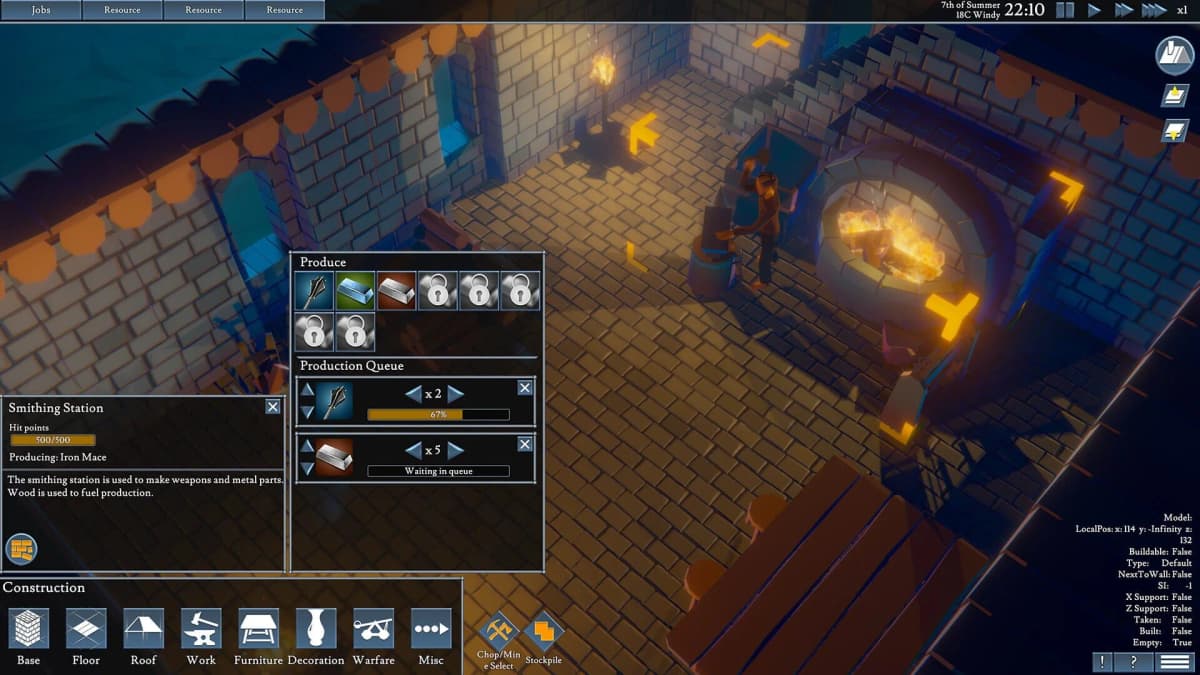
Every hour Redmund spent bent over the table produced physical items: lowly chronicles at first, then more advanced textbooks and theses once I’d unlocked better desks. These aren’t just abstract points. They’re literal stacks of books that need to be stored on shelves, hauled around, and protected. Each technology in the tree asks for a particular recipe of these tomes, and if they’re destroyed, that knowledge is gone until you rewrite it.
This system is brilliant in how it plugs directly into the rest of the sim. A stray fire, a lightning strike, or-foreshadowing-flooding can wipe out decades of accumulated research. When I eventually realized my cellar disasters could have eaten my library, I broke out in a cold sweat. Making knowledge into an actual resource you can lose fits the medieval theme perfectly. Before the printing press, an unlucky blaze really could set a community’s understanding back by a generation; in my settlement, it could have set back my dreams of stone walls and clever death-traps.
In raw usability terms, the research tree is straightforward, readable, and nicely paced. Unlocks come at a tempo that always gave me something new to try—better food preservation, improved construction materials, defensive gear—without overwhelming the early game. But again, it’s the way it plugs into stories that stuck with me. When knowledge can burn, you treat shelves and libraries with a kind of reverence, not just as another menu to optimize.
The cellar becomes a dungeon, an infirmary… and a personality test
Once the cellar actually existed, I kitted it out with shelves, stockpiles, and a bed. My idea was simple: primary storage plus a tucked-away cell to eventually become a dungeon for prisoners of war. Very on-theme, very medieval. In practice, my first “prisoner” was Redmund himself.
After a small skirmish with raiders—defending a rickety wooden platform that would later grow into something resembling a battlement—Redmund took a minor hit. Nothing serious. I assigned him to the bed in the cellar to recover, expecting he’d be back on his feet and back at the research table in no time.
Instead, I discovered one of my favorite little personality quirks in the game: every settler has activities they adore or despise. Redmund, I learned the hard way, loved convalescing. Even after his wounds healed, he kept trotting down the stairs to “rest” in the infirmary-dungeon, blissed out on the sheer joy of being off-duty. I’d drag him away with a manual command, he’d do ten minutes of work, then immediately beeline back to the bed like an NPC with a powerful attraction buff.
My actual medical ward was now a spa resort that happened to be attached to the only reliable food storage in town. In the end I did what any merciful medieval lord would do: I deleted the bed. Watching Redmund snap back to normal behavior the moment his favorite toy disappeared was a small but perfect emergent comedy beat. The game never lampshades it; it just quietly lets these traits collide with your architecture and routines.
Ratpocalypse in the “cursed hole”
I’d barely stopped laughing about Redmund’s basement addiction when Going Medieval threw the nastiest event of the run at me: a rat invasion. Not the usual “one angry animal bites a colonist and runs off” thing you see in other sims. This was a genuine swarm pouring up from unseen tunnels, and my cellar—crammed with meat, vegetables, and the occasional neglected carcass—might as well have had a neon sign that said “All You Can Eat.”
Within seconds, the little bastards were tearing through my winter reserves. Each chunk of meat they gnawed vanished from the stockpile tally, and the more they ate, the more brazen they became. The low point was watching a baby goat I’d forgotten to properly pen trot cheerfully down the stairs in search of hay and vanish under a tide of rodents. The combat log literally read like an execution: “Goat kid is being eaten.” I felt physically ill and also, guiltily, impressed.
I hit the panic button, drafted every able-bodied settler, and sent them down into the chaos. Fights in Going Medieval are a touch more readable than RimWorld’s but still messy, especially when you’re swapping layers—topside militia shooting down from a rampart, melee fighters crammed in stairwells, rats spilling up and down. It’s not a tactical masterpiece, but it’s tense and ugly in exactly the right way for a brawl in a cramped underground storehouse.
We won, eventually. The cellar floor was carpeted with tiny corpses, my food reserves were a fraction of what they’d been, and the emotional damage to my settlers (and me) was non-trivial. In the spirit of spiteful efficiency, I left the rat bodies in a corner stockpile, marked them as edible, and watched my colonists turn invaders into stew. Waste not, want not, and all that.
We won, eventually. The cellar floor was carpeted with tiny corpses, my food reserves were a fraction of what they’d been, and the emotional damage to my settlers (and me) was non-trivial. In the spirit of spiteful efficiency, I left the rat bodies in a corner stockpile, marked them as edible, and watched my colonists turn invaders into stew. Waste not, want not, and all that.
🎮 Get This Game at the Best Price
Compare prices instantly and save up to 80% on Steam keys with Kinguin — trusted by 15+ million gamers worldwide.
*Affiliate link — supports our independent coverage at no extra cost to you
From that moment on, the pit stopped being “the cellar” and became “the cursed hole.” Every time the camera drifted down there, some new annoyance was waiting: rotting corpses I’d forgotten to move, a wolf chasing a chicken down the stairs, an injured pilgrim trying to sleep between piles of salted meat. It was exhausting and also the point—I wasn’t just managing numbers, I was babysitting a physical space with a personality of its own.
Water systems turn my storage into a swamp
Going Medieval didn’t launch with water. It came later in early access, and I’d skipped that whole era, so 1.0 was my first time dealing with it. Surface water is immediately cool: rivers carving through the map, the ability to build dams and channels, even trap-filled kill corridors you can flood at will. It’s one of those systems that feels simple but has deep knock-on effects, especially when you start funneling it into moats and irrigated fields.
What I hadn’t really internalized until it was too late was that groundwater is a thing. I’d dug my cellar straight into bare dirt, no interior walls, because for two in-game years the soil did the job just fine. Then, in the middle of a peaceful stretch where I was mostly messing around with beekeeping and replacing my ugly wooden ramparts with brick, I got an alert: “Cellar flooded.”
Zooming down, I found my carefully organized storage transformed into a murky underground pool. Crates bobbed in ankle-deep water, beds were soaked, and the temperature had shot up enough that my preserved food was in danger. Water had seeped through the bare earth walls little by little until, suddenly, it hadn’t been little at all.
This is where Going Medieval’s construction tools really clicked for me. The game’s freeform voxel-based building means you can carve drains, dig emergency channels back to the surface, slap in temporary support beams, and generally improvise your way out of a disaster. I ended up re-cutting chunks of the cellar, sinking a drainage shaft off to one side, and then lining the entire room with wooden walls like some kind of medieval waterproofing hack job.
Of course, in the middle of this heroic remodeling, I removed the main staircase to reposition it… completely forgetting that three settlers were down there reorganizing shelves. With no accessible path out and zero wood stored below, they were stranded. Their mood bars nosedived as they waded around in the dark, hungry and damp, while topside builders scrambled to cut trees, haul logs, and slap a new stairway in before someone had a breakdown. It was maybe ten minutes of real time, but it felt like a full episode of disaster TV—again, all born from the simple decision “eh, I’ll just dig into dirt, what’s the worst that could happen?”
Building, pacing, and the joy of “just one more layer”
Stepping back from my cellar trauma, Going Medieval 1.0 feels far more complete and confident than the early access version I first tried. The new grand objectives and revised progression gently steer you towards bigger projects without forcing you into a specific playstyle. My little keep organically grew into a proper castle: outer curtain wall, inner courtyard, archer’s towers, kill zones, and eventually a chapel that I fully intend to expand into a monstrous cathedral with its own crypt—yes, I’ve apparently learned nothing about digging holes.
The key here is pacing. Big construction jobs look intimidating but are actually viable fairly early, even with half a dozen settlers, because the resource economy scales smoothly. Clay pits and kilns churn out bricks at a satisfying clip, timber flows if you manage replanting, and the game lets you stage builds in layers. I’d lay down a foundation, watch it take shape over a season, then add a second floor or a parapet, constantly tweaking as new tech unlocked better materials.
Verticality isn’t just a visual flourish either. Height advantage matters in combat; archers on walls seriously outperform anyone on the ground, and designing clever murder-stairs became a mini-game in itself. Combined with the water tools, I could have built genuine evil-engineer stuff—floodable tunnels, drowning traps, you name it. I only dipped my toes into that, but even basic moats and choke points made raids feel like puzzle encounters rather than random number checks.
Interface, performance, and rough edges
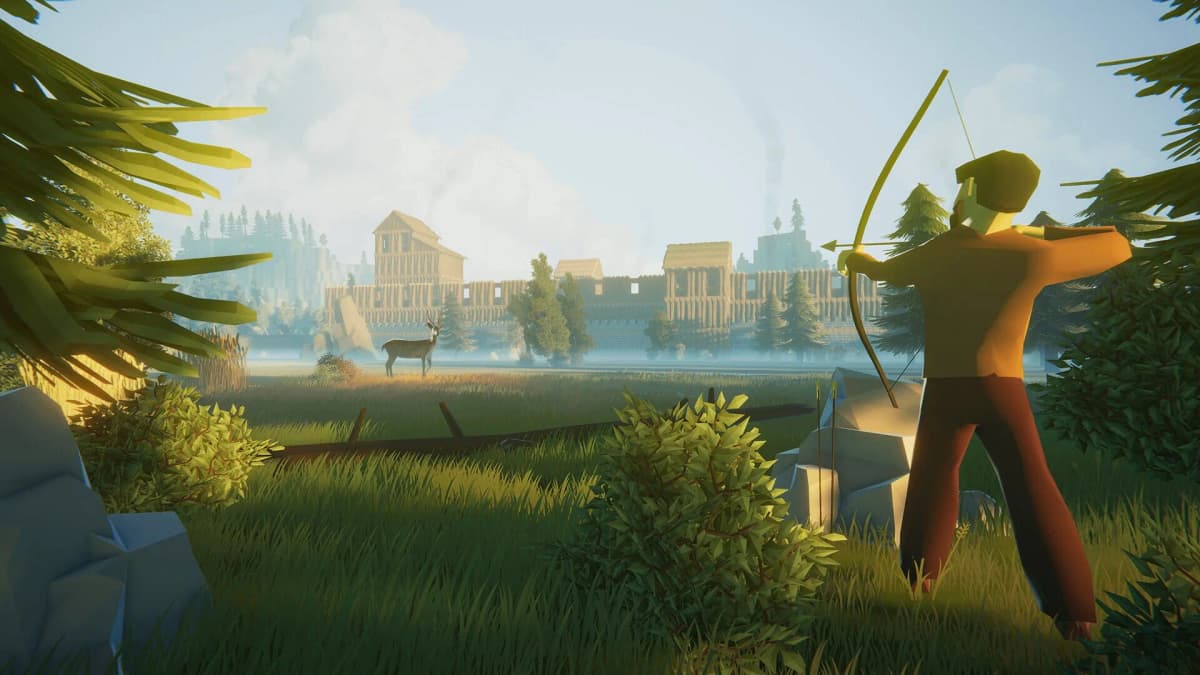
On the technical side, Going Medieval ran smoothly on my mid-range PC (RTX 3060, Ryzen 5, 32GB RAM) at 1440p. Even later on, with a multi-story castle and sprawling farmland, I didn’t see frame rate nosedives. The visual style is clean rather than flashy—think toy-soldier diorama more than gritty medieval misery—but it does its job, especially when zoomed out. At night, torches flicker across crenelations, and there’s a genuine sense of place to your town.
The interface is mostly solid but does show the genre’s usual growing pains. The job priority grid is powerful but overwhelming if you’re new to colony sims. Managing multi-layer constructions sometimes requires more camera wrestling than I’d like, and following multi-level fights during the rat invasion reminded me how easily units can vanish under floors and roofs if you’re not constantly toggling visibility modes.
Combat AI, too, can be a bit thick. Melee fighters occasionally take bizarre routes to reach foes, and there were a few moments where drafted settlers decided to path through the very cellar I was desperately trying to keep sealed during flooding. It never broke the game for me, but if you’re hoping for super-crisp tactical battles, this isn’t that. It’s more a chaotic brawl generator grafted onto a very sturdy builder.
Who Going Medieval is really for
If you love structured city builders where the joy is in perfect efficiency and beautiful symmetry, Going Medieval can do that, but it’s almost a waste of its talents. The game shines when you let things get a bit messy, when you accept that your grand hall will have a weird annex because of that time you had to dig an emergency drainage tunnel, or that your library is perched above a dungeon because Redmund wouldn’t stop faking sick days.
Players who bounced off Dwarf Fortress’s interface but adored the stories it creates will find a sweet spot here. It’s nowhere near as deep or insane as DF, but the freeform building and emergent disasters scratch a similar itch in a more approachable package. Fans of RimWorld will instantly recognize the “little people, big drama” energy, but the focus on 3D construction, tangible research, and water systems gives it its own identity.
If, on the other hand, you absolutely hate micromanaging moods, workloads, and weird personal quirks (like a man whose greatest joy in life is lying in a damp underground sickbed), this might grate. Going Medieval isn’t a chill city painter; it’s a steady stream of fires—sometimes literal—to put out, and the 1.0 version is confident enough in its systems to throw curveballs often.
FinalBoss // Gear
Level up your setup
01Top-rated gaming headsetson Amazon→02High-refresh gaming monitorson Amazon→03Gaming chairson Amazon→04Discounted game keyson Kinguin→Affiliate links · As an Amazon Associate, FinalBoss earns from qualifying purchases.
Want to Level Up Your Gaming?
Get access to exclusive strategies, hidden tips, and pro-level insights that we don't share publicly.
Ultimate Reviews Strategy Guide + Weekly Pro Tips