
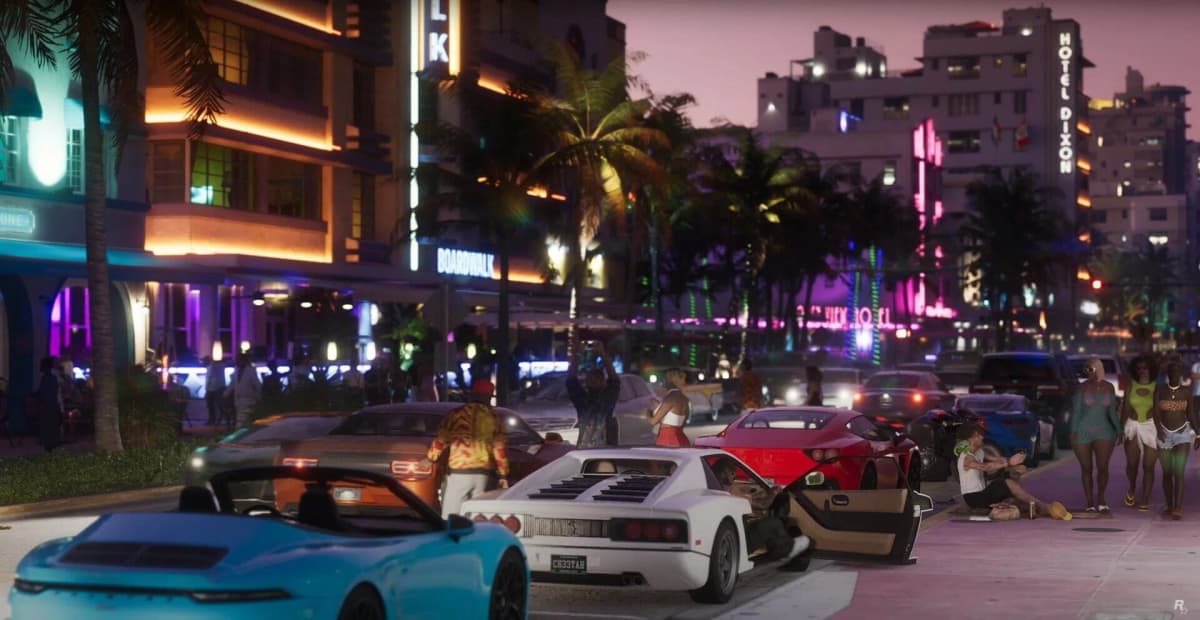
Cyberleek’s Grand Theft Auto VI campaign deserves no fan support, no traffic, and absolutely no money. The group attached a “pro-consumer” manifesto to unauthorized GTA VI footage and a purported map image on August 18 and 19, then used the attention to push cryptocurrency links, its $CYBERLEEK meme coin, and, in parts of the campaign, QR-code prompts. That is a grotesque way to exploit concerns that plenty of players, including me, genuinely share.
Grand Theft Auto VI is the biggest game on Rockstar’s slate, which makes every alleged screenshot, mechanic, location detail, and half-finished animation irresistible bait. Cyberleek knows that. The GTA VI material circulated across social platforms with Cyberleek branding attached right as Rockstar was preparing Grand Theft Auto VI: An Extended Look for Netflix on August 27. That timing gives the leak maximum oxygen, even though nobody has established that it changed Rockstar’s presentation plans.
I refuse to treat that as rebellious consumer activism. A movement earns trust through what it asks players to do. Cyberleek asked people to look at unauthorized material, amplify it, follow crypto links, and help create pressure around a game they have not played. That is engagement farming wrapped in a manifesto.
Table of Contents (4)
The manifesto contains real grievances. That does not excuse the campaign.
Cyberleek’s “CYBERLEEK Edict” makes three demands. It wants publishers to end digital pre-orders before independent reviews are available, stop selling single-player DLC that is already sitting in base-game files, and provide an offline fallback with a final patch that unlocks single-player content when servers are shut down. It also argues that physical pre-orders for tangible discs can remain, because a digital storefront has no stock shortage that requires customers to hand over money early.
- End digital pre-orders before independent reviews.
- Stop charging separately for single-player content already present in the base game files.
- Guarantee an offline end-of-life patch that preserves single-player access and unlocks remaining content after servers close.
There is plenty in that list worth arguing for. Digital pre-orders have become a lazy industry habit: publishers collect money before players know whether a game performs properly, whether its promises hold up, or whether its launch version has been cut to pieces for a future roadmap. Offline preservation for single-player games matters even more. A purchase should not turn into a decorative license because a company decides the servers are no longer worth maintaining.
That is why the manifesto lands with such a nasty thud. It borrows language from debates that many players already take seriously, especially after The Crew became the shorthand example for what happens when a publisher shuts down support and a paid game effectively dies with it. The Edict leans on that anger. It uses a real pressure point. But borrowing a legitimate complaint is not the same thing as earning legitimacy for the method.
Cyberleek did not invent those concerns. Stop Killing Games has spent years putting pressure on the industry over game preservation and end-of-life access. Its entire point is that players should not lose games they bought when corporate support ends. On August 19, Stop Killing Games publicly rejected Cyberleek’s GTA VI leak operation and told supporters not to send the group money. That was the correct call.
The distinction matters because consumer rights cannot survive on a foundation of illegal access and coercive attention tactics. If every cause becomes an excuse to breach a developer, dump unfinished material online, and threaten to keep disrupting a release cycle until a publisher issues a statement or apology, then “consumer rights” becomes a costume anyone can wear while doing whatever benefits them.
That is the part some people are pretending not to see. A sincere preservation campaign asks players to organize, pressure lawmakers, contact publishers, sign petitions, and keep the issue visible in public. Cyberleek asked fans to engage with stolen material and a branded ecosystem built around it. Those are not adjacent tactics. They are opposite ones.

The $CYBERLEEK coin gives the game away
The crypto promotion is where Cyberleek’s moral posture collapses. Leak material carried Cyberleek branding alongside calls to fund the operation through cryptocurrency links, and parts of the campaign also pushed QR-code prompts. The associated $CYBERLEEK token trades on the Solana blockchain, and a trading-volume figure tied to the frenzy put August 18 activity at about $11.8 million.
That number does not prove who collected what money, and it definitely does not explain who is behind every account using the Cyberleek name. What it does expose is the incentive structure. GTA VI’s hype becomes fuel for a speculative token. The more anxious Rockstar fans become about missing a clip, the more people repost it. The more people repost it, the more eyes land on the coin. The more eyes land on the coin, the more the campaign gets exactly what it asked for: attention, leverage, and a monetized audience.
A leak campaign that routes fans toward QR codes or wallet links is not a public-service announcement. It is a funnel. Fans should never scan it, never connect a wallet, never buy a token, and never convince themselves that tossing crypto at anonymous operators is a meaningful contribution to game preservation. It is financial risk stapled to stolen hype.
That ugly financial layer also separates Cyberleek from anyone acting as a genuine whistleblower. Whistleblowing involves exposing wrongdoing with evidence and accepting scrutiny for the claim. Cyberleek is selling a vibe: stolen material, a manifesto, threats of further disruption, and a meme coin. There is no principled consumer campaign that needs a speculative asset attached to it.
It also matters that the leak distribution was branded. A watermark on a circulating clip is not proof of noble purpose. It is marketing. It turns a supposed act of resistance into a signature, a logo, and a route back to the people profiting from the spectacle. Even the uncertainty around which social accounts were authentic only made the whole thing grimier. When a movement cannot even separate its message from impersonation, promotion, and wallet bait, fans should not reward the confusion.
Leaks punish the players who wanted to experience GTA VI properly
The most irritating defense of GTA VI leaks is the shrugging claim that fans can simply avoid them. That ignores how modern platforms work. One reposted clip turns into autoplay video. A thumbnail turns into a map spoiler. A fake “news” account turns a leaked mechanic into a headline. People who have waited years for Rockstar to reveal GTA VI on its own terms get major details shoved into their feed because somebody else wanted clout.
The August leak cycle included two gameplay clips and a full map image. The circulating material showed Jason in violent encounters, driving sequences, basketball outside his apartment, and a six-star Wanted system. One clip description got even uglier: Jason knocks a driver unconscious, repeatedly beats the driver with a wrench, and a devil icon appears in a way that suggests some kind of morality tracking. Whether every one of those details survives to launch is almost beside the point. They are exactly the kind of surprises players should be allowed to discover through a Rockstar trailer, a hands-on preview, or their own first hours in the game. Instead, Cyberleek turned them into disposable social-media debris.
There is another problem with treating leaked footage as gospel: nobody has officially confirmed that the circulating clips and map represent GTA VI’s current state. The material may come from an older development build rather than the launch game players will eventually get on PlayStation 5, Xbox Series X|S, PC, and through Rockstar’s official marketing partnerships. Unfinished lighting, animation, interfaces, systems, and map layouts can all create false expectations that later become ammunition against the final game. Players who pass around a rough clip as proof of a feature are setting themselves up to be angry at a version of GTA VI that may never exist.
That is not a small problem. Leak culture always pretends it is giving fans the “real” story ahead of the polished trailer. In practice, it often gives them a distorted one: disconnected scenes, incomplete systems, missing context, and half-understood mechanics that get inflated into promises. Then the final game arrives and people act cheated because a circulating clip from an unknown point in development did not map cleanly onto the finished product. Fans deserve better than hype built out of scraps and certainty built out of guesswork.

Rockstar and Take-Two moved quickly with DMCA takedowns against uploads on August 19. That tells fans the material is unauthorized. It does not turn every caption, alleged feature list, map label, or account claiming to have “more” into verified GTA VI information. The internet has always been very good at stapling fake details onto real leaks.
And even if a chunk of the footage is genuine, that still does not make the audience harmless. Every click teaches the platform to serve more of it. Every repost hands the leak another life. Every “I know it’s bad, but you have to see this” message does free distribution work for a campaign that already branded the material and tried to turn hype into money.
Stop treating every takedown-evading upload as GTA VI news
Fans do not need a complicated ethical flowchart here. The practical response is simple, and it protects both players and the conversation around consumer rights.
- Skip the clips and map images. Curiosity is understandable, but watching creates the audience Cyberleek is trying to build.
- Ignore every QR code, crypto link, and $CYBERLEEK promotion. GTA VI hype is not a reason to hand money or wallet access to anonymous operators.
- Do not repost mirrors or “download before it is deleted” links. Takedown evasion turns ordinary fans into free distribution staff for the campaign.
- Treat alleged new GTA VI details as unverified until Rockstar confirms them. A watermark proves that somebody wants recognition, not that every claim beside it is true.
- Report scam-like promotions and obvious reuploads. The goal is to reduce the leak’s reach rather than help it dominate every GTA VI discussion.
That last point matters more than people think. A takedown-evading upload is not hidden truth. It is usually bait with a second life. If the campaign wants to keep its material circulating after DMCA removal, the cheapest labor it can recruit is a fan base telling itself that spreading the clips is somehow in the public interest. It is not. It is janitorial work for a stunt.
This position does not require blind loyalty to Rockstar or Take-Two. Players should criticize digital-only releases, predatory pre-order culture, DLC carved out of finished games, and single-player titles that die when their servers do. Those fights are worth having loudly and repeatedly. They deserve organized advocacy, consumer pressure, preservation work, and laws that give buyers more durable rights.
It also does not require pretending Rockstar is above criticism because GTA VI is huge. Massive releases are exactly where player-rights debates should be sharpest. If you hate digital pre-orders, say so. If you want offline fallbacks for single-player games, demand them. If you think publishers should stop treating ownership like a temporary lease, keep that pressure on. Just do not let a leak brand with a coin and a funnel hijack the argument for itself.
Cyberleek’s operation weakens those arguments because it lets publishers dismiss valid concerns as the work of opportunists chasing chaos and crypto volume. Stop Killing Games understood that immediately. If a consumer-rights cause wants legitimacy, it cannot let an anonymous leak brand turn it into a ransom note with a Solana wallet attached.
Grand Theft Auto VI will get its official spotlight on August 27. Fans who care about the game, and fans who care about stronger ownership rights, should leave Cyberleek’s clips, map, coin, and QR-code bait in the gutter where they belong.
FinalBoss // Gear
Level up your setup
01Top-rated gaming headsetson Amazon→02High-refresh gaming monitorson Amazon→03Gaming chairson Amazon→04Discounted game keyson Kinguin→
Affiliate links · As an Amazon Associate, FinalBoss earns from qualifying purchases.
Want to Level Up Your Gaming?
Get access to exclusive strategies, hidden tips, and pro-level insights that we don't share publicly.
Ultimate Gaming Strategy Guide + Weekly Pro Tips