
Graveyard Keeper 2 isn’t just promising a bigger cemetery. Lazy Bear Games is quietly rewriting the core loop into something closer to a corpse-fueled automation and town-building sim – and that’s a much bigger swing than the announcement trailer makes obvious.
- The sequel shifts focus from a single graveyard to rebuilding an entire medieval town, with the cemetery becoming just one piece of a broader management puzzle.
- Zombie labor and automation are now central pillars, not late-game perks, turning the first game’s gimmick into a full production-chain economy.
- Combat, fortifications, and tower-defense elements are being layered on top, raising the question of whether this is smart tension or genre creep.
- tinyBuild is treating Graveyard Keeper like a scalable franchise, not a cult one-off – cross-gen console plans and a free first game are the tell.
Table of Contents (7)
From weird graveyard sim to full automation sandbox
Graveyard Keeper 2 was officially unveiled on April 9, 2026 during the Triple-I Initiative Showcase, with tinyBuild and Lazy Bear confirming a multiplatform launch on PC (Steam), PlayStation 5, Xbox Series consoles, Nintendo Switch, and the upcoming Switch 2. The original 2018 game has quietly moved over four million copies, which explains why this sequel isn’t being treated as a small experimental follow-up.
The first game was essentially “dark-humor Stardew in a graveyard” – time management, light crafting, an intentionally grindy economy, and slowly unlocking shortcuts while dismembering corpses for profit. Automation via zombies was added later and sat mostly as late-game lubrication for an already creaky loop.
This time the pitch is different. Official materials describe a shift where the gravekeeper’s role moves from “managing a cemetery” to “rebuilding The Town” as the Grand Inquisitor. Japanese outlet 4Gamer summarizes it as the job changing from “management to town reconstruction, with zombie-based automation evolving further.” The graveyard is still there – you maintain it, process bodies, and harvest parts – but structurally it looks like just one of several industrial sectors feeding a larger urban machine.
The Town itself is now a major space to restore and customize. Buildings, vendors, and services apparently come back online as you solve townsfolk problems and redirect resources. That’s a clear escalation of scope compared to the original’s small village hub, and it signals a design goal: make the macro layer (the town) the long-term progression track instead of just chasing better grave ratings and church income.
This aligns Graveyard Keeper 2 less with “cozy” life sims and more with the Factorio/Satisfactory school of long-horizon optimization – only here your conveyor belts are undead.
Zombie labor as the real resource system
The headline mechanic is deeper automation using zombies. In the first game, undead workers could chop wood, mine ore, or process materials, but they were essentially macros pasted on top of a manual loop that had already worn out its welcome for many players. Lazy Bear seems to have taken that feedback literally: in the sequel, automation is built into the core fantasy from the start.
According to the reveal, players will harness “flora, fauna, and human remains” to build increasingly complex machinery, then staff it with zombies. That implies production chains where corpses are not just a thing to dispose of, but a primary input alongside crops and resources. In other words: the morgue becomes a factory, not a trash can.
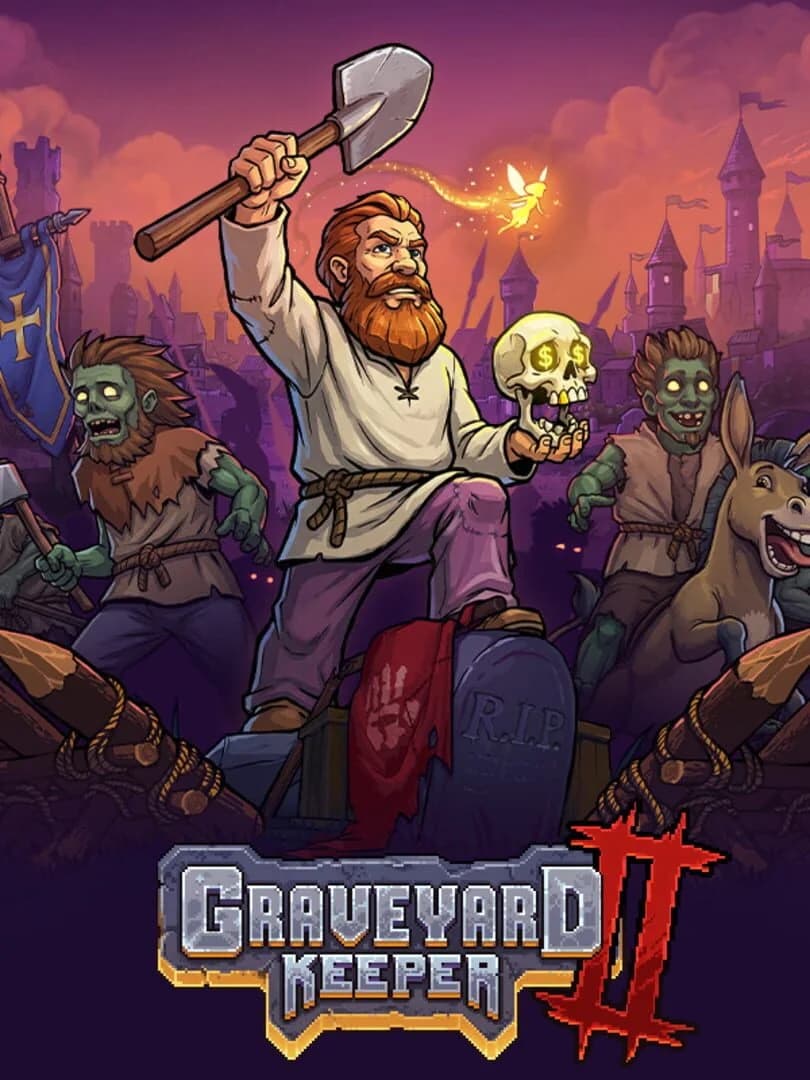
On paper, this fixes one of the original’s big problems: a lot of its systems existed in parallel rather than feeding each other. Gardening, preaching, autopsies, alchemy – they all generated money or materials, but the friction between them was often tedious rather than interesting. A tightly integrated automation layer could turn those same actions into meaningful choices about throughput, bottlenecks, and risk.
The risk is obvious, though. Automation sims live or die on interface clarity and systemic transparency. If you are managing multi-step corpse-processing pipelines, zombie work shifts, town construction projects, and NPC demands, every layer of obfuscation compounds into analysis paralysis. The original Graveyard Keeper was already confusing for new players; bolting industrial-scale automation on top only works if the studio is prepared to redesign their UX from the ground up.
There’s also a tonal question. Graveyard Keeper’s appeal came partly from how mundane, even banal, it made horrifying actions feel. Turning a villager into a resource node was funny because the game’s systems were relatively small and personal. Once you are min-maxing a corpse-powered production graph, the satire shifts toward something bleaker – closer to a factory game about late-medieval capitalism than a dark-comedy farm sim. That might be precisely what Lazy Bear wants; it will also narrow the audience.
Town rebuilding as the new long-term loop
The sequel’s meta-structure seems to hinge on restoring The Town and extracting value from its inhabitants. Promotional copy leans into the idea of turning every townsfolk problem into a business opportunity. You help people, you get access to new buildings or workflows, and your undead-run economy scales alongside the settlement’s recovery.
Design-wise, this is a familiar pattern: the town becomes the “prestige” bar that resets or expands as you progress. Where the first game effectively capped out at “optimize your graveyard and church income,” Graveyard Keeper 2 positions the entire settlement as your scoreboard. If that’s executed well, it solves the late-game drift where players had little reason to care about the world beyond grinding tech points.
But it also reopens one of the original’s sharpest criticisms: quest-driven bottlenecking. Graveyard Keeper loved to put core upgrades behind slow NPC questlines or time-gated events. If town reconstruction leans on similar structures – “wait three in-game weeks for this character to appear so you can unlock a critical building” – then the larger scope simply amplifies the frustration.
I’d want a straight answer from tinyBuild’s PR on this: how much of the town’s progression is locked behind hard time-gates or linear quests versus systemic milestones like production volume and resource diversity? If Graveyard Keeper 2 wants to compete in the automation lane, it cannot afford to have its main bottlenecks tied to arbitrary timers instead of player-driven efficiency.
Combat and tower defense: necessary pressure or genre creep?
One of the stranger additions is a more explicit combat and defense layer. Depending on which region’s press material you read, you’ll see references to leading a “zombie army,” party-based combat, and even tower-defense-style fortifications against undead hordes overrunning the city.
In theory, this gives the economy something to push back against. Instead of building just for the sake of bigger numbers, you are fortifying a town, sustaining an army, and responding to waves of enemies that threaten your infrastructure. That’s a tried-and-true way to inject stakes into a management game.
In practice, this is where many indie sims overextend. We’ve seen similar genre blending in titles like Cult of the Lamb, where management and action combat coexist but one side usually feels shallower. Lazy Bear’s own track record with Graveyard Keeper suggests they can build dense systems; they have not yet demonstrated they can also design satisfying real-time combat on top of that.
The key detail missing from the announcement is proportionality. Is combat a periodic event that tests how well you’ve built your economy and defenses, or is it a constant real-time tax on your attention? Are you directly controlling units and using abilities, or mostly configuring defenses and letting the simulation play out? The difference between “interesting pressure” and “stressful side mode” lies there.
Until we see raw gameplay that shows how often you’re pulled away from planning and automation to micro-manage fights, it’s hard to say whether this is meaningful tension or a marketing bullet point aimed at players who bounce off pure management sims.
tinyBuild is positioning this as a franchise, not a curiosity
The business side is straightforward: Graveyard Keeper has graduated from cult hit to franchise pillar. Over four million copies sold puts it in rare air for a weird, pixel-art management game about dissecting villagers. tinyBuild is responding accordingly.
Graveyard Keeper 2 is coming to every current major platform plus Switch 2, with messaging that suggests a near-simultaneous launch in late 2026 (even if no specific date is locked yet). That cross-gen spread is notable. Nintendo Life points out there’s no announced “upgrade path” between Switch and Switch 2 versions, which implies tinyBuild expects enough demand on both ecosystems to justify separate SKUs rather than treating the new hardware as the only real target.
Then there’s the marketing funnel: the original Graveyard Keeper is temporarily free on Steam, Xbox, and PlayStation around the announcement window. That’s less a goodwill move and more a user-acquisition strategy. Get a massive number of players into the first game now, let them hit its pain points and charms, then pitch the sequel as the solution: better automation, broader scope, cleaned-up systems.
This playbook is familiar if you’ve watched tinyBuild handle Hello Neighbor and its spin-offs. The difference here is that Graveyard Keeper’s core design is fundamentally systems-driven rather than mascot-driven; it’s harder to merchandise, easier to deepen. The risk is not overexposure so much as overcomplication – turning a sharp, weird sim into a bloated hybrid that satisfies no particular niche as well as the original did its own.
For players who bounced off the first game because it felt like a grindy, under-explained puzzle box, the promise of a more coherent automation-first design is meaningful. For those who loved its smaller, more focused rhythms, the question is whether the graveyard is still the heart of the experience, or just one more input node in a sprawling corpse-capitalism engine.
What to watch before release
- First deep-dive on automation systems. A detailed devblog or gameplay video explaining how corpse processing, zombie labor, and town-building interlock will show whether this is truly systemic or just layered grind.
- How often combat interrupts management. Any extended gameplay demo that clearly shows the cadence of battles, sieges, or tower-defense phases will make it obvious whether combat is a light pressure valve or a dominant time sink.
- Interface and tutorial design. Screenshots already show a more polished pixel-art style; the real test is whether menus, tooltips, and tutorials acknowledge how dense this sequel’s systems are and guide players accordingly.
- Platform parity, especially on Switch. If previews reveal major compromises or performance issues on the original Switch, that will signal how serious tinyBuild is about the console audience versus PC, where complex automation games traditionally thrive.
- A firm release window. Right now it’s “later in 2026” at best. If that slides or stays vague deep into the year, it likely means these new layers – especially combat and town rebuilding – are harder to integrate cleanly than the trailer suggests.
TL;DR
Graveyard Keeper 2 is taking the series from a single-plot cemetery sim to a full town-rebuilding and zombie automation game, with you playing the Grand Inquisitor running an undead-powered economy. That matters because it turns the original’s late-game gimmicks – zombies, industry, town influence – into the main attraction, while layering in combat and tower-defense elements that could either add real stakes or just noise. The one thing to watch is how tightly those systems actually connect in real gameplay footage; if the graveyard, town, automation, and combat don’t feed into a single coherent loop, this sequel risks becoming an interesting but unwieldy experiment.
FinalBoss // Gear
Level up your setup
01Top-rated gaming headsetson Amazon→02High-refresh gaming monitorson Amazon→03Gaming chairson Amazon→04Discounted game keyson Kinguin→Affiliate links · As an Amazon Associate, FinalBoss earns from qualifying purchases.
Want to Level Up Your Gaming?
Get access to exclusive strategies, hidden tips, and pro-level insights that we don't share publicly.
Ultimate Gaming Strategy Guide + Weekly Pro Tips