
Table of Contents (29)
GTA 6 PC Requirements: Predicted Specs and a No-Nonsense Optimization Guide
The first time I rewatched the GTA 6 trailer in 4K, my brain didn’t go to the story or the characters. It went straight to one evil little question: “Okay, but what kind of PC is this thing going to murder?”
Rockstar hasn’t announced GTA 6’s PC requirements yet, and given their history, the PC version will probably land after the console release. But we’re not totally flying blind. We’ve already seen what the RAGE engine did with Red Dead Redemption 2 on PC, and we know where modern open-world games are heading in terms of ray tracing, asset streaming, and CPU-heavy simulation.
So this is my gta 6 pc requirements – predicted specs and optimization guide: a mix of educated guesswork, hard lessons from RDR2, and practical advice from years of building and tweaking gaming rigs for open-world monsters like Cyberpunk 2077 and Starfield.
I’m going to be very clear where I’m speculating versus where we have solid precedent. Nothing here is “official,” but if you want to start planning upgrades instead of panic-buying when GTA 6 finally hits PC, this is the roadmap I’d use myself.
Big Picture: How Demanding Is GTA 6 Likely to Be?
Red Dead Redemption 2 is still one of the harshest, most CPU-hungry open-world games you can throw at a PC. It loves cores, eats RAM, and absolutely hates slow storage. GTA 6 looks like all of that stress, but in a denser, more vertical, more chaotic city with crowds, traffic, dynamic weather, and social media-style in-game content all layered on top.
That’s why I’m assuming a few things for GTA 6 on PC:
- SSD will be mandatory – mechanical hard drives are going to struggle badly with asset streaming.
- 16GB RAM will be the absolute floor, and 32GB will be the “comfortable” target.
- 6-core CPUs will be the real minimum, with 8-core/16-thread chips as the sweet spot.
- Modern APIs like DirectX 12 (or Vulkan) will be required; DirectX 11-era rigs are on borrowed time.
- Ray tracing support is almost guaranteed, even if it’s optional.
The way to keep this grounded is to anchor everything to RDR2’s real PC specs, then scale up logically for a next-gen urban sandbox.
RDR2 vs Predicted GTA 6 Specs: The Snapshot View
Before we get deep into builds and tweaks, here’s the top-down comparison: what Rockstar officially asked for with RDR2, and what I think is a realistic range for GTA 6 on PC.
Specifications
Think of that GTA 6 “minimum” column as “it runs, but you’ll be making compromises”. The “recommended” line is the target if you want a smooth 60 FPS at 1440p on mostly high settings, maybe with ray tracing at medium and some smart tweaking.
Why RDR2 Is Still the Best Crystal Ball for GTA 6
When I built a PC specifically to handle RDR2 back in the day, I learned the hard way that Rockstar’s engine behaves differently from a typical shooter or esports title. You can’t just throw a fast GPU at it and call it a day.
RDR2 taught us a few key lessons about the RAGE engine on PC:
- It’s brutally CPU-heavy. Towns and dense areas hammer your CPU with AI, physics, and scripting. 4 cores get obliterated, 6 cores survive, 8+ cores breathe.
- It loves RAM. 8GB technically worked, but 12–16GB became the real-world minimum as updates and higher settings came into play.
- Storage speed matters more than the spec sheet admits. The “HDD recommended” era is over. Even in RDR2, you could feel the difference when moving from HDD to SSD in terms of hitching and streaming.
- Settings aren’t created equal. A few sliders-population density, shadows, volumetrics-decide whether your FPS dies or lives.
GTA 6 looks like it’s doubling down on everything that stressed CPUs and RAM in RDR2: higher traffic density, more simultaneous NPCs, more interior spaces, dynamic weather over a city, and a heavy social feed “internet” layer that implies lots of background systems.
So I’m treating RDR2 as the baseline rule of thumb:
If your PC can’t run RDR2 comfortably today, GTA 6 is going to be even less forgiving.
Predicted GTA 6 Minimum Specs: The “It Runs” Tier (1080p, Low–Medium)
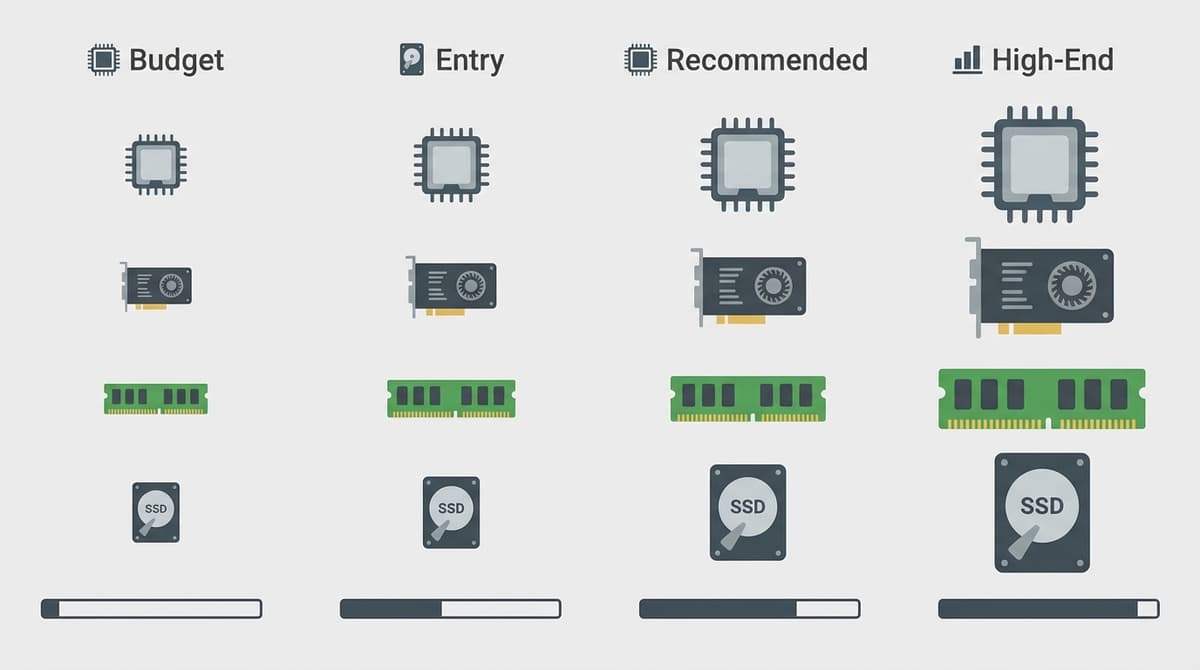
The goal here isn’t pretty. It’s: Will it launch, and can I get a mostly playable 40–60 FPS at 1080p with reasonable compromises? For that, I’d draw the line roughly here.
CPU: 6 Cores or Bust
I don’t see quad-core CPUs having a good time in GTA 6. Even 4-core / 8-thread chips will probably stutter in busy intersections and during chaotic missions.
- Realistic minimum: Intel Core i5-9600K or AMD Ryzen 5 3600
- More modern and better pick: Intel Core i5-12400F or Ryzen 5 5600
All of these are 6-core CPUs, and the newer ones (12400F/5600) come with nicer IPC and efficiency. If you’re still on an older quad-core like an i5-6600K or i7-4770, I’d put “CPU upgrade” fairly high on the list.
GPU: 8GB VRAM Is the Real Floor
I don’t expect Rockstar to outright block older cards like the GTX 1060 from launching the game, but you’re going to hit VRAM limits fast at anything above potato settings.
- Entry viable tier: NVIDIA RTX 2060 / RTX 3060 12GB, or AMD RX 6600 / 6600 XT
- Older but serviceable: GTX 1660 Super, RTX 2060 6GB, RX 5600 XT – with lowered textures and no ray tracing
I’d try to avoid any 4GB card unless you’re okay with aggressively low settings and stuttering when VRAM swaps to system RAM. 6GB is borderline; 8GB+ is where things start feeling somewhat safe for a huge 2020s open world.
RAM and Storage: 16GB & SSD or Don’t Bother
RDR2 already nudged into 12–16GB territory in busy areas. GTA 6 will almost certainly be worse.
- RAM: 16GB dual-channel (2x8GB), DDR4-3000/3200 or better
- Storage: 150–200GB on an SSD, ideally NVMe but SATA is acceptable
I don’t care what the hypothetical box says on release day: running this game off a mechanical HDD will be asking for hitching, pop-in, and general pain. SSD is non-negotiable at this point.
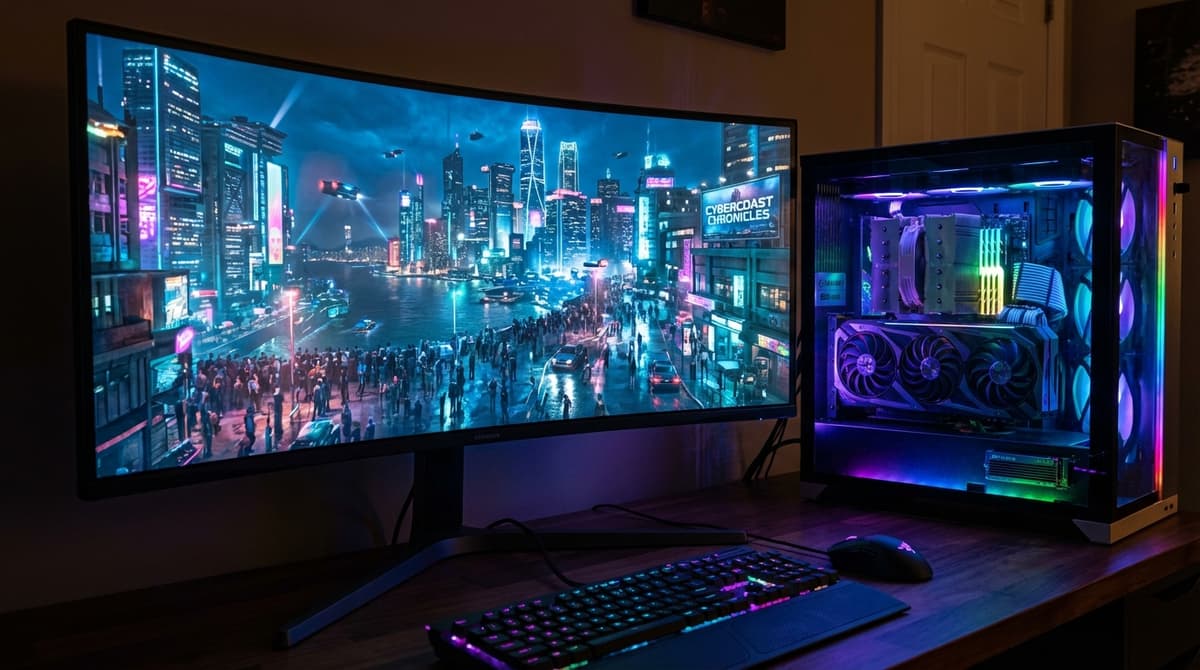
If you want a quick “am I minimum-ready?” sanity check today: if you can run RDR2 at 1080p on high settings around 60 FPS, you’re probably at or above GTA 6’s minimum trajectory.
Predicted Recommended Specs: 1440p High, 60 FPS, Ray Tracing on the Side
This is the tier I expect a lot of PC players to aim for: 1440p, high or very high presets, 60 FPS most of the time, and maybe some ray tracing if you lean on DLSS/FSR.
CPU: 8-Core Workhorses
For smooth city-wide simulation, big traffic jams, and crowd-heavy missions, I’d be much happier with an 8-core or a very strong 6+P-core hybrid CPU.
- Great current options: Intel Core i5-12600K / 13400F / 13600K, AMD Ryzen 7 5800X, 5800X3D, or 7700X
- Why these? They offer plenty of cores/threads and excellent single-thread performance, which RAGE-style engines really like.
If you’re already on something like a 5800X3D or 13600K, you’re in a fantastic spot for open-world games-those chips punch way above their weight in CPU-bound scenarios.
GPU: 12GB VRAM and Modern Upscaling
GTA 6 is almost certainly going to ship with some form of upscaling—DLSS for NVIDIA, FSR for AMD. That’s good, because true 1440p with high settings and ray tracing is no joke.
- Solid 1440p targets: NVIDIA RTX 4070 / 4070 Super, AMD RX 7800 XT
- On the lower edge: RTX 3070 / 3070 Ti, RX 6800 – might need more compromises in RT or dense areas
12GB of VRAM is the comfort zone here. Not because 10GB can’t run it, but because mods, HD texture packs, and post-launch patches tend to creep upward in VRAM usage. If you want this rig to feel good for years, err on the side of more VRAM.
RAM & Storage: 32GB Is the New Sweet Spot
I hate that 16GB is no longer the comfortable default, but between modern browsers, background apps, launchers, overlays, and big games, it’s where we are.
- RAM: 32GB (2x16GB). DDR4-3200/3600 CL16–18, or DDR5-5600–6000 on newer platforms.
- Storage: Fast NVMe SSD, 1TB total drive with at least 200GB free for the game and updates.
On Windows 11, pairing NVMe storage with DirectStorage support should also help reduce CPU overhead on streaming assets, especially for city environments where data streaming is constant rather than just during fast travel.
High-End Predictions: 4K Ultra, Max Everything, Heavy Ray Tracing
If you’re the kind of person who sees a new GTA as an excuse to justify a full-blown monster build, this is the territory you’re eyeing: 4K, ultra presets, ray tracing turned up, and maybe even path-traced lighting if Rockstar gets ambitious.
CPU: Cache Monsters and High-End Hybrids
At this end, we’re basically in “overkill for most games” territory, but open-world sandboxes really do scale with better CPUs, especially those with big caches.
- Today’s excellent options: AMD Ryzen 7 7800X3D, Ryzen 9 7900X / 7950X, Intel Core i7-13700K, i9-13900K
- Why 3D V-Cache? Chips like the 7800X3D are absurdly good at open-world, CPU-heavy games because that giant cache keeps more of the game world “close” to the CPU.
By the time GTA 6 lands on PC, there will almost certainly be a newer wave of CPUs, but if you’re building today, any of those top chips are going to age very gracefully into GTA 6.
GPU: “4090-Class” and Whatever Comes After
For native or near-native 4K with ray tracing, you’re squarely in flagship GPU territory. No sugar-coating it.
- Current-gen beasts: NVIDIA RTX 4090, RTX 4080 Super, AMD RX 7900 XTX
- Next-gen expectations: Whatever replaces these – call them “50-series” or “RX 9000-series” as shorthand, but they’ll push ray tracing much harder.
Expect to rely on DLSS/FSR even here. 4K with everything maxed and ray tracing cranked is just too much for pure native rendering to make sense, even on high-end cards. That’s just where the industry has gone.
RAM & Storage: 64GB for Modders and Multitaskers
For most players, 32GB will still be enough, even at 4K. But if you know you’re going to mod this thing into oblivion, stream, and keep twenty Chrome tabs open, 64GB starts to feel surprisingly sane.
- RAM: 32–64GB DDR5-6000+ on AM5 or LGA1700, or very fast DDR4 on older platforms.
- Storage: 1–2TB NVMe SSD, ideally PCIe 4.0 or 5.0, keeping at least a couple hundred GB free at all times.
I’d also keep GTA 6 on its own primary SSD rather than stuffed onto a secondary, nearly-full games drive. Open-worlds love free space and fast IO; don’t starve them.
Three Practical Build Paths: Budget, Mid-Range, and High-End
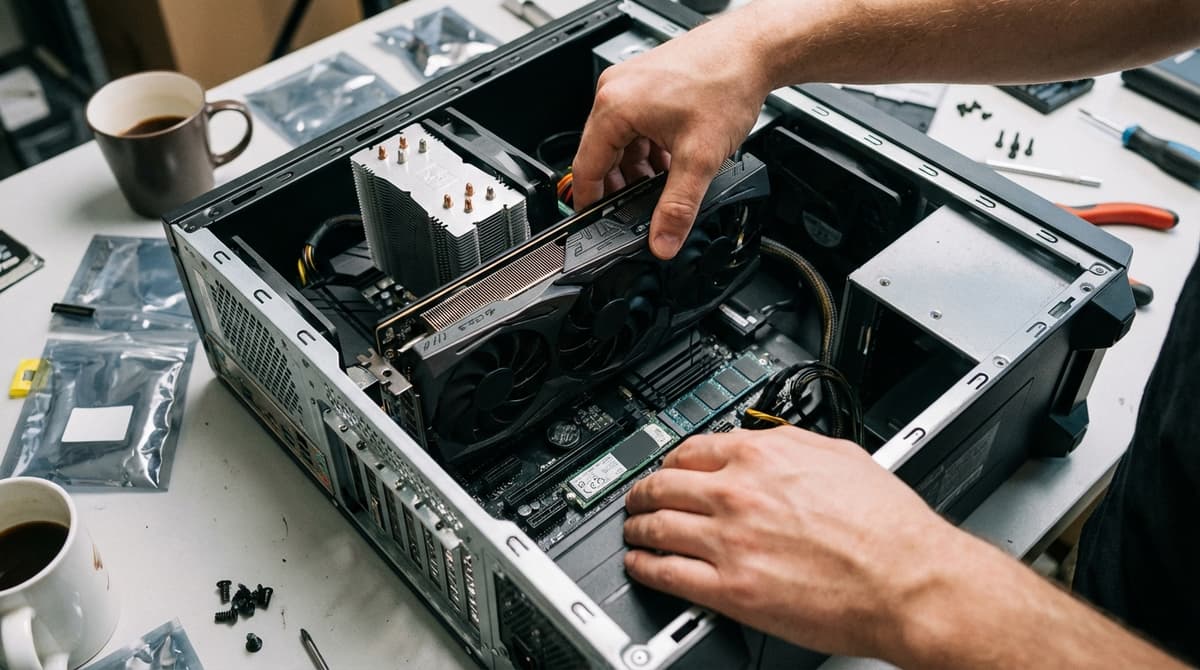
Theory is nice, but let’s turn it into actual builds you could assemble today (or aim for via upgrades) that should map nicely onto GTA 6’s likely demands.
Budget Build (~$800): 1080p, Playable Settings
This is the “I want it to run and look decent on a 1080p monitor” rig, using a mix of new and used parts when it makes sense.
- CPU: AMD Ryzen 5 5600 or Intel Core i5-12400F
- Motherboard: B550 (for Ryzen) or B660 (for Intel) with at least one NVMe slot
- RAM: 16GB DDR4-3200/3600 (2x8GB)
- GPU: NVIDIA RTX 3060 12GB or AMD RX 6600 XT (used if necessary for budget)
- Storage: 1x 500GB–1TB NVMe SSD
- PSU: 550–650W 80+ Bronze or better from a reputable brand
- Case & Cooling: Airflow-focused mid-tower, stock cooler is fine for these CPUs
This is basically a “RDR2 on high at 1080p” machine, which is exactly why I’m confident it’ll do fine with GTA 6 at low–medium, with a few settings nudged up if you’re patient with tweaking.
If you’re already on a similar rig, the single most impactful upgrade is likely moving from 8GB to 16GB RAM and from HDD to SSD. Those alone can turn a miserable experience into an acceptable one.
Mid-Range Build (~$1,300): 1440p High, My Personal Sweet Spot
This is roughly the tier my own main PC lives in, and it’s where I think GTA 6 will feel genuinely great rather than just “it runs.”
- CPU: AMD Ryzen 7 5800X3D or 7700X, or Intel Core i5-13600K
- Motherboard: B550/X570 (AM4), B650 (AM5), or Z690/Z790 (Intel), depending on platform
- RAM: 32GB (2x16GB) – DDR4-3600 CL16 on AM4/Intel, DDR5-5600+ on newer
- GPU: NVIDIA RTX 4070 / 4070 Super, or AMD RX 7800 XT
- Storage: 1TB NVMe SSD for OS + games, or 500GB OS + 1TB game drive
- PSU: 750W 80+ Gold, quality unit
- Cooling: Decent 240mm AIO or a high-end air cooler
The 5800X3D in particular is disgusting (in a good way) for open-world games, and paired with a 4070-class GPU, I’d expect GTA 6 at 1440p high, 60 FPS, with ray tracing on medium using DLSS or FSR set to Quality or Balanced.
If you already have a strong CPU but a weaker GPU (say, a 3060 or older), your smartest play is probably a GPU upgrade into this bracket. Conversely, if you have a 3070 but a crusty old quad-core, fix the CPU/platform first.
High-End Build ($2,000+): 4K, Maxed-Out Madness
This is the “I want to see Vice City’s neon reflected off every puddle in absurd fidelity” kind of setup.
- CPU: AMD Ryzen 7 7800X3D or Ryzen 9 7900X; Intel Core i7-13700K or i9-13900K
- Motherboard: X670/B650 (AM5) or Z790 (Intel)
- RAM: 32–64GB DDR5-6000+
- GPU: NVIDIA RTX 4090 / 4080 Super or AMD RX 7900 XTX
- Storage: 2TB NVMe SSD, ideally PCIe 4.0 or better, with GTA 6 on the fastest drive
- PSU: 1000W 80+ Gold/Platinum for headroom and stability
- Cooling & Case: High airflow case + 360mm AIO or serious air tower
This kind of rig isn’t just for GTA 6, obviously—it’s a multi-year, multi-game monster. But for a flagship Rockstar release, it’s the kind of build that should let you crank almost everything and still hit smooth frame times, especially with DLSS/FSR in the mix.
How to Squeeze More Performance Out of Whatever You Have
You don’t have to rebuild your PC from scratch to brace for GTA 6. A lot of performance comes from knowing what to tweak and what to ignore.
1. Test with “Stand-In” Games Today
The best predictor of how your rig will handle GTA 6 is how it handles games with similar demands right now. I like this quick sanity check:
- Red Dead Redemption 2: Crank it to high/ultra at your target resolution and see where your FPS lands.
- Cyberpunk 2077 or Starfield: Use these for ray-tracing and “next-gen asset streaming” stress.
- GTA V (heavily modded): Shows how your system handles the GTA-style chaos plus extra scripts and textures.
If you’re already struggling to hit 60 FPS in RDR2 at 1080p high, I’d start planning at least a small upgrade path (GPU, RAM, or storage) before GTA 6’s PC release window.
2. Kill the Real Bottlenecks First
Open-world games don’t behave like esports shooters. Your bottleneck might not be what you think.
- Still on HDD? Move the game to an SSD before you upgrade anything else.
- 8GB RAM? Jumping to 16GB is cheap and transforms stability.
- VRAM-starved GPU? Lower textures and geometry before you start nuking resolution.
- Old quad-core CPU? Even a budget 6-core modern chip can be a night-and-day upgrade.
Monitoring tools like MSI Afterburner with an on-screen overlay are worth their weight in gold here. Watch CPU usage, GPU usage, VRAM, and system RAM while you play RDR2 or Cyberpunk; whatever is pegged at 90–100% all the time is your first real problem.
3. Smart In-Game Settings Tuning (Based on RDR2)
GTA 6 will obviously have its own menu layout, but if it follows RDR2’s pattern, these settings will probably punch above their weight:
- Population density & variety: Lowering these frees up CPU time in busy streets.
- Shadows & ambient occlusion: Historically huge performance hogs; dropping them one notch often gives a nice boost.
- Volumetric effects (fog, light shafts, clouds): Expensive at higher resolutions; dialing them back can stabilize frame times.
- Reflection quality & ray tracing: These scale heavily with resolution. Start at low/medium RT and lean on DLSS/FSR.
What I usually do with games like this is pick a target FPS (say 60), turn on an FPS cap, and then tune settings until my frame-time graph looks smooth. Consistency beats a wildly fluctuating 120 FPS any day for this kind of game.
4. System-Level Tweaks That Actually Matter
I’m not talking about snake-oil “registry optimizers” here. Just a few boring but effective moves:
- Update GPU drivers before GTA 6 launches; those day-one drivers usually carry meaningful fixes.
- Enable XMP/EXPO in BIOS so your RAM runs at its rated speed, not at some sad JEDEC default.
- Disable background junk: RGB control bloatware, unnecessary overlays, browser tabs, and game launchers you don’t need open.
- Use a sane power plan: “High performance” or “Balanced” with minimum CPU state not stuck at 5%.
It’s boring housekeeping, but I’ve seen more than one “my PC is dying” complaint evaporate just by moving a game from HDD to SSD, turning on XMP, and closing three RGB apps fighting each other.
Laptop Players: What You Actually Need
GTA has always had a huge laptop audience, and GTA 6 won’t be different. The problem is that thin-and-lights don’t love long, sustained CPU and GPU loads in big open-worlds.
- Target GPU: RTX 3060 mobile at the bare minimum, ideally RTX 4060 or better.
- RAM: 16GB is the hard floor; 32GB is ideal if you’re buying new.
- Storage: 1TB NVMe SSD; GTA 6 will chew through space.
- Cooling: Bigger chassis = better thermals. I’d avoid ultra-thin designs for long GTA 6 sessions.
Expect to run at 1080p or 1440p with upscaling, and be prepared to let the fans roar. A decent laptop cooling pad can actually make a difference for sustained clocks in these games.
Pros & Cons of Prepping Early for GTA 6
Why These Predictions Are Reasonable (and Where They Might Be Wrong)
To be totally transparent: everything past RDR2’s official specs is an educated guess. But it’s not a wild guess.
We know how the RAGE engine behaves. We know how hardware requirements have trended for open-world games from 2019–2024. We know consoles are now SSD-only, 16GB combined memory machines, and that PC ports are increasingly targeting SSD-level streaming and 8-core CPUs as the “normal” baseline.
Could Rockstar pull off some black-magic optimization that makes GTA 6 run shockingly well on modest PCs? It’s possible. Could the opposite happen, and GTA 6 ships in rougher shape on PC and needs patches to stabilize? Also possible—we’ve seen that play out with more than one massive AAA open-world already.
So I’ve tried to thread the needle:
- Not assuming perfect optimization or total disaster.
- Leaning on RDR2’s real-world behaviour as the baseline.
- Matching performance “tiers” (1080p low, 1440p high, 4K ultra) to sensible modern hardware classes.
If Rockstar ends up being kinder than this to older hardware, great—your upgrades will just age better. If they’re harsher, the builds and priorities here still put you in a far better position than trying to brute-force GTA 6 on a 2015-era quad-core with a 4GB GPU and a hard drive.
FinalBoss // Gear
Level up your setup
01Graphics cardson Amazon→02Gaming laptopson Amazon→03High-refresh gaming monitorson Amazon→04Discounted game keyson Kinguin→Affiliate links · As an Amazon Associate, FinalBoss earns from qualifying purchases.