
Table of Contents (6)
Blaming AI for layoffs is executive cowardice, and Strauss Zelnick nailed that part
Blaming AI for layoffs is one of the slickest little scams in modern gaming, and I am glad someone at the top of a major publisher finally said the quiet part out loud. Strauss Zelnick, the CEO of Take-Two, has reportedly argued that companies claiming they cut thousands of jobs because of AI were not telling the truth. His point was much uglier and much more believable: they overhired around the COVID boom, mismanaged headcount, and then hid behind a shiny new buzzword when the bill came due.
That is not a minor distinction. It is the distinction between a hard business reality and a PR alibi. If a company says, “AI made us do it,” it sounds like a natural disaster. Nobody is responsible. Progress happened. Sorry about your rent. But if the real story is that leadership staffed up too aggressively, chased post-pandemic fantasy growth, and then panicked, that is not disruption. That is negligence with better branding.
And yes, I think Zelnick is right about that. Not because I suddenly trust CEOs to deliver moral clarity, but because this explanation matches what the last few years have looked like in games and tech. Companies went on hiring sprees when lockdown-era engagement numbers made everyone feel invincible. Then reality hit, and suddenly the same executives who could not stop talking about expansion started acting like mass layoffs were some unavoidable consequence of the future arriving early. Spare me.
The AI excuse is attractive because it turns bad decisions into destiny
This is why Zelnick’s comment matters beyond Take-Two and way beyond GTA VI. The AI layoff excuse is not just dishonest. It is useful. It lets leadership dodge blame, calm investors, and condition everyone else to accept a worse industry. Workers are supposed to think their jobs were erased by history. Players are supposed to think shrinking teams and thinner games are simply the cost of innovation. Everyone gets nudged to lower their expectations at the exact moment executives should be answering for their own mess.
I have no patience for that framing because we have already seen what happens when this industry starts treating workers as interchangeable and creativity as a spreadsheet variable. We get bloated open worlds full of dead air. We get live-service roadmaps that read like hostage notes. We get games that feel statistically assembled rather than authored. Then we get the same executives acting shocked when players drift away because the soul leaked out somewhere between the milestone deck and the quarterly call.
So when Zelnick says AI is being used as a false cover story for layoffs, I do not hear a grand philosophical statement. I hear the rare moment where a powerful executive admits what a lot of people in games already know: management wants the romance of technological inevitability without the embarrassment of admitting they screwed up staffing.
But let’s not pretend Take-Two is suddenly the patron saint of human creativity
Here is where I am not interested in turning this into a corporate redemption arc. Zelnick can be right about the lie and still be part of the same pressure system that created it. Take-Two has also talked about using AI and other technology to improve efficiency as AAA budgets spiral into absurd territory. That is not shocking. GTA VI is exactly the kind of project that makes publishers stare into the abyss of development costs and start asking what can be automated, streamlined, accelerated, or “assisted.”

And to be fair, some of that is sensible. If you are building a game on the scale Rockstar builds games, of course you want better tools. Of course you want help with organizing assets, speeding up repetitive tasks, or cutting some of the pain out of production. I am not one of those people who hears the letters A and I and starts acting like a demon just walked into the engine room. Tools are tools. The problem is what management thinks they are buying when they say “efficiency.”
The healthiest reading of Take-Two’s position is that it has cooled on the fantasy of some giant all-purpose internal AI revolution and is instead treating AI as support software. Narrow, boring, useful. That would make sense. It would also fit Rockstar better. This is a studio whose biggest games live or die on human judgment: tone, satire, pacing, level composition, ambient detail, and the weird little authored moments that make a city feel inhabited instead of procedurally occupied.
The less healthy reading is that everyone in management now knows they cannot sell “AI replaces talent” in public, so they are learning to say “AI empowers talent” while quietly pushing for smaller teams, higher output targets, and cleaner justifications for future cuts. That is the version players should not be naive about.
GTA VI is almost the perfect argument against replacing people with generative slop
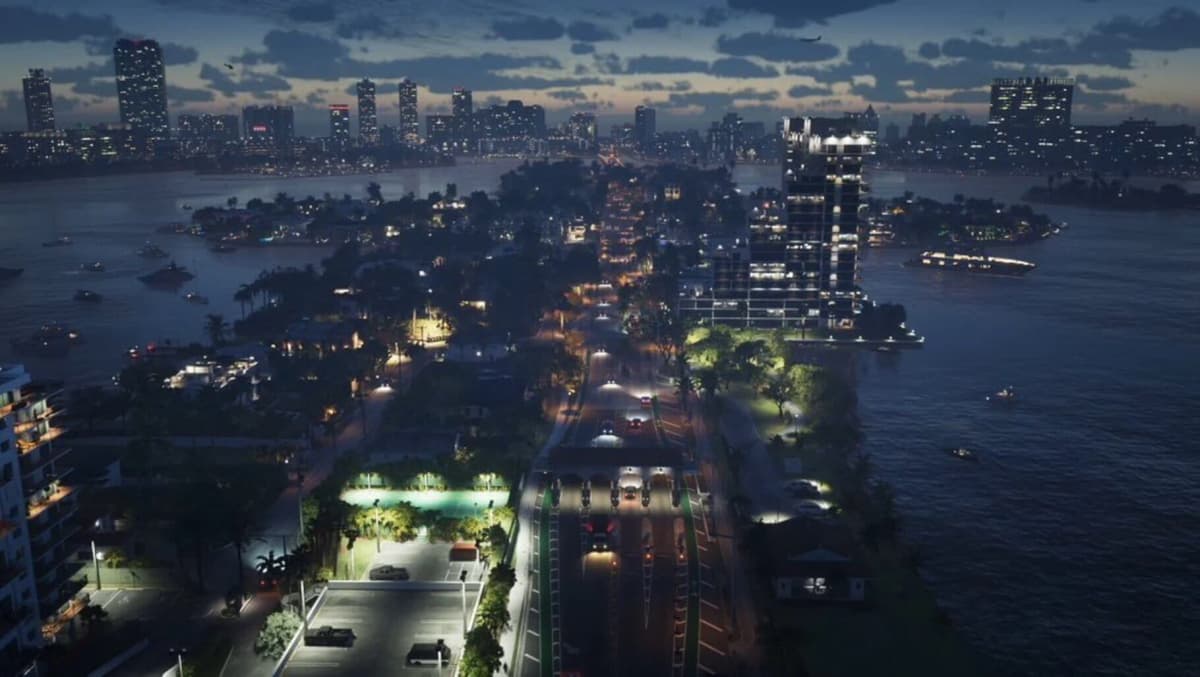
What makes this whole conversation so strange is that GTA VI is probably the worst possible flagship for the “AI can replace creatives” pitch. Rockstar’s open worlds are not impressive because they are big. Plenty of games are big. Rockstar’s games matter because they feel specifically observed. A street corner is not just geometry. It is staging. A bit of overheard NPC dialogue is not just filler. It is texture. A landmark is not just something to climb on your way to the next icon. It is part of a city with a point of view.

That stuff does not come from a prompt box. It comes from teams of artists, writers, world builders, audio people, mission designers, and editors making thousands of tiny judgment calls. The magic of a Rockstar sandbox is not volume alone. It is density with intention. Even when the company misses, you can feel the human hand in the miss. I would rather have that every single time than a machine-generated city full of competent emptiness.
That is why I keep coming back to this idea of AI being subordinate rather than central. If Take-Two truly sees AI as a productivity assist instead of a substitute for talent, that is the sane lane. Use it to help people work. Do not use it as an excuse to flatten the very craft players are paying for. Nobody is buying GTA VI because they hope Vice City was assembled by an especially fast autocomplete.
- Use AI to sort, search, tag, and speed up repetitive internal workflows.
- Use AI to help with bug triage, documentation, or rough technical prototyping.
- Do not use AI as a replacement for writing, environmental storytelling, performance direction, or the cultural satire that gives GTA its bite.
- Do not pretend “faster” automatically means “better” in a series built on authored detail.
The labor reality still matters more than the talking points
This is also why I refuse to treat one good quote from a CEO as proof that everything underneath is healthy. Rockstar’s labor story has never been simple, and recent reporting has described dismissals in the UK involving staff and union organizers during GTA VI’s final stretch. Those cases are reportedly being challenged, and the full picture is still disputed. That uncertainty matters. But even the existence of that fight is a reminder that public messaging and studio reality are not always the same thing.
If those reports bear out, then Zelnick’s line about AI not replacing jobs will land very differently depending on where you are sitting. It sounds great in an interview. It sounds less comforting if your name just disappeared from the payroll while the biggest game on the planet barrels toward release. This is the trap with executive truth-telling: sometimes they tell the truth about the wrong thing. Yes, AI might not be the reason. That does not automatically make the outcome fair.
And from a player perspective, this is not some detached labor-policy side quest. It affects the games. Burn people out, destabilize teams, or treat specialists as disposable during the final push, and you do not just hurt workers. You degrade the exact creative continuity that makes a giant, expensive game feel coherent. Players notice that eventually, even if they do not always know why. Weird tonal gaps. Reused ideas. Safer mission design. Less personality in the margins. Those things come from production decisions as much as design decisions.
What I take from all this is simple: the lie is changing, not disappearing
I think Zelnick’s criticism lands because it punctures a fashionable piece of corporate bullshit. Good. That bullshit deserved puncturing. But the next version of the same trick is already obvious. Instead of saying AI caused layoffs, companies will say AI increased productivity, then quietly decide they need fewer people to hit the same milestones. Instead of promising replacement, they will promise assistance. Instead of gutting teams with a sci-fi excuse, they will squeeze them with a workflow excuse.
That is why I do not think the real fight is over whether AI exists in game development. It obviously will. The real fight is over who it serves. Does it remove friction so talented people can make better games? Or does it become another management cudgel for demanding more output with less time, less stability, and less credit for the people doing the actual creative heavy lifting?
GTA VI sits right in the middle of that tension. It is a game that will almost certainly be used as proof of something, whether Take-Two intends that or not. If it lands, and I suspect it will, executives everywhere will try to claim lessons from it. Some will say giant budgets are still worth it. Some will say premium single-player worlds still dominate. Some will say better tools helped make the impossible manageable. Fine. But if anyone uses GTA VI’s success as evidence that human craft matters less, they are either delusional or selling something.
The honest lesson is much harsher and much simpler. Players still show up for games that feel handmade, even when the hand belongs to a company as huge and messy as Rockstar. We do not line up for algorithmic abundance. We line up for worlds with taste. Zelnick was right to say AI did not magically force those layoffs. Management did. And if Take-Two wants GTA VI to stand as a monument to anything, it should remember the people who built it are the asset, not the overhead.
FinalBoss // Gear
Level up your setup
01Top-rated gaming headsetson Amazon→02High-refresh gaming monitorson Amazon→03Gaming chairson Amazon→04Discounted game keyson Kinguin→
Affiliate links · As an Amazon Associate, FinalBoss earns from qualifying purchases.
Want to Level Up Your Gaming?
Get access to exclusive strategies, hidden tips, and pro-level insights that we don't share publicly.
Ultimate Gaming Strategy Guide + Weekly Pro Tips