
Table of Contents (11)
My first nights with Hades II: fast, witchy, and dangerously moreish
I went into Hades II with a simple plan: a couple of runs before bed on PC, note a few changes, sleep like a responsible adult. Three hours later (around 2:15 a.m., according to my shameful Windows clock), I was hunched over my controller whispering “just one more” because I’d finally rolled a build that made Melinoë’s Omega attacks explode with solar light. That’s the spark Hades II still has. It’s the same crackle the first game had-with a witchier rhythm, a Magick meter that begs to be managed, and a hub that feels alive even when you’re licking your wounds.
For context, I split my time between a desktop (Ryzen 7/RTX 3070 at 1440p, Xbox pad) and a handheld session on Switch in bed. Across the first week I logged roughly 28 hours, 52 runs, and 7 clears. My first clear came at run 12 with the Witch’s Staff, a heap of Apollo blessings that made my Omega Flourish burst into a blinding cone, and a clutch hex from Selene that let me freeze the frenzy for a heartbeat to reposition. From that moment, I was in-hooked not because it was easy but because it kept showing me new gears inside the same machine.
Melinoë’s feel: sprint, Magick, and the thrill of held buttons
The immediate difference from Zagreus is the way Melinoë moves. She’s more deliberate and more aggressive, with a sprint that’s a proper movement layer, not just a panic dash. The heart of her kit is the Magick bar: hold attack, special, or cast to perform an Omega version that drains Magick and changes the flow of a fight. It’s one of those systems you don’t “get” until you blow it at the worst moment-like the first time I held an Omega attack too long against Hecate and got sent to the corner for my hubris. That learning loop—risk longer channels for huge payoffs—is the core of Hades II’s identity, and it made me change how I approached every room.
On top of that, the cast is no longer just a projectile you lodge in fools and forget. It’s a ritual circle you lay down, with an Omega variant that can turn into a bomb, a snare, a laser—depending on your boons. I had a late-night run where Hestia’s blessings made my cast ignite anything inside the circle, and Hephaestus layered in armor-shredding properties; suddenly, what was a simple zone became my “boss blender.” I started walking enemies into my circle like I was luring them into a kitchen hazard I’d installed myself. Chef’s kiss.
Weapons that change your posture, not just your damage
I rotated through the arsenal and found each weapon didn’t just tweak numbers—it changed my brain. The Witch’s Staff is the default because it’s deceptively simple: poke, sweep, channel the Omega flourish and create a gorgeous arc that clears space. The Sister Blades are “lean forward” mode, encouraging dash-cancel aggression and target swapping; every time I took them I found myself flitting between foes, hunting for openings to drop an Omega cast and delete the pack.
The Moonstone Axe is the opposite: you plant, commit, and make decisions a beat earlier than you think. It’s absolutely brutal when a god blesses the special and you’re willing to trust your timing. The Umbral Flames are the “take a breath” weapon—hold a spot, melt things, watch your Magick carefully. And the Argent Skull? It’s chaotic good. Your special becomes a thrown explosive that you need to retrieve to reload, which led to the most “I can’t believe I survived” moment I’ve had in a roguelike this year: kiting a boss while scrambling through projectiles just to snag my skull off the floor and land the finisher. It’s slapstick tension in the best way.
Do all boons sing with all weapons? No. I ran into a few starts where early blessings didn’t cooperate with my choice, and I could feel the ceiling of a run dip early. The flip side is that the buildcrafting is wilder, and more flexible mid-run, than the first game. You can pivot if you’re willing to abandon sunk costs. Hera turned a middling staff run into a crit-fueled monster once, and I’ll never forget the Apollo + Artemis combo that made my Omega flourish both blind and crit—it turned rooms into piñatas, assuming I remembered to keep my Magick tanked up.
Chronos looms, but the Crossroads is where you exhale
Between runs, the Crossroads hub becomes a second game. It’s not just “the place you go to pick the next weapon.” Hecate is there—stern, sly, and surprisingly warm when she wants to be. Nemesis pops by with her scowl-and-snickers energy. Dora, the extremely over-it shade, drops in with mood. There’s a frog familiar named Frinos who waddled into my heart the first time he croaked and body-blocked a projectile for me. These aren’t flavor sprinkles; they’re people I wanted to check in on, and talking to them changes more than your mood.
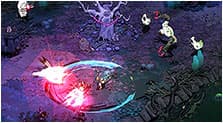
The cauldron of incantations is the big swing. It’s meta progression but dressed as witchcraft, and it works. After a few runs, I unlocked the ability to craft spells that alter the structure of future attempts: more wells, better fountains, alternate entrances, gathering tools (pickaxe, shovel, fishing rod) that let you pull resources straight out of rooms. It’s the difference between “I got stronger” and “I bent the world a little.” I remember crafting a simple incantation that spawned occasional resting alcoves in later biomes and thinking: that one decision changed how long I could push a failing build. It made me greedier.
There’s also an arcane system (think a tarot-like altar instead of the Mirror from Hades I) where you spend gathered ash and essence to unlock cards, then pin a subset for passive effects. Early on, I misread a card, flipped it the wrong way, and ended up with a negatively synergistic loadout that made my Magick regen crawl. I felt that mistake for an entire evening. But when you do dial in a combination—the card that refunds Magick on cast detonation, paired with boons that amp Omega attacks—you feel like you’re cheating the calendar. The best kind of cheat.
Bosses and biomes: familiar bones, sharper teeth
Hecate, your mentor and first real boss, is a tone-setter. The duel plays like a lesson wrapped in a beatdown: respect her phases, use the sprint smartly, and don’t get greedy with channels. My breakthrough was realizing my Omega cast could interrupt her “I own this circle” vibe if I set it early and baited her into it. The second major boss I faced (a rowdy musical trio whose party turns into a bullet hell gig) forced me into target priority discipline—blow up the support first, survive the guitar solo second. When I finally threaded a perfect Omega sprint through a blizzard of projectiles to finish the drummer, I audibly cackled. Then apologized to my sleeping neighbor.
Structurally, the biomes are still a climb. Rooms shuffle, encounters vary, but the order and silhouettes become familiar. There’s comfort in that; there’s also erosion. After 30 hours, I started recognizing the room archetypes by their furniture and hazard layouts before enemies spawned. That’s not a sin in a roguelike—reliability is part of the dance—but it’s where Hades II’s charisma doesn’t always outrun its routine. Some nights, I could feel the “okay, biome two, do the hallway thing, check the well, roll the god trial, try not to aggro the wrong deity” effect settling in.
Speaking of god trials: double-boon rooms where one god blesses you and the other gets mad are still hilarious and harrowing. I had Hera pelting me with malicious orbs because I took Hestia’s fire first; the pettiness of Olympus never gets old, and it’s mechanically spicy too. Duo boons can tilt whole runs into new shapes, but they’re not guaranteed, and that’s where restraint matters. Some runs you’re the conductor; some runs you’re the tambourine.
The writing keeps giving, even when the rooms repeat
Supergiant’s trick—trick feels insulting; gift is better—is making failure feel like progress. After a wipe, I wanted to get back not just to try a different build, but to hear what Hecate, Nemesis, or the gods would say about my last mess. The sheer volume of bespoke lines is wild. Around run 20, I got a new conversation about a boss I’d already beaten twice, and it recontextualized why Melinoë keeps the night going. There’s friction: gating some story behind specific materials or victories made me feel stuck for an hour here or there, and I had one night where all I rolled were “eh” conversations when I was hungry for a reveal. But the batting average is high, and the characters have that Supergiant blend of myth and mundanity that makes them feel human even when they’re capital-G Gods.
Art and sound: the vibe is the victory
I don’t need to tell you it’s gorgeous, but I will tell you what stuck with me. The way Melinoë’s Omega flourish paints the room for a split second—a crescent shimmer that says “you chose violence.” The Crossroads at dusk, candles breathing in the breeze. A particular track in the ocean biome kicks in with a sea-salted bassline that made me nod like an idiot while dodging. The hitstop on the Axe’s special—just enough to sell the weight. Voice work that lets Melinoë bristle, joke, and soften without ever feeling like she’s reading a cue.
One minor nit: in handheld play, the UI text toes the line of “squint a little,” especially in the incantation menu and boon comparisons. On a monitor, everything sings. Headphones bring out the small stuff: the hiss before a big enemy wind-up, the chime when an Omega channel hits the threshold. If you’re the kind of player who rides audio cues, you’ll feel seen.
Performance and polish: smooth sailing with a few splashes
On PC at 1440p, I was comfortably above 120 fps in most rooms with v-sync off, dipping into the 90s during the craziest screen-fills. I had one crash in 28 hours (during a room transition; autosave spared my progress) and zero run-killers. Load times are snappy, input latency feels crisp, and there’s enough control remapping to make oddball layouts viable. On Switch, docked play held a steady 60 in most encounters with momentary dips when a room turned into fireworks; portable is playable and pleasant, though longer loads and that tiny text in certain menus made me prefer the couch for long sessions.
Accessibility-wise, sprint/dash options, damage numbers, aim assists, and text speed sliders made it easy to tune the feel. I’d love an even bigger text scaling for handhelds and a colorblind-friendly mode for certain hazard contrasts, but I never felt gatekept by the defaults.
Where the loop stumbles: sameness and the early-boon choke
Let’s talk about the thing that might bounce you: repetition. Hades II embraces the roguelike loop with almost religious fervor. The cauldron, the arcana, the familiars, the social side—they all help the repetition feel meaningful. But after dozens of runs, the macro beats become predictable. The first two biomes, in particular, started to blur for me on nights when RNG handed me awkward early boons that didn’t fit my weapon. If the first three rooms don’t cough up a direction, you’re nudging a rock uphill hoping a mid-run blessing unlocks the fun. Sometimes it does. Sometimes you bail and try again.
It never stopped being fun to fight, and the writing buffered the grind, but I did feel the structure peeking through the curtain more often than I wanted. That’s the tax for a sequel that preserves the blueprint. If you bounced off the first game because the loop felt samey, Hades II won’t magically cure that. It polishes, expands, and complicates the loop—it doesn’t replace it.
Who this sings for (and who it might not)
- If you loved Hades I’s flow but wanted more build complexity and a richer meta, this is your feast.
- If you crave character interactions that evolve for hours, you’ll live at the Crossroads between runs.
- If you need every run to feel wildly different structurally, the biome sameness may gnaw at you.
- If your patience for RNG is thin, the early-boon choke on certain weapons could sour a night.
Moments that sold me completely
– Run 7, Witch’s Staff: Selene offered a limited-use hex that slowed the world. I hoarded it, obviously. Hecate’s final phase started, I panicked, popped the hex by accident… and then realized the best way to use it was aggressively. I walked through the shards of her spell, dropped an Omega cast at her feet, and finished the duel with a flourish I didn’t think I had in me. The game taught me something about how I was playing it.
– Run 19, Sister Blades: Poseidon knockback plus a boon that punished wall slams turned narrow rooms into bowling alleys. I was giggling as I bounced armored brutes between columns. Then a god trial hit, I angered the wrong deity, and the room filled with homing hate. Surviving that felt like inventing a new dance mid-song—messy and perfect.
– Run 34, Argent Skull: I built around reloading fast and detonating casts inside groups. It turned the boss arena into a game of fetch-and-bomb. The moment I sidestepped a grab, slid across the floor to scoop my skull, and instant-popped the special into the boss’s attack animation, I realized why this game keeps people up at night. It’s not the numbers; it’s the feel.
FinalBoss // Gear
Level up your setup
01Top-rated gaming headsetson Amazon→02High-refresh gaming monitorson Amazon→03Gaming chairson Amazon→04Discounted game keyson Kinguin→Affiliate links · As an Amazon Associate, FinalBoss earns from qualifying purchases.
Want to Level Up Your Gaming?
Get access to exclusive strategies, hidden tips, and pro-level insights that we don't share publicly.
Ultimate Reviews Strategy Guide + Weekly Pro Tips