
Hearts of Iron 4 Has a New Challenger: Battleplan Wants You Thinking Like a General
Game intel
Battleplan
Where fun meets chaos: Set in Pixel Vault's mashup universe, step in, apply your strategy and compete in our 3v3 auto-battler.
Why This Caught My Eye
Hearts of Iron 4 has sat on the WW2 strategy throne for years because it nails the global, grand strategy dance. But Slitherine’s newly revealed Battleplan is aiming at a different pressure point: the operational high command seat where plans, not clicks, win wars. Developed by Foolish Mortals, it promises “massive, month-long battles with hundreds of thousands of troops, second by second, day by day.” That pitch matters because few games truly let you act like a theater commander without burying you in minute-by-minute micromanagement.
Key Takeaways
- Operational-level focus: you draw objectives and movements each day, set contingencies, and let the plan unfold-no micro.
- Western Front campaign (1944-45): 10 historical missions from Normandy to the Bulge and into Germany as the British, Americans, or Canadians.
- Persistence matters: veteran management, post-mission specializations, and pre-made divisions like the “Big Red One.”
- Open questions: will the AI react intelligently across huge fronts, and does a 10-mission structure offer replay value?
Breaking Down the Announcement
Battleplan opens each scenario with a mission briefing, setting force strength and historical context. Then the day starts with a planning phase: you draw your goals on the map, sketch broad movements, and establish what reserves will do if a flank buckles or a gap appears. With “hundreds or thousands of troops” in play, you’re not babysitting squads-you’re drawing the big arrows and trusting your officers to execute. Foolish Mortals puts it plainly: “In Battleplan, you don’t just play a general, you feel like a general.”
Timing matters. Daylight gives better sight lines for assaults; night movement lets you stage dawn raids, but your opponent can do the same. Artillery barrages and carpet bombing can break a strongpoint at the precise moment your main push hits-if your timing is right. The sim ticks along continuously, but the tempo is day-by-day, encouraging you to pause at night, assess, and adapt. The team stresses that some battles will take days or weeks to grind out, and success comes from persistence and learning, not one perfect push. That ethos feels closer to Unity of Command’s operational problem-solving than the twitchy tempo of Steel Division or Company of Heroes.
There’s post-battle bookkeeping too: you tally casualties, assign veterancy bonuses, and shape your best units with passive and active specializations. You can hire premade divisions—yes, including the “Big Red One”—or build custom formations. That layer could be the secret sauce if it meaningfully links missions and creates enough attachment that losing a veteran unit actually stings.
Industry Context: Where It Sits Between HOI4 and Steel Division
Slitherine has a knack for the WW2 niche—Panzer Corps 2 scratches the hex-and-counter itch, while Headquarters: World War II hits that clean, tactical feel. Battleplan targets the space between Paradox’s nation-level sandbox and Eugen’s tactical microfests. HOI4 lets you redraw the map of Europe and script an alternate history; Steel Division asks you to win the next five minutes on a kilometer-wide front. Battleplan is promising to own the “month-long operation” tier: fewer levers than HOI4, but more breathing room than the tactical click-fest.
That’s exciting—if it works. Operational games live or die on AI and UI. If the AI doesn’t probe, counterattack, and regroup like a desperate defender around Caen, the whole “high command” fantasy collapses into watching arrows glide across a map. And if the UI doesn’t make day-by-day planning fast—templates, conditional orders, clear supply feedback—players will drown in admin. The promise of cutting supply lines and encirclement is great, but only if the game communicates why a pocket formed (or failed) without forcing you to drill into a dozen opaque screens.
Want to Level Up Your Gaming?
Get access to exclusive strategies, hidden tips, and pro-level insights that we don't share publicly.
Ultimate Gaming Strategy Guide + Weekly Pro Tips
What Gamers Need to Know
The campaign is ten missions across the Western Front from 1944: Normandy, the Bulge, and the drive into Germany. You’ll play as British, American, or Canadian high command, with the ability to recruit across national pools. That’s a strong historical focus, but it raises replayability questions. Are these tightly scripted recreations where you’re judged against history, or can the fronts genuinely evolve? Can we play as Axis commanders? The reveal doesn’t say.
Mechanically, the day-night cadence, artillery timing, and adaptive contingencies sound like the right ingredients. I’m especially into the idea of banking veterans and tailoring divisions, because it gives your operational choices weight beyond a single day’s gains. But the scale claim—“hundreds of thousands of troops”—needs clarity. That’s almost certainly simulation-scale rather than unit-count on screen, which is fine, as long as it translates into meaningful operational dilemmas like frontage management, tempo, and supply pressure rather than just bigger numbers in the corner.
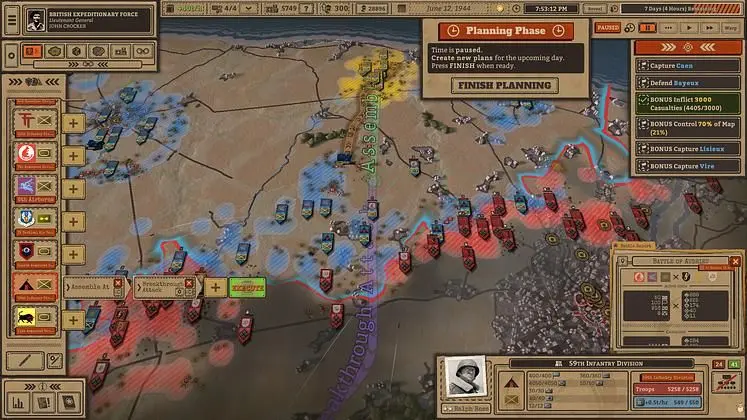
There’s no release date yet, and the ask is a wishlist for now. Before launch, I want to see: smart AI counterplans, robust time controls, clean overlays for supply and LOS, post-battle analytics that teach you why your plan worked or failed, and at least some branching objectives to avoid “history museum” syndrome. Mod support would be a huge win in this niche. Multiplayer wasn’t mentioned, but a WEGO operational head-to-head would be delicious if the engine can handle it.
TL;DR
Battleplan aims squarely at the operational sweet spot: you draw the plan, set contingencies, and live with the consequences over days and weeks. If the AI and UI deliver, it could be the high-command alternative HOI4 never tried to be. If not, it’ll be another pretty map with arrows that don’t fight back.