
Table of Contents (9)
Skateboards, screaming guns, and my messy first night in High on Life 2
About 30 minutes into High on Life 2, I was powersliding across a neon alien freeway on a skateboard while my guns yelled advice and insults at me, and I remember thinking: “Oh, they finally cracked it.” The first game had personality, but moment-to-moment it was a pretty standard shooter with talking guns. This time, the talking guns are strapped to a full-on movement shooter.
Then the game hard-crashed to desktop in the middle of a big combat arena. No autosave in the last 10 minutes. That became the rhythm of my entire playthrough: 15 minutes of “this rules”, followed by one moment of “are you kidding me?”
I finished the campaign in just under 15 hours, doing a good chunk of side bounties on PC (Ryzen 7 / RTX 3080, SSD) and dipping into the PS5 version to see how it held up. I came away genuinely impressed with how much Squanch has tightened the writing, expanded the mission variety, and completely rethought traversal. I also came away with a notebook full of crash timestamps, bug descriptions, and one absolutely cursed 12-step workaround to fix a soft-locked save.
High on Life 2 is the definition of a “yes, but” game. Yes, it’s one of the funniest shooters I’ve played in years… but its technical state at launch is rough enough that I can’t recommend it without a big asterisk.
A dumber, sharper story that actually goes places
The setup picks up right after the first game. You’re the now-legendary bounty hunter who saved humanity from an alien cartel that literally snorted people as drugs. Things are going “well” in the loosest possible sense: Creature has settled into being a slightly deranged family man, Les Do It has an… intimate relationship with your mom, and you’re still taking bounties because of course you are.
Then you stumble onto a new scheme: humans are once again a controlled substance, but this time it’s not a sketchy cartel, it’s a Big Pharma-style mega-corporation trying to legalize human-drug production and distribution. The structure is familiar-hunt down a roster of bigwigs, each with their own warped domain-but the sequel leans harder into building each bounty into a self-contained adventure rather than a single-note boss hunt.
One of my favorite missions starts as a straightforward “track the company’s key benefactor onto a luxury cruise ship” job. To board, you end up befriending a lonely, freshly-dumped alien on the dock, getting blackout-drunk with him, helping him process his breakup, and then sneaking aboard together. By the time you’ve recovered your confiscated guns, stolen a fedora with a colossal “circumcision laser” (yes, that’s exactly what it sounds like), and accidentally wandered into a knives-out style murder-mystery hosted by your own target, you’ve basically forgotten what the mission brief even was. In a good way.
The original High on Life sometimes felt like a string of skits taped to a corridor shooter. High on Life 2’s bounties feel more like full episodes of a deranged sci-fi show, each with a distinct tone and rhythm. One moment you’re exposing a crypto-slinging tech-bro wizard running a pump-and-dump scheme on his followers; the next you’re defending a single parking space at a literal parking convention as commentary on how hopeless convention parking is. The game is constantly looking for a new angle, and most of them land.
Structurally, it’s still a linear-ish campaign built around a hub and a mission board, but the variety within that framework is miles better this time. I rarely felt like I was just ticking off “another samey bounty” the way I occasionally did in the first game.
The humor: less Rick & Morty echo, more confident chaos
Humor is subjective, but this game had me laughing out loud way more often than I expected. I burned out on Rick and Morty years ago, and I was worried this would feel like stale leftovers from that vibe. It doesn’t.
The big shift is that High on Life 2 feels less beholden to Justin Roiland’s specific cadence. Without the “Morty voice” dominating, the rest of the cast gets to breathe. The guns all have stronger, clearer personalities, and the writers seem more willing to get weird in ways that aren’t just “swear more and mention sex.” There’s still plenty of crude stuff, but it’s sprinkled into jokes that actually have concepts behind them: media satire, office politics, predatory capitalism, basic human misery.
Pseudo, the AI voice in your suit, is a constant highlight, mostly because he sounds seconds away from breaking character at all times. There’s a bit where he starts ranting about whether there is or isn’t a fishing minigame, and you can practically hear the actor losing it in the booth. That sort of barely-contained chaos does a lot of heavy lifting.
The world is littered with ambient jokes too. Improvised news broadcasts that spew obvious nonsense waiting for the audience to correct them. Background NPCs muttering about union disputes and pyramid schemes. Posters, signs, and TV shows that all feel like someone’s first draft that accidentally shipped. It’s dense in a way you don’t often see; I’d stop mid-combat because a sign in the distance said something so stupid I needed to read it.
If the first game’s nonstop yammering grated on you, the sequel does give you some tools: you can tweak chatter frequency, and the pacing of the jokes feels more deliberate. But if you fundamentally dislike meta, fourth-wall-breaking comedy, this is not the game that will convert you. For everyone else, it’s some of the best comedic writing we’ve had in a shooter since maybe The Stanley Parable or Portal 2, just with more swearing and viscera.
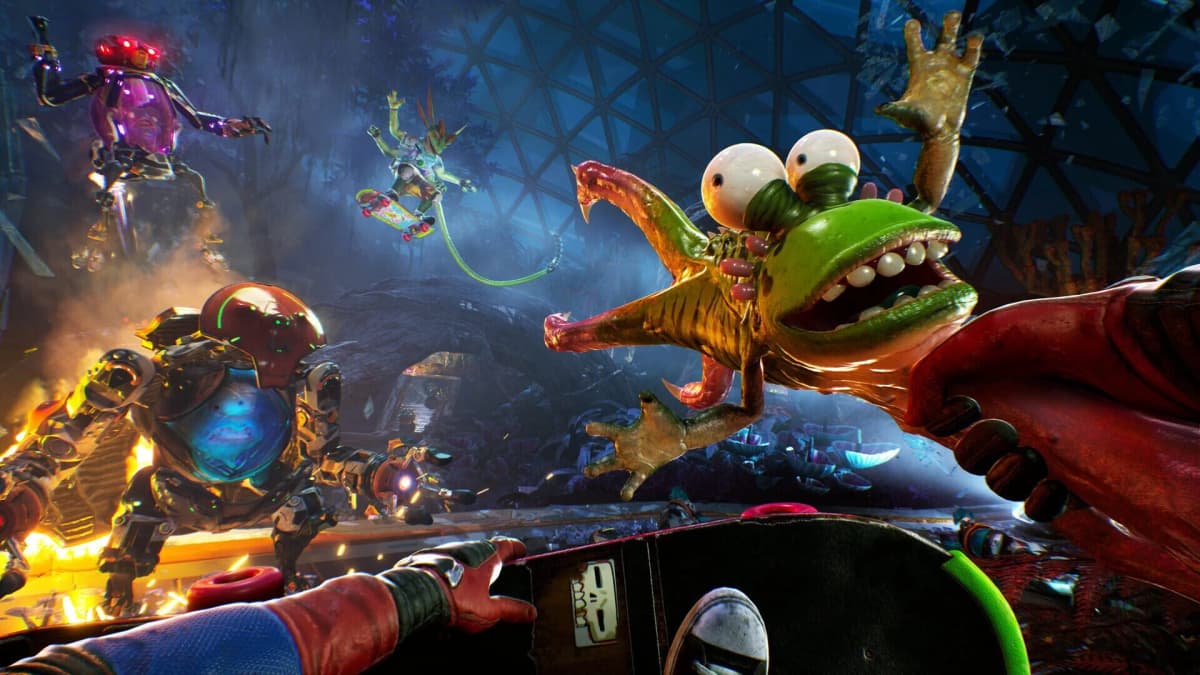
Movement shooter glow-up: the skateboard changes everything
The first High on Life was “Halo-coded”: floaty jumps, decent strafe speed, maybe a grapple here and there, but largely traditional. High on Life 2 chucks that foundation in the trash by handing you a skateboard and telling you to go nuts.
Tap what used to be the sprint button and you’re instantly on the board, shooting forward independent of (but affected by) your aiming. With a little practice you’re:
- Launching off ramps and environmental geometry for air time
- Wall-riding around the edges of arenas
- Grinding on rails that snake above and through combat spaces
- Kickflipping straight into enemies’ faces as a melee finisher
It’s not as precision-heavy as Titanfall 2’s movement, and it doesn’t hit Sunset Overdrive’s full “rollercoaster of death” energy, but it absolutely pushes High on Life into that movement-shooter space. Once it clicks, you stop thinking in straight lines. You’re chaining wall rides, grappling to floating platforms, and using the board to surf through crowds while your guns scream delighted murder poetry in your ear.
Crucially, the levels are actually built for it. Combat arenas have vertical layers, high rails crisscrossing killzones, half-pipes and ramps tucked into corners. Platforming segments and setpieces make explicit use of the board, forcing you to think about momentum and angle instead of just “double jump to the glowing ledge.” It never reaches boomer-shooter difficulty, but you can feel the designers trusting the player more than they did last time.
I kept thinking: if the last decade’s shooter toy was the grappling hook, this one is making a real case for “put skateboards in more FPS games.” Doomslayer on a deck is now a thing I genuinely want.
Guns with actual personalities (and useful tricks)
The talking guns, or Gatlions, are still the heart of the experience. Mechanically, they’re a solid loadout of archetypes-pistol, shotgun, automatic, utility weapons—but each has some twist that ties into both traversal and combat puzzles.
Sheath, a suave semi-automatic voiced by Ralph Ineson, quickly became my favorite. His primary fire feels punchy, but it’s his spear alt-fire that makes him sing: you can shoot out zipline anchors, redirect electricity, or skewer an entire group of enemies and detonate them in a chain reaction. The fact that he constantly comments on the architecture, capitalism, and the vulgarity of cruise ships just makes him more fun to keep equipped.
Knifey is still the tiny unhinged king, gleefully pushing you toward every violent or chaotic dialogue option. One neat touch: dialogue “choices” are now framed as which weapon you let speak for you, each bringing their bias to the conversation. The bloodthirsty knife will absolutely encourage murder, while other Gatlions nudge you toward mercy, scheming, or just weirdness. It does more for role-playing than I expected in a game that is otherwise very linear.
Mechanically, nothing here is revolutionary. You’ve seen alt-fires that freeze enemies or create platforms in a dozen other shooters. But the way High on Life 2 weaves them into traversal—skateboard lines that only exist because you remembered to spear a zipline target mid-air—keeps combat from devolving into “circle-strafe, headshot, repeat.” With some upgrades from the shop and optional bounties, you can build a toolkit that really sings with the movement system.
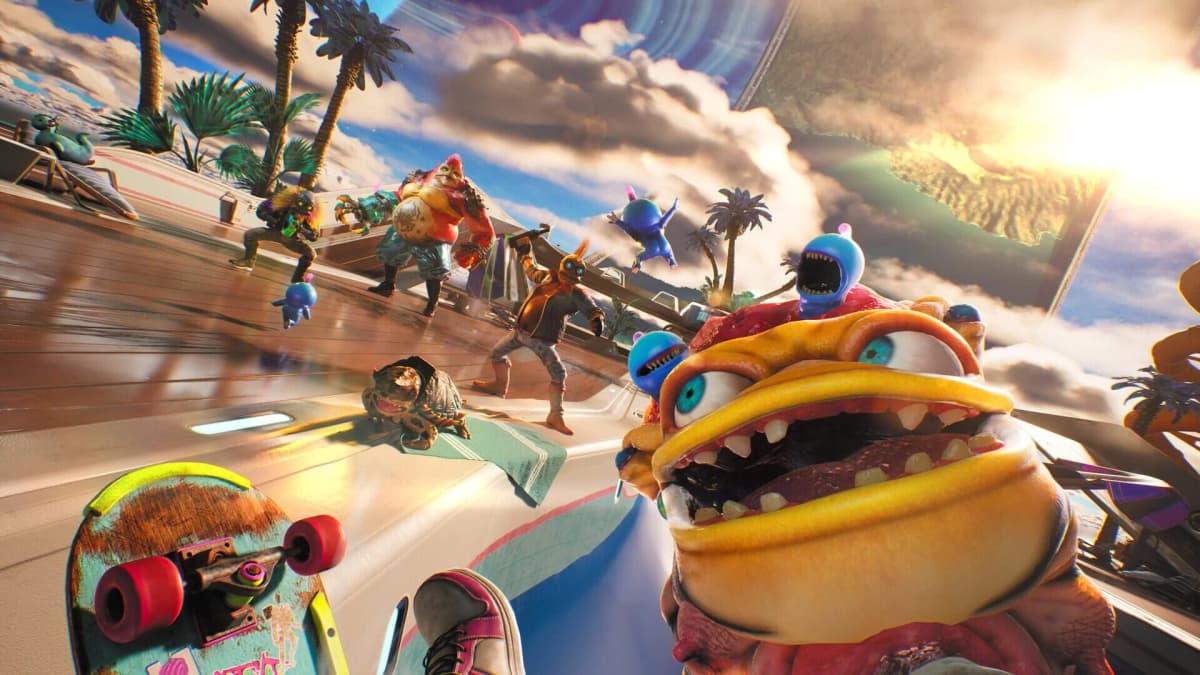
Difficulty, pacing, and those wonderfully weird missions
On normal, High on Life 2 is on the easier side. Enemies hit hard enough that you can’t sleepwalk, but this isn’t Doom Eternal where you’re essentially solving high-speed chess puzzles every encounter. This game wants you to be present enough to appreciate the jokes and the spectacle, not sweating reload timings.
Each area introduces its own enemy roster—security goons, mutant fauna, cult weirdos—and while they don’t force a wholesale playstyle shift, they at least give every biome its own flavor. Bosses are more imaginative than in the first game, mixing pattern-based bullet hell with traversal challenges that actually leverage the skateboard instead of trapping you in a flat circle.
What really sells the pacing are the missions that go completely off the rails. The cruise ship bounty I mentioned earlier, the parking convention siege, a whole stretch dealing with a wizard-CEO who treats magic like a blockchain start-up—these aren’t just side jokes stapled to levels, they are the levels. By the time the story reaches its inevitable “save humanity… again” climax, you’ve gone through such a grab bag of scenarios that the formula never really wore thin for me.
The hub world is denser, too. There are more distractions—TV shows, weird little errands, optional bounties—and the fact that you can skate around it makes simple back-and-forth runs less of a slog than in the first game. I wouldn’t call it a full RPG hub, but it’s a decent playground between the mainline missions.
And then the crashes started
All of that praise comes with a massive caveat: the game’s technical state at launch is not okay.
On PC, after some tweaking (dropping a couple of settings, disabling certain post-processing options), I got performance into a mostly-60fps window at 1440p. But even then, I recorded six full hard crashes across the campaign and roughly the same number of progression-blocking bugs.
One bug in particular almost ended my playthrough. A mission objective refused to update after a cutscene. Enemies stopped spawning. The door I needed to use stayed locked. Reloading the checkpoint didn’t help. Loading earlier saves didn’t help. The only way I eventually fixed it was by following a hilariously specific multi-step workaround someone had posted to the Steam forums: change a setting, reload, die in a certain spot, quit to desktop, reload again, trigger dialogue in a different order. That’s not “quirky jank,” that’s “my save is actually broken unless I troubleshoot this game like it’s an obscure mod.”
Other issues were less catastrophic but constant: enemies failing to spawn, bosses getting stuck in animation loops, audio desync in cutscenes, objective markers pointing to the wrong room, collision bugs that left me trapped under geometry until I suicided with a grenade. Individually, none of those are deal-breakers; together, they wear you down.
Console performance is, frankly, worse. On PS5, the framerate frequently dives during busy fights, the resolution takes a noticeable hit even in the “performance” mode, and you get aggressive texture pop-in and distractingly blotchy reflections. The Xbox versions are in a similar boat by all accounts: playable, but way too unstable for a game built so heavily on fast, fluid movement.
I don’t mind the occasional bug. We’re all sadly used to patch culture at this point. But High on Life 2 crosses a line where the technical issues stop being “rough edges” and start actively undercutting the things the game is best at. Nothing kills the rush of a perfect skateboard arena run like a random crash to dashboard.
Unreal Engine 5, pretty lighting, and ugly artifacts
Under the hood, this is one of the early wave of Unreal Engine 5 shooters, and you can feel both the ambition and the growing pains. The game uses flashy tech like Lumen for global illumination and fancy virtualized geometry, which gives some interiors and cityscapes a gorgeous, almost toybox-like quality when it all comes together.
But the implementation is uneven. On consoles especially, the reliance on software Lumen and heavy screen-space tricks leads to:
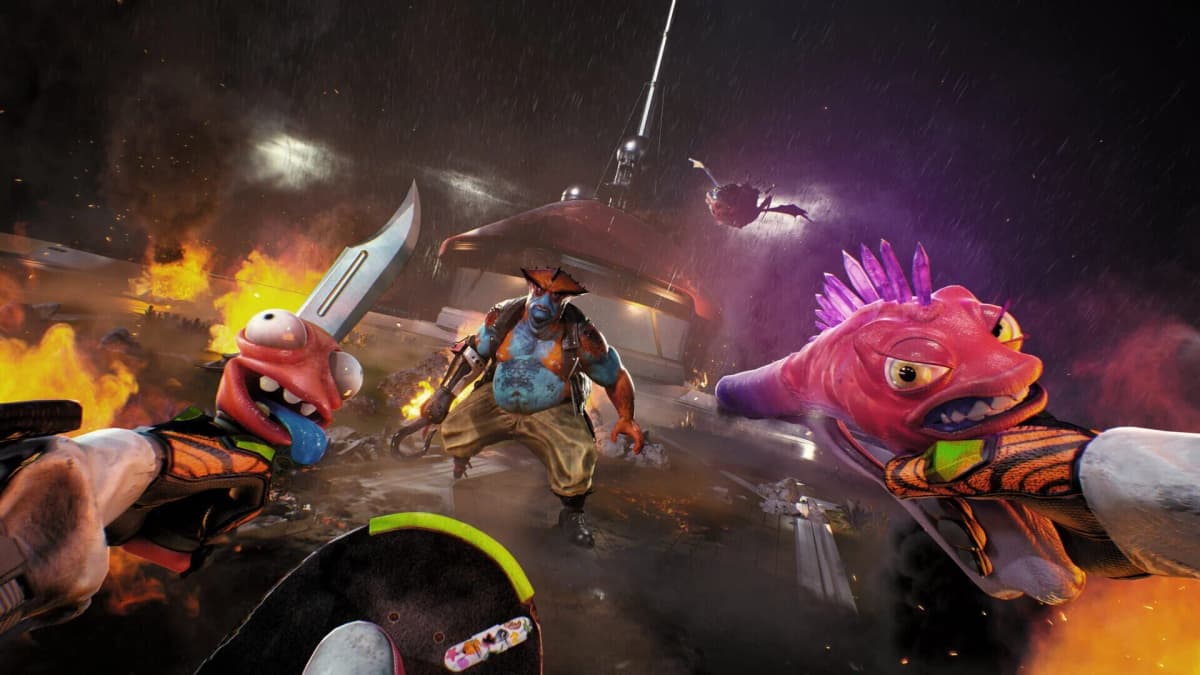
- Blotchy, shimmering reflections on shiny surfaces
- Shadow artifacts that pulse or pop in and out as you move
- Objects that look razor-sharp up close but muddy in the distance
It’s the kind of thing some players will instantly notice and others will tune out, but once you see it, you can’t unsee it. In calmer games you might be able to live with that; in a movement shooter where you’re covering half an arena every second, those visual hiccups turn into a subtle distraction.
On PC, you can brute-force some of the problems if you have the hardware. Crank things up, lock the framerate, accept that the occasional traversal-heavy zone will hitch. On consoles, you’re at the mercy of the current build, and right now that means inconsistent frametimes and visible compromises.
The audio, thankfully, is much stronger. Guns sound weighty, the skateboard has a satisfying grind/whirr that sells the speed, and the soundtrack leans into woozy, spacey beats that never overpower the voice acting. The latter is doing a lot of heavy lifting; even when a scene is technically janky, the performances keep it afloat.
Who should actually play High on Life 2 right now?
This is one of those rare games where my answer genuinely depends less on your taste in genre and more on your tolerance for jank.
If you loved the first High on Life and just want more: this absolutely is that, plus better mission structure, more varied enemies, and a vastly more interesting movement system. The writing is sharper, the cast feels better balanced, and the skateboard alone makes it hard to go back to the original.
If you’re into movement shooters—Titanfall 2, Neon White, even stuff like Sunset Overdrive—and you also enjoy loud, weird comedy, this is basically catnip. Just know that the game will occasionally pull the rug out from under you with a bug or crash, especially on PlayStation and Xbox right now.
If you’re sensitive to technical issues, or you only play on console, I honestly think you’re better off waiting. A couple of substantial patches could move this from “brilliant but broken” to “easy recommendation.” At launch, it sits awkwardly between those two states.
FinalBoss // Gear
Level up your setup
01Top-rated gaming headsetson Amazon→02High-refresh gaming monitorson Amazon→03Gaming chairson Amazon→04Discounted game keyson Kinguin→Affiliate links · As an Amazon Associate, FinalBoss earns from qualifying purchases.
Want to Level Up Your Gaming?
Get access to exclusive strategies, hidden tips, and pro-level insights that we don't share publicly.
Ultimate Reviews Strategy Guide + Weekly Pro Tips