
Table of Contents (11)
Silksong rewired my Metroidvania brain-in ways I adored and in ways that broke me
I went into Hollow Knight: Silksong with seven years of baggage and a controller already white-knuckled. Like you, I’d lived through the memes and the “Skong today?” ritual every showcase. I installed it on my PC (Ryzen 5/RTX 3070) and also tried a couple of hours on a Steam Deck OLED just to feel the handheld vibes. Within the first 90 minutes, after a confident ascent through Moss Grotto, I missed a ledge, overcorrected, and tumbled so far I found myself right back in Bone Bottom. That single fall summed up what Team Cherry is doing here: progress isn’t just a forward crawl; it’s a towering climb where gravity is both teacher and bully.
My first impression was amazement at how immediately different it felt while still wearing Hollow Knight’s bones. Hornet isn’t the Knight. She’s faster, mouthier, and the world bends around her agility. The very first bench I sat at in the Citadel’s underbelly asked for a rosary fee, and I caught myself laughing-miserly bug capitalism survives even in a ruined kingdom. Then I realized I’d wandered into a gauntlet I wasn’t ready for and had to decide: pay up to bank progress or backtrack and risk losing more. Silksong delights in forcing those choices early and often.
Vertical design changed how I planned every route
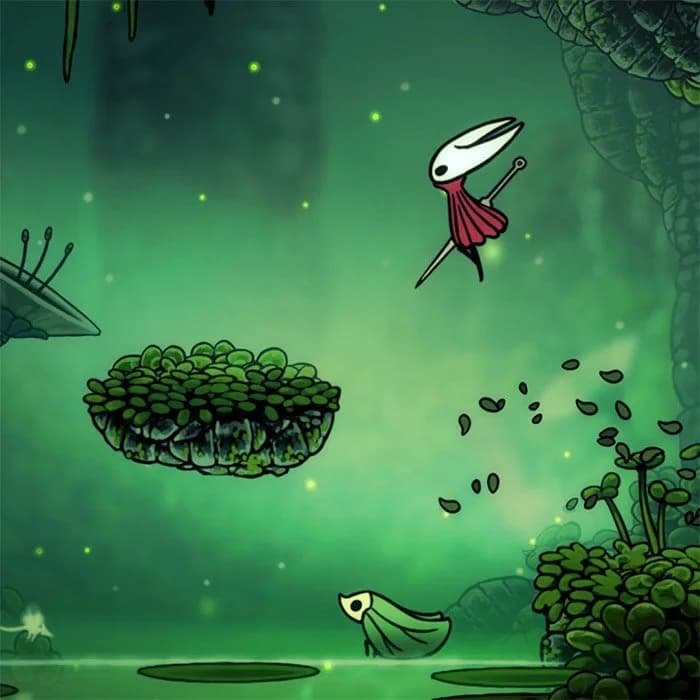
If Hollow Knight was a spiraling descent into rot, Silksong is a rope climb out of a pit with every strand frayed. Pharloom’s geography clicks after a few hours: you’re climbing a living machine. The further up you get, the more the world feels engineered. The Cogwork Core’s pipes and sprockets aren’t just set dressing; they’re training wheels for downward strikes you’ll rely on to cross saw-toothed canals and bounce off hazards like a fencer pogo-sticking through a factory.
The early Moss Grotto leap-of-faith that dumps you back in Bone Bottom is Team Cherry poking you: learn the terrain, learn to fall. Much later, I misread a moving platform in the Whispering Vaults and dropped straight into Bilewater, a maggot-stinking lake where every jump feels like a dare. That physical sensation-your stomach sinking IRL as Hornet plummets—comes up a lot. Gravity becomes a narrative device. Even if you stripped away the UI, you’d grasp the intent: you’re crawling up from death into a citadel built to keep you paying, praying, and pushing.
What struck me about the Citadel is how cohesive it is. Benches cost wages. Carcasses jam gears below the prayer halls. The choir at the zenith of Christopher Larkin’s score swells right as you crest a balcony to see the city spread like a cathedral of industry. It’s gorgeous, and it’s sick. The world-building reads like a ledger balanced by blood.
Movement and combat: a sharper needle, deeper kit
Hornet is a blaze. There’s a snappiness to her that makes every quick-turn and pogo flip feel risky and precise. You get her Bind heal early: a fast single-knot mend that gulps silk from your spool. It’s speed over safety, the exact opposite personality from the Knight’s long Focus—perfect for a heroine who fights like she’s dancing on glass. I rebounded on this system in hour two (why am I always healing at the worst time?), but by hour eight I was weaving in binds between enemy wind-ups like it was second nature. The game’s rhythm eventually becomes a series of tiny windows you learn to slam open.
The biggest systemic shift is the crest-and-tools loadouts. Think of crests as your anchor perks and tools as your active tricks. I ran three primary sets for most of the game:
- Explorer: yellow tools—caltrops for chip damage, a throwing ring for pull switches and harassing flyers, and a rosary magnet to scoop currency without backtracking.
- Bossing: bind speed-up, damage bump on perfect parries, a silk regen crest; swapped caltrops for a bomb that punished clustered patterns.
- Mob control: poison cogflies plus a blast that bursts on death, great in tight corridors like Sinner’s Road where Muckroaches mob you.
The depth here isn’t just numbers. Tools change how you look at enemies. A gremlin on a ledge isn’t just an obstacle; it’s a silk battery or a midair stepping stone if you chain a pogo and cancel into a dash. The Citadel’s guards are best dispatched with downward spikes—convenient, given that the environment above is basically a trampoline test course. The first time a Greymoor bird bug swerved at me, I cursed; by the time I got to Moorwing, that same swoop was a tells-into-muscle-memory masterclass. The game teaches without a tutorial box, and when it clicks, it feels like you’ve peeled back a layer of latent skill you didn’t know you had.
Difficulty: more punishing than Hollow Knight, but fair if you learn to bow out
Let’s not revise history: Hollow Knight wasn’t easy. Silksong escalates, but what spiked me the most wasn’t boss cruelty—it was freedom. This world lets you open doors you aren’t ready to walk through. I spent 40 minutes getting bulldozed on Sinner’s Road by Muckroaches because I was stubborn. When I returned with poison cogflies and a crest that refunded silk on kill, I breezed through. Same player, different kit, new outcome.
There are still “gotcha” moments. The swinging axe rigged to the only bench in Hunter’s March got me twice. I actually said “come on” out loud the second time, because yeah, I forgot. And the finale of Hornet’s confrontation with the Last Judge includes a fatal explosion that’s obvious once you’ve seen it, but on my first run it felt cheap. Most of the time, though, the game’s cruelty is playful. If you treat the map like a suggestion instead of a mandate, the rough patches smooth out.
The map is my favorite nemesis (and Silksong’s biggest flaw)
Here’s where I struggled. Pharloom is bigger than Hallownest, but fast travel feels only barely expanded. On paper, a sparse network of routes preserves the survival tension; in practice, after 12 hours, I had a creeping “left the oven on” anxiety. I’d earn a new traversal move, stand at a crossroads, and freeze. Wasn’t there a cracked wall in Greymoor? Or was it that stairwell above the Flea Caravan? The custom map markers help, but they’re just symbols—no context, no screenshots. I would pay in rosaries for Prince of Persia: The Lost Crown-style photo pins here. This game needs them more than most.
One anecdote that made me sigh-laugh: after clearing a puzzle in the Whispering Vaults, I remembered a high ledge back near the start of Bilewater. I sprinted back, spent 18 minutes threading the hazards, unlocked a chest with a crest I wasn’t going to use, and then had to climb all the way out again because the nearest fast travel point was two zones away and the closest paid bench had a toll I couldn’t afford without grinding. Is that survivalist flavor? Sure. Is it occasionally a fun-killer? Also yes.

This pacing swing is sharpest in the game’s middle third. The early hours funnel you enough to build confidence. Then the map blooms wide and says, “figure it out.” Veterans will grin. Newcomers might bounce off, frustrated. I changed my approach around hour ten: I started pinning suspected upgrades with a unique icon and forcing myself to check two pins per session. That mental rule salvaged my momentum.
Quests: when bulletin boards become busywork
Hollow Knight kept side content curated. Silksong throws up literal boards of wishes. The intent is clear: give you bite-sized goals to earn rosaries or nudge you toward unexplored corners. Functionally, they often feel like chores. “Kill ten of X” in a particularly nasty corridor or “fetch item Y” across the map lands flat when fast travel is stingy. I started using these as palette cleansers between boss attempts rather than something I chased obsessively.
There are bright spots. The Great Taste of Pharloom courier run riffs on Hollow Knight’s infamous Delicate Flower with a time trial that’s equal parts stressful and uplifting; the route taught me a cleaner path through a region I thought I’d fully grokked. Helping the root-witch in Shellwood spirals into a pregnancy-parasite parable that would be comfy in a Bloodborne anthology—it’s gross, pointed, and it lingers. But those standout quests are outnumbered by collectible laundry lists and a few rehashed boss encounters that feel like padding.
Weirdness worth celebrating
Silksong’s incidental moments are the ones that made me lean toward the screen. The Flea Caravan’s spa has a smizing voyeur perched above the baths, and Hornet’s “don’t push it” energy reads perfectly in her body language. Resting at the bench in Haunted Bellhart and then reloading to find Hornet cocooned in Widow’s silk—twisted and bound—sent a chill through me. These little asides feel like Team Cherry entertaining themselves, which in turn entertains us. Seven years brewed a strange tea; I’m glad they let it steep.
Animation, audio, and the tactile world
Seven years shows up in the frames. Hornet’s feet skitter when she brakes, her cloak snaps when you pivot midair, and your needle carves drapery into ribbons if you’re messy. Tiny red ants march off with fallen rosaries if you dally too long, a delightful insult that nudged me to play greedier and smarter. None of this changes the meta, but cumulatively it sells Pharloom as a place, not a level select.
Larkin’s soundtrack does that other kind of heavy lifting: mood math. The Moss Grotto’s woodwinds made early exploration feel curious rather than bleak, but by the time I hit the Citadel’s upper decks, the choral stacks had me thinking about cost—what it takes to build something beautiful atop bodies. Boss themes are compact and thematic rather than bombastic; Moorwing’s track tightens like a spring with every phase, teaching your fingers to move before your brain does. I’ve been humming one of the Citadel motifs for days, which is exactly what happened to me with the original game. Some habits die hard.

Performance and options on PC and Deck
On my desktop, the game stayed at a locked 120 fps at 1440p with negligible input latency on an Xbox pad. I never saw a frame hitch in busy mob rooms, even with particle-heavy tools like explosive bombs and poison swarms. On Steam Deck OLED, I capped at 60 and it held, though the tiniest screen text on the map legend had me squinting in handheld. There’s a decent set of toggles: screen shake, parallax strength, rumble intensity, and remapping for every action. I bumped rumble down; Hornet’s fast bind can buzz like a hornet if you leave it at default.
One minor gripe: the map’s contrast. The Citadel layers can crowd together visually, which makes it harder to parse routes at a glance. A high-contrast mode for the map would be a mercy, especially for handheld play. Also, let me buy more fast travel routes earlier—if benches cost money, sell me mobility too.
Who should play this
- Metroidvania lifers who enjoyed Hollow Knight, Ori, or The Lost Crown: You’ll revel in the verticality and the buildcraft. The open structure respects your problem-solving.
- Action platformer fans who love skill expression: The combat blooms the deeper you go; crests and tools enable real identity in playstyle.
- Newcomers or lapsed Hollow Knight players: Expect a steeper learning curve. The map and sparse fast travel may frustrate until you develop your own planning system.
- Completionists: Be ready for busywork. The bulletin board quests add chew but also bloat, and not every collectible sings.
What worked for me—and what tried my patience
- Standout: Vertical world design that ties enemy behaviors to traversal—downward strikes as both attack and mobility is chef’s-kiss smart.
- Standout: Crest-and-tools loadouts that actually change how you approach rooms and bosses; three builds felt genuinely distinct.
- Standout: Animation and soundtrack that elevate every run; the world is more tactile and musical than ever.
- Frustration: The map system lacks context—custom symbols without screenshots lead to the “I left the oven on” dread of forgotten secrets.
- Frustration: Stingy fast travel amplifies the midgame slog, especially when benches take a cut of your wallet.
- Mixed: Quest boards range from clever to checkboxy; the gems are buried in sand.
FinalBoss // Gear
Level up your setup
01Top-rated gaming headsetson Amazon→02High-refresh gaming monitorson Amazon→03Gaming chairson Amazon→04Discounted game keyson Kinguin→Affiliate links · As an Amazon Associate, FinalBoss earns from qualifying purchases.
Want to Level Up Your Gaming?
Get access to exclusive strategies, hidden tips, and pro-level insights that we don't share publicly.
Ultimate Reviews Strategy Guide + Weekly Pro Tips