

Game intel
Hollow Knight: Silksong
Hollow Knight: Silksong is the epic sequel to Hollow Knight, the epic action-adventure of bugs and heroes. As the lethal hunter Hornet, journey to all-new land…
I’ve been that person-refreshing forums during every showcase, squinting at threads like a moth to a lamp, waiting for a sliver of Silksong news. When Team Cherry finally stopped winking and actually handed over the needle, I sank into Pharloom like it was a familiar yet slightly hostile couch. By hour 5 I’d stopped thinking of this as “that massive DLC we never got” and started treating it like a full-blown Metroidvania with its own pulse. By hour 50, I had the map looking like a frantic spider’s web, 90% completion on my file, and a love-hate relationship with benches that borders on the unhealthy.
My setup: PC (Ryzen 7/RTX 3070), 144 Hz monitor, Xbox pad, and a few evenings on Steam Deck to test the handheld vibes. I’m the kind of player who hunts for secrets but refuses to open a wiki tab until I’ve banged my head against a wall a few times. In other words, Silksong’s target audience-and sometimes its chew toy.
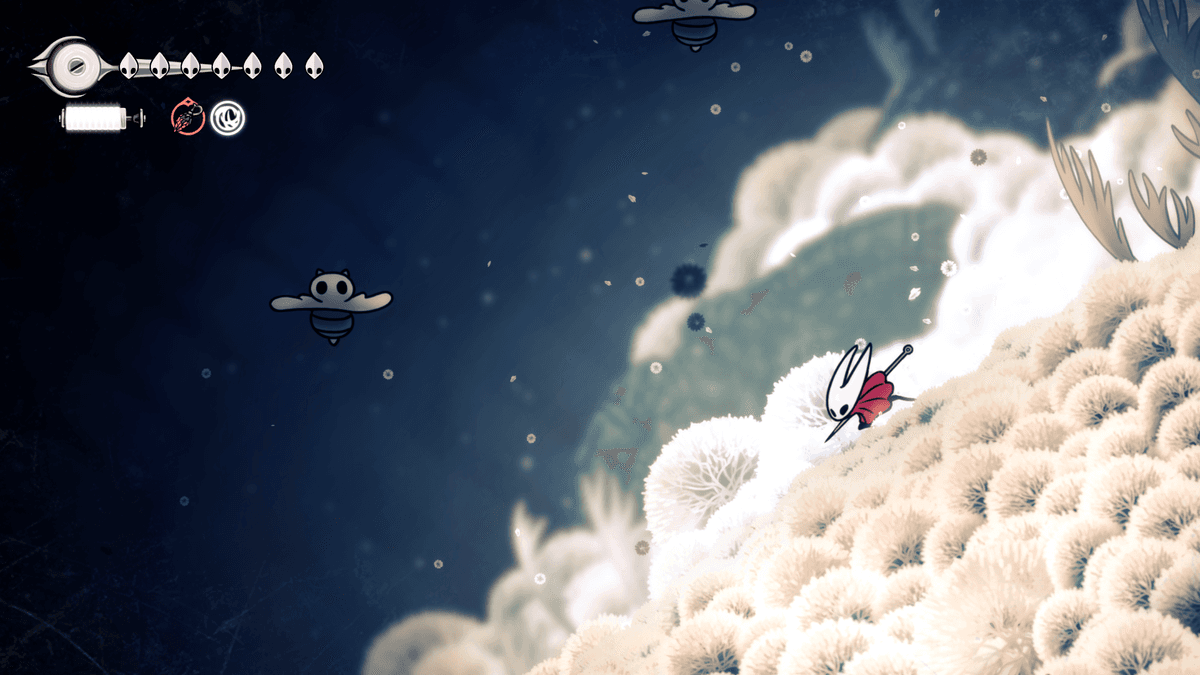
The first ten minutes are all speed and poise. Hornet’s stride is longer, her jump snappier, and that needle-thread dash slices space with intent. If the original Knight moved like a determined music box figure, Hornet pirouettes. She’s taller, quicker, and you feel it instantly in the way platforms stop being obstacles and start being opportunities. But here’s the twist that defines the whole game: hits often chunk you for two masks, and healing isn’t a quick sip. You stock silk through aggression and spend it to stitch three masks at once-powerful, but slow and committal. It changes your headspace. I oscillated constantly between “I’m fine, I’ve got this” and “oh no, I’m one mistake from the floor.”
That tension makes the simple act of standing still to heal a little dramatic every time. You pick your moments. You learn restraint. You also learn the diagonal pogo—an aerial downward slash that’s essential early on. I won’t lie; the first hour with that angle felt weird, and I whiffed into spikes enough to invent new swear words. Then the pieces clicked. By hour 8, I was ricocheting off enemies like I’d been doing it for years. The game nudges you toward mastery without a tutorial pop-up spelling it out. Classic Team Cherry.
Silksong is tough, but it’s honest. When I lost, it was because I got greedy, not because of something cheap. Bosses hit hard and evolve mid-fight, but their telegraphs are clean. There were sequences that demanded everything I had—silk management, pogo rhythm, dash-cancel windows—and the payoff was the good kind of adrenaline. The “hands shaking on the pause screen” kind.
What surprised me is the move variety that quietly blossoms as you find emblems. You can tweak air control, modify sprints, or coax a defensive tool out of your thread. An early emblem subtly reshaped my aerial strings, and later a sprint-based strike turned chase sequences into a violent ballet. For players who miss the original Knight’s weight, there’s even an emblem that mimics that older moveset. I tried it out of curiosity and immediately switched back—I’d already fallen for Hornet’s quicker cadence.
One fight still lives rent-free in my head: a midgame duel where the arena narrows in phases while projectiles create a crossfire that punishes panic dashes. The trick was realizing when to hold the line and heal (all three masks at once) versus when to cash silk on offense. The first time I threaded my needle through the final pattern cleanly, I genuinely laughed. Not at the boss—at myself, for how many attempts I’d spent ignoring the obvious “don’t dash into the spike wave” lesson.
Hallownest was elegiac, a fallen kingdom echoing with ghosts. Pharloom is present tense. People talk. Hornet talks back. She’s not a silent vessel; she has opinions and a gentle, practical way of helping. The result is a world that feels less mystical, more immediate—industrial outposts clanking in dim corridors, labor stitched into every wall panel, and a currency economy that seeps into almost everything. I actually paid to sit on a bench once, and I frowned at the screen like it had just charged me for using my own kitchen chairs. The joke is on me: that capitalistic bite is part of the fiction. It makes certain choices feel brutal but coherent with Pharloom’s cruelty.
Quests are framed as “Wishes.” It’s a lovely conceit: you help folks with what they want, not always what you want to be doing. Sometimes that means charming, self-contained errands with character payoffs. Other times it’s MMO-flavored grind requests—bring 300 pearls, collect X materials, or slaughter a quota of critters. I get why they exist; Pharloom is a society, not a tomb. Still, these requests occasionally stalled my momentum like a speed bump in a racetrack. I did them when they tied into exploration I was already doing, and happily ignored the rest until the late game.
And then there’s Sherma, a recurring pilgrim who became my moral support. Every time I expected the world to swallow him, there he was—cheerful, naive, somehow intact. He’s the game’s thesis distilled: hope persists, even in a place that charges you to breathe.
Let me put this bluntly: the bench placement will test your patience. There are zones where the walk of shame back to a boss feels like an endurance sport. FromSoftware has been adding mid-boss rest points for years; Silksong sometimes goes the other way. It fits Pharloom’s logic and increases the stakes, but on a couple of nights it also turned triumph into homework.
Same song, different verse with arena gauntlets. A handful of challenge rooms pile waves on waves, and the checkpointing is stingy. After midnight, with eyelids drooping, these sequences cross the line from “satisfying trial” to “please, just one more bench.” It’s never unfair; it’s just tiring. When the map design, enemy layouts, and healing system already require tight play, layering long runbacks risks wearing people down before they learn the lesson the encounter is trying to teach.
I’m a compulsive wall-tapper. If a tile looks like it’s keeping a secret, I want in. Silksong rewards that instinct—eventually. The early hours pepper you with little stashes that feel underwhelming: a bit of coin, a trinket that barely nudges your build, or a route that loops back in an unsexy way. I had a couple of “that’s it?” moments after multi-minute platform sequences. But somewhere around the midgame, the faucet opens. Whole biomes hide behind off-angle breaks. Side corridors snake into optional bosses. Emblems start transforming how you move and survive. That’s when the loop fell into place for me.
The diagonal pogo that once felt like a speed bump becomes a playground. With sprint-strike emblems, air flicks, and silk management, I found myself chaining movement through rooms that initially mauled me. One of my favorite “aha” moments came in a heat-scarred chamber where a tiny enemy bounced across a molten pool. It took me longer than I’d like to admit to read that as an invitation; when I finally followed, the rhythm of pogo-dash-pogo across lava turned into the kind of tactile sequence that makes your forearms buzz.
Fast travel exists, but it’s limited and contextual. Coupled with sparse benches, it means you’ll learn these spaces intimately. Some will love that. Some will bounce off hard. I landed in the middle: I respect the intent, I admire the world, and I still curse when a late-game detour eats ten minutes because I took the wrong vertical shaft.
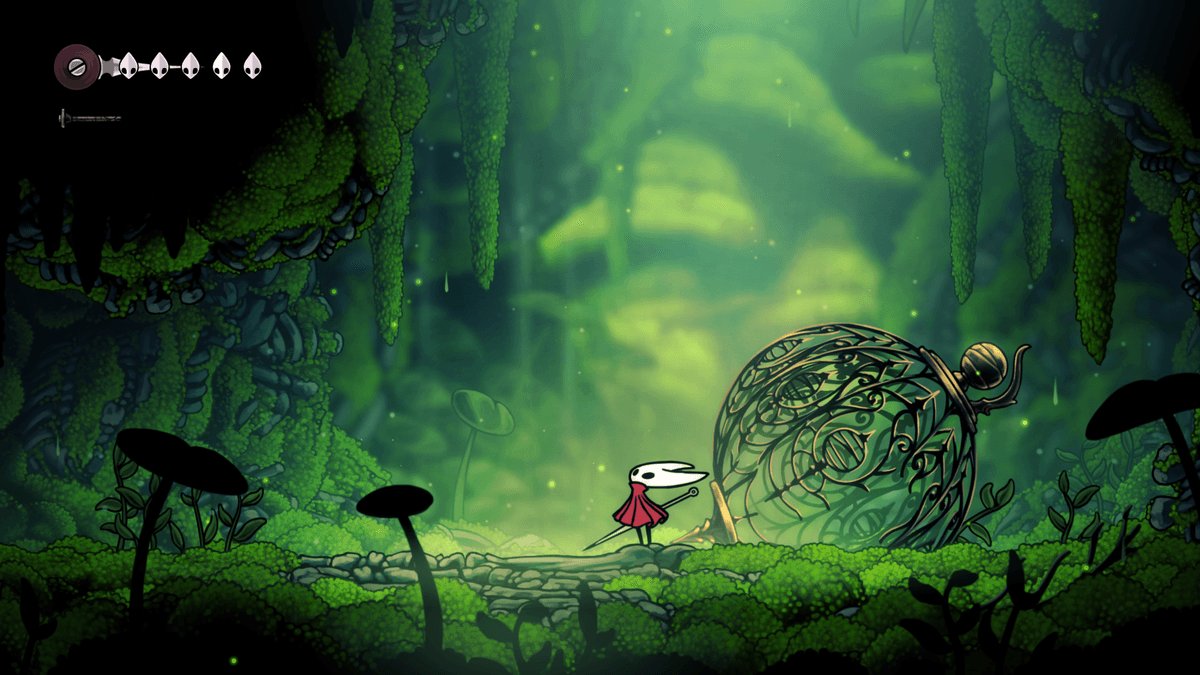
It’s no surprise that Silksong is gorgeous—clean silhouettes, bespoke animations for even throwaway enemies, rooms that feel hand-inked rather than tiled. What impressed me is how varied Pharloom manages to be without straying from its underground insect brief. Industrial hives hum. Fungal chambers feel damp to the eyes. A certain theater-themed stretch ties its boss choreography so cleanly to visual motifs that I stopped mid-fight to grin at a flourish I should have been dodging.
Christopher Larkin’s score is again excellent, but more reserved. Melodies creep in instead of announcing themselves. During exploration this restraint supports the tone; during a few boss fights I wanted the music to push harder. It’s a minor quibble; when the big themes swell, they really do lift the needlework on screen.
On PC, I ran the game locked at 120 fps with no stutters. Steam Deck mostly held 60 with mild dips in particle-heavy rooms; a quick frame cap smoothed it out. Load times are short, death-to-retry is snappy (until the geography lengthens it), and input latency feels razor crisp on a pad. I tried keyboard briefly and went back to controller—this is a dash-and-pogo game at heart, and my thumbs demanded the analog cradle.
Localization-wise, the English script reads well, and the characterization lands. I sampled French for a couple of hours out of curiosity and stumbled over a handful of typos—nothing game-breaking, but noticeable. Hornet herself vocalizes more than the Knight ever did; hearing her speak grounds the world, and I liked her matter-of-fact tone—kind, a little wry, focused.
If you adored Hollow Knight’s precision and you’ve been daydreaming about a faster, sharper lead, Silksong is basically a manifesto written for you. The bosses are stellar. The movement ceiling is sky high. The world is dense enough that, even at ~90% completion, I’m convinced I’ve missed a shameful secret or three. Fans will feast.
If you bounced off Hollow Knight’s toughness or its occasional opacity, Silksong doesn’t wrap you in a blanket. Basic assumptions aren’t over-explained. Benches are sparse. Runbacks can be long. Wishes sometimes nudge you into grindy chores. Newcomers can absolutely learn and push through—Team Cherry communicates mechanics through environments with elegance—but the game doesn’t pretend it was built around first-timers.
Three moments rewired how I felt: first, realizing that healing to three masks isn’t just a bigger sip; it’s a commitment that changes your whole tempo. Second, when that bouncing enemy in “don’t-touch-that” terrain taught me to trust visual hints over fear. Third, equipping an emblem that reworks sprint attacks and suddenly finding a style that was mine, not just “the game’s intended one.” These weren’t tutorial wins; they were personal, the kind that stick to your hands.
I wish the early exploration rewards packed more punch; a couple more impactful charms early would smooth the opening hours. I wish two or three boss runs had closer benches (even a one-time checkpoint after a gauntlet wave would help). And I wish the grindier Wishes signposted their narrative payoffs better, so I could prioritize the ones with heart and skip the ones that feel like side-hustle accounting.
None of those deal-breakers outweigh how often Silksong had me leaning forward, smiling like a fool after clearing a room I’d sworn was impossible. But they’re there, and if your tolerance for friction is low, consider this your friendly bug-shaped warning.
Silksong isn’t Hollow Knight 1.5. It’s a sibling carving her own path—faster, harsher, more conversational, and often more human in its worldbuilding. Pharloom’s economy and cruelty sometimes press on comfort in ways that feel intentionally exhausting. The trade-off is a world that breathes, bosses that dance, and a kit that rewards skill with a tangible sense of flow. After roughly 50 hours, I’m still thinking about routes I didn’t take and doors I barely registered. That’s the sign of a great Metroidvania: it doesn’t just end, it lingers.
Score: 9/10. A brilliant, demanding evolution that occasionally confuses cruelty with challenge, but when it sings, it soars.
Get access to exclusive strategies, hidden tips, and pro-level insights that we don't share publicly.
Ultimate Reviews Strategy Guide + Weekly Pro Tips