
Game intel
Hyrule Warriors : Les Chroniques du Sceau
A Legendary Pairing: Cut down entire legions of enemies as Link, Zelda, Midna and other characters from The Legend of Zelda franchise using over-the-top powerf…
I went into Hyrule Warriors: Chronicles of the Seal with a weird mix of excitement and caution. I adored the scrappy chaos of Age of Calamity, but the uneven performance left scars. This new one plants itself firmly in Tears of the Kingdom’s era-Zelda, Rauru, Sonia, the whole slate of Zonai weirdness-and that alone had me curious. I played on a Switch 2 mostly in handheld mode on the couch (Pro Controller when docked), logged just over 40 hours, cleared the main story, and chewed through a big chunk of side and progression tasks. My short verdict? The combat is the best this sub-series has ever felt, and the roster is refreshingly clone-free-yet the predictable story and a late-game resource grind dragged the fun down more than once.
By the end of my first session (about 3 hours), I’d already settled into the loop: hop around a Tears-themed Hyrule map full of icons, pick a main mission to push the story, divert into a handful of shorter side ops for resources, and deliver materials to unlock new combos, stats, and utility. It’s old-school musou layering with a Zelda coat, but the key difference is how your choices on the map actually matter. If a region falls, certain missions lock; ignore defense missions and you’ll find yourself re-liberating areas you thought you were done with. After I shrugged off a defense alert in the Hebra region, I had to replay a liberation I’d cleared the previous night. Annoying in the moment, but I begrudgingly appreciated that some icons weren’t just there to tick off for dopamine.
The structure mirrors Age of Calamity closely: a dozen-ish hours for a straight shot through the main story, and then an ocean of optional tasks. The twist this time is a set of character-specific objectives—kill counts with a certain weapon, duo-attack with specific partners, defeat a type of captain—that scale better than I expected early on. The frustration hits later when you realize the pot of gold at the end is a short dialogue scene per character. Some are cute, most are forgettable, and when I finished Rauru’s list and was met with a few lines that barely hinted at character growth, it felt like a missed opportunity.
Chronicles of the Seal plays it safe. Zelda’s past, her bond with Rauru and Sonia, and the rising threat of Ganondorf anchor the campaign beats. You trek to the corners of Hyrule to rally the Rito, Gorons, Zora, and Gerudo. Scenes are competently staged—camera work and lighting in the cinematics impressed me—but I called most twists two missions before they landed. There were moments I felt the warmth: a quiet exchange between Sonia and Zelda before a siege, a late-mission callback that wove nicely into Tears of the Kingdom’s iconography. But the story rarely pushes beyond “assemble the allies, face the darkness.” It’s not bad; it’s just safe. If you’re here mainly for narrative surprise, you won’t find much.
By hour six, the combat had me. Every character has two main attack buttons—light and heavy—with branching combos you expand by feeding the map’s task system. That’s standard musou scaffolding, but the spice is in how Chronicles embraces Tears’ toys without feeling like a gimmick. Zonai devices behave like limited-use tactical items governed by a battery meter. Early on, I leaned on the flamethrower too much. Then a Fire Moblin ambush taught me: swap to water cannon mid-chain, crack the weak-point gauge, and cash in the cinematic finisher. You can hot-swap devices on a quick-select wheel, and the difference between plinking away and tactically dismantling elites is night and day.
Fuse is here too, and it’s more than a reskinned buff. Tag a horn, blade, or other enemy drop to your weapon for a “burst” strike that meaningfully alters damage and reach for that moment. I started saving strong fuses for when an elite captain’s endurance bar appeared, stringing in a perfect dodge to slow time, then a duo-attack to detonate the gauge. Those duos are the secret sauce: they’re not generic, and they change based on who triggers them. Rauru initiating with Sonia gives you a clean, precise burst; Sonia starting with Rauru layers more crowd control. Link’s synergy with Tulin is phenomenal for air control—fantastic on outposts built into cliff faces where vertical control matters.
And yes, the musou tradition continues with big “Fatal” attacks. They look great, colorful and noisy in the best Zelda way, but they feel under-tuned. Dropping a full meter into a “room clear” and seeing a dozen enemies survive felt off. I ended up reserving these for boss windows rather than mob cleanup. It’s not a deal-breaker, but compared to the razor-sharp impact of perfect-dodge counters and duo bursts, the ultimates felt like fireworks without the boom.
Three moments stuck with me:
What impressed me most: everyone feels different. Not “one lighter, one heavier” different—different rhythms. The lance user has that measured, pokey cadence that rewards spacing; the heavy weapon bruiser is all about armor frames and grounded slams; the dedicated archer has real ranged presence without becoming a stationary turret. A couple of characters lag behind (one late unlock’s hit confirms feel mushy), but even my least favorite never felt like a skin on someone else’s moveset. Coming off years of Warriors games where at least a quarter of the roster felt redundant, this was a pleasant change.
Somewhere around hour twenty-eight, the shine dulled. To push high-level upgrades and finish character objective lists, I needed specific materials—some only dropped on certain short side missions, others tied to merchant rotations. Even with smart routing—stacking goals so a single battle fed three different upgrade tracks—I hit a farm loop that overstayed its welcome. A defense mission would pop, I’d clear it, then see another material gate across the map. Rinse, repeat. The problem isn’t just volume; it’s reward quality. Unlocking new combos is great. Getting a single-note post-objective dialogue that barely reveals new character shades? Not great.
I tried to pace myself—main mission, a couple side runs, then a detour into tasks—but the final quarter leans hard on those deliveries. If you’re the completionist type, brace yourself for long evenings of target farming. If you can ignore the checklists, you’ll have a better time than I did.
Here’s the big technical shift: the game feels consistently smooth in both handheld and docked modes. I didn’t see the kind of stutters that plagued Age of Calamity’s busier battles. The trade-off is obvious the moment you start mowing through mobs. Enemy groups spawn in smaller clusters—rarely more than thirty on screen—then pop in new squads as you clear the last. It keeps the action flowing, but that trademark musou thrill of carving a path through a sea of bodies is diluted. Dynasty Warriors: Origins puts far denser crowds in front of you; this is a different flavor of power fantasy.
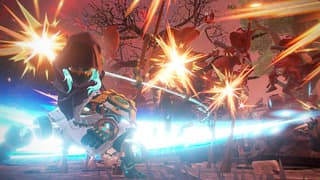
Visually, it’s clean and faithful to Tears of the Kingdom’s art direction. From the pale stone of the temples to the warm blues and greens of the fields, it feels like home. Get close to some textures and the illusion frays—flat rock faces, muddy wood—but in motion it’s fine. The creature roster hits the expected variants, with animations that read clearly even in crowded scuffles. Voice work is solid, with returning actors for Zelda, Rauru, and Sonia carrying a lot of the emotional weight. I wish more of the side material was fully voiced; outside main story cinematics, it’s a lot of text. One odd note: several cutscenes looked soft, like a mild blur filter sat over the image. It didn’t ruin the vibe, but it stood out compared to the crisp in-game action.
I did about two-thirds of my time handheld and didn’t fight the controls once. Camera snap-lock to named captains is sticky in a good way, the dodge window is readable, and the quick-select wheel for devices slots naturally under your thumb. On Pro Controller, everything breathes; I found it easier to execute perfect dodges into burst combos when I had a proper trigger under my finger. The UI does a decent job telegraphing enemy endurance gauges and type affinities—when a Fire Moblin winds up and your water cannon icon pulses just enough to remind you, you feel clever for reacting, not shepherded.
If you bounced off Age of Calamity because of frame drops but liked the idea, this is the fix you were waiting for. If you love Tears of the Kingdom’s gadgets and want a more arcadey, high-tempo playground for them, it’s here. If your musou itch is “let me erase a screen of enemies with one button,” the lighter crowds and timid ultimates may annoy you. Story-first players will find warmth and polish, but not boldness; combat-first players will feast for twenty hours, then wrestle with the grind.
Hyrule Warriors: Chronicles of the Seal is the most satisfying this Zelda spin on musou combat has ever felt. It’s tactile, it’s flexible, it respects your ability to read a fight and react with the right tool rather than just mash the same string. The Switch 2 performance finally lets the spectacle breathe, even if the price is thinner enemy densities. The story is comfortable, sometimes cozy, rarely daring. The endgame grind is the real villain, siphoning momentum right when the combat is at its most expressive.
I walked away impressed by the combat sandbox and the roster’s personality, frustrated by the late-game chores, and wishing the narrative took one or two bold swings. If you meet it halfway—embrace the systems, resist the urge to 100% everything—you’ll have a blast. If you’re wired for completion, pace yourself or prepare to sour on the back third.
Final score: 8/10
Get access to exclusive strategies, hidden tips, and pro-level insights that we don't share publicly.
Ultimate Reviews Strategy Guide + Weekly Pro Tips