
Table of Contents (14)
The Moment I Realized Absolum Had Me
I didn’t plan to fall in love with Absolum. This last stretch of 2025 has been ridiculous: great games everywhere, Hades II commanding timelines, and me trying to keep up like a goldfish with a Steam wishlist. But a few weeks ago at Summer Game Fest, I squeezed into a demo station for Absolum on a whim, then followed up with the Steam demo at home. That was it. Hooks in. Hours gone. I looked up from the screen and realized I’d skipped lunch, ignored messages, and mentally drafted a text to my group chat that basically said: “Hades II can wait-this thing slaps.”
Why do I care this much? Because I grew up burning holes in my Mega Drive controllers with Streets of Rage 2 and later spent hundreds of hours grinding Hades and Hades II. I’ve also sunk an embarrassing number of nights into training mode in fighting games, learning spacing, frame data, and the art of turning a jab into a juggle. I’m protective of these systems. I hate lazy nostalgia, and I hate roguelite lipstick slapped onto an action game even more. Absolum is not that. It’s the first time in years I’ve felt a beat ’em up evolve without losing its soul.
My Thesis: Absolum Isn’t Nostalgia Bait-It’s Beat ’Em Up 2.0
Absolum is the rare mashup that doesn’t feel like a pitch deck. It’s the right team, making the right choices, for the right reasons. Dotemu and Guard Crush already proved they understood the genre with Streets of Rage 4, and Supamonks shows up here with an art direction that doesn’t just pop; it detonates. This isn’t “remember this?” design. This is “feel this” design. The combat is deliberate and tactile, the roguelite layer actually respects player mastery, and the local co-op is tuned for laughter, swearing, and high-fives. It’s the best case scenario for a “Hades + Streets of Rage” elevator pitch because it’s not paint-by-numbers-it’s a new sketchbook.
The Combat: Slower, Meaner, and Built for Players Who Love Control
If Hades II is a dance floor, Absolum is a boxing gym. It’s side-scrolling, front-facing, and narrower by design, which forces discipline. You’re not skating around arenas; you’re cutting lanes, measuring depth, and corralling enemies into the angles that make your combos sing. That alone scratches a very specific itch for me. After a couple of runs, I stopped playing “roguelite tourist” and started playing like a Street Fighter fiend: bait the rushdown, step-slide to align the plane, jab confirm into launcher, wall-splat, OTG, repeat. The game pays you for this mindset with a combo system that actually respects intention.
Absolum lets you grab, juggle, wall-bounce, and apply pressure in a way that feels like layers on layers. Juggling isn’t just a party trick; it’s how you create breathing room, set up a Ritual-enhanced strike, or burn down a priority target. The hit-stop reads clean. The enemy tells—especially the exaggerated haymakers and telegraphed hooks—give you honest windows to parry, sidestep, or stuff. You can feel the Dotemu/Guard Crush DNA in the stickiness of hits and the way the camera gives space when you’re cooking. The combo counter never felt like marketing confetti; it felt like a performance review. I live for that.
Rituals, Arcana, and the Hades Comparison You’re Dying to Ask About
Yes, Absolum borrows the roguelite scaffolding that Hades popularized, but it twists it in meaningful ways. Instead of picking a weapon like in Hades, you pick a character—starting with Galandra or Karl—and eventually unlock a total of four. Each hero is more than a move list; they’re a mindset. You unlock new Arcana for each of them, which are powerful abilities you trigger when you’ve banked enough Mana mid-run. This matter-of-fact tweak changes the rhythm. You’re not swapping weapons to chase a build; you’re investing in a person and then deciding what kind of myth they become.
Between runs, you spend Splendor—the meta currency you earn by how far you survive, how much damage you deal, and sometimes via bonus conditions tied to the Arcana you chose—to unlock persistent perks, Arcana, and other materials on a Soul Tree. It’s readable, fair, and most importantly, it respects momentum. The curve isn’t a cynical grind treadmill; it’s a ladder you climb because you want to see what build your brain is secretly designing. There’s a clear progression logic: “If I unlock this Arcana and tweak that node, next run I can route fights toward wall-heavy arenas and abuse bounces.” That’s the good stuff.
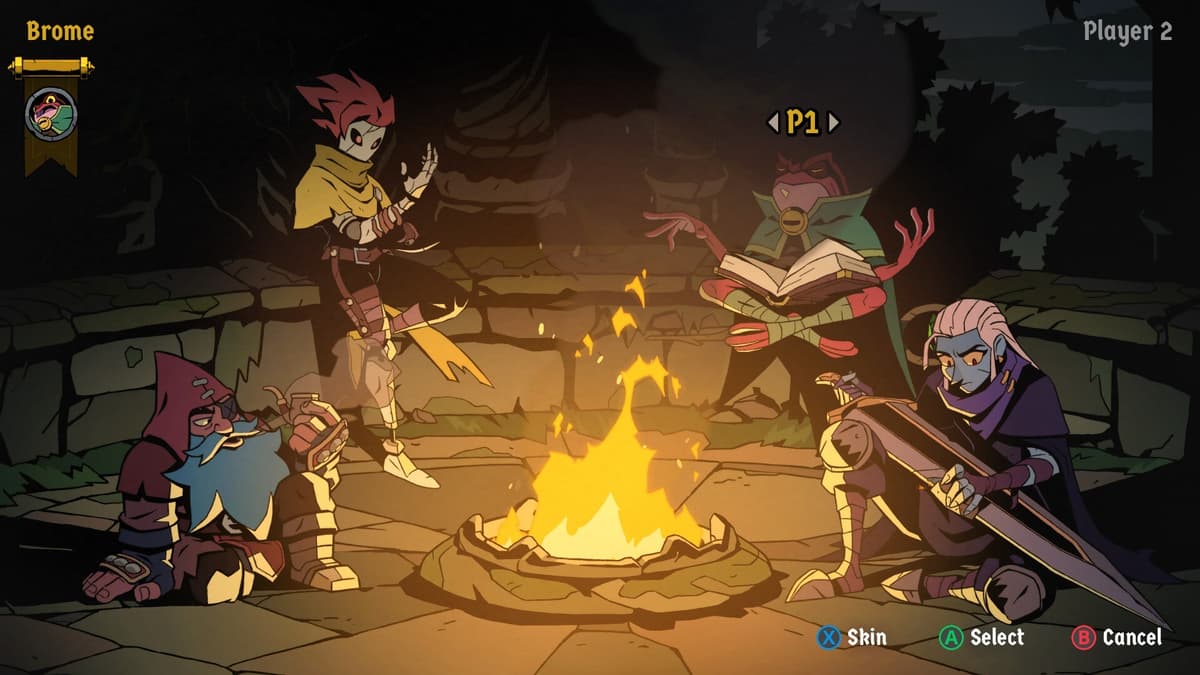
Then there are Rituals—room rewards that function like boons but with a delicious twist. Instead of telegraphing exactly what’s behind each path, Absolum often makes you choose without perfect information. At first, I rolled my eyes—RNG, my old nemesis—but it quickly clicked: this uncertainty keeps you honest. It prevents sleepy autopilot builds and, more importantly, it nudges you to master the fundamentals so any Ritual becomes a multiplier instead of a crutch. I’ve had runs where a Ritual iced my air juggle into a crowd-control monster and others where I pivoted to a guard-break heavy style because that’s what the game offered me. It felt less like a slot machine and more like jazz.
The Moment-to-Moment: Decisions, Not Spam
Absolum’s best trick is how it forces micro-decisions without screaming about it. Do you chase the wall bounce to squeeze out two more hits, or reposition for the next wave? Do you cash Mana for a flashy Arcana to stabilize, or hold it for the mini-boss you know is two alleys away? Will you clear a lane to create an escape vector, or fish for a throw that sends a brute into his own buddies? The game constantly presents you with risk and reward like a metronome. For someone who’s spent nights labbing in Tekken and Guilty Gear, this is dopamine heaven. And if you’ve never cared about frame traps in your life, you’ll still feel the satisfaction—because the feedback is physical. Your hands learn it before your brain names it.
Local Co-op: Couch Chaos with Actual Chemistry
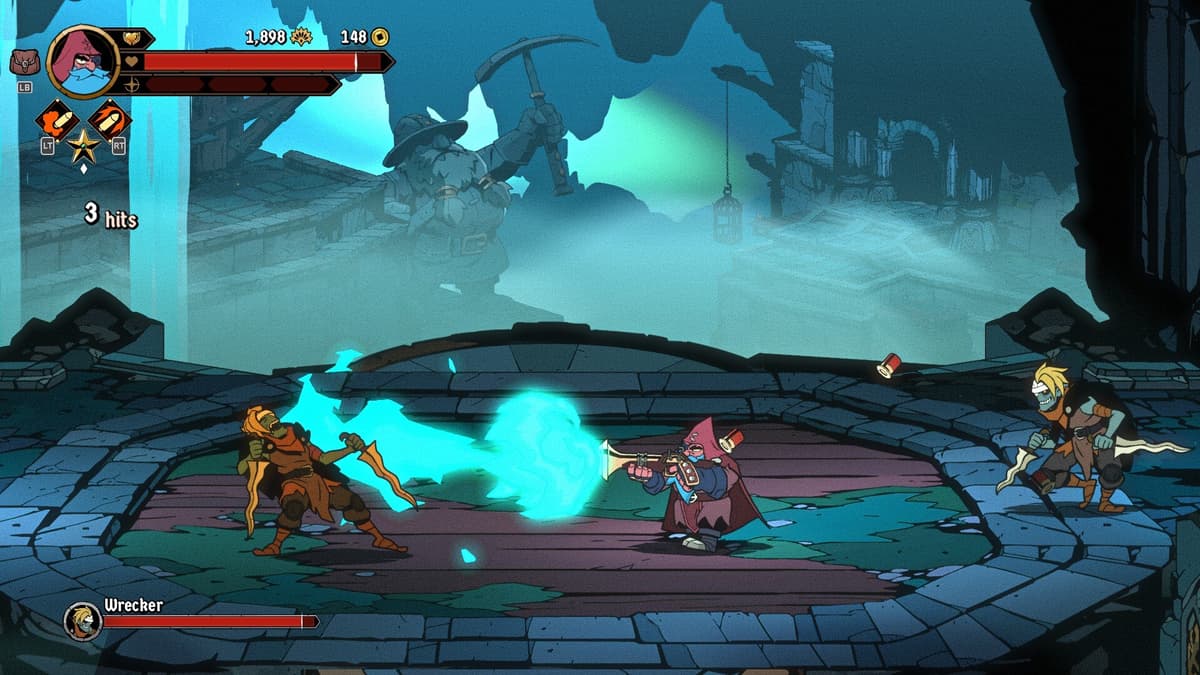
I played a chunk of Absolum in two-player local co-op, and this is where the game cements itself as a future favorite. Beat ’em ups live or die by cooperative feel—camera framing, enemy aggro, readable effects, and whether two people can share space without stepping on each other’s toes. Absolum largely nails it. The lanes are tight but intelligible, enemy spawns communicate lane priority, and the movesets feel complementary rather than redundant. There were plenty of “you juggle, I peel” moments where one of us held an enemy aloft while the other cleared flanks. That’s the street-fight ballet I want from this genre.
Is it perfect? No. A couple of busy rooms in later runs briefly pushed readability to the edge, and I’d love a toggle for stronger combo outlines in co-op specifically. But the base balance is there. When a beat ’em up makes you say “one more run” specifically because your duo synergy is cooking, that’s a win that can’t be faked.
Art and Sound: Supamonks Paints, the Soundtrack Drives
I don’t throw around “best-looking” lightly, but Supamonks is flexing here. Absolum looks like a living comic—thick lines, bold silhouettes, character expressions that punch through the screen. Enemies telegraph with swagger, and the animation sells weight without smearing the readability. There’s this delicious moment where a heavy’s fist winds up with a goofy, exaggerated stretch before detonating on impact. It’s funny and threatening at the same time, a Saturday morning cartoon that punches back.
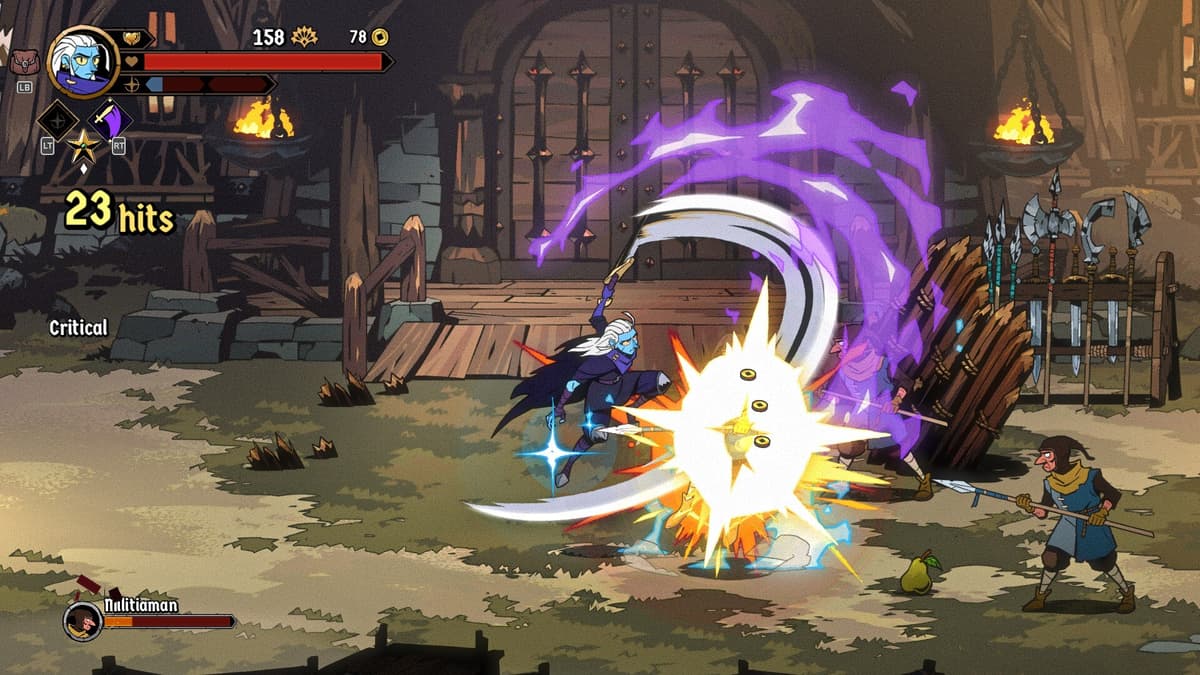
The soundtrack? Exactly the juice this game needs: an electro/rock pulse that sits in the pocket of your combos without drowning them. I’m a sucker for music that locks to tempo but never feels repetitive, and Absolum threads that needle. It leans into retro textures without cosplay. Audio cues for grabs, bounces, and parries are distinct enough to play by ear when your eyes are triaging three things at once. It’s craft, not nostalgia worship.
Events, Side Beats, and Why Runs Don’t Blur Together
One of my biggest issues with bad roguelites is sameness dressed as variety. Absolum dodges that with smart, bite-sized narrative beats and mid-run events. You run into NPCs who nudge you toward optional detours—maybe they whisper about a risky shortcut, maybe a favor that unlocks a side objective next time. It’s subtle but effective. It gives you small reasons to branch, fail, and try again. Combine that with the Ritual ambiguity and character-centric Arcana sheet, and you get a roguelite that resists autopilot not by burying you in systems but by giving you reasons to care.
Yes, I Prefer It to Hades II—Here’s Why
Let me be clear: Hades II is excellent. I put dozens of hours into the early access and returned for 1.0 because I love Supergiant’s craft. But it didn’t surprise me in the way Absolum does. I know the cadence of a Hades run; I can feel the shape of it from the first room. Absolum, because of its side-scrolling geometry and combo-first mentality, forces me into a different headspace. It rewards lane control and wall discipline the way a 2D fighter rewards corner carry. It gives me those “I got better, not just stronger” moments in a way that most roguelites promise and few deliver. And crucially, its co-op is built around that skill expression instead of just doubling enemy HP and calling it a day.
Where It Can Still Level Up
I’m not here to shill. There are edges that could use polish, and I want this game to be great over months, not just a week-long honeymoon. Here’s what I’d love to see tightened or expanded as Absolum marches toward (and beyond) launch:
- Ritual Clarity: Keep the uncertainty, but consider subtle iconography or silhouettes so high-level players can strategically route without killing the surprise. “Partial info” goes a long way.
- Co-op Readability Options: A stronger player highlight, optional combo outlines, or per-player color accents would make busy rooms sing even more.
- Training Tools: A simple dojo sandbox to lab juggles, wall bounces, and Arcana routes would be catnip for players like me and a bridge for newcomers.
- Difficulty Curves: Bosses are good pressure checks, but a couple spikes felt a touch abrupt. A granular difficulty slider or optional challenge modifiers would keep both casuals and diehards happy.
- Modes for Longevity: Boss rush, an endless survival lane, and weekly seeded runs with leaderboard support could extend the life without selling its soul.
- Accessibility & Comfort: Input remapping, colorblind-friendly palettes, optional input leniency, and a consistent 60 fps cap with low input latency are non-negotiable in a game this precision-heavy.
None of these are deal-breakers. They’re the kind of shrewd tweaks that separate “great launch” from “genre benchmark.” And given the pedigree behind Absolum, I’m optimistic.
Industry BS Check: This Is How You Do a Revival
I’ve lost patience with hollow revivals and buzzword alchemy. You know the drill: slap roguelite on your Steam page, dump a dozen currencies into a treadmill, and drown real combat in VFX soup. That’s coward design. Absolum calls that bluff. It puts the weight back in your fists and the mastery back in your hands. Its meta-progression supports skill instead of replacing it. Its art direction is a style, not a filter. And its co-op is not an afterthought. If you want to revive a classic genre in 2025, this is the blueprint: teach old systems new tricks without erasing the muscle memory that made them matter.
The Personal Stakes: How Absolum Changed My Play Habits
After the SGF hands-on, I told myself I’d just “poke the demo for 30 minutes.” Three hours later, I was pacing my living room, replaying a botched wall-bounce in my head like a missed parry in a tournament match. The next night, I dragged a friend over for couch co-op and that turned into another multi-hour binge. I’ve already started rationing my time with other games because I want to save room for “a few runs of Absolum” every evening. That’s rare for me now. I’m pickier than ever, and I don’t chase every indie darling the internet tells me to adore. Absolum earned its slot by making me better every time I boot it up. That’s how a game becomes a habit.
Why This Matters Beyond One Game
If Absolum lands the way I think it will, it won’t just be “another great Dotemu-adjacent brawler.” It’ll be proof that beat ’em ups can sit in the modern pantheon without apology. The genre doesn’t need to choose between arcade vibes and meaningful progression. It can do both. It can bring back couch co-op without feeling like a museum exhibit. It can push high-skill ceilings while staying readable and inviting. And it can blend a retro aesthetic with lush, expressive animation and a modern soundtrack that actually drives your play, not just your nostalgia.
Publishers will look at Absolum and either get the lesson—do less, but do it better—or they’ll copy the surface and miss the heart. I hope developers lean into the former. Build systems that teach players to love mastery. Make progression that’s an invitation, not a tax. Trust combat to carry the weight when it’s built with intention. And for the love of all that is holy, if you’re going to chase Hades, actually think about what made it sing. Absolum did. That’s why it works.
The Bottom Line: Play the Demo, Clear Your Evenings
Absolum grabbed me harder than any beat ’em up has in years because it respects my time and my skill. It blends Hades-style runs with the crunch and clarity of Streets of Rage, then layers in character-driven Arcana that make every return trip feel like a new thesis you’re testing in the lab. The Rituals keep you improvising, the fights demand precision, the art oozes personality, and the local co-op is built for genuine teamwork. It’s not perfect, but the foundation is rock solid, and the ceiling looks sky-high if the team keeps tuning with a player-first mindset.
I don’t dole out blanket endorsements lightly, but here’s mine: if you care about action games, if you’ve ever lost yourself to a combo counter, if you’re tired of roguelites lying about “getting good” while quietly buffing your stats, Absolum is the antidote. I can’t promise you’ll forget to eat lunch like I did. I can promise you’ll feel that old arcade electricity in your hands again—and that you’ll want to chase it for one more run. And then one more. And then, well… you’ll understand why I couldn’t put it down.
FinalBoss // Gear
Level up your setup
01Top-rated gaming headsetson Amazon→02High-refresh gaming monitorson Amazon→03Gaming chairson Amazon→04Discounted game keyson Kinguin→Affiliate links · As an Amazon Associate, FinalBoss earns from qualifying purchases.
Want to Level Up Your Gaming?
Get access to exclusive strategies, hidden tips, and pro-level insights that we don't share publicly.
Ultimate Gaming Strategy Guide + Weekly Pro Tips