
Table of Contents (10)
The night Coup hijacked my game shelf
I didn’t go into Coup expecting much. It’s a tiny box with some nobles in fancy outfits, a handful of coins, and rules you can explain in less time than it takes someone to grab a drink. On paper, that puts it in the same “yeah, sure, we’ll play that once” category as a million forgettable party games that get bought for one birthday and then die in a cupboard.
Instead, Coup walked into my game night, overturned the table, and quietly announced: “You’re all going to lie to each other now, and you’re going to love it.” And the worst part is-it was right. I am genuinely, embarrassingly obsessed with this game at the moment, and I kind of resent how good it is at hijacking any plans I have to play something else.
What sold me wasn’t the rules, or the theme, or even the neat little coins. It was one specific moment: a friend of mine, who is normally the most honest, conflict-averse person in our group, looked me in the eyes and said, dead serious, “I’m the Duke. I take three coins.”
Thing is, I knew-knew-they weren’t the Duke. I’d seen enough of the court cards flipped already. Logic screamed at me to challenge. My gut screamed louder. And yet I flinched. I let it go. Two turns later they couped me out of the game with that same stack of ill-gotten coins, tossed their cards onto the table, and revealed they’d been bluffing the entire time.
That’s the moment Coup stopped being “a cute filler” and started living rent-free in my head.
What Coup actually is (and why it feels so vicious)
If you’ve never touched it, here’s the gist. Coup is a 3-6 player card game where everyone is a shady noble trying to wipe out everyone else’s influence at court. You don’t have health points or armies; you have two face-down character cards—your “influence”—and a pile of coins in the middle.
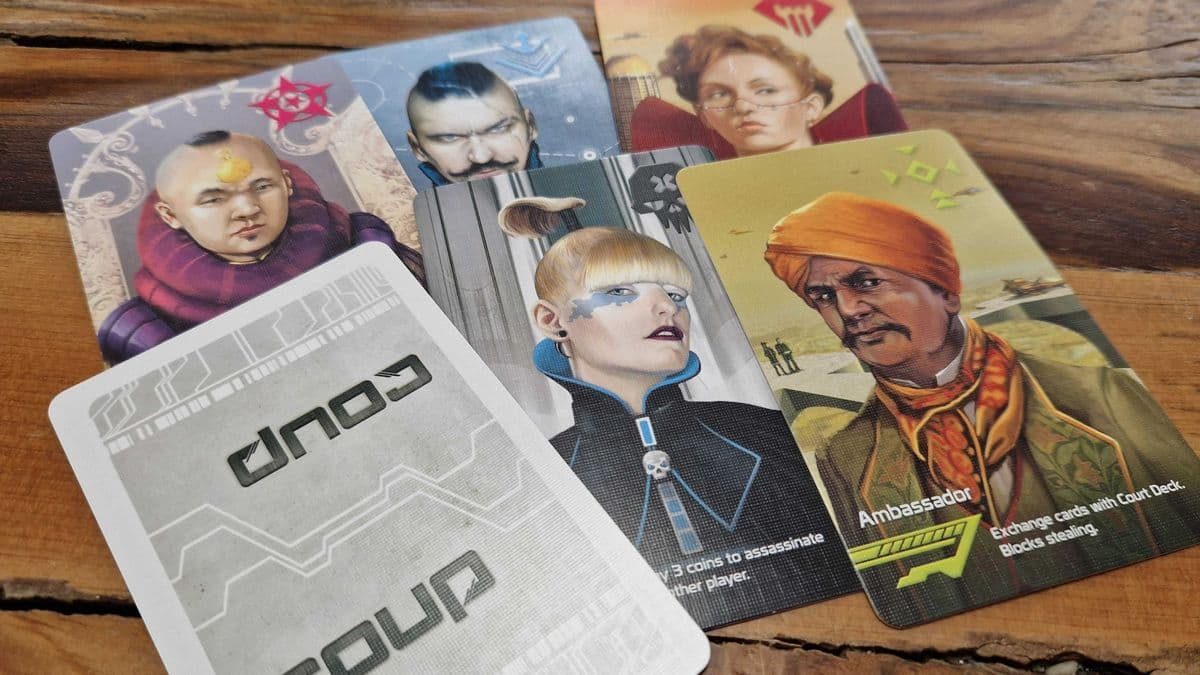
Those character cards come from a set of five roles, three copies each: Duke, Assassin, Captain, Ambassador, and Contessa. On your turn, you take an action. Some are neutral and always safe: take 1 coin (Income) or 2 coins (Foreign Aid, which the Duke can block). The interesting stuff lives in the claims:
- Claim Duke to take 3 coins in tax, or to block someone’s Foreign Aid.
- Claim Assassin to spend 3 coins and force someone to lose one of their cards.
- Claim Captain to steal 2 coins from another player (the Captain or Ambassador can block this).
- Claim Ambassador to swap cards with the court deck, and maybe keep better roles.
- Claim Contessa to block an assassination attempt.
The catch—and the entire soul of the game—is you can claim anything you want, whether you have that card or not. Other players can choose to challenge your claim. If they’re right and you were lying, you lose one of your precious influence cards, flipping it face-up. If they’re wrong and you really did have that character, they lose a card instead, and you shuffle your revealed card back into the court deck and draw a fresh one.
Lose both of your cards and you’re out. There’s also the titular Coup action: if you scrape together 7 coins, you can pay to instantly knock out one of someone’s cards with no blocks or challenges allowed. Hit 10 coins, and you’re forced to Coup—hoarding power in this court paints a target on your back.
That’s it. Two pages of rules. Fifteen minutes a round. No weird subsystems, no fiddly components, no endless iconography. And yet it has more real tension than half the giant “political intrigue” board games on my shelf that chew up three hours and require a rules lawyer present.
Why this ugly little knife-fight works so well
What hooked me is how fast Coup gets to the part of games I actually care about: the social pressure, the gut reads, the feeling that you’re one bad decision away from ruin. A lot of bigger political games—your Dune Imperium types, your galaxy-spanning 4X epics—promise political backstabbing but bury it under 90 minutes of “collect spice” and “move fleet to sector 7.”
Coup skips the foreplay. It drops you straight into a room of liars and says, “Figure it out.”
The design is razor clean. Every role does something impactful and intuitive: steal, protect, assassinate, manipulate the deck, hoard money. And because there are only five characters in the whole system, you internalize who does what almost instantly. That leaves your brain free to focus on the real game: “Is Anna really the Captain, or is she just trying to claw back from being broke?” “Why did Dan suddenly stop claiming Duke when no one has challenged him for three turns?”
What makes it even nastier is the elimination mechanic. When you lose influence, you don’t just take a hit; you flip a card permanently face-up. The entire table now knows one half of your starting identity. That shifted my brain in a big way. The first few times I played, I over-challenged everything. If someone so much as mentioned the word “Duke,” I was slamming the table like, “Prove it.”
Then I watched a friend get nuked in three turns because they did exactly that. Challenge wrong once, you’re crippled. Twice, you’re dead before you even get to feel clever. Suddenly the room went quiet. People started letting obvious lies slide because the cost of being wrong felt too high.

That’s the real genius here: Coup is about managing fear. Every time you choose not to challenge, you’re letting someone bend the game state in their favor. Every time you do challenge, you’re gambling one of your two lives on your read of a person. There’s no safety net of hit points or healing or comeback mechanics. Just two cards and your nerve.
Fifteen minutes that feel like a whole political drama
The theme isn’t deep, but it doesn’t need to be. You’re all part of some vague, dystopian future court, trying to overthrow each other. There’s assassination, stealing, and influence—classic “palace intrigue” vibes without a licensed IP stapled on. Yet it feels more like Game of Thrones than a lot of officially branded spin-offs I’ve suffered through.
I’ve had rounds where one player hoarded coins as an “obvious Duke,” soaking up three coins a turn while no one wanted to be the one to risk a challenge. By the time we collectively realized they’d been lying the whole game and just spamming Income while flexing their supposed power, they were sitting on a coup engine that took people out one by one.
I’ve seen a last-place player, stuck on one coin with both cards revealed but still technically alive, talk two other players into mutually assured destruction. “If you coup me,” he said, “she wins.” It was the most blatant manipulation I’ve ever heard at a table, and somehow it worked. One assassination, one bad challenge, and the “obvious loser” snuck through to victory.
It helps that the game state is always on a knife’s edge. Seven coins is a coup. Three coins is an assassination. One wrong move and your survival can evaporate in a single turn cycle. That constant threat pushes people into weird alliances and temporary truces, but there’s no formal team structure. It’s pure, shifting self-interest. You’re never really safe, you’re never really out of it, and that keeps everyone locked in.
It helps that the game state is always on a knife’s edge. Seven coins is a coup. Three coins is an assassination. One wrong move and your survival can evaporate in a single turn cycle. That constant threat pushes people into weird alliances and temporary truces, but there’s no formal team structure. It’s pure, shifting self-interest. You’re never really safe, you’re never really out of it, and that keeps everyone locked in.
🎮 Get This Game at the Best Price
Compare prices instantly and save up to 80% on Steam keys with Kinguin — trusted by 15+ million gamers worldwide.
*Affiliate link — supports our independent coverage at no extra cost to you
Why I’m obsessed with this game right now
Part of the reason I’m so obsessed with this comes down to where tabletop and video games are at right now. Everything is huge. Every box is promising a “campaign,” legacy stickers, hours upon hours of content. On the video game side, we’ve got roguelikes that think “short run” means 45 minutes and RPGs bragging about 120-hour main quests. There’s a place for those, obviously, but my spare time and my group’s attention span are not infinite.
Coup is the complete opposite energy. The rounds are about 15 minutes. Teaching the rules takes five, tops. You can play it with six people on a small table in a noisy bar and still have an amazing experience. There’s no setup overhead, no “we need exactly five players or it breaks,” none of that nonsense that kills so many game night plans.
And yet, it still scratches that same itch I get from deep strategy games and good roguelikes: meaningful decisions, risk management, trying to read the future from incomplete information. It’s just doing it with barely any mechanical fat. When a game this small keeps me thinking about last night’s moves the next morning, it’s doing something right.
It also helps that Coup fits into weird social gaps. Waiting for someone to show up? Play Coup. Just finished a long euro and everyone’s brains are mush? Play Coup. People are tipsy and you need something that can survive the chaos? Honestly, especially then, play Coup. The bluffing gets funnier, the challenges get bolder, and the table politics go fully off the rails.
Coup vs other social deduction games: why it hits different
I’ve played a lot of social deduction and hidden role games over the years. Werewolf, The Resistance, Secret Hitler, Blood on the Clocktower—the usual lineup of “we’re going to lie to each other for three hours and accuse our friends of being fascists.” They’re great, but they all have baggage.
Most of those games require a specific player count, a moderator, or at least a decent chunk of time and attention. They’re also heavily team-based. Half the table might be on one side, half on the other, with a few weird edge roles thrown in. That’s fine, but it spreads the focus out. Someone is always half-invested because they’re the Villager with no powers, or the game hinges on whether the one special role stays alive.
Coup isn’t team anything. It’s everyone vs everyone, and your “role” isn’t a fixed identity so much as a tool you can claim when it suits you. You’re not “the Assassin” all game; sometimes you’re pretending to be Duke just to stay alive. That fluid identity means nobody is ever stuck being the boring role. Your power is whatever you can convincingly sell to the table in that moment.
Compared to lighter bluffers like Love Letter, Coup has a nastier edge. Love Letter is fast and clever, sure, but it always felt more like a deduction puzzle than a political knife-fight. Coup’s forced coups at 10+ coins, the brutal “you’re out, sit down” elimination, and the ability to dogpile a leader give it teeth.
I also appreciate how little downtime there is. Even when you’re not the active player, you’re watching every move like a hawk, trying to piece together who’s holding what and who’s about to die. And when you do get eliminated, the round is short enough that you aren’t marinating in boredom for an hour. You get a breather, maybe grab a drink, then you’re right back in for the next coup.
The ugly side: player elimination, hurt feelings, and meta burnout
For all this praise, I don’t think Coup is some flawless masterpiece. There’s real baggage here, and it’s absolutely not the right fit for every group.
First: player elimination is harsh. Two bad calls early and you’re out by turn four. If your group is prone to dogpiling the same unlucky person, Coup can feel less like “witty intrigue” and more like “why do my friends hate me?” That’s not a game design flaw so much as a social reality, but it matters. This is a game you want to play with people who can separate game-night betrayal from actual hostility.
Second: Coup rewards loud, confident liars. Some people love that. Others absolutely do not. If you’ve got one or two dominant personalities at the table, they can steamroll quieter players just by sheer force of presence. The rules technically treat everyone equally, but the social meta absolutely doesn’t. I’ve watched more timid friends basically become ATMs for the confident sharks, feeding them coins via unchallenged steals because they’re too nervous to call the bluff.
Third: the meta can calcify. Because there are only five roles, your group will very quickly develop predictable patterns. “Jess always opens Duke.” “Sam never challenges in the first three turns.” Once that happens, you start playing people more than the game state. That’s fun at first, but it can also lead to stale openings and “correct play” dogma that sucks some of the chaotic magic out.
This is where the expansions like Coup: Reformation or additional character sets supposedly come in, shaking up the deck with new roles and mechanics. They’re great for replayability, but they also add complexity and a bit of rules overhead that I honestly don’t always want from something I treat as a fast party game. I’m torn: I love the purity of the base game, but I can feel that purity flirting with repetition if we spam it too hard.
Coup at the table today: tiny box, big footprint
The other thing I’ve noticed is how easily Coup muscles other games out of the rotation. We’ll sit down planning to run a crunchy co-op, or test some fancy new euro, and someone will say, “Let’s just warm up with Coup.” An hour later, we’re five games deep, people are still salty about a ridiculous Assassin bluff from two rounds ago, and that poor unpunched Kickstarter box is still sealed on the shelf.
I don’t know if that’s Coup’s fault or a sign that most modern games are bloated, but it’s interesting. This one tiny deck keeps winning the slot because it asks so little and delivers so much. It doesn’t need an evening. It barely needs a table. It just needs a handful of people who are willing to lie to each other’s faces and survive the fallout.
There’s even a digital version floating around on online platforms now, which makes complete sense. Coup’s mechanical footprint is light enough that it ports effortlessly, but personally, I think it loses something when you can’t stare someone down over their “totally real” Contessa. The whole point is reading body language, awkward pauses, the way someone reaches for the coin pile a little too quickly.
Where I land on Coup (for now)
Right now, I’m unapologetically obsessed with this game. Coup has crashed my game nights, infiltrated my backpack as the default “just in case” box, and turned otherwise chill evenings into tense, hilarious arguments about who is lying and who is just bad at math.
At the same time, I’m not blind to the cracks. It can be mean. It can be samey if you hammer it too often. It can absolutely tilt the wrong kind of group into real-world awkwardness. There are nights where I want the big narrative sweep of a campaign game, or the slow build of a long strategy session, and Coup feels too sharp, too fast, too eager to turn my friends into temporary enemies.
But that tension is kind of why I can’t stop thinking about it. Coup is brutally honest about what it wants to be: fifteen minutes of concentrated deceit, risk, and political pressure with almost no mechanical padding. If that sounds like your idea of hell, nothing I’ve said will convert you. If it sounds even a little bit tempting, there’s a good chance you’ll end up, like me, sitting at a table long after the last round ends, replaying that one disastrous challenge in your head and wondering when you’re going to get another shot at this court.
FinalBoss // Gear
Level up your setup
01Top-rated gaming headsetson Amazon→02High-refresh gaming monitorson Amazon→03Gaming chairson Amazon→04Discounted game keyson Kinguin→
Affiliate links · As an Amazon Associate, FinalBoss earns from qualifying purchases.
Want to Level Up Your Gaming?
Get access to exclusive strategies, hidden tips, and pro-level insights that we don't share publicly.
Ultimate Gaming Strategy Guide + Weekly Pro Tips