
Table of Contents (13)
My first 30 minutes with Dispatch: no suit, no city, just a coffee machine and a bruised ego
I expected rooftops and laser eyes. Dispatch opens with a desk, a headset, and the hollow thrum of office AC. Within minutes, Robert Robertson-yes, that name, and yes, he knows-goes from legacy superhero (the third to wear the Méca-Man mantle) to a middle manager inside the SDN, a call-center-meets-ops room that coordinates heroes around Los Angeles. It’s a hilarious bait and switch that told me exactly what kind of game this would be: less “save the city,” more “save face in the break room.”
By the end of my first session (about 90 minutes in), I’d stopped waiting for the game to turn into a brawler and started savoring the rhythm of its conversations. The writing has that crackle I associate with the best days of Telltale-specifically The Wolf Among Us and Tales from the Borderlands—but with a modern, sharper confidence. Exchanges whip by with snark and warmth. Punchlines land hard, then a throwaway line gut-punches you with a glimpse at the trauma sitting under all this caped nonsense.
What pulled me in: a superhero world that acts like The Office and aches like The Boys
AdHoc Studio leans into the mundane with glee. The most dangerous place in Dispatch is the HR channel. The most feared monster is a shared spreadsheet. In those cramped rooms, the game finds people. Robert’s Team Z—a crew of reformed villains on probationary hero duty—arrives as comic relief and quietly becomes the heart. Sonar is part bat, part adorable mess, part “do not let him near stimulants.” Phenomeman is divine power bottled in depression and misalignment with the humans around him. Court-Pif will pick any pocket and any fight, often at the worst possible moment. They’re larger than life and painfully human, and the script treats both sides as equally real.
Every episode balances gags with bruises. One mid-season cliffhanger had me staring at my screen, controller in lap, in that “did we just go there?” silence. And then a break-room bit three minutes later made me cackle. When the game eventually swings for an epic finale, it isn’t the stakes that sell it; it’s the way those stakes were built out of lunch-break confessions and petty grievances.
And it has the vocal chops to sell every line. Dispatch’s cast reads like a fantasy draft: Aaron Paul, Jeffrey Wright, Laura Bailey, Erin Yvette, Travis Willingham, Matthew Mercer—not to mention cameos from Jacksepticeye and MoistCr1TiKaL that, to my surprise, absolutely fit. Aaron Paul disappears into his role; Laura Bailey continues to be the Swiss Army knife of modern VO; Jeffrey Wright brings that effortless gravitas that turns exposition into gospel. It’s the kind of ensemble you’d expect from an HBO pilot, not a debut game from a new studio.
“Intelligence 6, I know what I’m doing”: the dispatch board is where I felt most like Robert
Mechanically, Dispatch is deliberately lean. You don’t walk around environments. There isn’t a “move a cursor around a room and click the shiny thing” layer between you and the scene. At first, I bristled. Then I realized how much tighter the pacing feels when the game just cuts to the good stuff—dialogue, decisions, consequences—without letting me meander. The trade-off is intentional momentum.
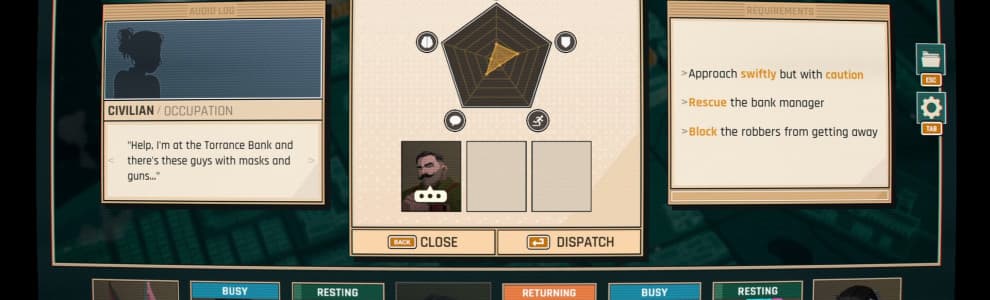
Where Dispatch surprised me was the, well, dispatching. Between narrative beats, you act as Handler, assigning Team Z to bite-size incidents around Torrance. Each hero has stats and quirks, and each call is a tiny riddle couched in flavor text. You scan a blurb—“elderly complaint about vibrating walls,” “suspicious package with ticking,” “cat, tree, irate HOA”—and try to infer if this needs brains, brawn, guile, or someone who won’t light themselves on fire at the sight of a toaster.
My favorite failure came early: I sent a hulking Golem with low Intelligence to investigate a “cryptic” burglary. He kicked the door in, scared the victim, and returned with exactly zero useful info. Lesson learned. Later, when urgent incidents start interrupting your board like flaming emails, the game adds a neat tension: commit your reliable duo to a time-sensitive rescue and you might leave a subtle, fussy case to a wildcard. Some missions explicitly warn you not to send certain people, and the few times I ignored that warning, the instant-fail taught me more about that hero’s limits than a stat sheet ever could.
There’s light progression here—level up heroes, bump a stat, unlock a synergy—just enough to make you care about your roster beyond their jokes. Pairing Sonar with a more grounded teammate gave me results I couldn’t get solo, and a couple late-game synergies made me feel clever for stacking the right personalities together. It’s not a deep management sim, but it’s a better narrative tool than I expected. Crucially, the story keeps going during these segments. Team Z chirps in your ear, roasts your bad calls, and accidentally reveals themselves while you play middle manager. I laughed a lot in the mission planner screen. Not many games can say that.
Hacking detours and QTEs: brief breathers that mostly stay in their lane
The other toy in the box is a minimalist hacking mini-game. Early on it’s “enter the right directions in the right order” simple. Toward the end, it picks up a Pac-Man vibe with little viruses that chase your cursor through mazes. None of it overstays its welcome. It won’t make anyone’s “best puzzles of 2025” list, but it breaks up the talky rhythm without derailing it. I appreciated that these were short punches, not new systems treated like headline features.
QTEs show up too, mostly in hectic set-pieces. The nice touch: you can disable them. For my first run I left them on and felt fine—clear prompts, reasonable timing. For a rewatch of the finale, I toggled them off and just let the scene breathe. It’s a small accessibility option that doubles as a stylistic choice, and Dispatch benefits from giving you that control.
The choice illusion: honest, clear, and still effective (unless you poke too hard)
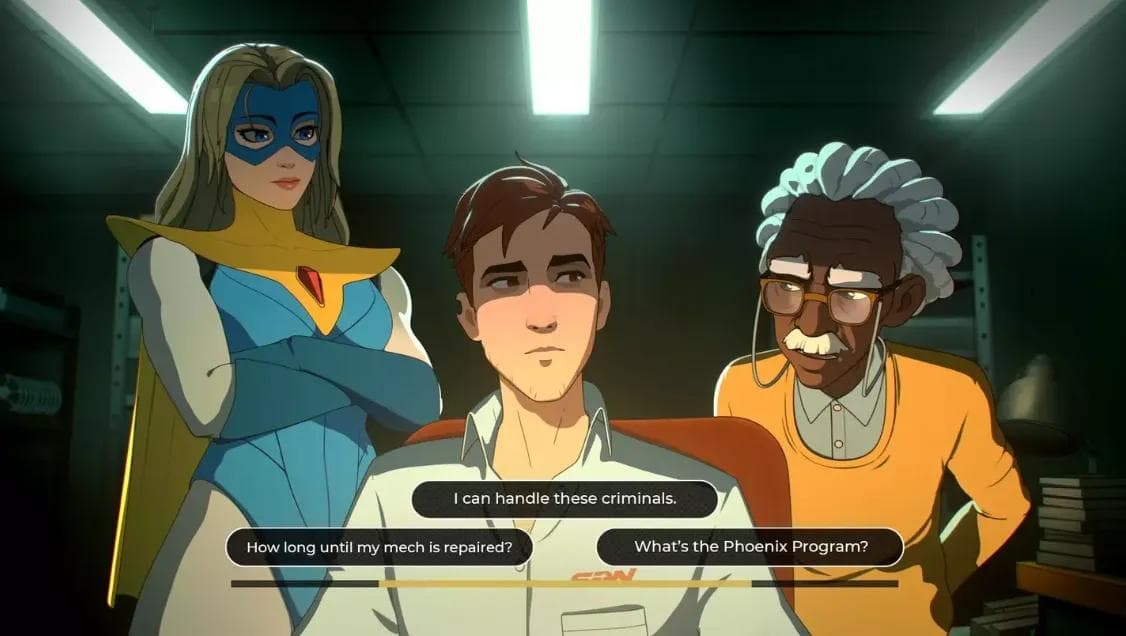
Let’s talk choices. Dispatch is at its best when it asks you how Robert carries himself, not how the world bends around him. The game rarely lies about that. Dialogue options are crystal clear—you won’t pick “Be stern” and then watch Robert perform a vicious stand-up routine that contradicts your intent. I can think of far too many narrative games that still trip over that.
Does everything branch? No. Most decisions affect tone, relationships, and immediate scene texture rather than sending you down wholly new paths. I counted only a couple moments that created truly exclusive sequences, and the first half of the season especially feels like it’s keeping you inside tight rails. The story it wants to tell is the story it tells.
But here’s the thing: the illusion is convincing because the writing is sharp and the acting is top-tier. In the moment, I felt ownership. Only when I went back to replay a couple episodes—pure curiosity, not frustration—did I see the seams. If you’re the type who save-scums to map the flowchart, you’ll find the scaffolding. If you watch it like a great season of TV, you’ll forget the scaffolding exists.
Presentation: Hi-Fi Rush flair, 90s heartbeat, and a French localization that slaps
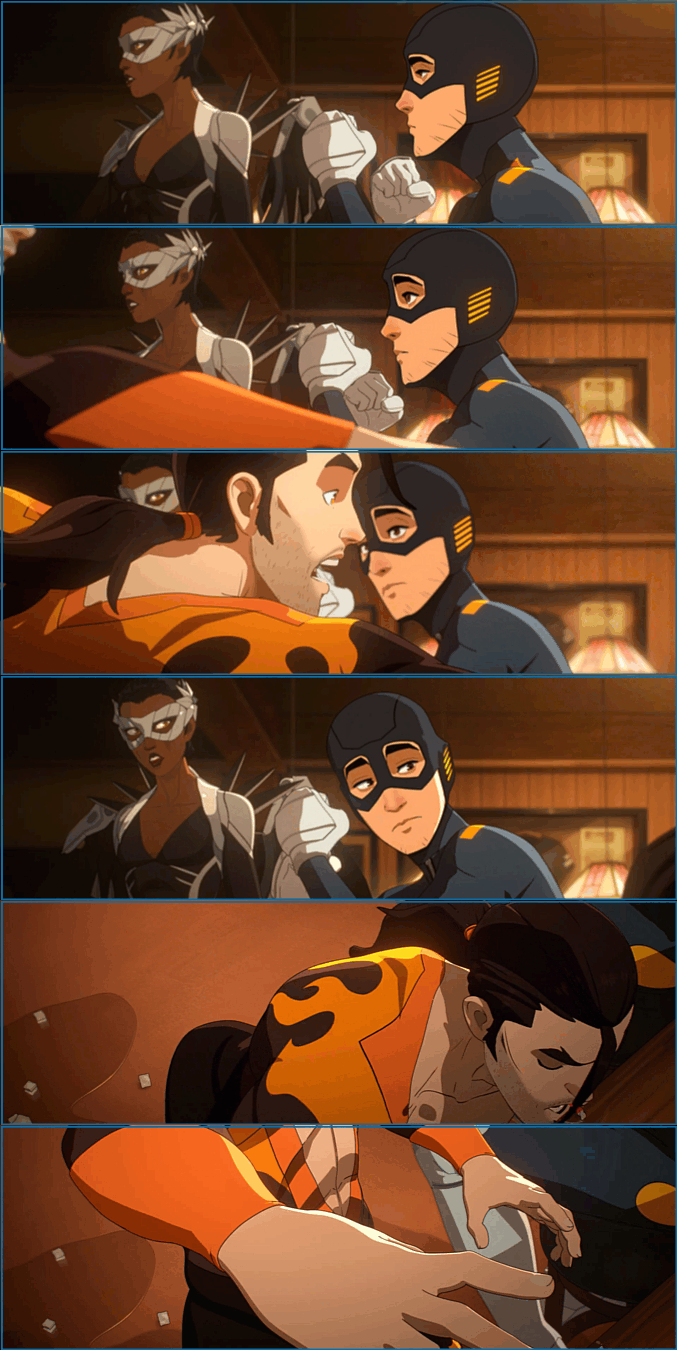
Visually, Dispatch goes with bold cel-shading that leans more into stylized character acting than photoreal spectacle. Think the colorful pop of Hi-Fi Rush funnelled into an animated series you’d have watched after school in the late 90s—clean silhouettes, exaggerated expression, tight framing built for performances. The way scenes cut is deliberate and punchy, and the lack of free roaming lets AdHoc control staging like a director instead of a tour guide. It works.
The music quietly ties it together. There’s an undercurrent of 90s texture—enough to tint a scene without turning into nostalgia cosplay. More than once I caught myself nodding along to a cue that slyly undercut what a character was saying. It’s the kind of soundtrack that respects silence and knows when to sting.
On localization, a quick shout: I flipped to French subtitles for a couple scenes out of curiosity and was impressed. The timing and bite of the jokes survive, which is no small feat when half the humor lives in rhythm. If you play in French, you’re in good hands.
Performance and settings on PC: refreshingly uneventful
I played on a mid-range PC (RTX 3070, Ryzen 5, 32GB RAM) at 1440p and it was boring in the best way: smooth, stable, no drama. This isn’t a GPU-melter, and it doesn’t need to be. I didn’t hit stutters in dialogue transitions, and alt-tab behaved, which matters if you’re the type to take notes mid-play (guilty). I bumped subtitle size up and appreciated the options there. Remapping worked as expected, and, as mentioned, QTE toggles are available. I ran into one minor lip-sync hitch in a late episode and a floating prop that did the “haunted mug” routine for a beat. Neither stuck around.
Episodic cadence: TV brain wins
I binged Dispatch in two evenings, which I suspect is how a lot of people will end up playing it. The episodic format gives each chapter a hook and a payoff, but the connective tissue really sings when you don’t have to wait a week. If you do go episodic, the length per episode is tighter than classic Telltale—focused, sometimes too brisk—but the rhythm fits the comedy-drama tone. Whether you binge or savor, the season structure suits this story.
Where the seams show—and why I didn’t mind (most of the time)
You can feel the realities of building a first game with a world-class cast. When a scene hints at a wider subplot—some dynamic within Team Z that begs for another three exchanges—sometimes you don’t get them. A handful of characters practically demand more screen time. I would have followed two of them into a full-on spin-off episode without complaint. And yes, when you replay to stress-test a choice, you’ll see how often the game gently steers back to a common road. None of this tanked my enjoyment, but it’s there.
And yet: the overall craft is strong enough that the constraints feel like stylistic choices more often than not. Removing free-movement fluff means the scenes hit faster and harder. Compact episodes avoid bloat. Letting me turn off QTEs respects my vibe on a second pass. The management layer pulls double duty as gameplay and character builder. For a studio’s first outing, this is confident stuff.
What clicked for me vs. what didn’t
- The writing is legitimately funny and painfully human in the same breath. I believed these people—even the ones with laser eyes.
- Dialogue choices are clear and honest. No “I picked polite and accidentally committed arson” moments.
- The dispatch board makes you feel like a handler, not a passenger. It’s simple, but it matters to the story.
- The voice cast is ridiculous—in the best way—and no one phones it in. Not even the YouTube cameos.
- Cel-shaded art and TV-style pacing fit the concept like a glove; the 90s tinge gives it flavor without kitsch.
- On the downside, deep branching is limited. If you replay a lot, you’ll see the scaffolding and a couple recycled beats.
- Some side characters deserve a bigger spotlight. There are hints of dynamics that don’t fully bloom.
- The hacking mini-game is fine, not memorable. Breezy is the win here.
Should you play Dispatch?
If you still quote lines from The Wolf Among Us or Tales from the Borderlands, Dispatch is the closest thing to that energy we’ve had in years—less noir, more office comedy, same commitment to characters. If you’re burned out on superhero bombast, this is refreshingly small and human even when it goes big. If your idea of a narrative game lives and dies by flowcharts and branch density, you might bounce off the rails. For everyone else, it’s a season of smart, funny, sometimes tender TV you get to nudge—and sometimes that’s exactly right.
The bottom line
After about 10 hours on PC—finishing the season and replaying a few key episodes—I walked away impressed and surprisingly moved. Dispatch knows what it is: a conversation-first, performance-driven story about a guy who used to be a superhero and now has to be a person. It gives you just enough agency to color inside its lines, and when it does swing toward spectacle, it brings that weight of accumulated small moments with it. I wanted a bit more space for a couple secondary arcs and a few more meaningful branches, but I’ll take a tightly written, perfectly acted story over empty “every choice matters” theater any day.
TL;DR
- Superhero office comedy with heart; more break room than battleground, in the best way.
- Top-tier voice cast (Aaron Paul, Jeffrey Wright, Laura Bailey, more) powers believable characters.
- Lean structure—no free roaming—keeps pacing tight and scenes focused.
- Dispatch-board management adds light strategy and great character banter.
- Choices shape tone and relationships more than plot; the illusion holds unless you replay extensively.
- PC performance is smooth and drama-free; welcome accessibility options (can disable QTEs).
- Wanted: a touch more branching and extra screen time for a couple stellar side characters.
FinalBoss // Gear
Level up your setup
01Graphics cardson Amazon→02Gaming laptopson Amazon→03High-refresh gaming monitorson Amazon→04Discounted game keyson Kinguin→Affiliate links · As an Amazon Associate, FinalBoss earns from qualifying purchases.
Want to Level Up Your Gaming?
Get access to exclusive strategies, hidden tips, and pro-level insights that we don't share publicly.
Ultimate Reviews Strategy Guide + Weekly Pro Tips