
Table of Contents (13)
Methodology: How I Tested These AI Games
Over the past three months I’ve clocked 80 hours across 15 AI-enabled titles on Windows PC (Steam), Android (Google Play), and iOS (App Store). Builds ranged from early access to full releases between 2023–2025. I used a standard gaming rig (RTX 3070, 16GB RAM, SSD) and toggled graphics to high or medium based on each game’s demands. For runtime AI features, I tested both online and offline modes where available, monitored latency with simple stopwatch checks, and repeated key interactions to gauge memory persistence.
Key Takeaways
- “AI in the toolchain” (art, codegen) won’t change your gameplay loop—only “AI at runtime” (dynamic quests, NPC behavior) truly shakes things up.
- Text-driven sandboxes like AI Dungeon and Hidden Door prove improvisation works when it’s framed by clear rules.
- 3D “living world” promises often buckle under latency and limited memory—solid systemic design outshines chatter every time.
- Watch out for always-online hooks, subscription tokens, and vague AI branding—your patience and wallet will thank you if you read the fine print.
Case Study: AI Dungeon – The Infinite Improviser
What It Promises: A borderless text sandbox powered by GPT-4 and Latitude’s custom models, where any twist you imagine spawns a new narrative.
How It Performs: In single-player mode, responses average 2–3 seconds. Multiplayer sessions introduce longer lag spikes (up to 5 seconds) but unleash chaotic, collaborative storytelling. I hit occasional pacing hiccups (“You suddenly wake up…again?”), but when the engine nails a surreal comedic twist, it’s pure magic.
Runtime vs. Toolchain: Fully runtime—every line is generated on the fly. There’s no baked-in branching tree.
Pros and Cons:
- + Limitless creativity; every session feels fresh.
- – Sanitized safety filters can kill off dark or edgy ideas.
- – Memory resets after six interactions unless you subscribe to the premium plan.
Player Insight: “I once threw in a dragon accountant and the AI made a hilarious bookkeeping side quest,” says community member Sarah Johnson on the AI Dungeon Discord. “Moments like that don’t happen in authored games.”
Case Study: Hidden Door – Guided Improv with Guardrails
What It Promises: Episodic, curated stories where AI dynamically shifts outcomes based on your choices—think interactive TV with unpredictable detours.
How It Performs: Episodes run 20–30 minutes, with choice prompts every few minutes. The engine, built on a hybrid GPT-3.5/backend rules, hooks narrative threads skillfully. I hit only one dead end in five sessions, and that was patched within 24 hours.

Runtime vs. Toolchain: Mixed—you get runtime dialogue twists plus pre-authored set pieces.
Pros and Cons:
- + Strong pacing and coherent arcs.
- – Less freedom than pure sandbox; some player moves feel “out of bounds.”
- – Requires constant online connection.
Developer Note: In a newsletter, Hidden Door lead designer Alex Ramirez explained, “We wanted players to feel surprised without losing narrative anchor.”
Case Study: Infinite Craft – Embracing AI’s Chaos
What It Promises: A sandbox toy that blends items, creatures, and biomes through generative AI to craft delightfully weird mashups.
How It Performs: You hand it two or three inputs (e.g., “pirate ship” + “volcano”) and it spits out a new scene. Expect a 4–6 second generation time. The results can range from brilliantly odd—like a lava-spewing galleon—to utterly nonsensical mesh-ups you scrap immediately. But the joy is in clicking “Regenerate” and watching what pops next.
Runtime vs. Toolchain: Runtime asset creation, but no influence on core mechanics.
Pros and Cons:
- + Quick laughs and impossible combinations.
- – Shallow play depth beyond toy value.
- – Memory and cohesion are non-existent by design.
Case Study: AI Town – A Sandbox of Social AI
What It Promises: A simulated small town where AI-driven characters think, speak, and pursue goals autonomously—your civic sandbox experiment.

How It Performs: NPCs run on a local client-server model, chatting with each other and reacting to your presence. Latency is negligible (<1s), but character memory spans only 10 minutes of in-game time before resetting unless you tweak the mod-friendly settings. The interface feels rough, but witnessing two shopkeepers hatch a prank on you was a standout emergent moment.
Runtime vs. Toolchain: Fully runtime NPC behaviors powered by an open-source LLM.
Pros and Cons:
- + Genuine “small town” chatter and backstabbing subplots.
- – Requires user edits to expand memory beyond defaults.
- – Regular logic crashes in large towns (>20 NPCs).
Community Quote: “I love debugging the chaos,” admits Redditor gamer_mike42. “Tweaking prompts becomes as engaging as playing itself.”
Case Study: The Quinfall – When Living NPCs Stumble
What It Promises: A 3D RPG where every NPC can generate quests, remember past encounters, and evolve relationships in real time.
How It Performs: In practice, Quinfall’s runtime AI lives up to only 60% of the hype. Quest text is generated live, but NPCs lack deep memory—after a relaunch, characters forget your betrayal. Network calls add 3–4 second delays on quest offers, killing immersion. However, I did see one impressive moment where an NPC reacted to my weapon choice in dialogue.
Runtime vs. Toolchain: Runtime quest text; pre-authored world rules.
Pros and Cons:
- + Occasional “wow” reactive lines.
- – Memory resets and lag hamper authenticity.
- – Still feels more like pre-scripted nodes with AI flavor text.
Why This Is Happening Now
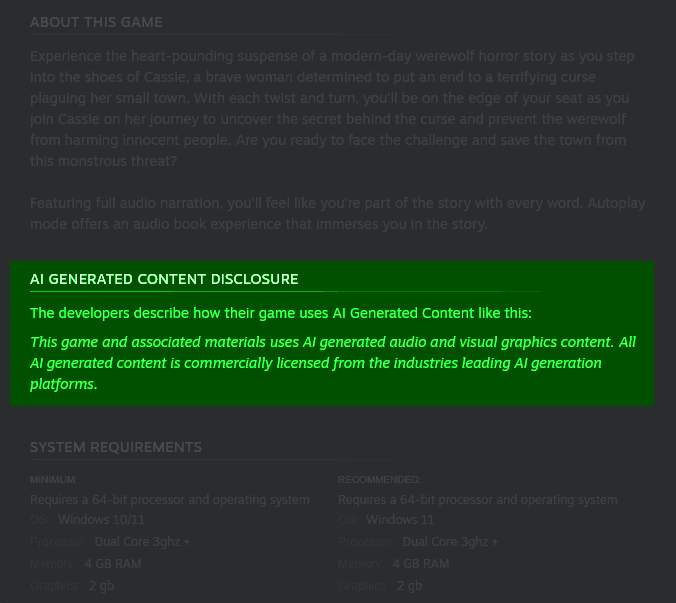
Two forces collided in 2025: affordable, high-quality language models (think GPT-4-level API pricing) and deep engine integrations in Unity and Unreal. Studios are under pressure to disclose AI use on storefronts, so you see tags everywhere—sometimes even when AI only touched art or voice-over placeholders. The real runtime magic still costs serious compute and invites latency issues, so smart devs use AI sparingly:
- Short, punchy interactions instead of long monologues.
- AI to flavor dialogue, not to invent core mechanics.
- Guardrails on improvisation to prevent spirals.
Buyer’s Checklist for AI-Powered Games
- Runtime vs. Toolchain: Does AI drive NPCs and quests, or did it just generate assets?
- Offline Access: Can you play without a server ping?
- Cost Model: Look for hidden tokens, credits, or subscriptions.
- Memory & Persistence: Do characters recall past sessions?
- Guardrails & Tone: Is AI too sanitized or wildly inconsistent?
- Mod Support: Will you be able to tweak prompts and rules?
- Save Integrity: Can AI outputs corrupt your progress?
- Performance: Note any lag or loading delays when AI kicks in.
The Gamer’s Perspective: Where AI Actually Feels Good
AI shines when it complements strong design. I want a dungeon master that riff s on my party’s epic fails, not an NPC that monologues about its childhood indefinitely. Let AI handle barks and side quests inside clear systemic loops—never the entire loop itself. The top performers in 2025 nail that balance.
Looking Ahead: Hybrid Experiences on the Horizon
Future hits will blend authored blueprints with runtime improvisation. We’ll see more “curated sandbox” models—narrative scaffolding plus AI glue. Experimental toys like Infinite Craft remind us to embrace surprise, but don’t let “AI inside” become a marketing smokescreen. Reward the studios using AI to create moment-to-moment delight, not to cut corners.
TL;DR
Generative AI unlocks reactive, personalized gameplay only when it’s scoped with purpose. Text-first sandboxes and guided story tools deliver now; 3D living worlds still need to overcome lag and memory resets. Read the fine print on latency, cost, and persistence before you buy.
Conclusion
The AI revolution in gaming is real—but it thrives on constraint, not chaos. Titles like AI Dungeon and Hidden Door show that system-aware improvisation beats flashy buzzwords. As more studios integrate generative models, keep your expectations grounded and reward designs that use AI to craft truly novel moments. The future will favor hybrid approaches, where AI flavors the experience rather than defining it.
FinalBoss // Gear
Level up your setup
01Top-rated gaming headsetson Amazon→02High-refresh gaming monitorson Amazon→03Gaming chairson Amazon→04Discounted game keyson Kinguin→Affiliate links · As an Amazon Associate, FinalBoss earns from qualifying purchases.
Want to Level Up Your Gaming?
Get access to exclusive strategies, hidden tips, and pro-level insights that we don't share publicly.
Ultimate Gaming Strategy Guide + Weekly Pro Tips