
Table of Contents (7)
Stumbling Out of Vault 111 on a Nintendo Console (Finally)
Booting up Fallout 4 on Switch 2 for the first time felt weirdly wrong in the best way. As that familiar “War never changes” monologue rolled, I had this moment of, “Oh, right, this has never actually been on a Nintendo system before.” Skyrim’s been passed around like a party flyer for over a decade, but Fallout always felt like the slightly grimier cousin Nintendo players only heard stories about.
On Switch 2, those opening minutes hit just like they did back on PS4 and PC: the too-perfect pre-war suburbia, the panic as the sirens wail, the walk into Vault 111 knowing everything’s about to go very wrong. Only this time, a few hours later, I’m looting raider corpses on my lunch break, the console propped up in tabletop mode, Joy-Con drifting just a little as I line up V.A.T.S. shots.
That’s the hook here, really. Fallout 4: Anniversary Edition on Switch 2 is the full-fat Commonwealth experience – base game, all the big expansions like Far Harbor and Nuka-World, all the workshop packs, and a frankly ridiculous amount of stuff to do – running on Nintendo hardware with three performance modes. It’s exactly the sprawling, comfort-food RPG I wanted on a handheld… and also exactly the same bug-riddled, occasionally infuriating Bethesda game it’s always been, with a few new frustrations thanks to missing console features.
How Fallout 4 Holds Up in 2026
I’ve finished Fallout 4 before, but coming back to it on Switch 2 reminded me how sharply the game splits in two: the big central story about finding your kidnapped son, and then basically everything else.
The main plot is still the weakest part. The emotional hook – watching your partner murdered and your baby stolen as you’re trapped in a cryopod – is strong, but once you hit the open world, the search for Shaun mostly becomes an excuse to bounce between factions. By the time the big twist lands, I’d already lost my emotional investment and was treating the main quest as just another checkbox.
Where Fallout 4 still absolutely sings is in the side content and environmental storytelling. An hour after leaving Sanctuary, I meant to head towards Diamond City. Instead, I got distracted by a radio play about a cheesy pulp hero, followed the trail, and three hours vanished as I lived out my best Silver Shroud cosplay, stalking through the streets in a trench coat, delivering hokey one-liners before headshotting raiders. That quest is just as brilliant today as it was at launch.
Same with the stranger rabbit holes. I stumbled into the Cabot House again, remembered half of what was going on, and still ended up getting sucked into its bizarre family drama and ancient-super-technology weirdness. Fallout 4 is piled high with this kind of stuff – self-contained stories, small tragedies, stupid jokes written in terminal logs, and little vignettes that make the Commonwealth feel less like a backdrop and more like a graveyard full of half-remembered lives.
The faction arcs still do good work, too. The fascistic Brotherhood of Steel, the secretive Institute, the morally conflicted Railroad trying to do right by synths – none of them come away looking spotless, and picking your endgame allegiance still stings a bit. That feeling survived the jump to Switch 2 intact.
Then there’s settlements. Early on, Preston Garvey (yes, he is still obsessed with new settlements needing your help) introduces the building system, and you either immediately feel your brain lighting up or your eyes glazing over. On Switch 2, I fell right back into it: scrapping half of Sanctuary for parts, wiring up turrets, trying to make beds line up just so. It’s janky and fiddly, but there’s something magic about turning a wrecked diner into a functional trading hub while a radstorm rolls in.
The Anniversary Edition’s workshop packs only deepen that rabbit hole. I went from throwing together scrap shacks to building dumbly overengineered bunkers with neon signs and fancy guard towers, all on a portable machine. It’s still optional – you can more or less ignore settlements beyond the bare minimum – but if you click with the system, there’s a scary number of hours to lose here.
The DLC holds up well, too. Automatron drops pretty early and gives you custom robots to build and tinker with, which is god-tier for tinkerers. Nuka-World is a messy, morally bankrupt theme park playground that I still have a soft spot for. But Far Harbor remains the standout: moody atmosphere, thick fog, morally complicated factions, and some of the best writing in the game. Playing that arc in handheld mode during a rainy evening just felt right.
Performance Modes: 30, 40, or 60 FPS in the Wasteland
Fallout 4 on Switch 2 gives you three performance options in the menu: a 30fps “quality” mode, a 40fps middle ground, and a 60fps “performance” mode. I bounced between all three for a while before settling mostly on 40fps.
Docked, the 30fps mode looks the cleanest. Resolution targets are higher, distant objects are sharper, and textures hold together better. It’s not suddenly a modern showpiece – texture detail, shadows, and materials are still firmly last-gen – but from the couch it looks solid. The trade-off is that 30fps feels a bit stodgy now, especially when you’ve seen the other modes.
On the Switch 2’s 120Hz screen, 40fps is the sweet spot. It feels dramatically smoother than 30 without blurring the image as aggressively as 60. This is where I spent most of my time, both handheld and docked. Sprinting through the Glowing Sea, V.A.T.S. popping in and out, feral ghouls flailing at you – it all just feels more responsive here. When things got hectic, like super mutant camps with grenades flying, I did notice minor dips, but they were rare enough not to bother me long-term.
The 60fps mode is where the engine really stretches its legs. Aiming feels snappier, and melee in particular benefits from the extra smoothness. But the cost is obvious: dynamic resolution gets aggressive. In busy areas, image quality softens noticeably, especially in handheld play. If you value responsiveness over clarity and mostly play docked, this might still be your go-to. Personally, seeing the world smear a bit every time I swung the camera in portable mode pulled me out of it.
An update adding DLSS support for the higher frame-rate modes has been announced, which could help claw back some sharpness at 40 and 60fps. As it stands at launch, the modes are all serviceable, with 40fps feeling like the intended “best of both worlds” compromise.
Stability-wise, frame pacing is mostly consistent. I had occasional hitches in dense areas like downtown Boston or when a physics mess exploded (literally – a car chain-detonated near Goodneighbor and the engine had a small panic), but nothing close to the disaster that was Skyrim’s early performance on the original Switch and its shaky debut on Switch 2. This is unquestionably a better-looking and better-running port than that.
Visual Trade-Offs and Handheld Comfort
Visually, you’re getting something roughly on par with Fallout 4’s later console patches, tuned for the Switch 2’s hardware. Docked, the game can push up towards higher resolutions with acceptable texture work and lighting. No ray tracing, no fancy new effects, but the art direction does the heavy lifting. That washed-out, retro-future Boston vibe still works.
In handheld mode, the compromises are more obvious but also easier to forgive. Dynamic resolution steps in more aggressively, and you’ll notice softer edges and distant objects losing detail, especially in the 60fps mode. Character faces can look a bit waxy up close, and foliage has that familiar “Bethesda hedge of triangles” look. But the smaller screen hides a lot of sins, and wandering the wasteland on a commute feels a little surreal in the best way.
UI scaling is… okay. Pip-Boy text is readable in handheld, but it toes the line of being a bit too small for longer sessions. I found myself leaning in more than I’d like when digging through perk descriptions or modding weapons. It’s not a deal-breaker, just something to be aware of if your eyesight isn’t perfect.
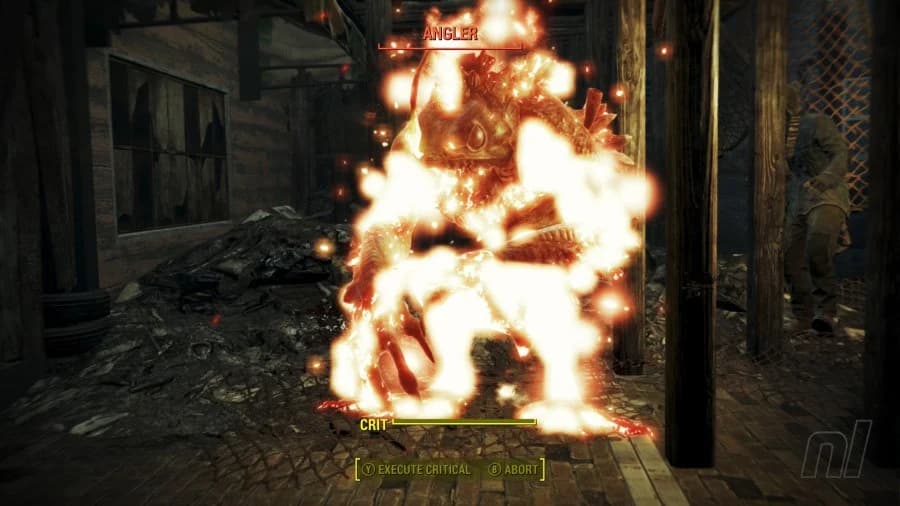
Load times are respectable. Fast travelling from Sanctuary to Diamond City took a handful of seconds most of the time, not the half-minute slogs of the PS4 days. Entering interior cells still triggers a loading screen every time, but downtime never got annoying enough for me to stop using fast travel or dipping into buildings.
The Same Old Bethesda Bugs… and Then Some
Here’s where things get messy. Fallout 4 on Switch 2 is absolutely carrying forward its “Bethesda jank” bloodline. If you’ve played this game before, you know what that means: physics wig-outs, NPCs getting stuck on geometry, quest scripts occasionally forgetting to fire, companions teleporting in weird places, and so on.
On this port, I ran into all the classics and a few extra irritations. The standout nightmare for me was a bug that silently disabled sprinting. One second I’m dashing across a ruined freeway, the next my character plods along like their shoes are full of cement. No debuff, no obvious cause, just… no sprint. Restarting the game fixed it, but the first time it hit, it almost got me killed by an alpha Deathclaw I absolutely should not have been fighting at level 12.
I also had multiple audio issues: gunshots dropping out mid-fight, ambient music looping weirdly, and one memorable moment where a whole conversation played without any voice audio until suddenly catching up in a garbled burst. Script glitches still happen – a quest-giver once refused to acknowledge I’d completed his objective until I reloaded an earlier save – and I had three full crashes to the home menu over roughly 40 hours.
Are these constant? No. Over a long playthrough, the chaos sort of blends into the background. But every time a hard crash hit right after a big fight, or my sprint vanished mid-encounter, I was reminded that this port didn’t use its trip to Switch 2 as a chance to meaningfully clean house. If anything, it feels like the same shaky skeleton with some new graphical clothes.
If you pick this up, do yourself a favor: turn on frequent autosaves and get into the habit of manual saving before big conversations, dungeon crawls, or settlement building sessions. It’s old-school PC RPG discipline, but it’ll save you from a lot of anger when the engine decides it’s had enough.
Controls and the Strange Absence of Switch 2 Features
Moment-to-moment, Fallout 4 feels fine on the Switch 2 controller. Sticks are responsive, aiming is serviceable, and V.A.T.S. remains the great equalizer when you don’t feel like lining up headshots manually. You can tweak sensitivity enough to make it comfortable both docked and handheld.
But for a 2026 port on Nintendo’s new hardware, the lack of platform-specific features is impossible to ignore. There’s no gyro aiming, no pointer-style option, no touch interaction with the Pip-Boy menus, and no mouse-style control despite the system supporting it. Coming from Splatoon or any shooter that’s embraced motion controls, going back to pure stick aiming in a game like this feels unnecessarily clumsy.
It stings more because Fallout 4 is a game that really benefits from fine control. Poking out from behind cover to land a couple of precise rifle shots, or popping a short burst at a charging ghoul, is exactly the sort of interaction gyro elevates. Instead, you get a straight port of the old console layout with just enough button remapping options to avoid disaster, but nothing that takes advantage of what Switch 2 can actually do.
There’s also no support for things like separate control profiles for handheld and docked modes, which would have been nice given how different the contexts feel. You can make one compromise setup and live with it. It works, but it never feels like this version was truly designed for Switch 2 – more like it just happens to run on it.
Who Is This Port Really For?
So where does that leave Fallout 4: Anniversary Edition on Switch 2?
If you’ve never had a machine that could run a mainline Fallout and the TV show has you itching to explore the wasteland, this is a huge deal. You’re getting hundreds of hours of content – base game, every major DLC, tons of cosmetic and workshop extras – in a package you can play handheld on the couch or docked on a big screen. For a Nintendo-only player, this is basically a post-apocalyptic feast.
If you played Fallout 4 to death on PC with mods, the story is different. You’re giving up mod support, higher-end visuals, and better control options for portability and a new set of bugs. That trade-off might still be worth it if the idea of Far Harbor in bed or building ridiculous settlements on the train sounds appealing, but this is not a definitive version in any technical sense.
If you bounced off Fallout 4 back in the day because of its writing or mechanical feel, this port doesn’t change any of that. The same divisive design choices are all here: the more limited dialogue system compared to New Vegas, the heavier emphasis on shooting, the settlement grind. The Switch 2 version adds convenience and portability, not reinvention.
FinalBoss // Gear
Level up your setup
01Best-selling Switch 2 gameson Amazon→02Switch 2 accessorieson Amazon→038BitDo controllerson Amazon→04Discounted game keyson Kinguin→Affiliate links · As an Amazon Associate, FinalBoss earns from qualifying purchases.
Want to Level Up Your Gaming?
Get access to exclusive strategies, hidden tips, and pro-level insights that we don't share publicly.
Ultimate Reviews Strategy Guide + Weekly Pro Tips