
Table of Contents (15)
Back to the Zone: How this DLC actually scared me
I don’t scare easily. Resident Evil as a kid fried those circuits long ago, and my October routine still includes trudging through Silent Hill 2 like it’s a Sunday jog. Pacific Drive never wore the “horror” label, but it always felt like it could lunge for it if it wanted. Whispers in the Woods doesn’t lunge-it stalks, it whispers, and then it pounces when you’re elbow-deep in the glove box looking for duct tape. Within my first 30 minutes back in the Olympic Exclusion Zone, I watched little red marks bloom across my map like a rash, heard a voice on the radio recite scripture through a smile, and then felt a whole new kind of panic as something vast and formless pressed in from the treeline. I floored it. Bad idea. The highway kinked; my back bumper met a fir tree; the dash lights stuttered; something antlered skimmed the windshield-and then the world went chromatic and wrong. I limped back to Oppy’s with tires like chewed gum and hands shaking. That’s the tone-setter. That’s Whispers in the Woods.
Ironwood Studios calls this a story expansion, but the label doesn’t cover the vibe shift. The base game is retro-futurist science weirdness with a motorhead soul. The DLC taps folk horror veins: rituals, masked figures, feral belief systems growing in the cracks. It doesn’t rewrite Pacific Drive; it reframes it. And it does so by adding a single pressure you can feel at all times: the Whispering Tide.
The Whispering Tide changes how you drive, think, and panic
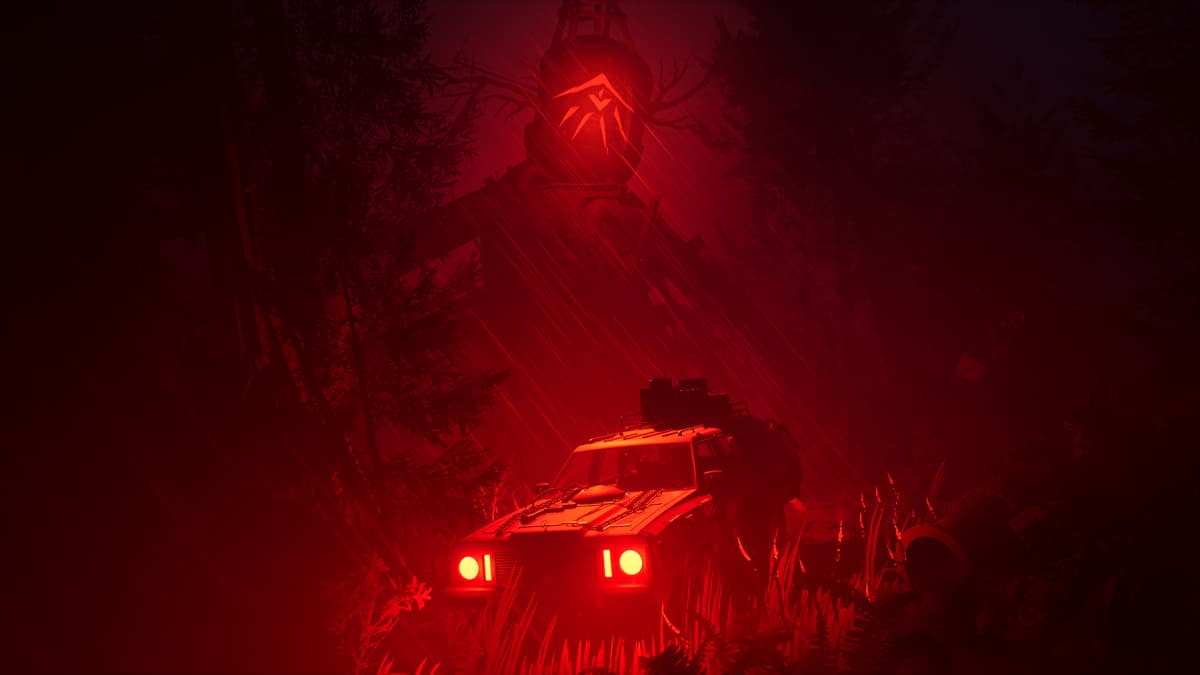
I’d read about the Tide before I hopped in-some amorphous force, a rising danger, yadda yadda—but descriptions undersell it. The Tide is a living timer and a presence. On the map, it’s a net of red icons closing. In the world, it’s a procession of shadow bodies, antlered silhouettes, an arachnoid mass flowing between boles. When it’s on you, the air goes oily with color; the HUD struggles; the car coughs like it’s swallowing night. The closest touchstone I can name is Echoes of the Eye’s shadow chases in The Outer Wilds: it’s not the jump, it’s the dread of knowing it will find you if you dawdle. But there’s a key difference: in Pacific Drive you’ve got a brittle, beloved physical thing to shepherd through the encounter. I love that car like it’s a character, so when the Tide smears across the windshield and the wipers only push streaks of sickly aurora around, I feel that in my ribs.
Design-wise, the Tide forces cleaner runs. It punished my hoarder brain. In the base game, I’d pull over to strip every abandoned chassis, clack-clack-clack the screwdriver minigame until my pockets groaned, then limp to the gate. With the Tide breathing hot and metallic over my shoulder, I had to choose: do I take that side road for a potential alternator, or do I keep my foot in it and live? More than once I greedily swung for salvage, then saw those red map pricks multiply and felt my stomach do a little skydive. Notably, even after 20 hours, the Tide never became “seen equals solved.” It’s too intangible for that—more tone than model. That helps it stay scary.
New anomalies are meaner and weirder (Hooligan, Highwayman, and Gloom Pockets)
The new anomalies match the folk horror angle with a grin that shows teeth. The Hooligan is the one I tell stories about. It’s basically a Tourist that went to charm school and then juvie—stands there “offering” a crate if you meet its eyes, but the second you look away it rushes your ride and boots it like a bully punting a lunchbox. I caught my first Hooligan in my rearview as I crouched to pop a trunk latch: a still statue with a cardboard box at its feet, humble as a camp offering. Spun to grab the loot, looked back, and the whole chassis lurched with a metallic whomp. I yelped. I don’t yelp.
Then there’s the Highwayman, an Abductor variant that acts like a bored god with a trebuchet. The base Abductor already made me flinch when it yanked my car half a mile sideways; this thing just hurls you. It doesn’t feel random either—it aims for trouble. One throw put me pinwheeling over a shallow ravine straight into a ring of Tourist Traps. I was still in reverse when the first trap bloomed and the radio hissed with sermonizing laughter. You learn to spot it out of the corner of your eye: a shimmer, a stretch, a mean-spirited curiosity. Meanwhile, Gloom Pockets (those vanta-black bruise clouds) patrol routes like guard dogs. They mute the world as they pass, sucking the soundscape flat so your own engine sounds guilty. Explore-happy players like me get trained to dart in, breathe, and back out before the air curdles.
Artifacts and attuned parts: the roguelike toys that make risk worth it
All that dread would just be punishment if Whispers in the Woods didn’t give you tools that feel clever to use. Thankfully, artifacts and attuned parts go beyond novelty. Artifacts are little behaviors you graft onto your car—quirks with teeth. My favorite combo turned the wagon into a petty gremlin: one trinket honked my horn automatically whenever an anomaly grabbed the car; a second trinket forced those same anomalies to let go when the horn honked. Boom: feedback loop. Suddenly the Highwayman’s set pieces lost a lot of their bite, and I could plan around the chaos. In another run, an artifact turned my hazard lights into a short-range deterrent that made Hooligans hesitate just long enough to scoot past. Pacific Drive has always flirted with buildcraft; this is the first time I felt myself theorycrafting a “loadout” the way I would in an action roguelike.
Attuned car parts extend that idea. You’re not just slapping scrap on to stop the bleeding; you’re forging parts with resonance values that play nice with the Tide’s weird physics. Think sigil-speckled doors that shed a grab, or a bumper that spikes a synergy meter so your warding holds a beat longer. I started prioritizing attuned fenders and windows over raw armor—not because they had the best numbers, but because they bought me seconds, and in this DLC seconds are currency. It scratches a different itch than the base game’s “make number go up” loop; this is more “make number go sideways in a way that fits what’s hunting me.”
Rites rewire the rules of a run (and humbled my favorite build)
Rites are the DLC’s best trick. They’re bespoke runs with modifiers that alter the Zone’s personality. The standout for me was the Rite of Community. The Tide rises continually unless an anomaly grabs your car—then it recedes for a breath. Sounds simple until you realize your “get off me” horn combo is now sabotaging you; every honk breaks the grab and the Tide surges again. One run turned into a perverse dance where I slowed to let a Tourist latch on, then feathered the throttle while the Tide subsided, then sprinted to the next patch of safety. My whole approach inverted. That’s the kind of designer mischief I adore: it forces you to learn the same space with a different brain.
Several rites also subtly push you out of your favorite routes. I’m a side-road goblin by nature, but Rites keep nudging you into uncomfortable zones with better energy nodes, or forced detours through Gloom swamps. That I left a Rite feeling wrung out but oddly satisfied—the exact feeling I chase in Souls-likes—is the best compliment I can give here.
The one system that tripped me up: Harmonic Energy and the Resonator
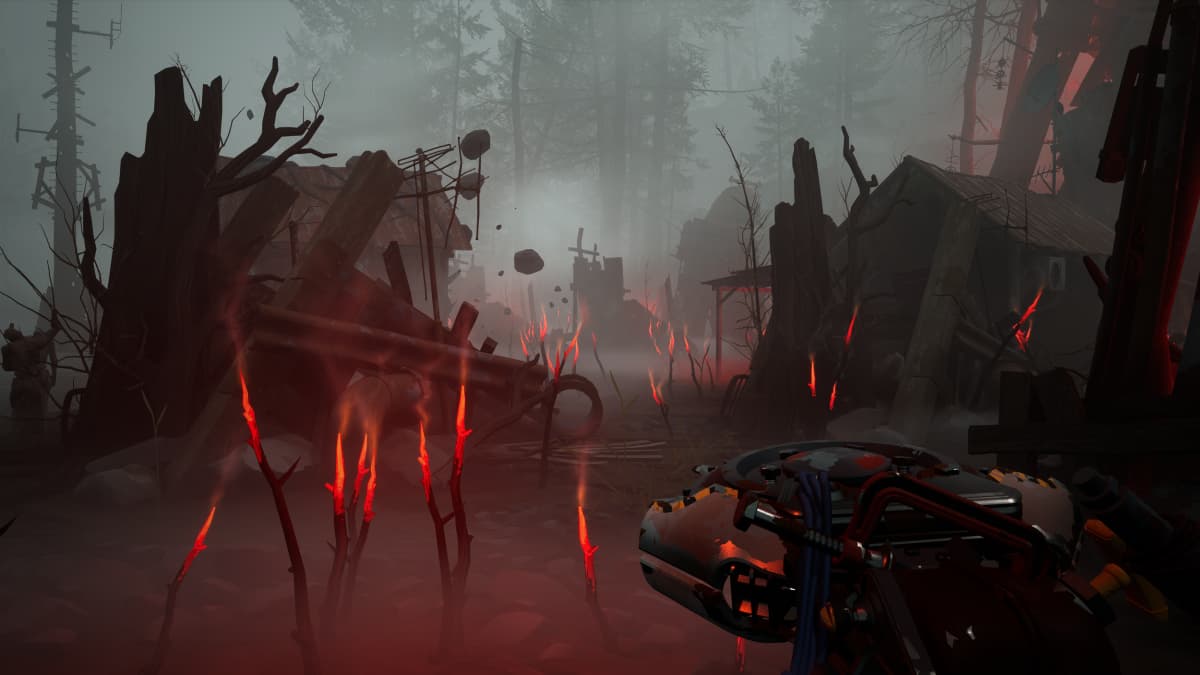
I wish I could say the new systems all clicked. They don’t. The Harmonic Energy economy and its poster child, the Resonator, are conceptually cool but practically fussy. The loop—charge the Resonator at an altar, use it to power an Attuned Capacitor, use that to juice parts and wards—sounds occult and tactile on paper. In practice, it’s three trips between battery A and socket B when one would do. The Resonator looks like a rocket launcher that joined a pagan book club; it handles like a portable charger with extra steps. After a few sessions, I had the choreography down—park close to the altar, pop the trunk, Resonator out, charge, slot, point, beep-beep—but it’s busywork without payoff, especially when the rest of Pacific Drive’s maintenance has such lovely physicality.
I’m the last person to beg for streamlining in a survival game; the time it takes to replace a headlight is half the charm. The difference here is that Harmonic Energy doesn’t map to a real-world task in a satisfying way. It doesn’t feel like tinkering. It feels like managing a currency with awkward pockets. The tutorial wrappers also brought back the base game’s original “too much, too fast” vibe—sprawling tooltips layered atop overlapping meters. I got it in the end, but my first two hours were a chorus of “wait, what am I charging, and why?” The upside: once the ritual clicks, it fades into the background, and you can focus on the good stuff.
Sound and story tone: radio sermons, possessed pop, and a folk horror pivot
Pacific Drive’s soundtrack was already a road-trip mixtape with teeth. Whispers in the Woods scratches those teeth on a chalkboard. Songs arrive drenched in static, vocals detuned until they sound uncomfortably human-adjacent. The radio—previously a comforting misfire of ads and weird broadcasts—now carries a voice that’s all smile and knife. The cult leader shtick could’ve been cheesy; instead it’s unnervingly casual. Once, while I was inching a cracked wagon across a one-lane bridge, he started reciting Revelations in a tone that suggested he was reading me a recipe. It’s campfire-story effective, and it suits the DLC’s focus on the people who grew up inside the Zone’s nonsense. Less ARDA labcoat lore, more “what beliefs bloom when reality bends and nobody comes to help?”
It’s very VanderMeer by way of damp flannel and highway reflectors. No jumpscares. No cat-in-a-vent. Just the sick knowledge that the only thing separating you from a maw of unknowable intent is an engine you tuned yourself and a door you riveted at 2 a.m. That’s my kind of horror: consequence horror.
Performance and polish on PS5: mostly smooth, sometimes stressed
I played the DLC on PS5 with performance mode toggled and a DualSense that has seen better days. The good news: the framerate held steady in most biomes, including during red-alert scrambles where the Tide was nipping my bumper. I did hit a few micro-stutters when a Highwayman yeeted me across a streaming boundary, and once the world took an extra beat to repopulate foliage after a Tide surge. Nothing fatal, just moments where the sim was clearly juggling a lot and dropped a ball for a second.
On the quality-of-life front, the 600-ish days of patches since launch show. Mid-run saves saved my sanity; I paused a nightmare Rite at a roadside altar and came back the next evening without any weird state bugs. The expanded gameplay presets are a thoughtful touch too—I nudged anomaly aggression down one tick during a late-night session when my brain was soup, then ticked it back up on a fresh morning coffee. Credit where it’s due: Ironwood’s stewardship of this game makes returning to it feel safe even when the content itself is anything but.
What actually changed my mind
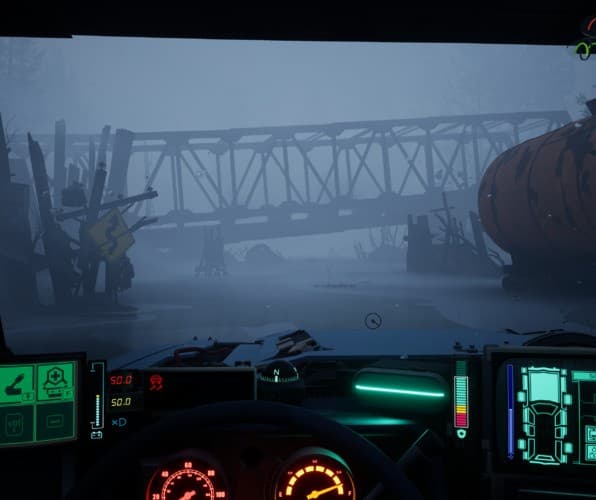
Three moments flipped the switch from “this is a good DLC” to “this is special.” First: a Rite of Community run where I realized my horn combo—the thing that had carried me—was actively making things worse. I stopped, killed the engine, let a Tourist clamp on, and listened to the radio guy chuckle through the static while the Tide ebbed. That little flash of “oh, you got me” design delight hit hard. Second: I tried to ignore a Hooligan because I was in a hurry; it sprinted up and kicked me square into a Gloom Pocket. The world went muffled and monochrome and it felt like being buried alive with the headlights on. Third: I took a detour for scrap I didn’t need and paid for it with a total wipe—I limped a three-tire sled toward the exit while the Tide poured over the hood like liquid shadow, and my wipers just made it worse. I escaped with a sliver of health and a new respect for restraint.
Who should play Whispers in the Woods
- If you bounced off Pacific Drive because the danger curve softened late-game, this DLC points it upward again with a steady hand.
- If you loved the vibe but wanted more “systems that talk to each other,” artifacts and attuned parts will scratch the buildcraft itch without turning it into a spreadsheet.
- If you’re here for pure lore dumps, temper expectations. The story beats are in the margins and the airwaves rather than long cutscenes.
- If you’re allergic to fiddly energy management, brace for the Harmonic Energy/Resonator ritual to test your patience until it clicks.
- If folk horror does it for you—rituals, masks, belief as technology—you’ll feel right at home, and then not at all at home, which is the point.
The little details that convinced me this was made to be played, not demoed
- The map screen gradually freckling with red Tide markers is a masterclass in slow-burn pressure—you feel hunted before you see anything.
- The way the DualSense hums when the Tide brushes the car—like a cat purring on a radiator—made me physically uncomfortable in the best way.
- Artifacts aren’t just passive stats; they tweak behaviors in ways that are legible in the moment. Honk-release is still my MVP combo.
- Rites push you into bad habits for good reasons, then make you unlearn them—smart design with narrative teeth.
- The radio’s cult leader performance is unsettlingly chipper. Horror rarely nails “pleasant menace.” This does.
What tripped me up (and how I’d fix it)
Harmonic Energy and the Resonator need fewer steps or clearer affordances. A simple “hold triangle to route energy along the whole chain” prompt, or a visible flow diagram on the altar UI, would turn a three-step shuffle into one satisfying ritual. As it is, I had a few sessions where the loop yanked me out of the game’s rhythm. Also, a toggle to allow artifacts to override each other with a quick prioritize menu would help when you accidentally create a combo (hi, Rite of Community) that punishes your muscle memory. The bones here are strong—the friction is in the joints.
The bottom line after 20 hours
Whispers in the Woods takes Pacific Drive’s road-worn station wagon and threads antlers through its grill. It’s the same machine, but it looks at you different. The Whispering Tide adds a pressure that reshapes your routes and your priorities. New anomalies inject mischief and danger that feel authored without feeling scripted. Artifacts and attuned parts make the kind of emergent builds I actually want to experiment with. Rites mess with your head in ways that feel playful and mean and fair. The Harmonic Energy/Resonator ritual is the one drag—a ritual that drags when it should feel sacred—but once it fades into the background, the DLC sings.
I went in thinking “spooky DLC for a non-horror game, sure, seen it.” I came out white-knuckled, laughing, and talking to my car like it was a scared dog. That’s a good night out, and a great reason to come back to the Zone. If you loved Pacific Drive even a little, this is a worthwhile return trip. If you never quite clicked with it, this might be the push: fear is an incredible teacher, and this DLC knows how to teach.
Score
8.5/10 — A tense, inventive folk-horror detour that occasionally stalls in its own rituals, but nails the feeling of being chased by something you can’t quite see.
TL;DR
- The Whispering Tide is a brilliant, dreadful pressure that reshapes how you play.
- Hooligan and Highwayman anomalies add memorable chaos and personality.
- Artifacts and attuned parts enable fun, emergent “car builds” that actually matter.
- Rites are clever rule-benders that make old roads feel new and scary again.
- Harmonic Energy/Resonator loop is fussy and unintuitive—but tolerable once learned.
- Performance on PS5 is solid with minor stutters during big physics moments.
- Come for the scares, stay for the stories you’ll tell about the ones that got away.
FinalBoss // Gear
Level up your setup
01Top-rated gaming headsetson Amazon→02High-refresh gaming monitorson Amazon→03Gaming chairson Amazon→04Discounted game keyson Kinguin→Affiliate links · As an Amazon Associate, FinalBoss earns from qualifying purchases.
Want to Level Up Your Gaming?
Get access to exclusive strategies, hidden tips, and pro-level insights that we don't share publicly.
Ultimate Reviews Strategy Guide + Weekly Pro Tips