
I’ve played a lot of “you run a small business” sims over the years-gas stations, cafés, mini-marts, even a deeply cursed medieval apothecary. There’s a pattern they almost all fall into: the first 30-60 minutes are a sleepy grind. Empty shop, no customers, tiny budget, a tutorial gently patting you on the head while you wait for the game to actually start.
Retro Rewind – Video Store Simulator basically looks at that formula, rips it up, and chucks it in the returns bin. Within about two minutes of starting my first day, I was juggling a line at the register, a stack of un-rewound tapes, a ringing phone, and a guy asking if I had something “with explosions, but… y’know, smart.”
I booted up the free PC demo on Steam “just to see what the vibe was” and resurfaced an hour and a half later with cramping fingers and a weird urge to buy a second-hand VCR. It’s one of the most immediately engaging job sims I’ve touched in years, and it leans so hard into ’90s VHS nostalgia that I could almost smell the plastic clamshells through my monitor.
Table of Contents (8)
The first 30 minutes: straight into the deep end (in a good way)
My usual expectation with management sims is: opening slog, slow trickle of customers, lots of staring at half-empty shelves. Retro Rewind doesn’t bother with any of that. You hop on your chunky old CRT-and-keyboard combo, slam in an order for some random tapes, plop a few shelves down… and as soon as you open the doors, people start streaming in.
No multi-day tutorial. No “we’ll unlock the register for you later.” The game assumes you can figure it out on the fly, and honestly, that immediacy is the hook. In my first in-game morning I:
- Emptied the returns bin and scanned a pile of bizarrely titled tapes (“A Scientist and His Sailor” being the early favorite)
- Realized half of them weren’t rewound, cursed their former renters, and popped them into my trusty rewinder
- Restocked shelves by hand, actually thinking about where to put horror vs. family movies
- Worked the register, taking cash and counting change instead of just clicking a “complete transaction” button
- Took a phone reservation from someone who “needed” the hottest new release that night
It’s busy from the jump, but it’s not overwhelming. There’s this pleasant clumsiness to your first day: you’re dashing between tasks, bumping into customers, occasionally letting someone wait a bit too long while you rewind yet another tape left at the credits. The pace feels surprisingly close to what working in an actually popular shop is like: not impossible, but you never really stop moving.
Tactile work beats spreadsheets: the joy of actually doing the job
The number one thing that makes Retro Rewind stand out is how hands-on everything feels. A lot of management sims abstract away the grunt work into menus and timers. Here, the grunt work is the game-and that’s why it’s weirdly compelling.
You don’t press a button to “process returns.” You walk to the giant blue bin by the door, scoop an armful of VHSes, and physically scan each one at your little counter terminal. The scanner makes that chunky beep that lives somewhere between a cash register and a supermarket checkout. It’s tiny details like this that give every task weight.
Rewinding is the same story. The returns that weren’t rewound get tossed into a pile, and you slap them into your rewinder one at a time, watching the little progress bar spin as the tape whirs back to the beginning. It’s busywork, but it’s satisfying busywork; the kind of small loop that keeps your fingers and brain gently occupied while you keep half an eye on the door for the next customer.
Even handling the register is more than a single click. You pick up the tape, scan it, the price pops up, you grab the cash, count the change, and hand it back. It reminded me a bit of House Flipper or PowerWash Simulator in the way it takes a mundane task and leans into the physicality of it-but the pace is way faster. You don’t get to zen out completely because someone is always queuing behind your current customer, or the phone rings just as you’re closing the till.

The result is that 10 minutes in, I wasn’t thinking about “systems” or “optimal builds”—I was just working the store, the same way I once found myself half an hour deep into The Coin Game without realizing I’d basically been doing virtual odd jobs in an arcade. The game nails that “one more task, then I’ll quit” rhythm.
A love letter to the ’90s video store (warts and all)
I’m just old enough to remember renting tapes as a kid and hovering around the horror aisle like it was forbidden knowledge. Retro Rewind taps straight into that memory bank. The whole store is bathed in warm fluorescent light and loud patterns—ugly in that perfectly period-accurate way. The movies have that direct-to-VHS, half-parody naming energy. The customers look slightly exaggerated and cartoony, reminding me a bit of the style in Schedule 1.
You’re not just running a bland “media rental business.” You’re running a very specific kind of shop from a very specific time. That means:
- People calling to reserve new releases, because if you didn’t, they’d be gone by Friday night
- Stacks of photocopied flyers to hand out on the street to drum up business
- Snack and drink machines by the walls so customers can grab a soda with their action flick
- Late fees lurking in the background as a future mechanic (the demo teases, but you can see the potential)
And yes, there’s an adult section. The game doesn’t turn it into a big sleazy spectacle—you just choose to dedicate a back-shelf area to “mature” content if you want to. But mechanically, it’s a clever bit of authenticity. Older players will remember that quiet moment where someone would shuffle up to the counter with an obviously adult tape, trying not to make eye contact. Retro Rewind captures that awkward energy without dwelling on it.
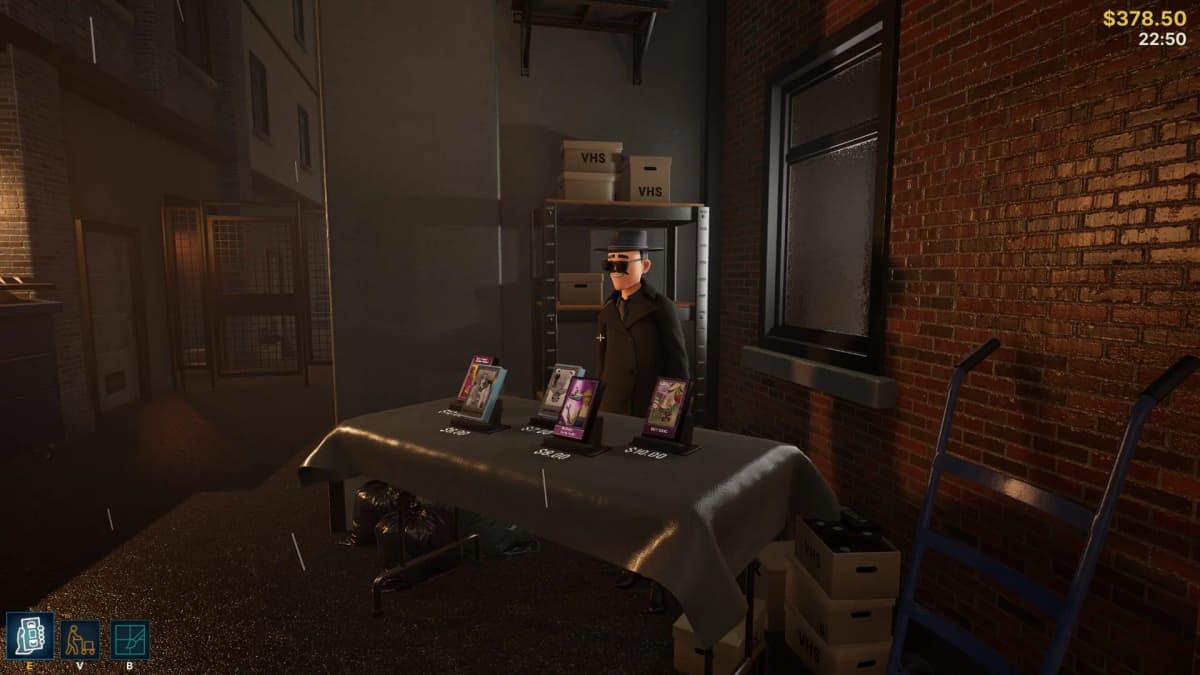
There’s even a shady vendor in the back alley who’ll hook you up with bootleg tapes: low-risk money, higher moral (and maybe legal) risk. In the slice I played it’s a small, simple decision—do you stock them or not—but you can see how it might spiral into bigger consequences as your store grows. It’s exactly the sort of “scrappy owner” temptation that fits the era.
From chaos to control: building the store of your dreams (or nightmares)
Underneath the frantic scanning and rewinding, Retro Rewind is still a management sim. You’re making money, expanding the shop, and trying not to drown in your own success. The more tapes you buy, the more shelves you need. The more shelves you have, the more customers show up, which means more tickets to process, more returns to sort, more phone calls to answer.
Pretty quickly I found myself planning out little “zones” in my cramped shop:
- New releases right up front for maximum impulse renting
- Family-friendly shelves near the counter so I could keep an eye on kids
- Horror and cult stuff tucked into a corner for the weirdos (my people)
- An awkward little nook in the back for the adult films, just like every sketchy rental place from my teens
There’s a basic but satisfying customization layer here: posters on the walls, tacky carpets on the floor, that kind of thing. It’s not full-on Two Point Hospital levels of interior design, but it gives your shop character, and more importantly, it makes you feel like this is your place, not a generic save file.
- New releases right up front for maximum impulse renting
- Family-friendly shelves near the counter so I could keep an eye on kids
- Horror and cult stuff tucked into a corner for the weirdos (my people)
- An awkward little nook in the back for the adult films, just like every sketchy rental place from my teens
There’s a basic but satisfying customization layer here: posters on the walls, tacky carpets on the floor, that kind of thing. It’s not full-on Two Point Hospital levels of interior design, but it gives your shop character, and more importantly, it makes you feel like this is your place, not a generic save file.
🎮 Get This Game at the Best Price
Compare prices instantly and save up to 80% on Steam keys with Kinguin — trusted by 15+ million gamers worldwide.
*Affiliate link — supports our independent coverage at no extra cost to you
What really hooked me was the hint of future complexity. The game lets you see that hiring employees is on the horizon, which is both a relief and a little scary. Right now, in the early game, you’re doing absolutely everything yourself: stocking shelves, handling the till, rewinding tapes, answering the phone, refilling snack machines. It’s busy and fun, but you can feel the ceiling approaching where you simply can’t keep up alone.
The idea of eventually delegating—putting an employee on returns while you focus on curation or promotion—has a ton of potential. If the full release delivers on that, it could hit a sweet spot similar to the later-game flow of Gas Station Simulator, where you go from harried clerk to slightly-more-competent manager without losing the tactile tasks entirely.
Always something to do: the pacing that kept me glued to the screen
After about 10 in-game days (roughly 90 minutes on my PC), I realized I hadn’t alt-tabbed once. No idle waiting for bars to fill. No dead air where I was just watching a clock tick down. Every “spare” moment is an opportunity: stock a shelf, check the alley, tweak your inventory, hand out flyers, or just do a quick rundown of what’s selling.
Each day is tightly structured. Morning is mostly about cleaning up yesterday’s mess: returns, rewinds, reshelving. Midday is a blur of rentals, recommendations, and calls. Evenings tilt toward last-minute rushes and impulse snacks. By closing time, I was often catching myself thinking, “Okay, one more day, then I’ll quit,” and of course, I didn’t.
This is where Retro Rewind reminds me of that Writing on Games piece about Downhill Domination: on the surface, it looks like silly, disposable PS2-era chaos, but under the hood it’s carefully tuned so you’re always making little decisions without feeling crushed by them. Do you leave a customer waiting at the till while you grab that ringing phone, or do you let the caller go to voicemail and risk losing a reservation fee? Do you spend your last bit of cash on a big-name new release or pad out a niche genre your locals seem to love?
The demo doesn’t go incredibly deep into long-term progression or failure states, so I can’t say how well this juggling act holds up over 20+ hours. But in the slice I played, the pacing is razor sharp. It respects your time while still making you feel like you’ve done a solid shift at the end of each day.
The rough edges and things that might not click for everyone
For all the praise, this isn’t some perfect, infinite sandbox—at least not yet. A few things stood out to me while I played.
First, repetition is baked into the concept. If the idea of scanning and rewinding dozens of tapes every in-game day makes you tired just reading this, Retro Rewind might not convert you. I found the rhythm soothing in that “oddly satisfying” way, but I can see some players bouncing off the routine once the novelty of the VHS aesthetic wears off.
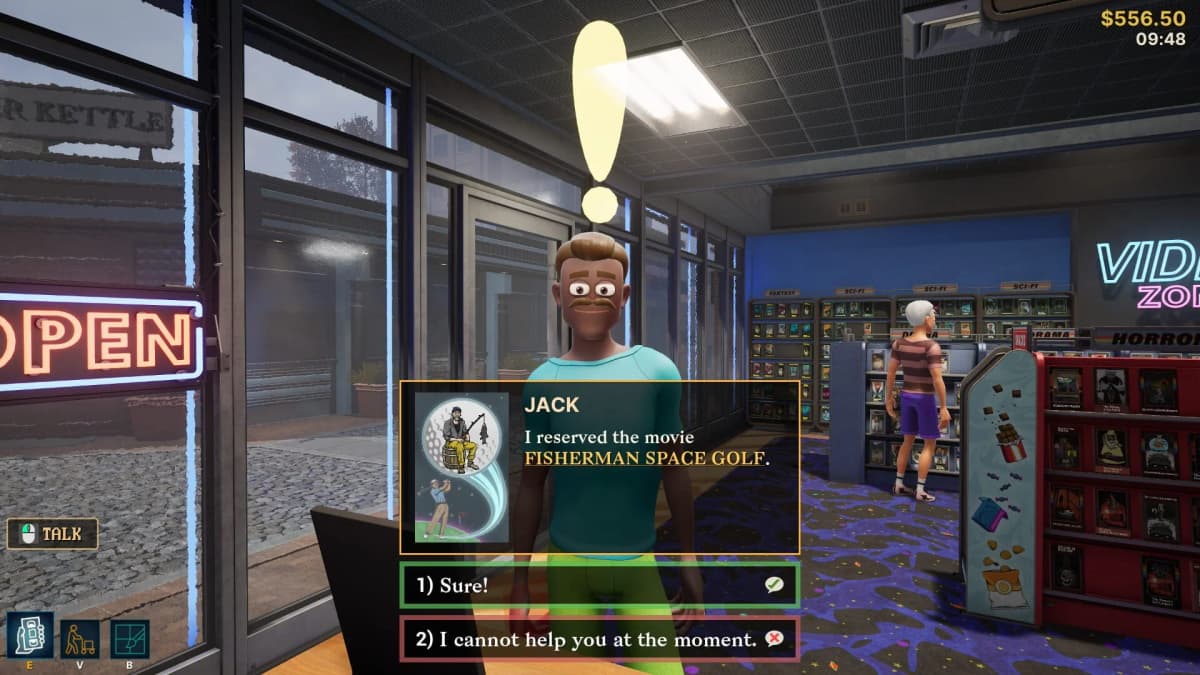
Second, the customer interactions are more functional than deeply characterful in the current build. You get some flavor text and preferences—“I want something scary but not too scary,” that kind of thing—but you’re not getting Persona-level social links or narrative arcs here. This is a job sim first, nostalgia trip second, narrative game a distant third.
Performance-wise, on my fairly average gaming PC (RTX midrange card, 1440p monitor), it ran flawlessly. No stutters, no crashes. At the same time, visually it’s clean and charming rather than technically impressive. If you’re chasing ultra-realistic lighting or 4K cine-photography, that’s not what this is aiming for. The cartoony look fits the tone, but it’s not going to melt your GPU—or your retinas.
Finally, because the game throws you into the deep end so fast, the onboarding might feel a little abrupt if you’re new to this type of sim. I enjoyed figuring things out on the fly, but there were a couple of moments where I realized after a few days, “Oh, I could have been doing that more efficiently from the start.” A few more subtle tutorial nudges wouldn’t hurt, especially around inventory planning and customer preferences.
Who Retro Rewind is perfect for (and who might want to skip it)
If any of the following statements make your heart flutter a little, this game is probably for you:
- You grew up haunting the horror or anime aisle of your local VHS rental place.
- You love tactile, first-person sims like Gas Station Simulator, House Flipper, or The Coin Game, where you’re actually doing the job, not just moving sliders.
- You prefer games that get busy quickly instead of making you grind through an hour-long tutorial.
- You’re a sucker for lo-fi, slightly janky, deeply cozy indie experiences.
On the other hand, you might want to hold off or just stick to the free demo if:
- You need complex economic simulations with detailed spreadsheets and market modeling.
- You bounce hard off repetitive tasks and micro-management loops.
- You want a heavy story focus or deep character arcs from your sims.
- The VHS era means nothing to you and you don’t particularly care about ’90s nostalgia.
The cool thing is that the demo already gives you a clear snapshot of how the full game is going to feel moment-to-moment. Within 20 minutes you’ll know whether scanning tapes and restocking shelves under fluorescent lights is your idea of a good time or a digital nightmare.
FinalBoss // Gear
Level up your setup
01Top-rated gaming headsetson Amazon→02High-refresh gaming monitorson Amazon→03Gaming chairson Amazon→04Discounted game keyson Kinguin→Affiliate links · As an Amazon Associate, FinalBoss earns from qualifying purchases.
Want to Level Up Your Gaming?
Get access to exclusive strategies, hidden tips, and pro-level insights that we don't share publicly.
Ultimate Reviews Strategy Guide + Weekly Pro Tips