
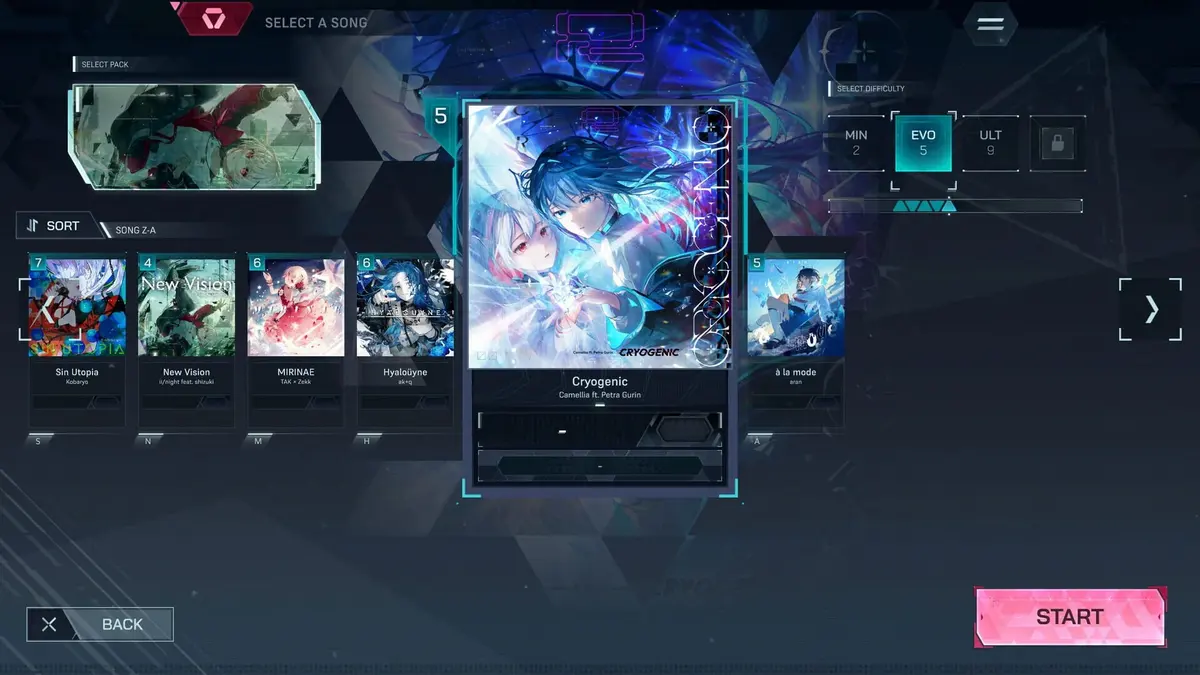
In Falsus puts more than 70 songs on its launch-day slate, yet the music that most justifies its price is not waiting in a generous song-select menu. It sits behind a progression structure that asks players to commit to a lengthy visual novel, card crafting, and light puzzle work before the game opens its richest rhythmic material. That contradiction defines lowiro’s ambitious rhythm adventure: the play is sharp enough to demand attention, while the route to more of it is far harder to defend.
Released on Steam for Windows PC on September 9, 2026, In Falsus costs US$39.99, with a US$35.99 launch discount. At that price, I expected a rhythm game willing to foreground its charts and soundtrack. Instead, lowiro has built a full hybrid experience around them. Parts of that decision are genuinely distinctive. Other parts repeatedly make the game feel protective of its own best material.
Table of Contents (7)
What defines In Falsus
- The keyboard-and-mouse 6-KEY system creates a demanding physical rhythm language built around two different input zones.
- More than 70 songs are included at launch, with more than 40 original tracks written specifically for In Falsus.
- Four difficulty settings — MINIMAL, EVOLVED, ULTIMATE, and FORBIDDEN — support charts that reach level 11.
- Five high school girls lead a Japanese-voiced, branching near-future visual-novel story about lies, emotions, and Binds.
- Scenario progression, Cards, crafted materials, and song access are tied together so tightly that rhythm-first players cannot cleanly separate one from the others.
The rhythm system is the reason to play
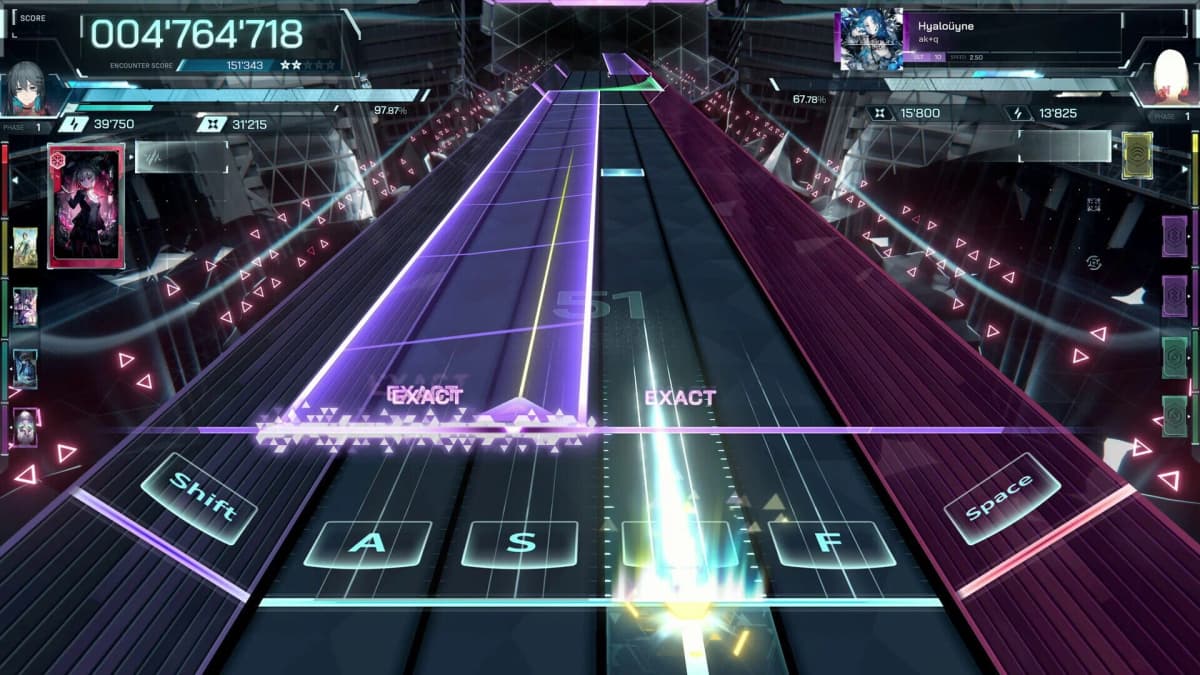
In Falsus earns its strongest praise the moment its mouse-and-keyboard system takes over. The left hand handles the keyboard while the right hand manages the mouse, creating a split-focus format that asks for much more than fixed-lane tapping. The upper lane uses the mouse for Field and Flick notes, while the lower lane assigns Tap and Hold inputs to ASDF, Left Shift, and Space. That division gives the game a genuinely different rhythm-game identity.
The mouse-controlled skylane work is the centrepiece. Rather than merely reacting to notes arriving in a familiar set of columns, the player has to maintain spatial control with the mouse while keeping the keyboard hand locked into precise timing. The system creates pressure through coordination rather than visual clutter. A chart can demand clean lower-lane execution while the upper lane pulls attention across the screen, forcing both hands into a conversation that standard keyboard rhythm formats rarely create.
That is why the charts feel so satisfying when they click. In Falsus does not flatter the player with a soft learning curve or a passive presentation. It asks for deliberate movement, rhythm discipline, and the willingness to develop muscle memory across two different control languages. The difficulty ladder gives that structure room to breathe: MINIMAL, EVOLVED, ULTIMATE, and FORBIDDEN allow the game to accommodate a broad range of comfort levels, while the level-11 ceiling provides a meaningful destination for players seeking dense, demanding charts.
I admire how confidently lowiro commits to the mouse. It would have been easy to treat the pointer as a decorative extra, but In Falsus makes it mechanically central. The result is a rhythm system with real personality, one that turns hand placement and screen space into part of the challenge. When the game is focused on this relationship between the skylane and the keys, it belongs in the conversation with the most inventive PC rhythm design.
The soundtrack deserves far more freedom
The soundtrack compounds that positive impression. More than 70 songs are available at launch, and more than 40 of them were composed specifically for In Falsus. That is substantial musical weight for a new rhythm release, especially one built around an electronic identity and charts demanding enough to invite repeat attempts. The library is not a side dish to the narrative. It is the game’s clearest source of energy and its most convincing long-term draw.
Unfortunately, In Falsus treats song access as a reward for participating in its wider progression loop. The scenario unlocks music. Card strength helps with harder scenario encounters. Rhythm play then feeds into the broader structure. The design is coherent in the narrowest sense: every system has a reason to exist, and no mode is completely isolated from the rest. Coherence, that said, does not automatically equal convenience or pleasure.
For a player who wants to practice charts, chase improvement, or simply sample the full launch library, this structure is a serious limitation. The game ties nearly its entire discography to story progression, including its most desirable material. A 70-plus-song headline loses some of its force when access to that catalogue is paced by mandatory non-rhythm content. The issue is not that a rhythm game has a narrative. The issue is that the narrative has too much authority over the music.
That choice makes In Falsus feel unusually possessive of its own strengths. The more compelling the songs become, the more frustrating it is to encounter a gate between the player and the next chart. Rhythm games thrive on return visits: drilling a pattern, raising a score, moving upward through difficulty, or simply playing a favourite track again. The available material does not establish that the complete soundtrack becomes freely selectable before story completion, and that uncertainty undercuts the game’s strongest replay argument.
The story has ambition, but it carries too much weight
In Falsus is built around five high school girls in a near-future society where emotions and deception become visible through Binds, the colour-changing neckwear that reacts to lies. The concept gives the game a strong visual and thematic foundation. A world where private feelings become public signals has obvious dramatic potential, and the five-protagonist structure could have created an involving network of competing perspectives.
The problem is that the writing does not make the required investment feel worthwhile. The visual-novel material is long-form, fully voiced in Japanese, and branching, but its central role in the game magnifies every weakness. This is not a brief narrative wrapper before the real game begins. The scenario is the lock on the door to the soundtrack, which means its pacing and prose are forced to carry the expectations of rhythm fans who may have arrived primarily for the charts.
In a more successful hybrid, the story sections would build anticipation for the next musical challenge or deepen the emotional meaning of a song already worth replaying. Here, the relationship too often reverses. The music gives the narrative urgency that the narrative does not consistently generate on its own. In Falsus wants its themes of truth, lies, and visible emotion to connect every component, but the writing does not earn the degree of control it has over progression.
The structural issue is more important than any individual scene. Scenario advancement is not optional flavour text, and the game does not let rhythm-focused players push deeply into one subsystem while leaving the others behind. That can be a strength for players seeking a deliberately integrated adventure. For everyone else, it creates friction every time the game withholds another chart in service of a story that has not convinced them to stay.
Cards add texture, yet also extend the detour
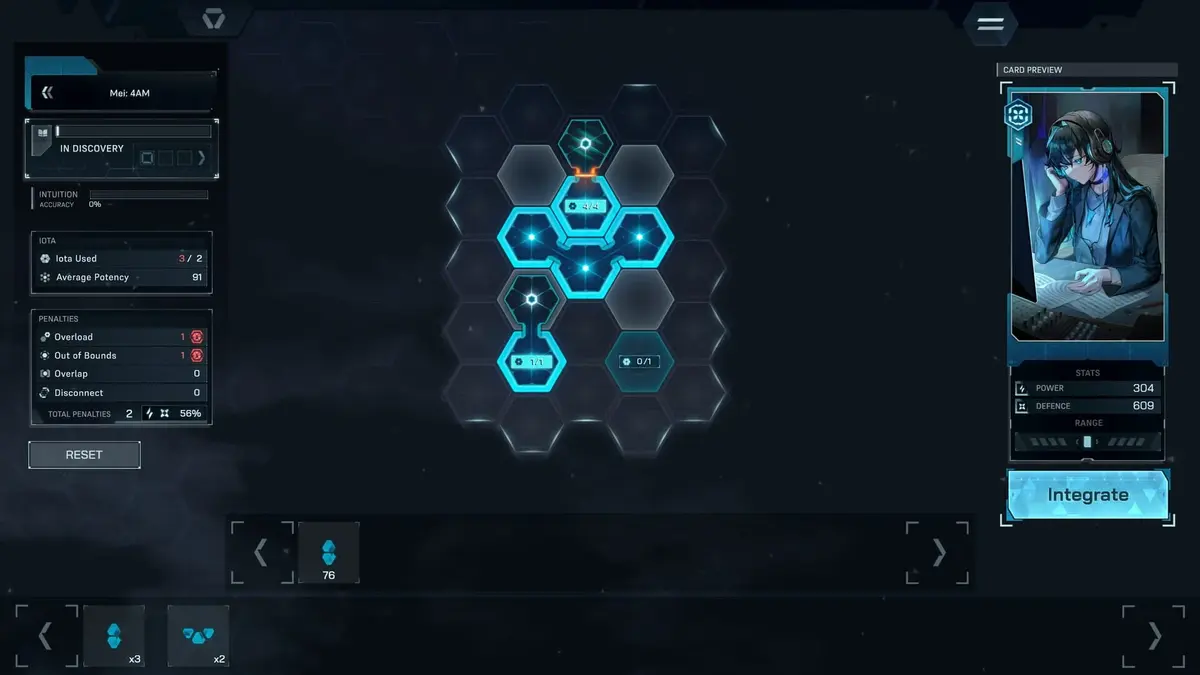
The card system reinforces the same all-or-nothing philosophy. Cards modify gameplay, and up to five can be equipped at once. Blueprints allow crafted Cards to be integrated by slotting earned materials into grid layouts, giving the progression layer more texture than a simple sequence of unlock notifications. There is a real attempt here to make preparation matter rather than treating it as a cosmetic menu exercise.
That system has value because it gives the adventure structure mechanical stakes. Stronger Cards support harder scenario encounters, while materials and blueprints create an additional reason to consider how the game’s systems fit together. Players who enjoy light buildcraft alongside visual-novel storytelling may find this interdependence rewarding. In Falsus has clearly been designed as a rhythm adventure rather than a pure score-attack package.
Still, the Cards cannot solve the larger pacing problem. They make the detour more elaborate, not less of a detour. Every added layer increases the distance between a rhythm-first player and the next meaningful chart. The card mechanics are competent enough to support the premise, yet they do not transform the mandatory progression loop into something I want to revisit as eagerly as the music itself.
Who should play In Falsus
In Falsus is for players who want a hybrid experience and are willing to accept the visual novel, Cards, materials, and puzzles as essential parts of the rhythm journey. Anyone drawn to intricate mouse-and-keyboard coordination, difficult electronic charts, Japanese voice acting, and a five-protagonist narrative framework will find a lot of ambition here. The game rewards patience because its core rhythm design has genuine depth.
Players seeking immediate song access, rapid practice sessions, or a front-end built around unrestricted chart selection should be much more cautious. The story is structurally tied to access, and the game’s best musical rewards are not placed within easy reach. For that audience, the frustration is not a minor inconvenience. It is the central compromise.
Bottom line
In Falsus earns a 7/10. Its rhythm system is excellent: inventive, demanding, and built around a mouse-and-keyboard format that gives the game a rare mechanical identity. The large soundtrack and level-11 chart ceiling provide a strong foundation for replay, but the visual-novel and card progression loop places too much distance between players and the music they came to play.
lowiro has made a game with elite rhythm mechanics and a frustrating sense of access control. The unresolved tension is whether an integrated rhythm adventure should ask players to embrace every one of its systems before granting them full access to its greatest strength. Here, the charts make a powerful case for patience; the surrounding structure never fully earns the right to demand it.
FinalBoss // Gear
Level up your setup
01Top-rated gaming headsetson Amazon→02High-refresh gaming monitorson Amazon→03Gaming chairson Amazon→04Discounted game keyson Kinguin→Affiliate links · As an Amazon Associate, FinalBoss earns from qualifying purchases.
Want to Level Up Your Gaming?
Get access to exclusive strategies, hidden tips, and pro-level insights that we don't share publicly.
Ultimate Reviews Strategy Guide + Weekly Pro Tips