
Intel is nudging laptop gaming performance forward with its new Core Ultra 200HX “Plus” chips, but the more interesting story right now might be how quickly everything around those CPUs is getting better – and cheaper.
- Intel’s new Core Ultra 9 290HX Plus and Ultra 7 270HX Plus promise around 8% more gaming performance at the top of the stack without adding cores or raising max clocks.
- The gains come from under-the-hood tweaks – a 900MHz die‑to‑die frequency bump and a new Binary Optimization Tool that speeds up select games at the software level.
- OEMs will use these in premium rigs from ASUS ROG, Lenovo Legion, Alienware, Razer, MSI, and more – while last‑gen HX laptops with OLED and RTX 50‑series GPUs are already dropping under $1,300.
- Meanwhile, displays are racing ahead, with 180Hz 1440p gaming monitors dipping under $200, arguably offering more noticeable upgrades than an 8% CPU bump for most players.
Table of Contents (7)
Intel’s ‘Plus’ branding is about bragging rights, not mass upgrades
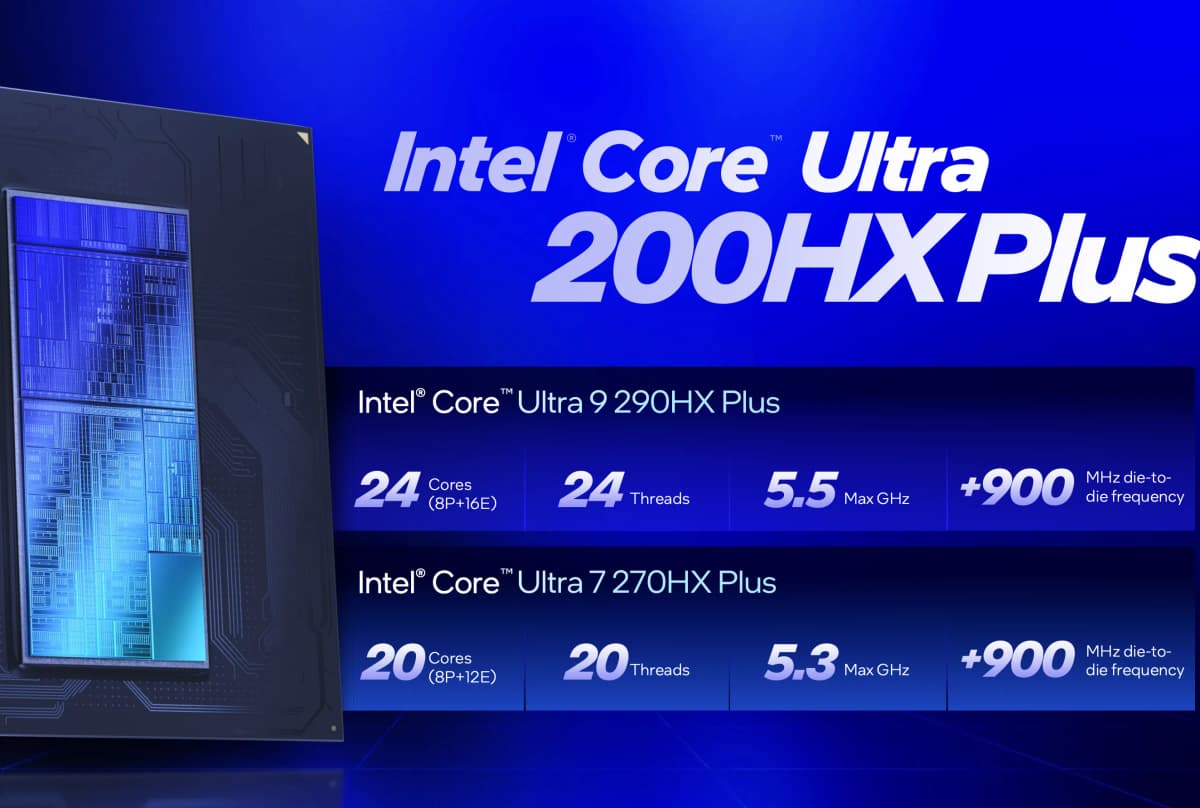
On paper, the new Arrow Lake Refresh mobile flagships look familiar. The Core Ultra 9 290HX Plus sticks with 24 cores (8 performance, 16 efficient) and a 5.5GHz boost clock – the same core count and peak frequency as the existing 285HX. The Core Ultra 7 270HX Plus mirrors the 265HX with 20 cores (8P + 12E) and a 5.3GHz boost, with a small bump to E‑core frequency.
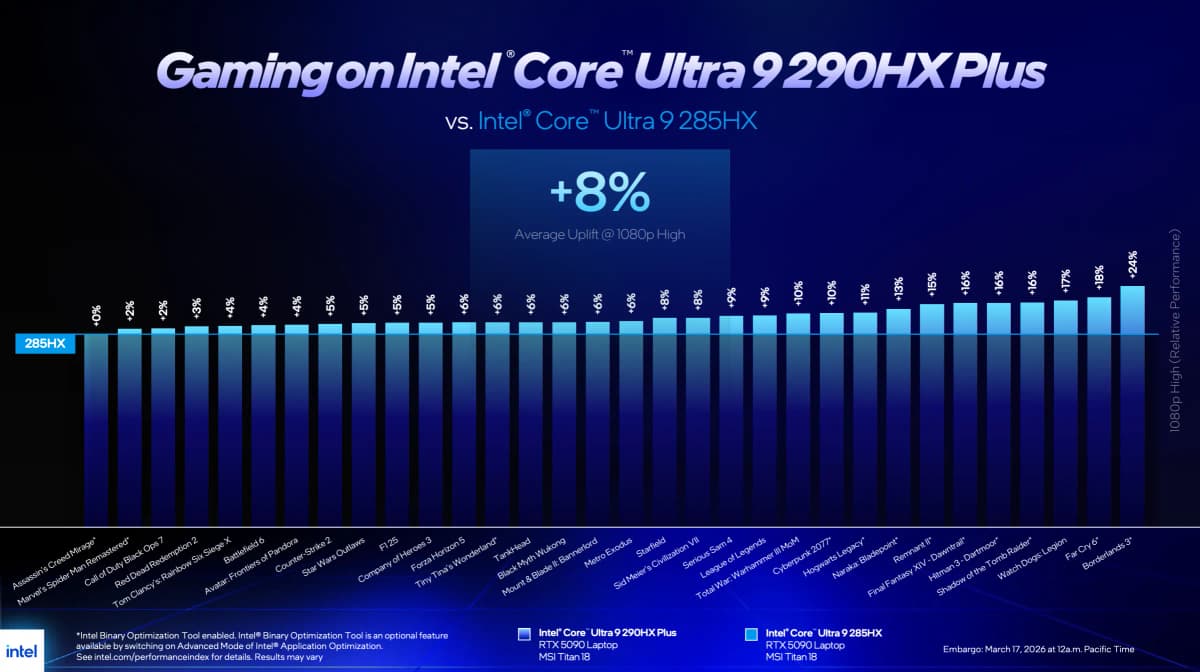
Yet Intel is claiming roughly 8% average gaming uplift over the 285HX generation at 1080p High, and much bigger wins versus older Alder Lake parts like the i9‑12900HX. No extra cores. No headline frequency bump. So what changed?
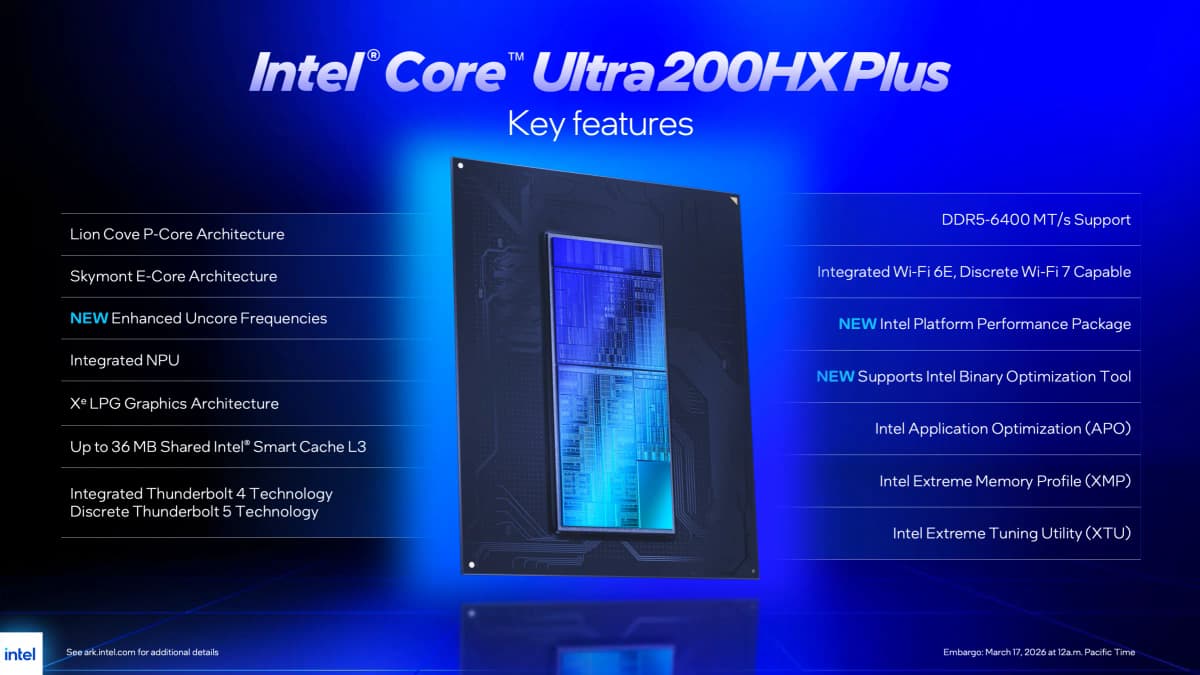
Two things matter here. First, Intel cranked up the die‑to‑die (Uncore) frequency by 900MHz, speeding up how fast the CPU tile talks to the rest of the SoC. That means lower latency between cores, cache, and memory – exactly the stuff that can squeeze out a few extra FPS in CPU‑bound games. Second, there’s the new Intel Binary Optimization Tool (BOT), a software layer that rewrites application code on the fly to run more efficiently on Arrow Lake in “select games.”
This is the new shape of enthusiast CPUs: less about adding more cores every year, more about wringing a few extra percent out of the silicon we already have with smarter interconnects and clever software.
8% more gaming is nice – but not a reason to ditch a 255HX or 285HX
Intel’s own positioning tells you who this is for. The “Plus” label is explicitly their enthusiast tier at the top of the mobile stack, destined for halo laptops from Lenovo Legion, ASUS ROG, Alienware, HP, Acer Predator, Razer, MSI, and Maingear. We’re talking 16–18 inch monsters with RTX 50‑series GPUs, big power bricks, and price tags to match.
If you’re on something like a Core Ultra 7 255HX already – the 20‑core chip powering Lenovo’s 2025 Legion Pro 5 Gen 10 – this isn’t suddenly making your laptop obsolete. That Legion Pro 5 configuration IGN highlighted pairs the 255HX with an RTX 5070 (115W), 16GB of DDR5‑5600, a 1TB SSD, and a 16‑inch 2.5K 165Hz OLED panel with VESA True Black 600 and full DCI‑P3 coverage. It’s Wi‑Fi 7 ready, has DisplayPort 2.1 over USB‑C, HDMI 2.1 – and it’s already dipped below $1,300 in spring sales.
That’s the uncomfortable comparison for Intel: while they’re selling an 8% bump at the very top end, last‑gen HX chips are already “fast enough” for most people and are being bundled with legitimately high‑end GPUs and OLED screens at midrange prices.
Where the 290HX Plus and 270HX Plus really shine is for people jumping from older platforms – say an Alder Lake i9‑12900HX. There, Intel’s own numbers show huge gaming and single‑threaded gains, plus modern perks like Thunderbolt 5, Wi‑Fi 7, and better power management. If you’ve been sitting on a three‑ or four‑year‑old gaming laptop waiting for a “big” step, combining these CPUs with current‑gen GPUs and panels might finally justify the leap.
Where the 290HX Plus and 270HX Plus really shine is for people jumping from older platforms – say an Alder Lake i9‑12900HX. There, Intel’s own numbers show huge gaming and single‑threaded gains, plus modern perks like Thunderbolt 5, Wi‑Fi 7, and better power management. If you’ve been sitting on a three‑ or four‑year‑old gaming laptop waiting for a “big” step, combining these CPUs with current‑gen GPUs and panels might finally justify the leap.
🎮 Get This Game at the Best Price
Compare prices instantly and save up to 80% on Steam keys with Kinguin — trusted by 15+ million gamers worldwide.
*Affiliate link — supports our independent coverage at no extra cost to you
The real shock is how fast displays are outpacing CPUs
While Intel fights for single‑digit gains at the silicon level, the rest of the gaming stack is racing ahead in ways you feel instantly.
Take monitors. WePC spotted the ASUS ROG Strix XG27ACS – a 27‑inch 1440p Fast IPS 180Hz gaming display with 1ms GtG, G‑Sync Compatible support, ELMB Sync, HDR400, and USB‑C with up to 90W power delivery – dropping to $199 on Amazon, down from $269.
180Hz at 1440p with decent HDR and wide color (ASUS quotes 133% sRGB) used to be mid‑to‑high‑end territory. Now it’s flirting with budget pricing. Pair that with even a “mere” RTX 4070‑tier GPU and an older HX CPU, and you’ve transformed your experience more dramatically than any 8% CPU uplift is going to.
It’s the same on the laptop side: that sub‑$1,300 Legion Pro 5 with a 2.5K 165Hz OLED panel will change how your games look and feel far more than going from 255HX to 270HX Plus ever will. Black levels, motion clarity, input response – these are upgrades you notice in the first five minutes.
The question Intel hasn’t answered yet: how often will BOT actually matter?
The most interesting part of these chips might not be the silicon at all, but Intel’s Binary Optimization Tool. Intel is pitching BOT as a “first‑of‑its‑kind” layer that improves native performance in select games – no AI frame generation, no skipped work, just smarter code paths for Arrow Lake.
That sounds great, but there are two big unknowns:
- How many games will actually be optimized? “Select titles” can mean anything from a handful of showcase AAA releases to a real, growing list of popular games.
- Will those gains reach current, non‑Plus Arrow Lake laptops? If BOT is purely a platform feature, last‑gen buyers might still benefit. If it’s limited to “Plus” silicon, it starts to look more like a marketing bullet.
If I had Intel’s PR in front of me, that’s the question I’d push: what’s the roadmap for BOT support, and how many titles will be optimized by the end of 2026? Without that answer, it’s hard to judge how much of this 8% uplift is a lab demo versus something you’ll feel in a Steam library with a backlog the size of your SSD.
What to watch next
- Independent benchmarks: Third‑party reviews of 290HX Plus and 270HX Plus laptops over the next few months will show whether Intel’s 8% gaming uplift holds up – and in which titles.
- Actual laptop launches: Keep an eye on new ROG, Legion, Alienware, and Predator models through mid‑2026, especially where these CPUs are paired with RTX 50‑series GPUs and high‑refresh OLED or mini‑LED screens.
- BOT support lists: Watch for Intel to publish (or leak) a concrete list of BOT‑optimized games and update cadence. That’ll tell us if BOT is a real ecosystem play or just launch fluff.
- Price pressure from last‑gen HX rigs: Deals like the Legion Pro 5 under $1,300 are the canary in the coal mine; if they become common, “Plus” laptops will need more than single‑digit gains to justify premium pricing.
TL;DR
Intel’s new Core Ultra 9 290HX Plus and Ultra 7 270HX Plus squeeze about 8% more gaming performance out of Arrow Lake laptops via faster die‑to‑die links and a new Binary Optimization Tool, not more cores. That’s meaningful if you’re jumping from older Alder Lake machines, but it’s not a must‑upgrade for anyone already on recent HX silicon, especially while OLED gaming laptops and 180Hz 1440p monitors are crashing in price. For most players, the smartest move in 2026 isn’t chasing a “Plus” badge – it’s pairing a solid CPU with a better GPU and a legitimately great display.
FinalBoss // Gear
Level up your setup
01Top-rated gaming headsetson Amazon→02High-refresh gaming monitorson Amazon→03Gaming chairson Amazon→04Discounted game keyson Kinguin→Affiliate links · As an Amazon Associate, FinalBoss earns from qualifying purchases.
Want to Level Up Your Gaming?
Get access to exclusive strategies, hidden tips, and pro-level insights that we don't share publicly.
Ultimate Gaming Strategy Guide + Weekly Pro Tips