
Table of Contents (6)
Intel’s new gaming CPU actually changes laptop choices – here’s why
This caught my attention because integrated graphics finally stopped being a polite afterthought and turned into something you can legitimately game on. Intel’s new Core Ultra 300 “Panther Lake” laptop chips ship an Arc B390-based Xe3 GPU that, in early hands-on testing, stomps AMD’s Ryzen AI 300 integrated graphics by massive margins – to the point where demanding titles like Cyberpunk 2077 and F1 25 hit playable frame rates without a discrete GPU.
- Arc B390 (Xe3) delivers roughly 50-78% better real-world performance versus Ryzen AI 300 integrated graphics.
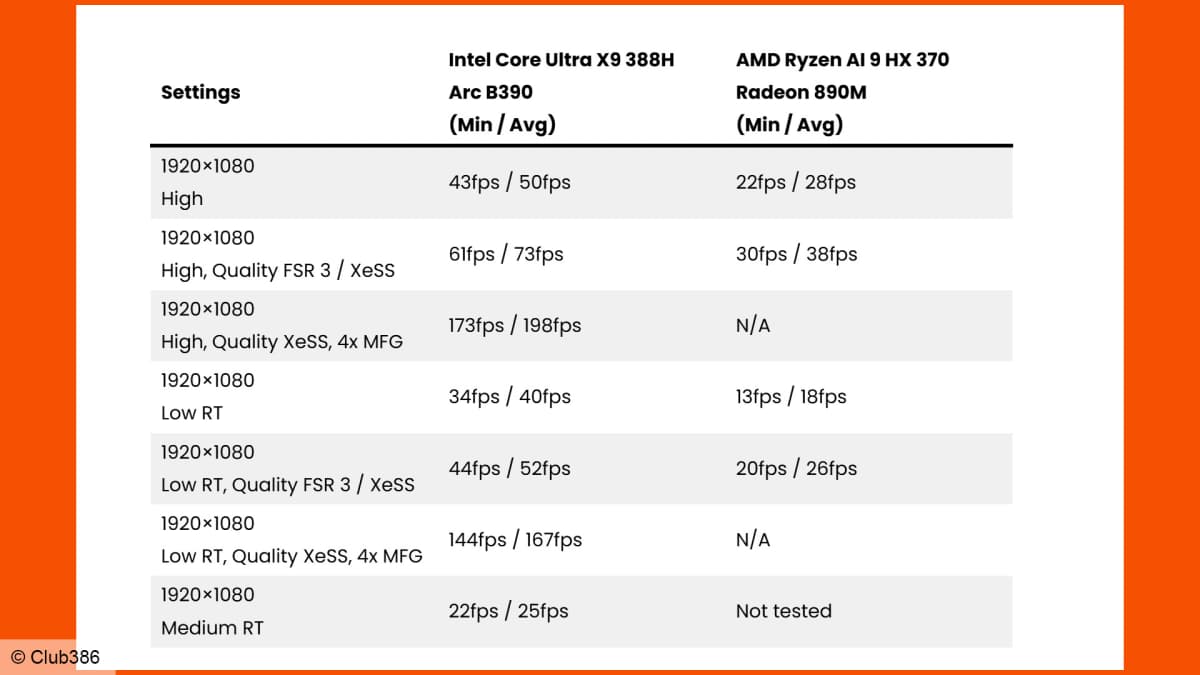
- Cyberpunk 2077: Intel ~50fps (1080p high) vs AMD ~28fps in Club386 tests; ray tracing even hits ~40fps on low.
- Upscaling + multi-frame generation pushes numbers into the hundreds but uses “fake frames” – don’t confuse that with native rendering.
- Caveat: the fastest results require Intel’s X-series mobile SKUs (X9 388H) and will cost more.
Breaking down the numbers (the stuff that actually matters)
Club386 compared a Lenovo laptop with an Intel Core Ultra X9 388H against an Asus Vivobook S with an AMD Ryzen AI 9 HX 370. In Cyberpunk 2077 at 1080p on the high preset, Intel posted about a 50fps average with 43fps 1% lows while the AMD system managed 28fps average and 22fps 1% lows. Intel’s claim of a ~73% GPU uplift versus AMD’s Radeon 890M is backed up — Club386’s hands-on showed up to ~78% better frame rates in some tests.
That matters because hitting 40-60fps in Cyberpunk 2077 on stock laptop hardware used to require a discrete RTX-class GPU or heavy upscaling. Panther Lake also supports XeSS upscaling and multi-frame generation, which Club386 used to push frame rates to as high as ~198fps — but that comes with the familiar trade-off of generated frames (they counted three generated frames for every real one in that test). Still, the ability to pair quality upscaling with an integrated GPU is a sea change.

Why now — and why Intel’s approach works
Panther Lake isn’t just a GPU bump. Intel merged power-saving lessons from Lunar Lake with Arrow Lake’s tiled, scalable design and moved to the Intel 18A manufacturing process. That combination allows the Arc B390 to run far closer to discrete GPU class performance while staying inside the thermal and battery envelope of modern laptops. For gamers who juggle work and play, that’s huge — one machine can handle productivity and AAA gaming without a separate GPU.
Caveats, AMD’s response, and the real competitive picture
Don’t pop the champagne for AMD just yet. The Ryzen AI 400 series hasn’t improved integrated GPU performance over the tested Ryzen AI 300 chips, and AMD’s real high-end play is its Ryzen AI Max / Strix Halo series (Strix Halo is the one with discrete-level integrated GPU). In my prior testing of the Strix Halo-based Ryzen AI Max 390, compact devices could hit around 50fps in Cyberpunk 2077 — very strong, but historically these Strix Halo SKUs have been expensive.
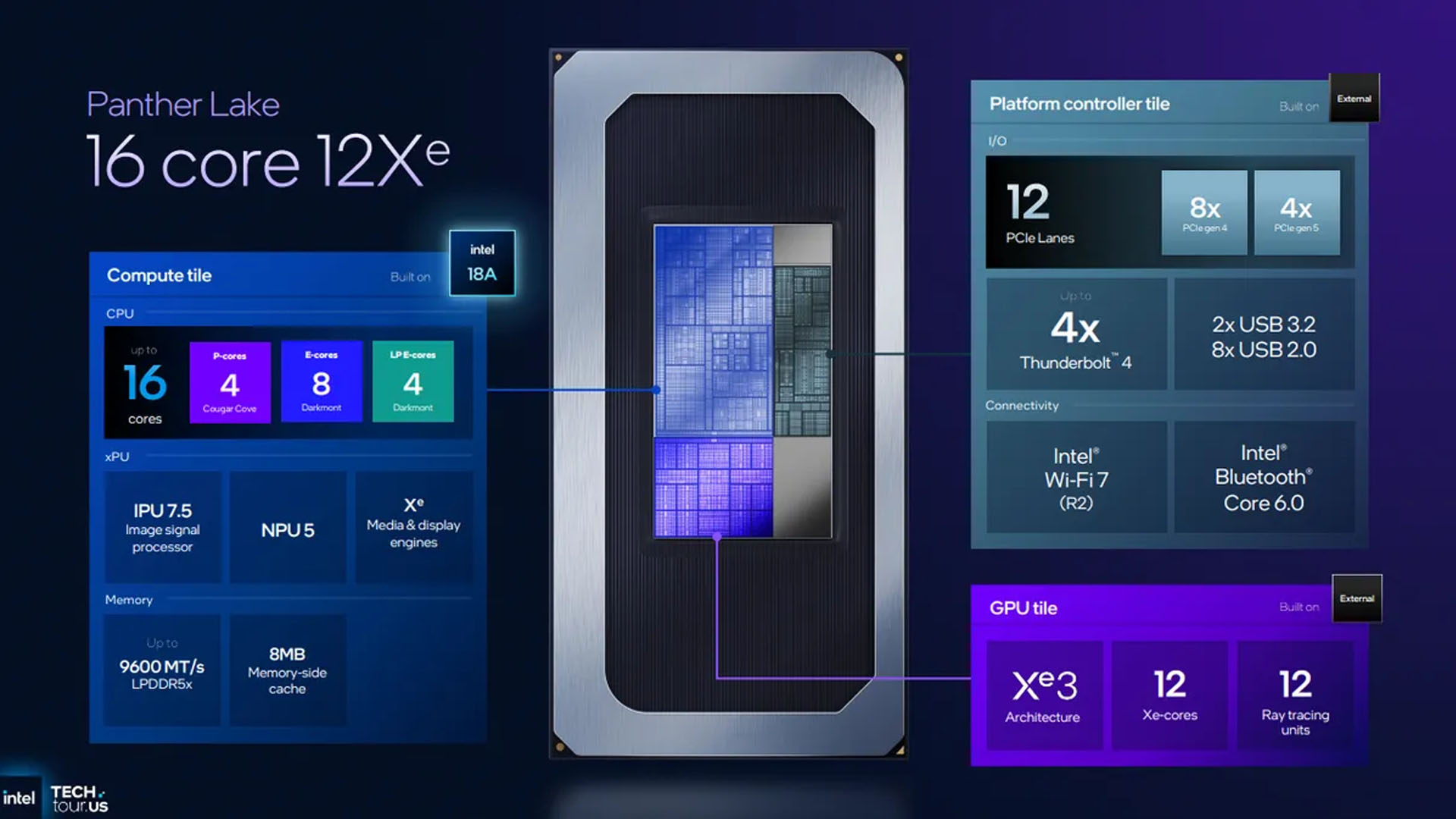
AMD’s newer Strix Halo models aiming to cut core count (and price) while keeping GPU muscle are an important counterpunch. If those arrive at consumer-friendly prices, Intel’s one-two punch might be checked. For now, that said, Panther Lake’s Arc B390 gives Intel a practical win for mainstream and thin-and-light gaming laptops.
What gamers should actually do
If you’re shopping for a gaming laptop in 2026, pay attention to the suffix: the X in Core Ultra X9 388H matters. It denotes the higher-tier GPU silicon. Expect a premium for those chips, but also expect a laptop that can handle modern AAA games at reasonable settings without a discrete GPU. If you own or plan to buy a thin, work-first laptop and want casual to serious gaming on the side, Panther Lake changes the calculus.
That said, if you want the absolute best integrated-GPU play and price isn’t an object, watch AMD’s Strix Halo refresh. If you want the best value-for-performance right now, Panther Lake looks like the smarter bet for many buyers.
TL;DR
Intel’s Core Ultra 300 Panther Lake chips with Arc B390 Xe3 GPUs represent a real turning point for integrated laptop gaming. They don’t magically replace discrete GPUs for desktop-level performance, but for gamers who want one machine that does work and plays modern AAA titles without a hot, power-hungry dGPU, Panther Lake is a game-changer — and 2026 is shaping up to be the year gaming laptops finally get interesting again.
FinalBoss // Gear
Level up your setup
01Top-rated gaming headsetson Amazon→02High-refresh gaming monitorson Amazon→03Gaming chairson Amazon→04Discounted game keyson Kinguin→Affiliate links · As an Amazon Associate, FinalBoss earns from qualifying purchases.