
Table of Contents (10)
Kena on Switch 2: A “smaller” version that somehow feels like the right one
The first thing that hit me booting up Kena: Bridge of Spirits on Switch 2 wasn’t a frame-rate counter or pixel-peeping comparison. It was the way the opening forest just felt right on a handheld screen, curled up on the couch, Rot wobbling behind Kena like a tiny, chaotic entourage. I’d already played (and beaten) Kena on PS5 back in 2021, where it was this pristine “look, the new console is here” showpiece. On Switch 2, it’s less of a showroom demo and more of a cozy hike with a gorgeous art book in your lap-and that shift actually suits the game a lot more than I expected.
This port is clearly built as a reintroduction ahead of the sequel, a chance for anyone who skipped it the first time (or drifted off halfway through) to come back under friendlier conditions. Ember Lab has bundled in all the DLC, tweaked difficulty options, and leaned on DLSS to keep things moving. The result isn’t perfect-if you know what Kena looks like on PS5 or a high-end PC, you will see the cuts-but as an overall package on Nintendo’s new hardware, it’s easy to recommend.
Remembering what made Kena special in the first place
Coming back to Kena a few years later, I’d honestly half-forgotten the details of the plot. What I remembered was vibes: the way the forest glows at dusk, the soft chimes in the soundtrack as you crest a hill, and, of course, the Rot—those soot-sprite cousins that turn the whole game into a walking plushie catalogue once you start putting hats on them.
In case this is your first time, the setup is simple but effective. Kena is a Spirit Guide, tasked with helping restless spirits move on by unraveling what’s keeping them tethered and, when necessary, whacking corrupted monsters with a very solid staff. The story isn’t some wild twist machine; it’s more like a well-done animated film about grief, guilt, and letting go, the kind of thing that would be right at home on your streaming service’s “emotional but wholesome” row.
That comparison isn’t accidental. Kena made a name for itself as “the Pixar-looking indie,” and yeah, the cutscenes still carry that energy. Stylized but expressive faces, lush environments, strong silhouettes on every character—it’s all art-direction-first rather than raw tech flex. That’s partly why this Switch 2 version survives the downgrade as gracefully as it does: the underlying design is good enough that it doesn’t collapse when you start shaving off visual flourishes.
Visual compromises: where the Switch 2 cut the corners
Let’s get the obvious out of the way: if you play this right after the PS5 version, you’ll spot the differences within seconds. The two big tells for me were hair and edges.
Kena’s hair on PS5 is this flowing, almost overachieving mass of strands that swish and react in a way you don’t usually see from a smaller studio. On Switch 2, it’s noticeably toned down: chunkier, less reactive, and missing some of that ultra-fine detail. It doesn’t look bad—it just looks like someone turned the “fancy hair” slider from 11 down to about 7 so the system doesn’t melt. We’ve seen a similar thing happen in other demanding ports, and it’s the same trade here: save the processing power for the stuff that actually affects how it plays.
The other giveaway is edge shimmer. When you’re exploring villages or looking at wooden beams and rooftops at an angle, the anti-aliasing on Switch 2 just isn’t as clean as the PS5 version. You get that subtle “twinkle” on fine geometry when you move the camera, especially in docked mode on a big TV. It’s not catastrophic, but if you’re used to pristine image treatment, your eyes will notice it immediately.
The thing is, these compromises are kind of the cost of doing business on a hybrid console—even this newer, beefier one. And again, because Kena leans so heavily on strong shapes, confident lighting, and smart colour work, the overall look survives the haircut. The moody purples of corruption, the warm oranges of village lanterns at night, shafts of light through dense foliage…it all still lands emotionally.
In handheld, the visuals arguably look better than they do on a big screen. The slight aliasing is harder to see, and the DLSS upscaling feels more than good enough for a 1080p-ish handheld display. On the OLED-style Switch 2 screen, I kept catching myself just stopping to pan the camera around because the art was doing more work than the underlying pixel count.
DLSS and performance: this is where the port wins
The payoff for those visual trims is performance that actually feels reliable, which is exactly what you want in an action-adventure built around dodging, parrying, and timing your Rot abilities. The Switch 2 port leans on DLSS to upscale from a lower internal resolution, and while you can see the occasional softness in fast motion, the frame-rate solidity more than makes up for it.

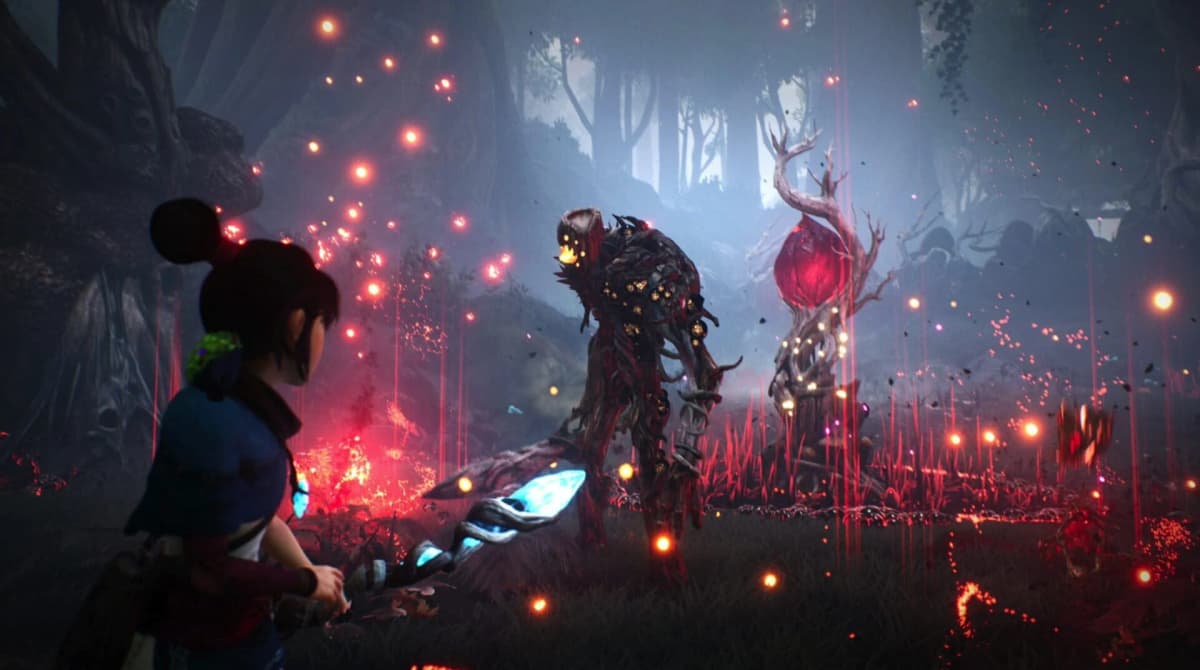
Running around the opening forest area, flicking between staff strikes and light bow shots, I never felt like the controls were swimming or delayed. Boss fights—where the original PS4-era version could sometimes feel a bit choppy in busy moments—held together well here. The heaviest particle spam, with Rot charged up and corruption exploding everywhere, still felt snappy. I’m not going to pretend it never dips, but it never dropped enough to mess with muscle memory.
Compared to something like playing Kena on Steam Deck, the Switch 2 version feels more “console-stable” and less like a PC you’re constantly tempted to tweak. On Deck you can absolutely brute-force better settings if you’re willing to tinker and accept higher power draw; here, Ember Lab has already made the big calls for you and handed over a version that just behaves.
Docked mode holds up well too. You do see the higher resolution expose more of the rough edges—again, that aliasing shimmer—but in exchange you get a clean, trustworthy frame-rate when you’re planted on the couch with a controller. For a lot of players, especially kids or folks who don’t want to juggle options menus, that trade is going to be ideal.
Combat and exploration still hit that “comfortably challenging” sweet spot
I’d half expected to bounce off the combat the second time around. Back in 2021, a lot of people were surprised at how tough Kena could be, especially if you marched in assuming its cute art meant “press X to win.” On Switch 2, with muscle memory dulled by time, I was curious whether it would feel cheap or just demanding.
It holds up. Kena’s moveset is still pretty stripped-back—light/heavy staff attacks, a bow that unfolds from the staff, shield pulse, and later on some nice Rot-enhanced tricks—but the game gets a lot of mileage out of timing and enemy mix-ups. Small encounters are about spacing and little confidence checks on your dodges; bosses will punish greedy hits, but they’re readable once you slow down and actually watch them.
Exploration is still the real heart of the game, though. The way areas slowly open up as you purify corruption, the little environmental puzzles that ask you to redirect Rot or reposition crystals, the hidden Rot buddies themselves tucked under rocks or perched on beams—all of that feels tailor-made for handheld play. I found myself slipping into a loop of “clear a combat encounter on the TV, then wander around handheld for an hour just cleaning up collectibles.” It’s the same game structurally, but the form factor changes how you nibble at it.
The platforming is a touch floaty, but that’s always been part of Kena’s DNA. It never asks for precision-platformer levels of accuracy, and the Switch 2 port doesn’t mess with the feel. If you struggled with the odd missed jump or slightly awkward ledge grab on other systems, that’s still here, but it’s not worse either.
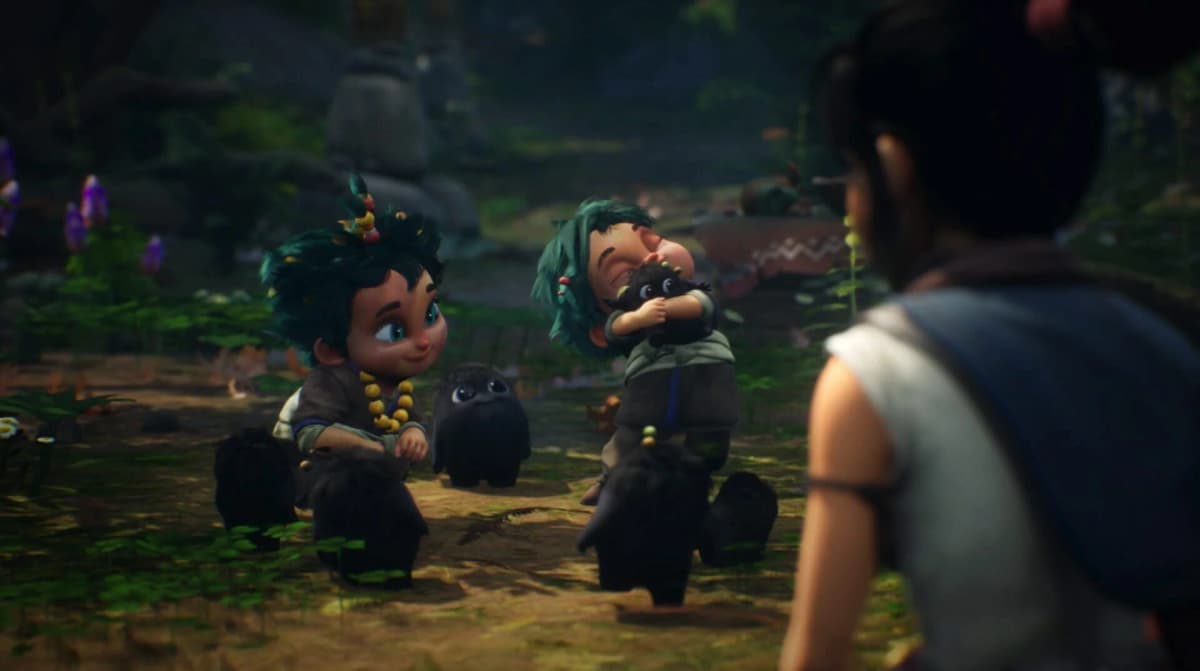
The Rot remain the real stars, and they shine on a smaller screen
I’d forgotten how much of Kena’s soul lives in those little inky blobs. On a big TV they’re cute. On a handheld right in your face, they’re dangerously adorable. Watching a crowd of them strain to lift a stone or wobble nervously when you aim them at a corrupted growth hits different when they’re a couple of inches from your thumbs.
Mechanically, the Rot are still your wildcard. You send them to distract enemies, move objects, or cleanse corrupted fields. As you find more of them, they essentially become a second resource pool for stronger abilities. But it’s the presentation that sells them—those tiny squeaks, the anxiety when you charge a Rot Hammer attack and hope you’re not about to waste it into a boss’s i-frames, the little celebrations when they finish a task.
The Switch 2 version doesn’t add any new Rot-specific content, but the existing hats and cosmetics are all here, and they fit the platform’s energy perfectly. It has that “pass the console around and show your friends the dumb mushroom hat you found” vibe that Nintendo hardware has always encouraged.
New difficulty option and bundled DLC: smart, player-friendly tweaks
Where this port quietly improves the overall package is in its options and extras. All the previous updates and DLC are included out of the box, so if you bounced off the original before things like the extra charmstones and cosmetics arrived, you’re getting the full-fat version now without thinking about it.
The standout change is the expanded difficulty range. Originally, Kena shipped with four difficulty levels, but there was this awkward gap between “Story Mode” (very forgiving) and the default setting that could feel like a brick wall for less experienced players. On Switch 2, Ember Lab has slotted in an extra step: Apprentice Spirit Guide.
I played most of this run on that new setting just to see how it lands. It keeps enough bite that bosses don’t feel like pushovers, but it sands off the worst spikes. Enemy damage is dialed back, parry windows feel a bit more generous, and recovery from mistakes isn’t quite so punishing. It’s exactly the sort of middle-ground mode I wish had been there at launch, and on a Nintendo system that a lot of younger players will be using, it makes a ton of sense.
If you’re a series veteran coming back from PS5 and want that original sting, the higher difficulties are still there, including the post-game modes and challenges that really test your grasp of the mechanics. The important thing is that the switch (no pun intended) between “I just want the story” and “I want a fair fight” finally has some nuance.
Audio and soundtrack: still one of the game’s secret weapons
One of the reasons Kena got under my skin the first time was its soundtrack, and the Switch 2 port thankfully doesn’t mess it up. The ambient, percussive score still does heavy lifting in selling the world as a real place. Wooden flutes, drums, and vocal textures slide in and out as you move from quiet forest paths to tense combat arenas, and the handheld’s headphones-first reality actually flatters it.
There’s something very right about exploring a ruined shrine with good earbuds on and letting the mix sink in. Environmental sounds—wind through leaves, Rot chattering, crunch of dirt paths—are all intact. The Switch 2 version doesn’t appear to have downgraded audio assets in any noticeable way, so if you were worried about compressed, tinny sound to match the visual cuts, that hasn’t happened.
PS5 vs PC vs Switch 2: which version makes the most sense now?
If you’ve never played Kena before and own multiple platforms, the choice comes down to what you value more: sheer fidelity or the way you want to consume this kind of game.
PS5 and a decent PC are still where Kena looks its absolute best. Hair is fuller, foliage density can be higher, anti-aliasing is much cleaner, and high-res displays show off all that animation work. If you’re the kind of player who pauses in photo mode for half an hour to chase the perfect screenshot, those versions are tough to beat.
But in terms of how the game feels to live with, the Switch 2 port makes a surprisingly strong argument. Being able to chip away at a story chapter in docked mode and then slip into handheld to hunt Rot, clear corrupted flowers, or mop up side content fits the pacing better than being locked to the TV. The added Apprentice Spirit Guide difficulty makes it easier to recommend to less experienced players in your house, too.
If you already finished Kena on PS5 and you’re wondering whether this is worth double-dipping for: only if you really want that portable replay. There’s no brand-new story content, no extra chapter exclusive to Switch 2, no wild graphical overhaul. What you get instead is a well-judged, technically sensible port that nudges Kena closer to “Nintendo-style adventure” territory, where charm and comfort matter more than individual pixels.
Who this Switch 2 version is perfect for
After a full run, the picture’s pretty clear:
- New players on Switch 2 who enjoy Zelda-likes or action-adventures with light RPG systems and heartfelt stories.
- Parents looking for something visually stunning but emotionally grounded to share with slightly older kids (there’s combat and some darker themes, but nothing extreme).
- People who bounced off the original because Story Mode was too easy and the next step up felt like a wall—the new difficulty genuinely helps.
- Fans who loved Kena in 2021 and want a relaxed replay on the couch or in bed before the sequel hits.
If you’re hyper-sensitive to visual downgrades, or you live for razor-sharp 4K image quality, you’ll probably be happier sticking with PS5 or PC. This port doesn’t even try to win that fight. It aims for “beautiful enough, fast enough, and comfortable to play,” and mostly nails it.
FinalBoss // Gear
Level up your setup
01Best-selling Switch 2 gameson Amazon→02Switch 2 accessorieson Amazon→038BitDo controllerson Amazon→04Discounted game keyson Kinguin→Affiliate links · As an Amazon Associate, FinalBoss earns from qualifying purchases.
Want to Level Up Your Gaming?
Get access to exclusive strategies, hidden tips, and pro-level insights that we don't share publicly.
Ultimate Reviews Strategy Guide + Weekly Pro Tips