
Table of Contents (15)
King of Meat Had Me Cackling, Then Cursing-And I Kept Coming Back Anyway
I went into King of Meat with low expectations and a group chat full of skeptics. “Amazon’s making a party brawler now?” was the mood. After about three hours on PS5-two dungeons in solo and one chaotic night with friends-I realized this wasn’t some cynical content mill. It’s a loud, messy, oddly sincere co-op brawler-platformer with a mean satirical streak. It’s also the first game in a while to make me belly laugh one minute and swear at my TV the next. By hour 15, I had a pretty clear sense of what works: combat and co-op. And what doesn’t: the platforming and the grind.
Context matters: I split those 15 hours between solo runs and sessions with three friends, all on PS5 with crossplay enabled. I didn’t build levels beyond the tutorial, but I browsed a lot of community creations and took a tour through the featured event dungeons. So if you’re here for deep creator-mode theorycrafting, that’s not me. If you want to know what it feels like to bash through a gaudy hellshow with three buddies while the audience screams for blood? Pull up a chair.
First Impressions: A British Bloodbath Wrapped in a TV Satire
The game dumps you into Loregok, a realm where dragons, trolls, and skeletons share airtime with greedy corporations and a ravenous fanbase. You’re a “Brute,” and the camera never lets you forget you’re on a degenerately overproduced television show. The tone is very British—dry sarcasm, meta jabs at influencer culture, and an all-in commitment to over-the-top gore. I toggled voiceover from English to French out of curiosity and stuck with the French dub for a few hours; it’s genuinely fantastic, with lines landing harder than I expected in a party game. The satire isn’t deep, but it is consistent—and the game uses it to justify the chaos, the announcers, the gimmick arenas, and basically every “what if we threw a hundred bombs into this room?” design choice.
After the first night, I wrote down: “Combat feels immediate. Platforming… doesn’t.” That never stopped being true.
The Combat Pops: Meaty Hits, Stupidly Fun Ultimates, and Environmental Mayhem
King of Meat’s brawling sits in that sweet spot between accessible and expressive. Within minutes I was swapping between a chunky hammer and a rapid-fire crossbow, canceling into dodges, and launching enemies into spike walls because the room layout basically invites you to be a jerk. The game deals you “glorious attacks” (think irreverent ultimates) that are silly on paper—burp blasts, hot-potatoes-of-doom—but surprisingly tactical in practice. One of my favorite moments came around hour six: we pulled a lever to flood a killbox with bomb crates, chain-burped a cluster of trolls into the carnage, and watched the scoreboard multiply like a slot machine.
This is where the game’s production shines. The hit-stop is perfectly tuned. The sound mix gives every slam a satisfying, rumbly thud. Rooms are full of traps you can weaponize: swinging blades, air vents that juggle bodies, rotating flamethrowers. It’s less Diablo and more a gleefully stupid arena brawler where the environment is your co-conspirator. Performance on PS5 stayed at a confident 60 FPS even when particle effects melted my eyeballs. I did dial down camera shake in the settings after a few headachey rooms, and that helped with readability when the screen turned into fireworks-and-ketchup soup.
Minor gripe: in the largest rooms, readability can tank. When four players, thirty enemies, and a dozen traps all scream for attention, I occasionally lost my character in the mess and took an unnecessary hit. It fits the show’s vibe, sure, but clarity matters in a score-chasing game. The tools are strong enough that I never stopped enjoying fights, I just learned to take a half-step back and play angles rather than jumping into the blender.

Then the Platforming Shows Up and Kills the Vibe
I don’t think King of Meat is a bad platformer. I think it’s a heavy one living in a game that wants to move fast. The jump arc feels weighty, ledge grabs don’t always register when you’re moving diagonally, and the air control is just stingy enough that you can’t course-correct once you’ve committed. On its own, in bespoke platforming dungeons, that’s fine. But the moment the game asks for precise jumps in the middle of combat, the rhythm breaks. Twice during a “classic” dungeon, our squad blitzed through two big fights and then spent five minutes botching a sequence of moving platforms above a pit of meat grinders. The laughs died. The momentum died. We started counting attempts out loud, which is never a good sign in a score-chaser.
In solo, the friction doubles. I have a decent tolerance for old-school precision—it’s part of my diet—but here the character’s heft fights the layout, and it feels like you’re working against the game’s dominant strengths. When the focus stays on arenas, hazards, and crowd manipulation, King of Meat sings; when it asks for tight jumps with its current physics, it clears its throat and goes off-key.
Co-op Is the Real Show: 3-4 Brutes or Bust
I tried it solo. It’s playable. It’s even occasionally awesome when you crack a room’s logic and throw a perfect sequence of traps at a mini-boss. But this is a social game at heart. With three or four players, the chaos turns into jazz. One person kites a mob toward a pressure plate, another chains a glorious attack to knock them across a flame grid, someone else drops bombs at the exit, and suddenly you’re composing an explosive set piece on the fly. We laughed more in those nights than we had any right to.
The absence of local co-op is a bummer; this is exactly the kind of game I want to throw on for a couch session. Crossplay does ease the pain. Matchmaking was quick, and, aside from one mid-dungeon disconnect in my first week, the netcode held up just fine. Runs are short enough that a failed attempt doesn’t feel like wasting an evening, and the game gets you back in fast. It’s got that “one more arena” pull, especially when the leaderboards taunt you with a friend’s score from two minutes ago.
Progression: Too Linear, Too Slow, Weirdly Agnostic About Difficulty
Progression is where my enthusiasm cooled. You level up, unlock cosmetics, fish for better gear, dabble in tonics and glorious attacks, and chase dungeon/arena rankings. On paper, that’s enough carrots. In practice, a few carrots are made of plastic. The big oddity: the XP payout doesn’t scale meaningfully with difficulty or thoroughness. You can sweat through a nasty dungeon and walk away with the same experience as a breezy standard run, which immediately incentivizes… you guessed it: farm dungeons. Within days, the community tab was peppered with quick-clear XP grinds. I get it. I also hate it, because it undermines the game’s best loop: optimizing chaos.

Cosmetics are a brighter spot. They unlock on a steady drip, and buying them with gold you earn by actually playing feels respectful. Tuning a build around preferred weapons and a favorite glorious attack is satisfying, even if the overall power curve is conservative. It’s just that in solo, the grind grinds. In co-op, your squad’s synergy papers over the progression’s flatness, because the “power” you feel is in your coordination, not your stats. I wish the game reinforced that with better difficulty scaling rewards.
Leaderboards and Score Chasing: A Smart Counterweight
Thankfully, the ranking system rewards how you play, not how long you grind. Combos, speed, mixing up your actions, hitting objects, tagging enemies without getting hit—these pump your score and push you up the arena leaderboard. This is where the combat’s depth pops. On one late-night session, we shaved twenty seconds off a run by re-routing enemies through a fan corridor we’d ignored earlier, and watching the multiplier pop off was more gratifying than any XP bar. If the devs keep layering smart modifiers and seasonal challenges on top of this, score chasers will be fed for a long time.
Creation Mode: Powerful, Friendly, and Potentially the Game’s Future
I’m not a born level designer, so I stuck to the tutorial and browsing. Even from that limited view, the tools feel strong and friendly. Drag-and-drop pieces, snappy snapping (ha), a clean grid, logic links for traps and triggers—within minutes you can wire a lever to a bomb chute and build a joke room that becomes a legit challenge when you add a timer and some environmental hazards. I ran a handful of community-created dungeons that leaned hard into puzzles, and they already stretched the game in interesting ways the shipped content doesn’t fully explore yet.
The featured tab is curated enough to avoid the “endless beige” problem, and seeing branded event dungeons pop up—yes, we had a MrBeast-flavored set while I was playing—suggests Glowmade and Amazon plan to keep the pipeline moving. This is the fork in the road: if the community stays active and updates drop often, King of Meat could bloom into a platform for wild party-night experiments. If that pipeline dries, you’re left with a good brawler tethered to uneven platforming and a conservative progression model.
Technical Notes: Flashy, Stable, Occasionally Hard on the Eyes
On PS5, performance was largely a non-issue. The game ran at 60 FPS during my sessions, even when particle effects flooded the screen. Load times were snappy. I tweaked a few settings—turned down camera shake, nudged motion blur—and found a sweet spot. Controller rumble sells the thumps without being overbearing. One online disconnect aside, crossplay sessions felt smooth, and matchmaking didn’t keep us waiting long.
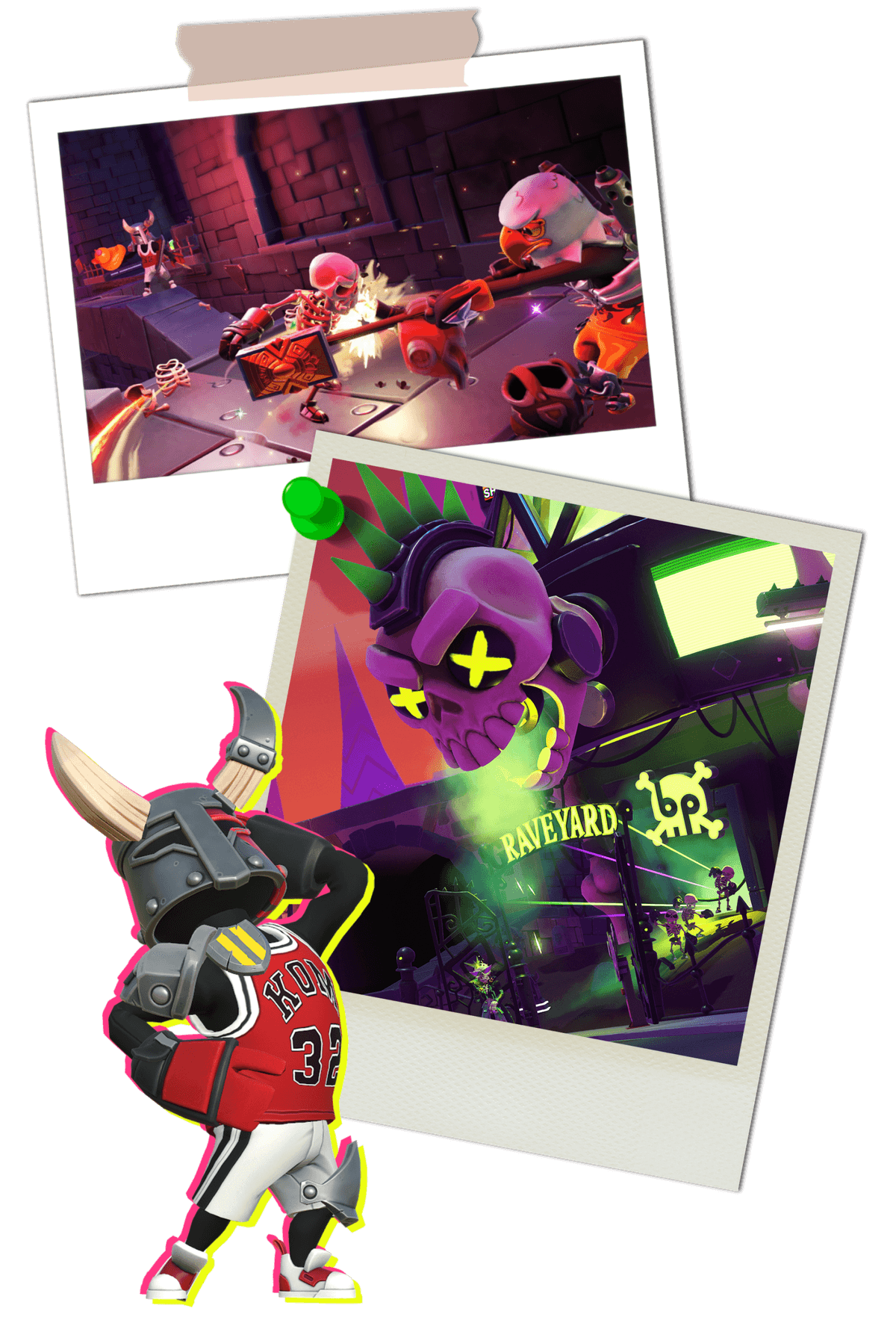
Visually, the game embraces loud colors, chunky textures, and a maximalist TV-show aesthetic. It’s intentionally tacky, and it works for the satire, but the same excess sometimes muddies the on-screen action. I don’t need sterile clarity, but a bit more visual hierarchy—brighter silhouettes on teammates, bolder hazard outlines—would reduce those “where am I?” moments in the busiest rooms.
Comparisons: Imagine Overcooked’s Panic, Hades-Lite Combat, and LBP’s Creator DNA
King of Meat sits at a crossroads I’ve seen before. The co-op panic reminds me of Overcooked at its most unhinged; the combat borrows the immediate punch of a Hades-lite without aspiring to its nuance; the creation tools feel like they’re built by folks who loved LittleBigPlanet but wanted less friction. It’s not as clean or precise as any of those touchstones, but it fuses their vibes in a way that makes sense when you’re in the thick of it with friends.
Who This Is For (And Who Should Skip)
- If you’ve got a regular trio or quartet and love score-chasing chaos, this hits.
- If you’re a tinkerer who thrives on building devilish rooms for others, the editor’s ready for you.
- If you prefer solo, precision platformers with clean progression incentives, look elsewhere.
- If couch co-op is non-negotiable, the lack of local play will sting.
Moments That Sold Me (and One That Didn’t)
Two snapshots from my notes. Around hour 10, we hit an arena with giant bellows that pushed everything across the floor like a wind tunnel. We set up a line: I juggled mobs with a hammer uppercut, our archer buddy tagged stragglers, and our third lured the horde into the airflow so they’d slide into a spinning saw river. We cleared the room in a minute and topped our friend leaderboard by a mile. Pure dopamine.
Then there’s the flip side: that vertical platform segment above the grinder pit. Same crew, same night. We failed a simple moving platform chain six times because the jump timing and air control felt just off enough to punish any improvisation. The room before it was a joyful blender. The room after it was a joyful blender. That one corridor was a vibes vacuum. Multiply that feeling across a few dungeons and you get why I’m torn.
What I’d Like Patched or Tweaked
- Reward difficulty properly. If I sweat, let the XP reflect it. Kill the incentive for farm dungeons.
- Give us sharper platforming or redesign mixed rooms to lean into movement tools rather than pixel-precise jumps.
- Improve readability in max-chaos rooms—clearer silhouette work and hazard cues would go a long way.
- Local co-op, please. This game was born for couches and trash talk.
The Bottom Line
King of Meat is a riot when it lets you be a cunning gremlin with your friends. The combat is chunky, the environmental hijinks are genuinely creative, and the score-chasing loop scratches that “again, but better” itch. The satire gives it a flavor you won’t confuse with anything else. But the platforming’s heaviness and a progression system that shrugs at difficulty pull it back from the top tier. If the community thrives and updates tighten those rough edges, this could be a staple on Friday nights for a long time. Right now, it’s a very good time with caveats—one I’m happy to recommend if you’ve got a crew ready to cause trouble.
Rating: 7.5/10
TL;DR
- Sharp, weighty combat with hilarious “glorious attacks” and trap-heavy arenas.
- Co-op (3-4 players) is where it sings; crossplay helps, but no local co-op hurts.
- Platforming feels heavy and saps momentum in mixed combat-platform dungeons.
- Progression is too flat; XP doesn’t scale well with difficulty, encouraging farm runs.
- Creation tools are powerful and friendly; community events and curation look promising.
- Runs great on PS5 at 60 FPS; readability dips in max chaos without some settings tweaks.
FinalBoss // Gear
Level up your setup
01Top-rated gaming headsetson Amazon→02High-refresh gaming monitorson Amazon→03Gaming chairson Amazon→04Discounted game keyson Kinguin→Affiliate links · As an Amazon Associate, FinalBoss earns from qualifying purchases.
Want to Level Up Your Gaming?
Get access to exclusive strategies, hidden tips, and pro-level insights that we don't share publicly.
Ultimate Reviews Strategy Guide + Weekly Pro Tips