
Table of Contents (7)
Returning to Bohemia in 2026: Why I Waited for This Upgrade
When Warhorse announced native PS5 and Xbox Series versions of Kingdom Come: Deliverance as a free upgrade, I finally stopped making excuses.
I’d bounced off the PS4 version back in 2018. Not because the game wasn’t interesting – the grounded medieval setting, the clumsy early combat, the sheer “you’re just a dumb peasant, deal with it” attitude is exactly my kind of thing. But playing it on a PS4 Pro at 1080p and 30 fps with muddy textures and frequent hitches made it feel older than it actually was.
Fast‑forward to 2026: Kingdom Come: Deliverance II is out, widely praised, and very much a direct continuation of Henry’s story. If you care about narrative continuity, the first game suddenly matters again. Warhorse seems to know this, because they’ve rolled out proper native apps for PS5, PS5 Pro, Xbox Series X and Series S – not just backward compatibility – and given them away free to existing owners.
So I went back in. Across a week I split roughly 15 hours between a PS5 (and later a PS5 Pro) hooked to a 120 Hz VRR OLED, and a Series X on a more typical 60 Hz LCD. I replayed the prologue, wandered the forests, got mugged by bandits again (some things never change), and rode into Rattay’s busy streets to see how badly the new 60 fps target would hold up.
The short version: visually, this is the game I always wished the console version had been. But the “60 fps” promise is very much conditional, and whether you’re happy with it depends heavily on your display, your console, and your tolerance for mid‑40s dips when the world gets busy.
What’s Actually New in the Native PS5/Series Versions
First big clarification: this isn’t just the old PS4/Xbox One code running under backward compatibility. These are separate native apps with their own icons and save data, and they pull from what is essentially the PC “ultra” preset.
On PS5 and Xbox Series X, once you dive into the options, you’ll notice a crucial new toggle: HD textures. Flip that on, and the most obvious annoyance of the last‑gen version evaporates. Armor engravings, wooden beams in taverns, the mud under your boots – it all gains definition instead of that Vaseline‑smeared look the PS4 build sometimes had. Cloth, chainmail, and stone walls finally hold up when the camera gets close during dialogue.
Other visual upgrades are less immediately flashy but add up:
- Shadows: The game now uses the PC’s ultra shadow setting on the premium consoles. Grass, foliage, and character silhouettes look sharper and less “chunky.” You notice it the moment you walk through a forest at dawn – those skinny tree branches actually cast convincing shadows instead of blurry blobs.
- Ambient occlusion and interiors: Inside houses, barns, and churches, the lighting finally feels dense. Corners are darker, objects sit more firmly in the scene, and faces aren’t lit like they’re floating in a grey fog. It does wonders for the atmosphere when you’re sneaking through a dim hall.
- Volumetrics and “dust in the air”: The god rays and dust motes that PC players have enjoyed for years are here. Standing in a Rattay tavern with sunlight raking in through the shutters, you see floating particles catch the light. It’s one of those tiny details that sells the illusion of space.
- Level of detail: Pop‑in is dramatically reduced on PS5 and Series X. Trees, fences, and distant buildings fade in more gracefully, and NPCs don’t just blink into existence five steps ahead of you as often.
The catch? Not every console gets the full treatment.
On Xbox Series S, there’s no HD texture toggle at all. Texture quality sits somewhere between the old PS4 build and the new PS5/Series X version. From a distance, it’s acceptable; up close you can see the downgrade in materials. Shadows and ambient occlusion are also pared back, and the global illumination indoors is more prone to subtle flickering around beams and furniture. Volumetric lighting, interestingly, does remain – so you still get those dust shafts in interior scenes.
The other oddly specific wrinkle is PS5 Pro. There’s no separate “Pro-enhanced” build. It’s the same PS5 app, just running on slightly beefier hardware. That means no PSSR upscaling, no extra graphical toggles, nothing flashy on the box. In practice, though, the Pro’s higher clocks and better GPU grunt give it a minor edge in image clarity and frame rate stability, which I’ll get to later.
Resolution, FSR1, and the Shimmer Problem
If you were hoping this upgrade would finally make Kingdom Come: Deliverance a razor‑sharp 4K showpiece on your big TV, temper expectations.
On PS5, PS5 Pro, and Xbox Series X, the game runs with a dynamic resolution that hovers between 1080p and 1440p. The upper end is hit more often on PS5 Pro thanks to the raw horsepower, but there’s no native 4K mode here at all. Instead, Warhorse uses AMD’s ancient FSR 1 for scaling, which is basically a spatial upscaler with some sharpening sprinkled on top.
In motion, that has a couple of consequences:
- Fences, roof tiles, and distant foliage have a tendency to shimmer or crawl just a bit as you pan the camera.
- Fine detail on armor and clothing can “buzz” at certain angles, especially in bright daylight.
- Extreme long‑distance detail softens more than you’d hope on a 4K panel.
FSR 1 was already dated when the sequel shipped; seeing it here in 2026 feels like someone dug through the engine drawer and grabbed whatever was easiest to plug in. It’s not disastrous – this isn’t some blurry PS3‑era smear – but if you’ve gotten used to modern TAAU or DLSS‑style reconstruction in newer open‑world games, you’ll notice the downgrade instantly.
On Series S, resolution ranges between roughly 720p and 972p before upscaling. On a 1080p screen it’s… fine, honestly. On a 4K display you’re really leaning on that upscaler, and shimmering plus softer edges are just part of the deal.
So the look of the game lands in a weird middle ground: the assets, lighting, and shadows finally match the game’s ambitions, but the image sitting on your TV doesn’t have the crispness you might expect from a current‑gen re‑release. It’s a clear step up from running the PS4/Xbox One code, just not the transformative 4K leap a lot of us hoped for.
Chasing 60 fps: How Each Console Actually Feels
Warhorse targets 60 fps across every current‑gen machine. There’s no 30/60 toggle, no quality vs performance preset – one mode, take it or leave it. On paper, that sounds simple. In practice, the story is messy.
On base PS5, the game often feels like a 60 fps experience. Roaming the countryside on horseback, sneaking through forests, crossing small villages at night – the frame‑time graph is mostly a straight line. Controls feel snappy, bow aiming is far more manageable than in the old 30 fps build, and sword fights finally have that extra responsiveness I always wanted.
The problems start when the CPU is under strain. Anywhere with dense crowds or busy AI routines, the frame rate cracks:
- Early on in Talmberg’s barracks, where several guards and NPCs mill around in a constrained space, I watched the game drop into the mid‑40s.
- Riding through the main road in Rattay during the day – vendors shouting, nobles arguing, peasants loitering – the same thing happens. The game tanks from a smooth 60 into the high 40s, sometimes flirting with 45.
On my VRR OLED, this wasn’t a disaster. The dips were obvious, but they didn’t turn into visible stutter – more a sense of the game “softening” for a second. On a standard 60 Hz set, though, those same sections felt legitimately choppy. You get that uneven rhythm: 60, then a clump of frames in the 40s, then back up again.
- Early on in Talmberg’s barracks, where several guards and NPCs mill around in a constrained space, I watched the game drop into the mid‑40s.
- Riding through the main road in Rattay during the day – vendors shouting, nobles arguing, peasants loitering – the same thing happens. The game tanks from a smooth 60 into the high 40s, sometimes flirting with 45.
On my VRR OLED, this wasn’t a disaster. The dips were obvious, but they didn’t turn into visible stutter – more a sense of the game “softening” for a second. On a standard 60 Hz set, though, those same sections felt legitimately choppy. You get that uneven rhythm: 60, then a clump of frames in the 40s, then back up again.
🎮 Get This Game at the Best Price
Compare prices instantly and save up to 80% on Steam keys with Kinguin — trusted by 15+ million gamers worldwide.
*Affiliate link — supports our independent coverage at no extra cost to you
Series X is a bit of an odd one. You’d expect it to match or surpass PS5, but in practice it’s slightly less stable in those same hotspots. The quiet countryside still holds near 60 most of the time, but the busy town scenes dip lower and more often – hovering in the mid‑40s where PS5 might keep to high‑40s or low‑50s. I also saw the occasional, faint tear near the top of the screen during sudden camera spins, something I didn’t notice on PS5.
Again, with VRR enabled on a capable TV, those fluctuations smooth out to something acceptable. Without VRR, you’re in for a decent amount of judder every time you hit a market or guard‑heavy area.
PS5 Pro, unsurprisingly, fares best of the bunch. The exact same stress tests – Talmberg barracks, Rattay’s main drag – still drop below 60, but now I was mostly seeing low‑50s instead of mid‑40s. The difference isn’t night and day, but enough that the game’s “feel” in motion crosses an invisible threshold from “semi‑annoying” to “mostly smooth.” If you’re particularly sensitive to dips and you’re staying in the PlayStation ecosystem, the Pro genuinely earns its keep here.
The surprise winner in some scenarios is Xbox Series S. Because it’s running lower‑end settings and a much smaller resolution window, the frame rate holds up better than you’d expect. In open fields and smaller villages, the game hugs 60 fps more tightly than base PS5 and Series X. Dense NPC scenes still dip – you’re not escaping the CPU limitations – but I was more often seeing drops to around 50 rather than straight into the 40s.
In a four‑way comparison, the pecking order usually looks like this:
- PS5 Pro: most stable overall, but still not a locked 60.
- Series S: surprisingly strong thanks to big visual concessions.
- PS5: solid most of the time, but town centers and NPC clumps sting.
- Series X: generally similar to PS5 but with slightly heavier drops in the worst spots.
So does the game “run at 60 fps” on consoles? In relaxed exploration and smaller fights, yes, and it feels great compared to the old 30 fps cap. In the busiest hubs and scripted crowd scenes, absolutely not. The range is more like 45–60 fps on PS5 and Series X, with Pro and Series S inching that floor up a bit.
Living With the Upgrade: Loading, Feel, and Atmosphere
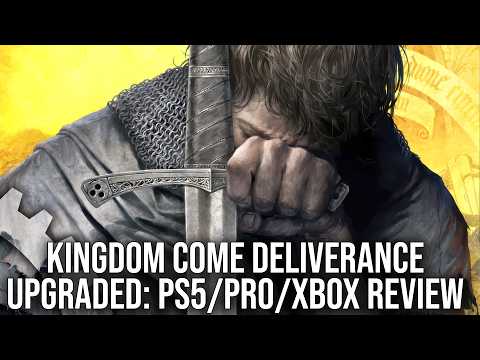
Putting aside graphs and numbers for a moment, this is the first time Kingdom Come: Deliverance has felt properly at home on a console for me.
Loading times are dramatically better than the last‑gen build. Fast travel hops between towns feel snappy, and even full reloads after a botched burglary or failed duel are quick enough that I never reached for my phone. That alone makes experimentation – and failure – less punishing.
Combat benefits massively. Early game swordplay is still clumsy by design, but once you get a handle on feints and combos, the extra frames make timed parries and directional blocking feel more intuitive. Archery, which I found borderline miserable at 30 fps back in the day, is now actually viable; tracking a moving bandit at range no longer feels like you’re fighting input lag and Henry’s inexperience at the same time.
The upgraded interiors and lighting also change the vibe in subtle ways. Sneaking into a noble’s house at night, with only a stolen torch and the richer ambient shadows, has more tension. The monastery, with its pools of candlelight and properly dark corners, feels more oppressive. The game always had strong art direction; now the tech isn’t constantly undermining it.
It’s not perfect. The FSR shimmer never fully goes away, and when the frame rate noses into the 40s as you trot through a crowded street, you’re reminded that under all the patches and console wizardry, this is still an eight‑year‑old CryEngine game being wrangled into shape.
Who This Upgrade Is Really For
If you’re a brand‑new player eyeing up Kingdom Come: Deliverance II and wondering how to catch up, the answer is simple: this is now the best way to play the first game on console, full stop.
You get PC‑ultra level settings in most areas, HD textures (on PS5 and Series X), better shadows, better volumetrics, faster loading, and input‑responsiveness that fundamentally improves combat and traversal. Once you’ve tasted this, going back to the PS4/Xbox One builds is not an option.
If you’re a returning player who already finished the game on PC, this is more of a “nice to have.” The upgrade doesn’t surpass a well‑tuned PC with modern upscaling and a locked 60+ fps. It just brings the console versions closer to what PC players have had since 2018, with some compromises on resolution scaling and performance in heavy scenes.
If you’re ultra‑sensitive to frame‑rate drops and don’t have a VRR‑capable TV or monitor, I’d be more cautious. The dips into the 40s in busy areas are frequent enough that they could genuinely bother you, especially if you’re coming from newer, more stable 60 fps open‑world titles.
FinalBoss // Gear
Level up your setup
01Top-rated gaming headsetson Amazon→02High-refresh gaming monitorson Amazon→03Gaming chairson Amazon→04Discounted game keyson Kinguin→Affiliate links · As an Amazon Associate, FinalBoss earns from qualifying purchases.
Want to Level Up Your Gaming?
Get access to exclusive strategies, hidden tips, and pro-level insights that we don't share publicly.
Ultimate Reviews Strategy Guide + Weekly Pro Tips