
Table of Contents (7)
White-knuckle silence: my first crash in Sky Team
On our very first game of Sky Team, we died in total silence.
I was the pilot, my partner was the co-pilot. We rolled our dice behind our little cardboard screens, dropped them, glanced up at each other, nodded like we actually knew what we were doing, and then… nothing. No table talk, no “use a high die there,” no “I’ve got the flaps, don’t worry.” Just two people, four dice each, and a cockpit full of unlabeled slots that suddenly felt like a bomb defusal panel.
Thirty seconds later, we were coming in too fast, tilted slightly to the right, and staring at a runway that we were absolutely not going to hit. The nose of the tiny cardboard plane overshot the landing strip on the approach track, the rules coldly informed us that this meant “catastrophic failure,” and we just burst out laughing. It felt less like losing a board game and more like replaying that “we should have seen this coming” moment from a disaster movie.
That was the hook. Over the next couple of weeks, Sky Team went from “we’ll try this cute two-player curiosity” to the game I kept pulling out for just-one-more-landing sessions. It’s my game of the week for March 2026 not because it’s big or flashy, but because it takes a simple idea-limited communication plus shared dice allocation-and turns it into some of the tensest, smartest co-op I’ve played in years.
How Sky Team actually works (and why every die feels lethal)
Sky Team is a strictly two-player, fully cooperative board game about landing a passenger plane. One player is the pilot, the other is the co-pilot. Together you’re trying to bring the plane from several thousand feet down to the runway without stalling, overshooting, colliding with another plane, drifting off the glide path, or forgetting something important like, you know, the landing gear.
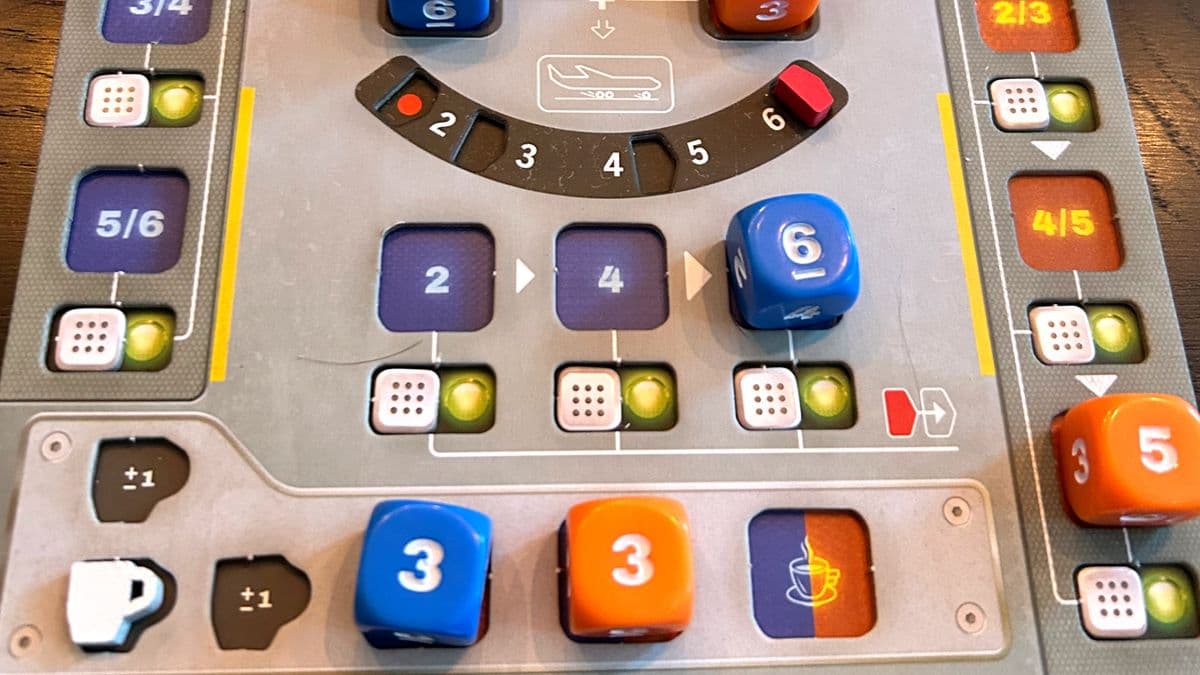
Structurally, each round is very straightforward. You both roll four dice behind screens. When you’re ready, you reveal them and then, taking turns, assign those dice to slots on your shared cockpit board. Those slots represent all the things you need to deal with on an approach: thrust, axis (banking left or right), flaps, landing gear, radio communication, and a couple of special tools like coffee that let you tweak numbers.
The trick is that many of those slots care about the relationship between your dice, not just what you personally rolled. Speed is based on the sum of one of your dice and one of your partner’s. Axis (whether the plane is banking left or right) is based on the difference between another pair of dice. The board constantly asks you to combine values in ways that you cannot openly coordinate.
So let’s say I, as pilot, slot a high die into thrust, hoping to keep us moving fast enough to reach the runway in time. My partner doesn’t know my exact value, just that I hesitated before placing it. They decide to “play it safe” with a low die. Surprise: the total is way too low, we slow down too much, and we end up short of where the runway is marked on the approach track. One round later, we’re still a little high and a little short, and there’s not enough sky left to fix it.
Axis is even nastier. The closer the difference between your two dice, the more level the plane. If the difference is big-because one of you dumped a six while the other used a one—you’re banking hard left or right, and if that dial slides off the safe middle band, the plane essentially cartwheels into the ground. Some of our funniest losses have been “oops, we definitely both thought the other person was going to place low there.”
The rest of the cockpit is about juggling priorities. You need to clear other planes off the flight path using the radio. You need to drop the landing gear before touchdown. You need to fiddle with flaps to widen your safety window so small mistakes don’t kill you. But you only get four dice each, and two of those really ought to go to thrust and axis. Every other slot you fill is a tradeoff and, because you’re not allowed to share exact numbers, those tradeoffs are loaded with anxiety.
There are some tools to fight back against the randomness. Coffee lets you adjust a die up or down by one pip; you get those by committing dice to the coffee cup instead of something more essential, banking that flexibility for later. Some scenarios add ways to reroll or substitute dice. But even with those, the design deliberately leaves you living on the edge. You never have quite enough control to feel safe, and that’s exactly what makes every landing memorable.
The magic (and misery) of not talking
I’ve enjoyed limited-communication games before—The Crew, Hanabi, The Mind—but Sky Team hits differently because the table is so small. It’s just you and one other person, staring at each other across a cockpit, feeling completely responsible for the same 200 cardboard passengers.
The rules at our table are simple: we can agree a general plan before a round (“we really need to get the landing gear down this time” or “let’s prioritize staying level over speed”), but once the dice are revealed and we start placing, we shut up. No tapping, no pointing, no humming “Left, left, left.” Just body language and timing.
This creates a weirdly intimate kind of focus. After about three games, I noticed we were subconsciously learning each other’s habits. If my partner instantly slammed a die onto thrust without looking up, I read that as “they rolled something strong and want to carry us forward.” If they hesitated with a die hovering over axis, that usually meant “I’ve got a middling number; your choice decides whether we live or die.”
One of my favorite moments came during a late-night game when we were one round from landing in the “easy” first scenario, Montreal. We needed to stay level, keep speed in a narrow safe band, and finally get our landing gear down. My dice were a disaster: a pair of ones and a couple of fours. I burned a four on gear, because without it we were toast anyway. That left me with terrible options for thrust and axis.
I deliberately waited. My partner, seeing that, quietly placed a mid-value die on thrust. I responded with one of my ones, gambling that the total would land us in the lower edge of the safe speed zone. Then they paused, stared at me, and dropped a die into axis that perfectly matched the one I’d been saving. Plane stayed level, we eased onto the runway, and we both finally exhaled. We hadn’t said a word, but it felt like a conversation.
When it clicks, Sky Team feels like mind-reading. When it doesn’t, it can be agonizing. There was an evening where we whiffed three landings in a row because we kept misjudging each other’s risk tolerance. I’d play a high die into thrust thinking “we have to push, we’re running out of altitude,” while my partner consistently played low, trying to stay safe. The game forced us to have a meta-conversation between rounds about how aggressive we each like to be under pressure.
That’s my favorite thing about Sky Team: it isn’t just a puzzle of numbers; it’s a puzzle of personalities. You’re not only reading dice, you’re reading a human being you (hopefully) like or love, and discovering how they panic, compromise, and adapt when the margin for error is razor-thin.
Scenarios, modules, and how the difficulty keeps ramping
The base game doesn’t stop at “land a plane once.” It gives you a stack of different airports and modules that gradually twist the screws. You start with a relatively gentle approach into Montreal, with low traffic and a forgiving layout. Once you’ve managed that a couple of times, new boards and rules slide in: busier airspace, trickier approach patterns, extra systems to monitor.
Later scenarios introduce things like crosswinds pushing your axis off-center, extra tracks to manage fuel, tighter timing, or more planes queueing up around you that have to be cleared via the radio before you can even think about landing. Mechanically, it’s all still just dice placement, but every new rule is layered on in a way that targets your complacency.
Our first few plays were spent just surviving the basic descent. A week later, we’d gotten cocky and pulled out a more advanced airport with heavy traffic. That was the night we realized Sky Team has a quiet mean streak. We were doing fine on thrust and axis, but we kept dumping our low dice into the radio to clear other planes, and we completely forgot about flaps. When we finally hit the runway, our safety window was so narrow that a tiny axis wobble slammed us into the tarmac.

The modular design also gives the game real replay value. You can mix and match some of the modules once you know what you’re doing, effectively tuning how much chaos you want. Want a shorter, sharper game? Use a scenario with fewer rounds but nastier constraints. Want a slow-burn, procedural-feeling descent? Pick a longer track and add a subsystem like fuel that forces you to make tough choices over multiple rounds.
Crucially, none of these additions ever bury the core hook. You’re still living and dying on the sum and difference of those key dice. The add-ons just give you more ways for those sums and differences to matter. That keeps the tension fresh even after a dozen landings; you’re not just memorizing one scripted puzzle, you’re coping with new stressors on top of a very tight foundation.
Components, clarity, and teaching new copilots
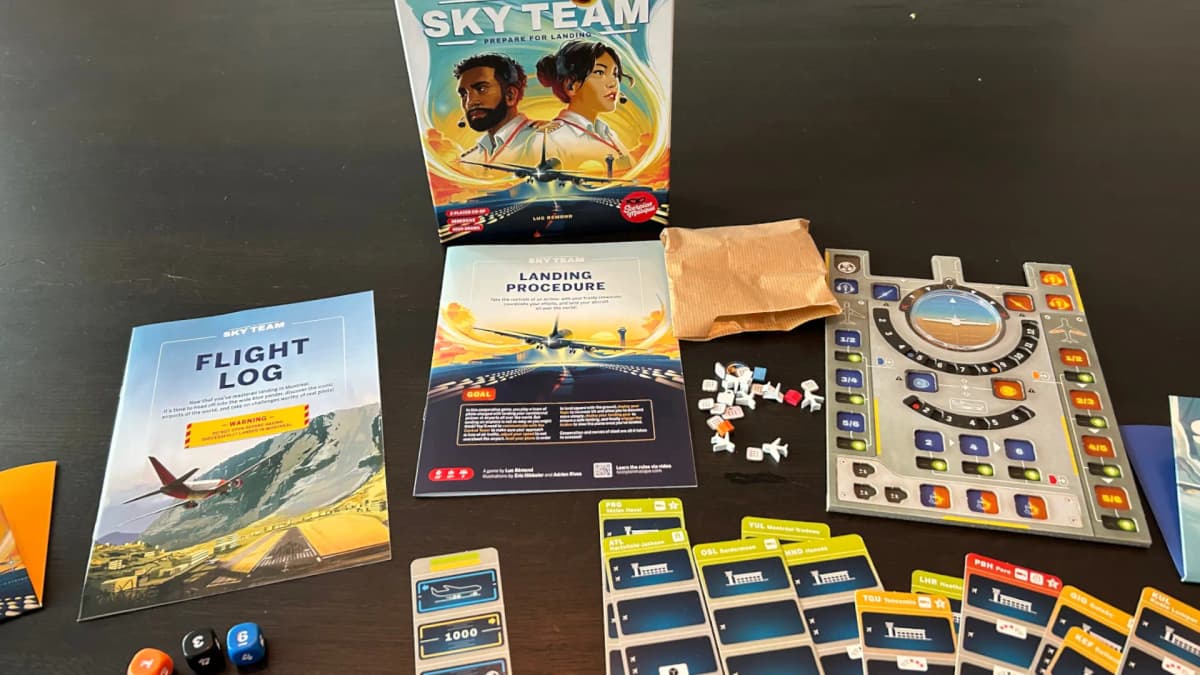
Physically, Sky Team is tidy and functional rather than flashy, which suits the design. The cockpit board is the star: it’s laid out like a stylized control panel, with clearly marked spots for dice and simple icons explaining what each zone does. On our first game, we had the rulebook open the entire time, but by the second or third, we barely needed it; the iconography is that intuitive once you’ve seen each effect trigger a couple of times.
The dice themselves are chunky and readable at a glance, which matters more than you’d think in a game where a single pip difference can mean “everyone lives” instead of “everyone is now a cautionary news headline.” I appreciated that the altitude and approach tracks are also cleanly laid out. When you crash in Sky Team, you always know exactly why, because the board tells the story: too fast, too tilted, too late with gear, too many planes in your way.
Teaching the game turned out to be much easier than it looks. The rulebook is structured around the idea of learning by doing: start with the basic landing, then add one or two extra rules as you go. I’ve taught it to a fairly casual player who normally sticks to party games, and after a slightly bewildered first round, they were fully in. The dice make it approachable; you roll, you place, things happen. The depth comes from all the interactions and the silence, not from pages of edge cases.
The only small usability bump for us was remembering the exact restrictions on communication. The rule set around what you can say before each round is a little fuzzy if you’re trying to play “by the book,” and different pairs will naturally drift toward stricter or looser interpretations. We ended up agreeing a house style that felt right for us: broad intentions ok, exact numbers and positions off-limits. As long as both players want the same level of purity, that ambiguity isn’t really a problem.
Where Sky Team might lose you
As much as I’ve fallen for Sky Team, it is absolutely not for everyone.
First, the obvious: it’s two-player only. There’s no official variant for three or four, no solo mode baked in. For me, that hyper-focused design is part of the charm, but if your group rarely plays with just two at the table, this will sit on your shelf more than it should.
Second, it can be genuinely stressful. A lot of co-op games soften failure—you lose a city here, you flip a card there, and you can usually see a comeback path. In Sky Team, you can have twenty spotless minutes of cooperation and then blow it all on a single unlucky or misread die. That makes the highs incredible (our first perfect landing felt ridiculous in the best way), but the lows can sting.
There’s also a slice of luck you simply have to accept. Yes, coffee and other tools let you massage bad rolls, and smart play absolutely matters, but there will be rounds where the dice come up in a way that gives you no good options. If your tolerance for “we died because we rolled four ones” is low, or you want tight, deterministic puzzles like chess or pure abstract strategy, this game will occasionally feel cruel.
Finally, the emotional temperature can get spicy. You’re constantly making judgment calls about what your partner will do, and it’s very easy to slide from “we messed up” to “you messed up.” The game does a great job of framing everything as shared responsibility, but you still need the right partner—someone who can laugh off a fiery crash instead of silently tallying your misplays.
Who Sky Team is perfect for
When it lands, Sky Team absolutely sings. It’s a brilliant fit if you:
- Regularly play games as a couple or with one close friend
- Enjoy tense cooperation where communication is limited or indirect
- Like dice games but want more structure and meaning than just “roll and hope”
- Appreciate short, replayable sessions you can fit into an evening
For us, it’s become that “we’ve got 30 minutes before bed, want to try a landing?” game. It sits in the same mental space as The Crew or a tight two-player card game, but the theme and physicality make it feel more dramatic than its footprint suggests.
It also works surprisingly well as a “relationship test” game, in the best sense. Over multiple plays, you start to learn how you each handle pressure, how willing you are to take calculated risks, and how quickly you can forgive each other when the plane explodes for the third time in a row because someone forgot the landing gear again. That shared arc—from clueless rookies to a well-oiled silent cockpit—is incredibly satisfying.
FinalBoss // Gear
Level up your setup
01Top-rated gaming headsetson Amazon→02High-refresh gaming monitorson Amazon→03Gaming chairson Amazon→04Discounted game keyson Kinguin→
Affiliate links · As an Amazon Associate, FinalBoss earns from qualifying purchases.
Want to Level Up Your Gaming?
Get access to exclusive strategies, hidden tips, and pro-level insights that we don't share publicly.
Ultimate Reviews Strategy Guide + Weekly Pro Tips