
Updated 9 October 2026 for Last Asylum: Plague v1.0.65 (iOS, released 20 September 2026). Unlock levels below come from the game’s official site and two community wikis. The larger wiki dates its checks to 30 August to 2 September 2026.
Table of Contents (13)
Quick answer: how to start Last Asylum: Plague
Build Farms, Lumberyards and Herb Gardens first, then push the Sanctuary. Keep the clinic running from day one, because every Sanctuary level needs a set number of clinic stars. From Sanctuary 12, keep the Research Lab one level below your target. Reach Sanctuary 6 for the Alliance Hall, Barracks and Training Grounds, Sanctuary 7 for the Research Lab, and Sanctuary 8 for Curio Hall and a second squad. Put early hero shards into Arthur, and join an active alliance.
Building guide: what unlocks at each Sanctuary level
Use this table as a building requirements cheat sheet. All levels are Sanctuary levels.
| Sanctuary level | What unlocks | Why it matters |
|---|---|---|
| 1 | Farm, Lumberyard, Herb Garden | The three resource producers. You can place several of each. |
| 3 | Builder’s Hut (storage buildings are also available by now) | Gives a free speed-up window and opens paid build queues. |
| 4 | Squad 1, Tavern, Walls, Gear Workshop, Explorer’s Camp | Your first squad and the campaign. The hero level cap rises from 5 to 15. |
| 6 | Alliance Hall, Barracks, Training Grounds, Infirmary, Falcon Tower | The core systems: alliances, troops and the world map. |
| 7 | Research Lab, Raven Nest, Arena, Warrior Statue | Research opens. Survival Battle opens at this level too. |
| 8 | Squad 2, Watchtower, Curio Hall | A second squad and the Curio collection. |
| 10 | Alliance Duel, Private Stable, Alliance Stable | Weekly alliance competition and caravans. One wiki lists the stables at level 11. |
| 15 | Raven Workshop, Elixir Scramble | Raven gear production and a new alliance event. |
| 20 | Squad 3 | A third squad. Heavier costs start here. |
The sources differ by one level on a few buildings (Infirmary 6 or 7, Alliance Hall 5 or 6, Private Stable 10 or 11). The table follows the official site wherever it covers the building.
Why the Early Game in Last Asylum: Plague Feels So Brutal
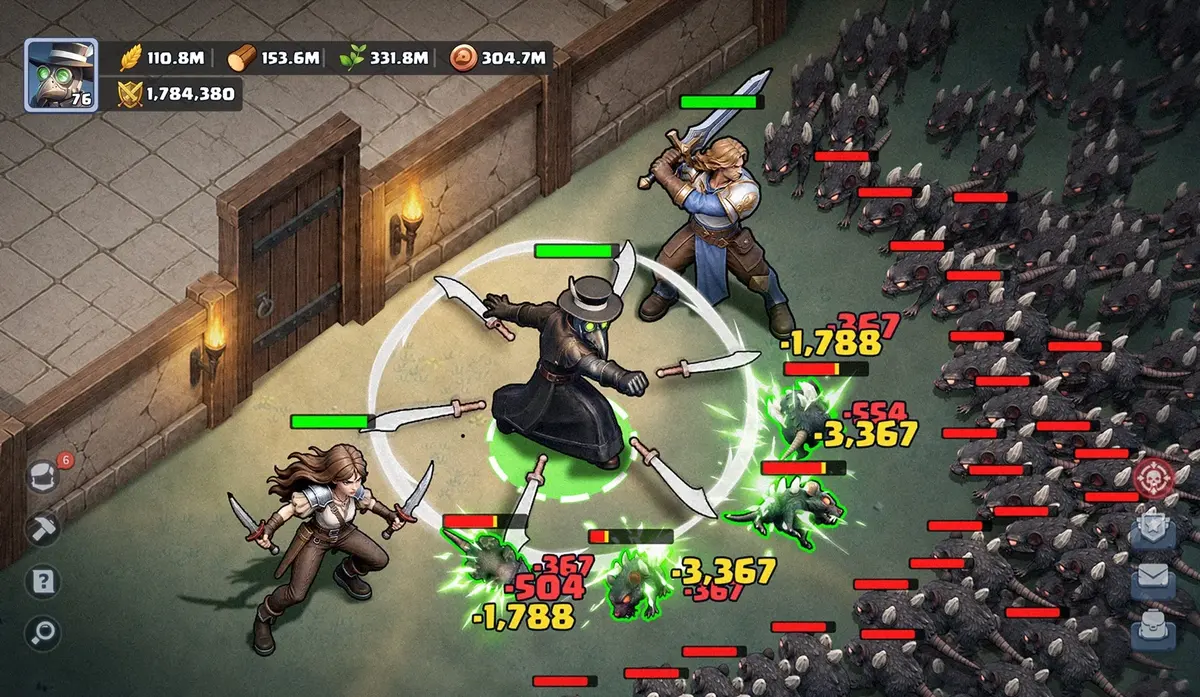
The App Store description lists four jobs at once. You run a Sanctuary and treat patients, hold off the Rat Swarm, send survivors out to gather timber, herbs and food, and form hero squads to take ruined towns. All four draw on the same grain, timber and herb stockpiles, and your Sanctuary level decides how fast any of them can grow.
The official site’s Sanctuary guide sums up the order in four words: economy first, Sanctuary third. Its build order is production buildings, then storage, then Sanctuary levels, then the clinic and wards, then defense, then research. This guide follows that order.
Step 1 – Take the Free Early Rewards (Then Spend Speedups Where They Count)
The early game hands out a lot of free progress. The community wiki lists the main sources:
- Exploration chain: 153 one-time steps, including 145 recruit tickets. The first ticket comes at step four.
- Quiz of Wisdom: 15 questions. A correct answer pays 10 diamonds and a wrong answer still pays 5.
- Rat hordes: hunting them pays recruit tickets for energy that refills anyway.
- Daily free pulls: one free call in Surprise Encounter, one free Wishing Wheel coin and one free pull in each of the five recruit pools, all reset daily.
Spend diamonds slowly. PocketGamer’s beginner guide advises against paying diamonds for instant completions early on, and names the permanent extra build queue as the one premium purchase worth considering. On speedups, players have two habits: PocketGamer suggests spending them on the Sanctuary, while players on r/LastAsylumPlague suggest holding them for the event phases that score them (see the Survival Battle section below).
Step 2 – Build a Stable Economy: Herb Garden, Farm, Lumberyard First
All three producers are available from Sanctuary 1 according to the community wikis, and you can place several copies of each. They produce resources every hour:
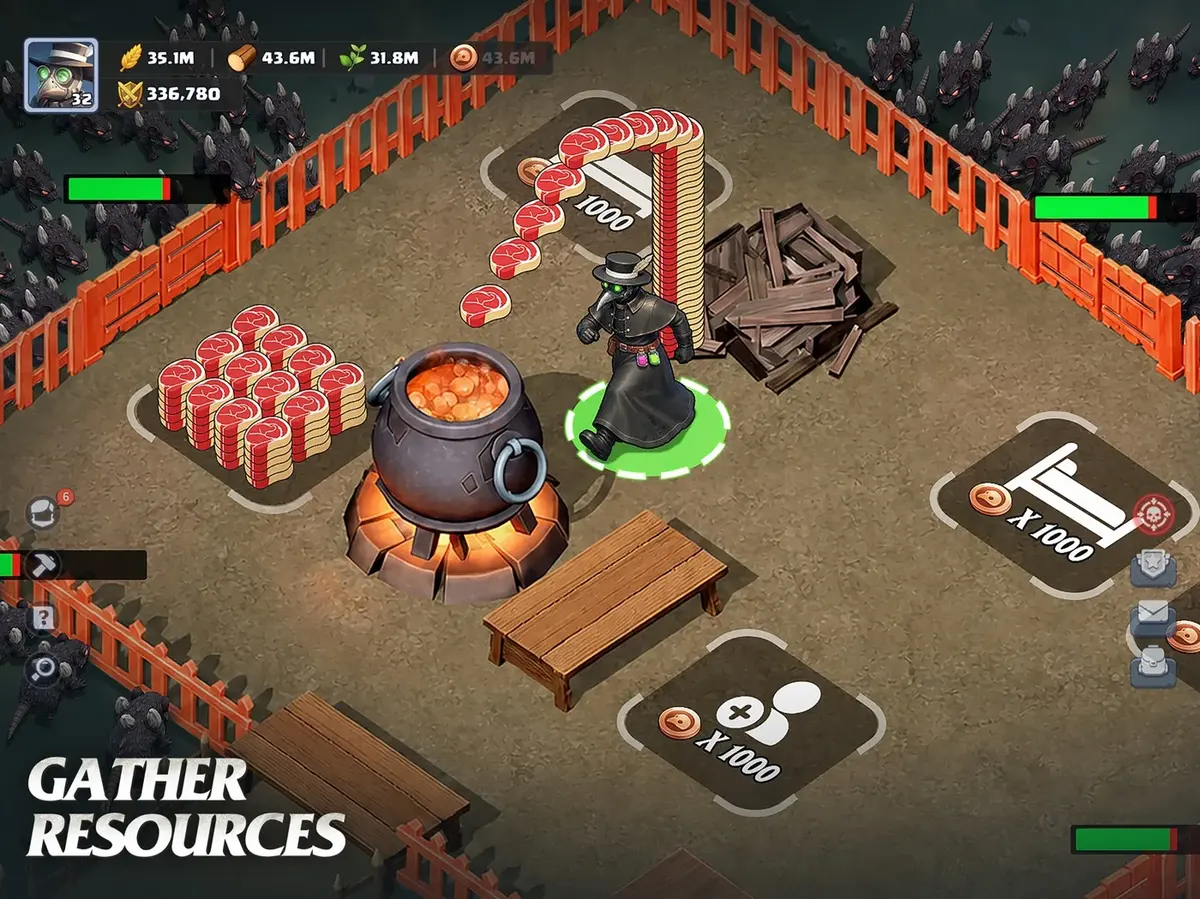
- Farm: grain. Sanctuary upgrades need it from level 2.
- Lumberyard: timber. Sanctuary upgrades need it from level 2.
- Herb Garden: herbs. Sanctuary upgrades need them from level 9, so herb production matters most once you pass the first few levels.
Three smaller points help the economy along:
- Survivors: newly arrived survivors carry traits that boost output, such as timber or grain. PocketGamer advises assigning them early and swapping later. Some buildings have their own survivor posts, for example four in the Alliance Hall.
- Storage buildings: the Granary, Lumber Depot and Herb Storage protect grain, timber and herbs from raid losses. Build them before you stockpile for a big upgrade.
- Builder’s Hut: unlocks at Sanctuary 3 and gives a free speed-up window, which lowers diamond costs.
Do not chase maximum level on every producer. The wiki notes that the top levels of production buildings rarely pay back through production alone, and their main value is Might and unlock requirements. Players on r/LastAsylumPlague make the same argument about the last Herb Garden levels, although some still level them for the survivor bonus.
Step 3 – Sanctuary as Your Core Hub: Upgrade Smart, Plan Ahead
The Sanctuary is a single building that can reach level 30. It cannot be moved or demolished, and its level caps every other building. It also sets your hero level cap and base hero stats. The hero level cap is 5 up to Sanctuary 3, 15 at Sanctuary 4, 25 at Sanctuary 5, then 5 more per level up to 150 at Sanctuary 30.
Every upgrade checks three things, so look at all of them before you start a long timer:
- Resources: grain and timber from level 2, herbs from level 9.
- Clinic stars: a star total that is checked, not spent. It is 17 at Sanctuary 3, 112 at Sanctuary 10, and 326 from Sanctuary 28 onward.
- A prerequisite building: each level also asks for one other building at a set level, such as Walls, Training Grounds, Alliance Hall, Infirmary, a statue, Barracks or a resource building.
Check the next two or three prerequisites before every push. The wiki’s estimate for reaching Sanctuary 17 is about 250 million resources and 425 hours of construction on a single queue, so extra queues and alliance help matter. Players disagree on how far to take this: one popular r/LastAsylumPlague post says not to match every building to your Sanctuary level, while the top reply points out that some buildings must be raised several levels before the next Sanctuary upgrade can start. The prerequisite list above is the way to settle it for your own account.
Step 4 – Clinic and Research Lab: The Two Gates Behind Every Sanctuary Level
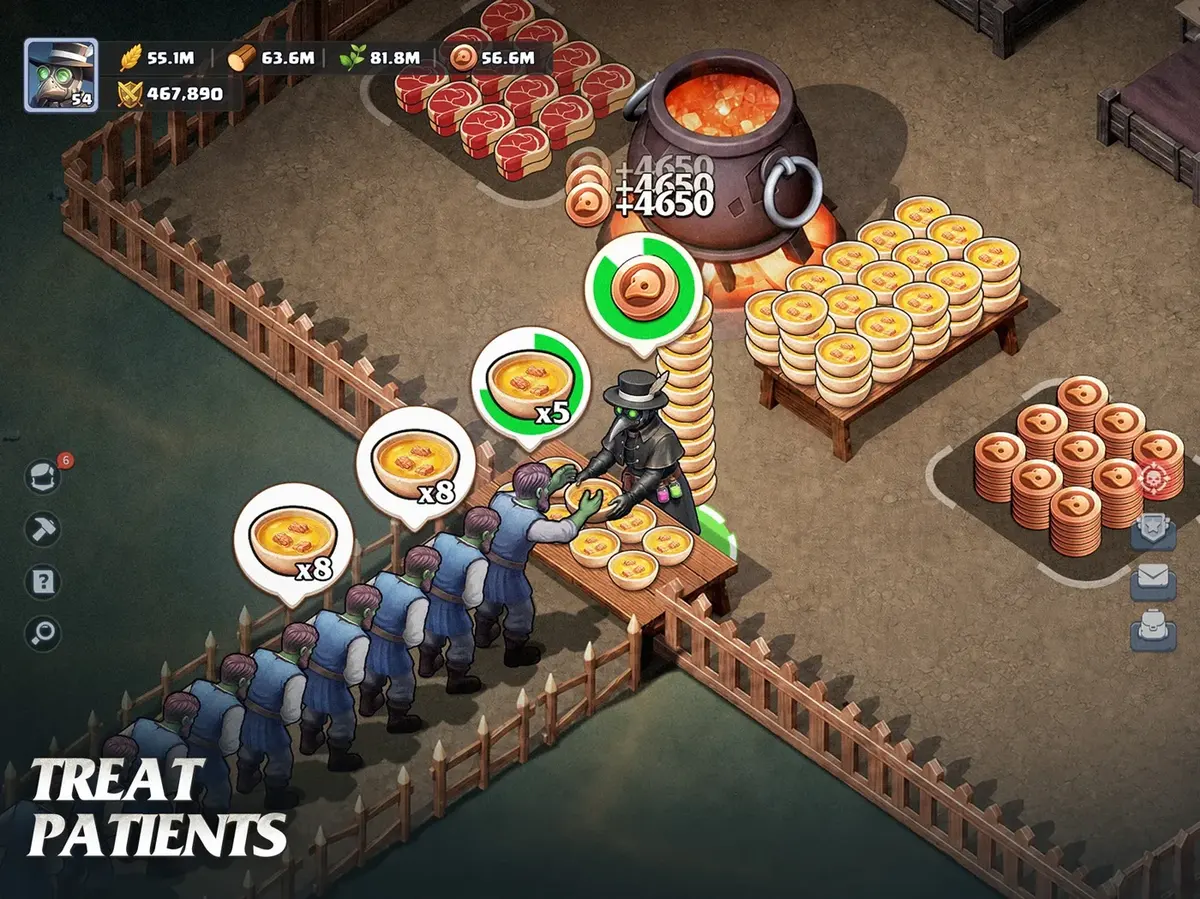
The App Store description says you treat patients, craft herbal remedies and expand your wards. The community wiki adds the part that matters for progress: Sanctuary levels require clinic stars, the stars build up slowly and cannot be sped up, so a delayed clinic turns into a blocker. Its advice is to build the clinic first. The sources we checked do not document individual hospital staff roles, so this guide does not describe any.
The Research Lab is the second gate:
- It unlocks at Sanctuary 7. One wiki also lists clearing campaign stage Dense Forest 14 as a requirement.
- Sanctuary 11 needs Research Lab level 7. From Sanctuary 12 to 30, the Lab must be one level below the Sanctuary level you are aiming for.
- Research trees open as the Lab grows: Development and Economy at Lab 1, Hero at 5, Soldier at 6, Squad research at 8, Alliance Duel at 10, Caravan Transport at 15, Elite Troop at 20.
- The game marks a recommended first research node, and the wiki notes that it speeds up construction for every later building.
Early Development and Economy research also buys Might more cheaply than other branches. Hiring troops is the cheapest Might of all, at about 8 resources per point, but troop Might disappears when the soldiers die. Research costs about 12,572 resources per point and buildings about 21,805, and both are permanent. If you are asking how to increase Might, that trade is the answer: troops for a quick event total, research and buildings for lasting strength.
Step 5 – Heroes, Squads, and the First Wall: Rat Swarm
A squad is five heroes in two rows. Tanks take the front row and damage dealers the back row, and only support heroes heal. Heroes of the same faction give a bonus to HP, attack and defense: +5% for three, +10% for a three-plus-two split, +15% for four and +20% for five. Warriors beat Warlocks, Warlocks beat Rangers and Rangers beat Warriors, each by 20% damage.
For a new account:
- Shards go to Arthur first. He is the one hero the base pool guarantees, and he is in the guarantees of all four hero pools. In the wiki’s squad ranking, the best possible squad drops from a score of 100 to 64 without him.
- Starter five: Arthur and Bella in the front row, Marlena, Claire and Celia behind them. All five are Warriors, so the squad gets the full +20% bonus. Our free-to-play starter team guide covers the substitutes.
- One main squad at first. Squad 1 opens at Sanctuary 4, Squad 2 at 8 and Squad 3 at 20. Players on r/LastAsylumPlague say the same thing in plain words: do not build every hero you unlock, put your resources into your main march.
- Troops follow the Training Grounds. Level 7 soldiers arrive at Training Grounds level 20, which needs Sanctuary 20, the same level at which Squad 3 opens. Level 10 soldiers need Training Grounds level 30 and the Elite Troop research.
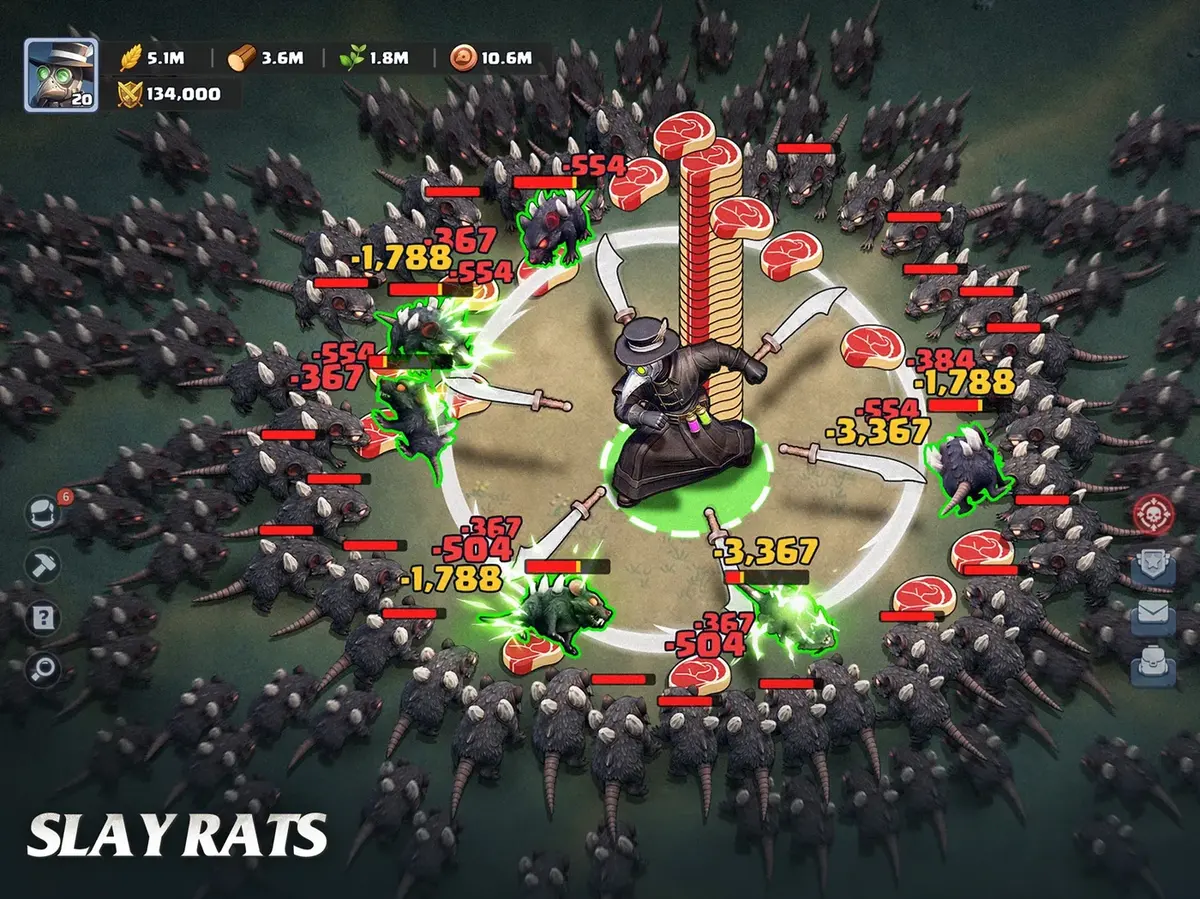
The Rat Swarm is the game’s wave defense. The App Store description says you recruit and upgrade heroes, build as many defensive towers as you can, and slay the Rat King to repel the swarm. We found no official or wiki source that gives wave counts, tower stats or a proven tower layout, so none are listed here. Use the squad rules above, and check the in-game Rat Swarm screen for the current requirements.
Step 6 – Join an Alliance and Expand the Right Way
The Alliance Hall unlocks at Sanctuary 6 and needs Falcon Tower level 1. Alliance members can tap Help on your construction, research and training timers, and each help removes a fixed number of seconds. At Alliance Hall level 1 you can receive 4 helps of 30 seconds each, at level 10 it is 10 helps of 39 seconds, and at level 30 it is 20 helps of 59 seconds. Joining an alliance also pays 300 diamonds, and joining before Sanctuary 8 moves your base next to the alliance leader.
Pick the alliance with care:
- Size and activity: the wiki advises a reasonably large alliance with a decent Might ranking, because a small one earns no Alliance Duel scrolls. Alliance Duel opens at Sanctuary 10.
- Scam invites: players on r/LastAsylumPlague report alliances with a pinned message saying you must join a WhatsApp, Discord or Telegram group or be kicked. The contact there then shows a fake “server shutdown” mail and pushes you toward another game. Players say real alliances do not ask for this, so leave one that does.
Curio Hall: unlock level and what it does
Curio Hall unlocks at Sanctuary 8. You can build one, its maximum level is 1, and it costs 480 grain and 360 timber. It does not give a bonus by itself. It opens the Curio collection: 31 artifacts, each in a single copy, each giving a permanent bonus that cannot be removed once placed. You buy Curios with universal shards and raise them with their own shards.
Check the bonus line before you buy, not the artwork. Half of the 31 repeat each other’s numbers, and five of them give the same hero HP bonus. Rarity changes the cost sharply: an SR Curio costs 20 shards to buy but 15,624 to max, while an SSR costs 70 and a UR 140, and each of those two needs only 728 shards to max. The wiki therefore treats SR Curios as the weakest place to put shards.
Private Stable and Research Lab: when they unlock
The Research Lab opens at Sanctuary 7, as covered in Step 4. The Private Stable, which is the caravan building, opens at Sanctuary 10 on two fan sites and at Sanctuary 11 on the larger community wiki. Plan both from your Sanctuary level.
Survival Battle guide: what to save for each phase
Survival Battle opens at Sanctuary 7 and arrives on server day two. It runs five phases in turn, and each phase scores only one kind of action. The wiki’s advice is to hold supplies back until the phase that pays for them.
| Phase | What scores |
|---|---|
| Enhance Heroes | Recruiting a hero once: 400 points. Every 1,950 Antitoxin spent: 1 point. |
| Build Territory | 1 minute of construction speedup: 10 points. 1 point of building Might gained: 1 point. |
| Train Soldiers | 1 minute of training boost: 10 points. |
| Research Technology | 1 minute of research speedup: 10 points. 1 point of tech Might gained: 1 point. |
| Enhance Raven | 1 Stamina: 100 points. Every 10 Raven Fruits: 1 point. |
A diamond bundle scores 30 points in every phase. All five phases feed one leaderboard, and the top spot wins a UR hero Omni Shard and a Curio Chest (SSR). The wiki does not list how long each phase lasts.
Step 7 – Small Daily Habits That Snowball
The wiki’s daily routine, in its own priority order, gives a ready checklist:
- Collect idle income before its 8-hour window closes. Survivors in the Explorer Camp extend the window.
- Run covert operations, the main source of hero experience.
- Fight the five free Arena battles in the lowest arena, worth up to 250,000 Antitoxin.
- Use the free daily pulls listed in Step 1.
- Help your alliance. Help rewards count for the first 100 helps each day.
- Check the build queue first. Keep something building, and from Sanctuary 12 make sure the Research Lab is one level below your next Sanctuary level.
FinalBoss // Gear
Level up your setup
01Top-rated gaming headsetson Amazon→02High-refresh gaming monitorson Amazon→03Gaming chairson Amazon→04Discounted game keyson Kinguin→Affiliate links · As an Amazon Associate, FinalBoss earns from qualifying purchases.
Want to Level Up Your Gaming?
Get access to exclusive strategies, hidden tips, and pro-level insights that we don't share publicly.
Ultimate Guide Strategy Guide + Weekly Pro Tips