
Table of Contents (11)
Building the Final Battle that lived in my head since 1998
The Legend of Zelda: Ocarina of Time is hardwired into a very specific part of my brain. It’s late ‘90s, a chunky CRT humming in the corner, and way too many hours of my life melting into that last showdown against Ganondorf and his monstrous final form. That entire sequence became one of those mental “screenshots” that never really go away.
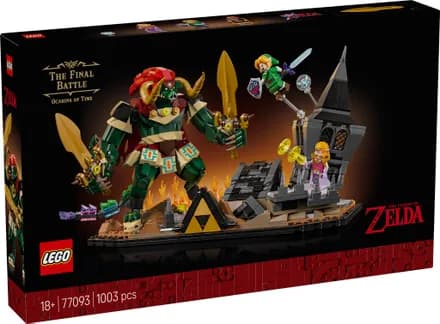
So when LEGO announced LEGO The Legend of Zelda: Ocarina of Time – The Final Battle, my inner 12-year-old and my slightly more responsible adult wallet started arguing immediately. A 1,003-piece diorama recreating the collapse of Ganon’s Castle and the final confrontation? With a towering Ganon build, Zelda and Link minifigs, and a Ganondorf popping up from the ruins? That hits every nostalgia nerve I’ve got.
I picked it up at the LEGO Store launch weekend, cleared off my desk, and spent just over two and a half hours building the whole thing in one sitting. By the time Ganon’s massive horns were in place and Zelda was standing at the edge of the ruined arena, I felt the same mix I did at the end of the actual game: exhilarated, but with a few nagging “if only…” thoughts I couldn’t shake.
This is absolutely a set that understands Ocarina of Time, particularly that last battle. It’s packed with thoughtful prints, tiny references, and one of the best Nintendo minifigs LEGO has done so far. It’s also a set that feels caught between being a display piece and a play set, and the big Ganon build pays the price in articulation and flexibility.
What you actually get in the box
The Final Battle set clocks in at 1,003 pieces and is structured around a compact, ruined slice of Ganon’s Castle. On top, or rather around it, you get the real stars:
- Minifig Link in his Ocarina of Time adult design
- Minifig Zelda in her royal gown, finally getting the attention she deserved in LEGO form
- Minifig Ganondorf, the Gerudo King, complete with cape and armor elements
- A large brick-built Ganon, towering above the arena in full boar-demon glory
The footprint is tighter than I expected when I heard “final battle” and pictured the whole arena from the N64 climax. It’s more of a stylized diorama that suggests the space rather than a huge board to move figures around on. If you’ve seen the massive Great Deku Tree set, this is far more compact and focused, both in scale and intent.
What hit me immediately is that this is a very collector-minded set. The front-facing side is clearly designed for shelf presence: Ganondorf or Ganon rising from the cracked floor, Zelda fixed at one end, Link ready for the finale. Spin it around and the illusion breaks; the back is mostly structural, some exposed technic, and a couple of hidden features, but it’s built to be seen from one angle.
Build experience: relaxing, dense, and full of tiny gremlins
I built the whole thing in a single session, and the pace felt almost exactly right for a 1,000-piece set. No bag dragged on forever, but a couple of them reminded me how much LEGO loves 1×1 and 1×2 pieces these days. This might be one of the most “micro-piece heavy” sets I’ve personally put together.
If your floor is a vortex for tiny bricks, this set will test you. Every row of crumbled masonry, every chunk of ruined platforming is stitched together with tiny plates and tiles. I got strangely proud of myself for making it through without losing a single part to the carpet, which is not my usual track record.
The actual build is fairly straightforward, but there’s just enough trickery in the internal mechanisms and angled surfaces to keep it from becoming autopilot work. The lever system that lets Ganondorf “erupt” from the floor is especially satisfying to assemble. You build what looks like normal wreckage, then realize it’s actually a disguised hatch supported by a simple but clever technic arm underneath.
Fans of big, elaborate mechanical LEGO sets might find this one modest. It’s closer to a detailed display diorama with a couple of neat moving tricks than a kinetic, play-feature-heavy kit. For the length of the build, though, I never hit the “I just want this to be done” wall, which is about the highest compliment I can give a mid-size set like this.
Printed details only, no stickers in sight
One of the most pleasant surprises: there are zero stickers. Every emblem, pattern and texture that looks like a decal is actually printed directly on the piece. For a licensed diorama leaning heavily on specific iconography, that’s huge.
Ganon’s armor plating, ornamental details, and even some environmental textures feel crisp and saturated in a way that would have been a nightmare to get right using stickers on curved or tiny surfaces. It also means the set ages better; no peeling edges, no misaligned shield graphic you stare at for years knowing you placed it just slightly off.
The tradeoff, of course, is those printed parts are a bit less flexible if you’re big into MOCs. A tile with a very specific Ocarina of Time pattern doesn’t slot easily into a generic castle build without looking oddly specific. Personally, I’ll take perfect prints over sticker anxiety every single time, especially on a set trading this hard on nostalgia and accuracy.
Minifigs: Ganondorf steals the whole show
Link and Zelda are both solid, with detailed prints that line up nicely with their N64-era designs rather than the more painterly Breath of the Wild look. Link gets his green tunic, hat, and Master Sword; Zelda gets intricate gown printing that feels appropriately royal on such a small canvas.
Ganondorf, though, is the star. LEGO absolutely nailed him. The combination of his flowing cape and a custom shoulder armor element that wraps around his neck makes him feel imposing even next to the much larger Ganon build. The face print has that perfect smug, threatening energy that fits the character without going too dark for LEGO’s tone.
He also ties directly into one of the set’s smartest play features: a lever at the back lets you “summon” Ganondorf up through the shattered floor, recreating that moment before he transforms into Ganon. You press, he emerges from beneath, and the ruined arena suddenly feels alive in a way a static diorama doesn’t usually manage.
Ganon: intimidating statue, underwhelming action figure
The brick-built Ganon is where my feelings get complicated. On a shelf, posed just right, he looks incredible. The silhouette – hulking arms, massive horns, cape draped behind him – immediately reads as Ocarina-endboss Ganon. There’s a lot of smart piece usage in his face and torso, layering slopes and printed armor panels to keep him from feeling like a big monotone blob.
But once I started actually trying to pose him, the limitations kicked in. His legs and feet have decent movement, enough to give him a slight forward lean or a more neutral stance. The arms are far more restricted. Shoulders can shift, but the elbows are fixed. You don’t realize how much that matters for a boss that fights with giant swords until you keep trying to angle them into more dynamic positions and hitting the same stops over and over.
He ends up feeling less like a big, posable creature and more like a detailed statue you can tweak a little. Compared to something like LEGO’s large Optimus Prime or even other creature builds with more segmented articulation, Ganon stands out as oddly stiff for such a climactic character.
He ends up feeling less like a big, posable creature and more like a detailed statue you can tweak a little. Compared to something like LEGO’s large Optimus Prime or even other creature builds with more segmented articulation, Ganon stands out as oddly stiff for such a climactic character.
🎮 Get This Game at the Best Price
Compare prices instantly and save up to 80% on Steam keys with Kinguin — trusted by 15+ million gamers worldwide.
*Affiliate link — supports our independent coverage at no extra cost to you
Part of this is clearly structural; the designers needed him solid enough to loom over the arena without wobbling or collapsing if you nudge the display. From that angle, the compromises make sense. But as someone who grew up rolling around that arena dodging his swipes and lining up sword strikes, I really wanted just a bit more motion in those arms to sell the drama.
The awkward choice: Ganondorf or Ganon on display
There’s also a weird, unavoidable tradeoff built right into the core concept of the set. The arena is designed to feature either Ganondorf (minifig) bursting from the ground or Ganon looming over it. You can technically have both present, but the visual storytelling falls apart if Ganondorf is chilling there in Gerudo form while his demon form also dominates the battlefield.
When I had only Ganondorf in place, the diorama felt a little empty. The ruined castle, Zelda on one side, Link on the other – it all sets the stage, but without the towering Ganon build, it lacks that over-the-top final boss energy. Swap to Ganon, though, and the problem flips: the minifig Ganondorf I love so much ends up tucked away off to the side or back in the box.
That tension is baked into the design. If you’re all-in on display accuracy and you want a snapshot of the very final phase of the battle, Ganon is the obvious choice. If you care more about minifig scale and the story moment when the King of Evil rises from the rubble, Ganondorf takes the stage and the huge creature build becomes a spare.
I found myself swapping between them a couple of times during the first day, trying to decide which “felt right” for where the set lives on my shelf. I eventually landed on Ganon front and center with Zelda and Link, which means the best Nintendo minifig in the set currently lives in a small parts tray. As a collector, that stings more than I expected.
Easter eggs and tiny nods to Ocarina
The set would feel much more generic without the small in-world details hidden throughout the build. Very early on you assemble a Megaton Hammer tucked into the ruins – a lovely callback to one of the game’s more memorable tools, and a nice way to reward anyone who spent way too long rolling around Death Mountain back in the day.
There’s also a concealed stash of heart pieces embedded in the structure. They’re not front-and-center; you discover them as you build, just like cracking open pots or cutting grass in the game. That vibe runs through the whole set. It doesn’t bombard you with references, but it sprinkles in enough that every few minutes of the build you hit another “oh, that’s clever” moment.
Compared to LEGO’s Great Deku Tree, which is practically a shrine to hidden mechanical tricks and dual builds, The Final Battle is more restrained. The focus is less on complex transformations and more on capturing the tone of that last, desperate stand with a few carefully chosen callbacks.
There is one moment from the actual game you won’t find represented, and it’s understandable even if a small part of me is disappointed. In the original N64 ending, Link’s final strike is by driving the Master Sword into Ganon’s forehead. LEGO and Nintendo obviously aren’t going to let you reenact “Master Sword lobotomy” on a retail set. As a fan, though, I couldn’t help but eye the sculpted brow on the Ganon build and imagine a hidden slot for a minifig-scale sword to complete the recreation.
Display, play, and where this set actually fits
After living with the finished model for a bit, it’s clear this is aimed more at adult collectors and nostalgic Zelda fans than at kids looking for a hyper-playable set. The limited articulation on Ganon, the single strong display angle, and the overall density of the build justify that read.
You can absolutely play with it – the lever-driven Ganondorf reveal is fun to trigger, Link and Zelda look great in hand, and Ganon is sturdy enough to move around without feeling fragile. But if you’re used to big, swingable playsets with multiple rooms and tons of accessories, this will feel more like a curated scene than a toy you constantly rearrange.
Price-wise, it sits in that familiar “premium nostalgia” bracket – around the €120 mark in Europe, and likely similar in dollars elsewhere. For just over 1,000 pieces with all-printed elements and a licensed IP, that’s not outrageous by modern LEGO standards, but it isn’t an impulse buy either.
For me, the value came down to how much I cared about that exact moment from Ocarina of Time. As someone who still has the final battle music burned into memory, building this felt like closing a circle that started back on the N64. If your attachment to Ocarina is more casual, the compromises – especially Ganon’s stiffness and the Ganondorf-versus-Ganon display dilemma – are harder to ignore.
Who this set actually suits
- Ocarina of Time diehards who can instantly picture the ruined arena and want that snapshot on a shelf.
- Adult LEGO collectors who appreciate printed elements, focused dioramas, and clever but not overwhelming mechanical features.
- Nintendo figure fans who will lose it over how good Ganondorf and Zelda look in minifig form.
If you’re looking for:
- A highly poseable big-fig creature with lots of articulation
- A sprawling, kid-first playset with rooms, vehicles, and tons of accessories
- A budget-friendly entry point into LEGO Zelda
…this probably isn’t the right box to crack open first.
FinalBoss // Gear
Level up your setup
01Top-rated gaming headsetson Amazon→02High-refresh gaming monitorson Amazon→03Gaming chairson Amazon→04Discounted game keyson Kinguin→Affiliate links · As an Amazon Associate, FinalBoss earns from qualifying purchases.
Want to Level Up Your Gaming?
Get access to exclusive strategies, hidden tips, and pro-level insights that we don't share publicly.
Ultimate Reviews Strategy Guide + Weekly Pro Tips