
Table of Contents (8)
Why this monitor matters more than a price tag
Big, curved OLED desktop monitors have been the promise for years. LG just delivered one that’s genuinely different: a 45″ 5K2K OLED with DisplayPort 2.1, a true OLED panel (0.03ms response, 1.5M:1 contrast), and dual refresh profiles that hit 165Hz in its high-res mode and 330Hz at 1080p. And yes, it’s currently $650 off – the largest discount we’ve seen. That combination is what changes the calculus for serious PC and console players, but it’s not an unconditional slam-dunk.
Key takeaways
- LG’s UltraGear 45GX950A-B is effectively the first mass-market 45″ 5K2K OLED aimed at gamers, pairing high resolution with high refresh and DP2.1 bandwidth.
- The two-year warranty that explicitly covers OLED burn-in is unusually consumer-friendly, and addresses the biggest emotional blocker for buyers.
- Hardware caveats remain: a 45″ 5K2K panel is about 125 ppi – great for size but not as pixel-dense as smaller 4K monitors – and hitting top refresh rates still demands a powerful GPU or clever scaling.
- Context matters: the industry-wide OLED shift (noticed across laptops and even console discourse) makes this monitor a logical next step — the discount makes it a timely buy for those who were sitting on the fence.
What the launch actually signals
Last year’s OLED rush didn’t stop at laptops — it rewired expectations. GamesRadar flagged how OEMs finally took displays seriously in 2025, and IGN’s deal coverage of OLED-equipped laptops shows vendors are comfortable shipping high-contrast panels in mainstream hardware. LG’s 45GX950A-B is the monitor industry catching up: a living-room-sized OLED that speaks the language of PC gaming (DisplayPort 2.1, 330Hz modes) while also acting as a docked-console display and a laptop hub (USB-C with 90W PD).
The practical trade-offs
Don’t let the spec sheet do all the talking. A 5120×2160 panel at 45″ is about 125 ppi — you get a lot of real estate and immersion, especially with an aggressive 800R curve, but you don’t get the pixel density of a 27″ 4K monitor. That matters for text clarity and for users sitting very close to the screen. The curve is great for cinematic immersion — less so for multi-window productivity where straight edges and palettes matter.
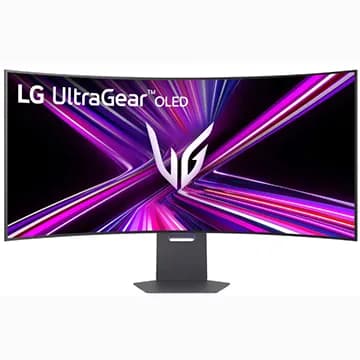
Then there’s the performance math. The monitor’s dual-mode approach is smart: 165Hz at the panel’s higher-resolution mode, and a 330Hz mode that drops to 1080p. That’s a useful compromise — competitive esports players can chase ultra-high Hz at lower resolution, while single-player and cinematic gamers can enjoy the 5K2K canvas. But to actually push the panel in native modes you need modern GPUs (or next-gen consoles for up-to-120Hz 4K), and consoles won’t exploit DP2.1’s top-end bandwidth. In short: impressive tech, but demands on the rest of your setup are real.
The one thing PR hoped you wouldn’t notice
LG leans hard on specs — and for good reason — but the uncomfortable observation is that most buyers will never push both the resolution and the refresh ceiling simultaneously. Most users will live in a compromise mode. The kicker that LG probably doesn’t want shouted from the rooftops: you’re buying an extremely capable display that will reveal weaknesses elsewhere in your rig (GPU, cables, input limitations) faster than it will reveal its own.
Why the burn-in warranty matters
OLED burn-in is the elephant in the room for buyers switching from LCD. Listing a two-year warranty that covers burn-in is a direct admission that this is a real risk — and also a practical risk-mitigation for consumers. That alone will shift many fence-sitters into the “buy” column; it’s also the kind of consumer-friendly move GamesRadar and IGN have noted other manufacturers are only starting to make in 2025-26.
What to watch next
- Independent long-term burn-in tests and firmware updates — the warranty is great, but real-world durability tests will settle this.
- Price movement: the current $650 discount is the lowest recorded price; watch whether competitors match it or whether LG holds the line.
- Windows and GPU drivers fully supporting DP2.1 high-res, high-Hz modes without glitches; early DP2.1 rollouts have had stumbles.
- Alienware and other OEMs’ upcoming OLED laptop launches — if laptops standardize on OLED, demand for premium external OLED displays will spike.
If I were talking to LG’s PR rep I’d ask: what real-world brightness and panel longevity numbers can you share under standard gaming use? The warranty is a strong gesture — but buyers want hard numbers, not just assurances.
TL;DR
LG’s UltraGear 45GX950A-B is a milestone: a 45″ 5K2K OLED that pairs true-OLED contrast and DP2.1 bandwidth with genuinely useful high-refresh modes, and it’s now $650 off to its lowest price. The two-year burn-in warranty removes a major buying obstacle. But expect trade-offs: pixel density, GPU requirements, and the curve’s desk ergonomics mean this is a powerful, specific tool — not a universal upgrade.
FinalBoss // Gear
Level up your setup
01Top-rated gaming headsetson Amazon→02High-refresh gaming monitorson Amazon→03Gaming chairson Amazon→04Discounted game keyson Kinguin→Affiliate links · As an Amazon Associate, FinalBoss earns from qualifying purchases.
Want to Level Up Your Gaming?
Get access to exclusive strategies, hidden tips, and pro-level insights that we don't share publicly.
Ultimate Gaming Strategy Guide + Weekly Pro Tips