
Table of Contents (10)
A beautiful goodbye wrapped around one really weird choice
Life Is Strange: Reunion feels like it shouldn’t work as well as it does. It’s a direct sequel to a controversial ending, it resurrects a character whose fate has already broken hearts multiple times, and it dares to say, “No really, this is the big, final Max and Chloe chapter.” That’s a trio of landmines. I went in half-expecting a nostalgia cash-in that would cheapen what the original game meant to me.
Instead, what I got was one of the most emotionally precise, character-first stories Deck Nine has ever done… wrapped around a central mystery that eventually flips the table in a way that still doesn’t fully sit right with me.
On a moment-to-moment level, Reunion is exactly the kind of game I wanted when they first said “Max and Chloe reunion.” It’s tender, awkward, angry, funny, and occasionally devastating. It lets you inhabit both of them in a way the series has never tried before. But when the mask finally comes off the antagonist, it feels less like messy human drama and more like a writers’ room high-five that no one stopped to sanity-check.
So this isn’t a simple “it’s amazing” or “they ruined it” situation. Reunion is both: a deeply satisfying farewell to two of the best-written characters in modern games, and a story that undercuts its own maturity at the exact moment it should have trusted it the most.
Coming home to a campus on fire
Reunion drops Max into a new life at Caledon College, a fancy but quietly tense campus that feels like an echo of Blackwell Academy with the volume turned down. She’s older, more guarded, but still that same girl who overthinks every conversation and hides behind her camera… or would, if she’d ever allowed herself to keep one.
The opening hits fast: Max returns from a trip to find the college in flames, people screaming, the sky choked with smoke. The sequence is chaotic in a way Life Is Strange rarely is; you’re not just wandering and watching tragedy happen, you’re scrambling through collapsing corridors, guided by sirens and panicked NPCs, while the game quietly teaches you the new twist on her powers.
Her time manipulation is back, but it’s “wrong.” Every rewind is heavier, glitchier, framed as something that probably shouldn’t be possible anymore after the events of Double Exposure. The first time I hit the familiar trigger and watched the flames roll backwards while the items in Max’s pockets stayed put, I got that old thrill from the original game, but with a nervous edge – like I was cheating the universe one more time and it knew.
Max’s desperate attempt to stop the inferno pushes her back before the fire, back into the web of cliques, town politics, and institutional rot that will eventually ignite Caledon. And then, with a setup that easily could’ve gone full nonsense, Chloe is back.
Without spoiling the exact mechanics of her return, Deck Nine leans into the multiversal logic of Double Exposure and the emotional fallout of the original game. It’s surprisingly elegant, not a cheap resurrection. The way Max reacts to seeing Chloe again – a half second of disbelieving silence before the dialogue wheel even appears – is the moment Reunion proved it understood why bringing her back was such a big deal.
Playing both sides of Max and Chloe’s relationship
The boldest choice Reunion makes is handing you full control of both Max and Chloe, in gameplay and in conversation. You don’t just pick what Max says and watch Chloe react; during key scenes, the game lets you swap between them mid-dialogue and choose how each responds. It’s like juggling two internal monologues at once.
At first, I wasn’t sure I liked it. One of the core tensions of earlier games was never quite knowing how the other person would take your words. If I control both sides, is it even a “choice” anymore, or just writing fan fiction of the perfect reconciliation?
Then I hit an early argument scene in Max’s dorm. Max was retreating into guilt and apology; Chloe was hiding hurt under jokes and impatience. I tried playing it “balanced” — gentle Max, slightly softened Chloe — and it felt wrong, like sanding off their edges. So I rewound, switched to Chloe in her angrier mode, and let her say the thing she would absolutely blurt out: basically, that Max doesn’t get to keep martyring herself forever.
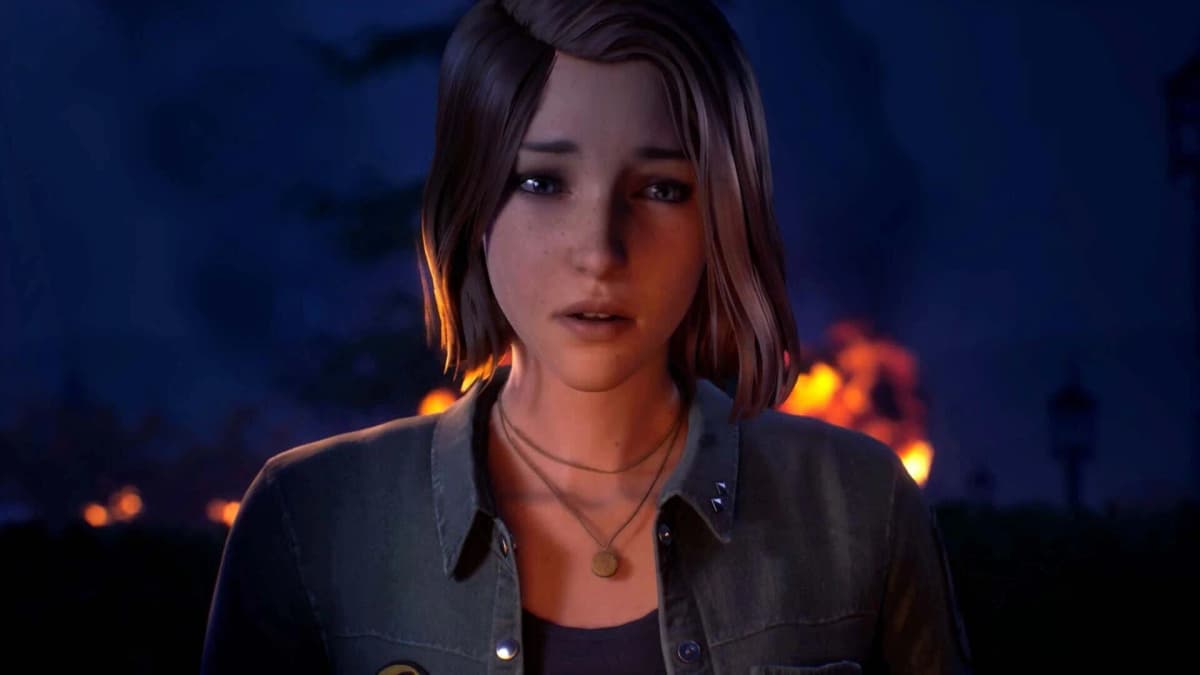
This time, when I swapped back to Max, her options had shifted. Because I’d allowed Chloe to be authentically pissed, Max could either double down on self-loathing or finally admit that she also needed something from Chloe. That back-and-forth, controlled entirely by me but still feeling like them, was when the system clicked. I wasn’t gaming a meter; I was deciding which version of this relationship lived in this timeline.
There’s no “fail state” in these conversations — you can’t accidentally break them up with one bad choice — and that will rub some people the wrong way. For me, it felt like Deck Nine acknowledging just how much Max and Chloe mean to players. The tension shifts from “please don’t punish me for picking the wrong dialogue line” to “what kind of history do I want them to carry into their future?” It’s subtler, but for a game about reunion and healing, it fits.
Time manipulation as both puzzle and intimacy tool
Mechanically, Max’s powers are used in familiar but satisfying ways. Investigations are built around scouting information, rewinding, and approaching people with knowledge you technically shouldn’t have. It feels less like solving logic puzzles and more like emotional sleuthing.
One side quest had me trying to mediate a conflict between a student activist and a campus security officer. The first run-through, I fumbled the conversation, picked a defensive line as Chloe, and watched the whole thing escalate into shouting. Rewinding didn’t just reset the scene; it unlocked new, more nuanced options because I’d heard what each of them really feared underneath the bluster. Max could then preempt those fears, and Chloe could aim her sharp tongue at the system instead of the person. It felt like using time travel as emotional intelligence rather than a cheat code.
The set pieces where Max keeps physical items through rewinds are the mechanical high points. There’s a sequence in the burning building where you’re effectively assembling a solution across multiple doomed attempts: grabbing a fire axe in one loop, a keycard in another, then finally chaining everything together in the “real” timeline. The DualSense rumble on PS5 ramps up to this tight, vibrating hum whenever you’re about to push things too far, and the score builds this nauseous, almost Vertigo-style wobble. It sells the idea that you’re stretching reality like taffy.
My favorite use of the power, though, is a small, almost throwaway romantic scene. If you choose to pursue the Max/Chloe romance (which the game handles with a warmth and casual queerness I wish more studios had), there’s a moment where you can rewind not because you messed up, but because Max wants to savor something. You’re effectively redoing the same tender exchange in slightly different ways, chasing the version that feels most right. It’s cheesy and perfect.
Letting Chloe stay rough around the edges
The big relief: Reunion doesn’t sand Chloe down into a safe, marketable version of herself. She’s older, yes, and you can play her with more restraint, but the game fully supports the version of Chloe who is impatient with authority, allergic to bullshit, and foul-mouthed in a way most conversation systems would quietly punish.
Letting Chloe stay rough around the edges
The big relief: Reunion doesn’t sand Chloe down into a safe, marketable version of herself. She’s older, yes, and you can play her with more restraint, but the game fully supports the version of Chloe who is impatient with authority, allergic to bullshit, and foul-mouthed in a way most conversation systems would quietly punish.
🎮 Get This Game at the Best Price
Compare prices instantly and save up to 80% on Steam keys with Kinguin — trusted by 15+ million gamers worldwide.
*Affiliate link — supports our independent coverage at no extra cost to you
There’s a scene where a smarmy administrator tries to pin blame on one of Max’s friends. The “polite” options are there — de-escalate, redirect, talk about due process — but the most Chloe-coded line is essentially “pull your head out of your ass and look at the actual problem.” In most choice-driven games, that’s the “bad” choice. Here, it triggered a stunned silence, then a grudging reset of the conversation. It was the right pressure point for that person at that moment.
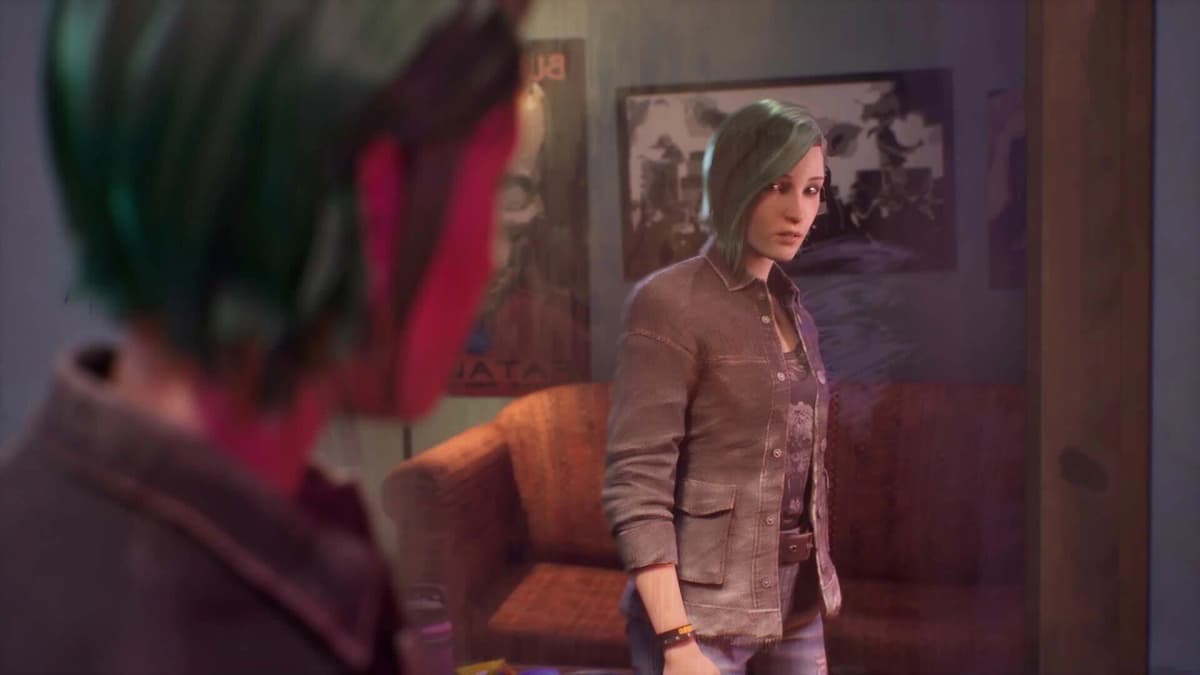
The writing is consistent like that across the whole cast. Even minor characters feel like they have internal lives: anxious overachievers, disillusioned staff, townies who resent the college’s presence. When Chloe goes off on someone, it doesn’t feel like you’re just picking the “mean” option; it feels like you’re inhabiting a person who has always been terrible at playing nice, for reasons the series has patiently built over years.
Hannah Telle and Rhianna DeVries absolutely carry that weight. Telle’s Max has this brittle calm, like she’s constantly trying not to crack open, and DeVries finds new layers in Chloe’s bravado. There are line reads where Chloe is being openly affectionate and still can’t help turning the last word into a half-joke, and it just feels like two people trying to grow while staying themselves.
When the mystery finally points at the wrong person
All that grounded character work makes the central misstep sting more. For most of its runtime, Reunion builds a compelling, messy situation around Caledon College and its town. You’ve got financial pressure, class resentment, climate anxiety, activist burnout — a believable tangle of motives that could plausibly escalate into something catastrophic.
The game smartly avoids cartoon villains for a long time. Administrators have legitimate constraints, activists have blind spots, even the most “obvious” suspect has sympathetic angles. It feels like the fire is going to come from a tragic collision of flawed people and systemic rot, which is exactly the kind of story Life Is Strange tends to nail.
And then the mask comes off, and the answer to “who’s really behind the blaze?” is… well, it’s a twist. A big, swinging-for-the-fences reveal that had me staring at the screen trying to convince myself the game was about to double-twist back to something grounded. It doesn’t.
Without spoiling details, the ultimate antagonist feels chosen for shock value rather than thematic resonance. The series has absolutely done melodrama before — this is still Life Is Strange — but this particular heel turn doesn’t match the careful work the script did to humanize everyone else. It’s not that the culprit is impossible, exactly. It’s that their motivation, as explained, plays like an outline note that never got a full draft.
It doesn’t destroy the story. The final emotional beats for Max and Chloe still land, and the game quickly refocuses on their choices in the aftermath rather than dwelling on the villain monologuing. But I couldn’t shake the feeling that a more obvious, less twisty culprit — one rooted in the tensions the game is otherwise so good at exploring — would’ve fit far better than the big “gotcha” we actually get.
Presentation: gorgeous vibes, awkward faces, and that hair bug
Visually, Reunion sits very close to Double Exposure. Caledon’s campus is instantly familiar if you played that game: red-brick buildings, rainy courtyards, cozy interiors cluttered with student life. It’s not chasing photorealism, and I’m glad. The stylized character models and painterly lighting still give it that slightly dreamlike Life Is Strange feel.
The trippier sequences — the liminal spaces Max gets pulled into when the timelines strain too hard — are standouts. One late-game sequence turns familiar corridors into Escher-like loops lit by emergency lights and embers, with ghostly echoes of past conversations playing backwards. It’s unnerving without falling into edge-lord horror.
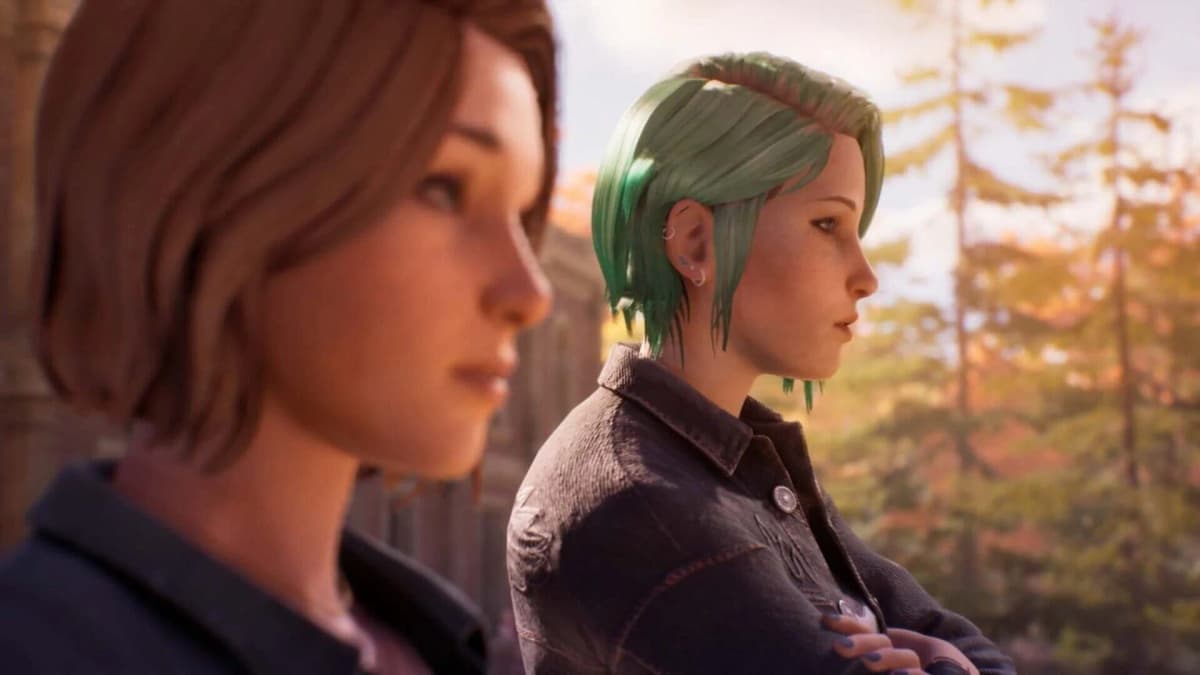
On PS5, I played in the performance-focused mode. Frame rate was solid, loading was short, and the haptics added just enough texture without feeling gimmicky. The soundtrack leans into acoustic, indie-adjacent tracks again, with a few licensed songs that feel perfectly chosen for quiet dorm walks and rooftop conversations.
But there are rough spots. The most noticeable was a recurring visual bug where characters’ hair would randomly snap to a washed-out white for a frame or two, especially in busy scenes. It’s not game-breaking, just immersion-breaking, like everyone is briefly cosplaying as a glitchy anime protagonist.
Facial animation is also inconsistent. There are scenes where Max’s eyes and tiny mouth twitches carry more emotion than the words; then a big confession drops and someone’s face slips into that slightly dead, waxy look you’d expect from a game two generations back. Given how much this series leans on close-ups of people’s faces as they listen, not just speak, those misses stand out.
Is Reunion for longtime fans only?
This is very clearly a game made for people who already care about Max and Chloe. You can play it without having touched the original or Double Exposure, but the emotional impact shrinks dramatically. The story assumes you know what Arcadia Bay means to them, what their possible fates were, and why being handed control of both of them in the same scene is such a loaded gift.
Mechanically, it’s still a Life Is Strange game: you’re walking, talking, investigating, occasionally doing light puzzles. If you bounced off earlier entries for being “too much talking, not enough doing,” Reunion isn’t going to change your mind, dual-protagonist system or not.
But if you liked where Deck Nine took the series, yet felt wary about Chloe’s return being a cynical move, Reunion genuinely feels like an attempt to earn that choice. It doesn’t erase earlier endings; it builds a new, specific branch of the multiverse where these two broken people get one last shot at figuring themselves out together.
FinalBoss // Gear
Level up your setup
01Top-rated gaming headsetson Amazon→02High-refresh gaming monitorson Amazon→03Gaming chairson Amazon→04Discounted game keyson Kinguin→
Affiliate links · As an Amazon Associate, FinalBoss earns from qualifying purchases.
Want to Level Up Your Gaming?
Get access to exclusive strategies, hidden tips, and pro-level insights that we don't share publicly.
Ultimate Reviews Strategy Guide + Weekly Pro Tips