
Table of Contents (16)
Anxious laughter, shared deaths, and a game that plays it safe
I went into Little Nightmares III with my living room lights off and my headset up, expecting that familiar cocktail of dread and curiosity. I played on a PlayStation 5 Pro, mostly in Performance mode, and finished the campaign solo in just under five hours before replaying sections in co-op with a friend using the Friend Pass. Across those sessions, a pattern set in: I loved the mood, I liked the rhythm, I winced at the stumbles, and I kept wishing Supermassive had colored outside the lines more often. It’s a great new Little Nightmares-sometimes too much so.
Where I’m coming from and how I played
I’m one of those people who fell hard for the original’s “escape the grotesque” vibe and then stuck with the sequel’s meaner chases because it made the world feel predatory. I like to play these games one notch above comfortable: headphones, no pause unless my cat steps on the controller, and a stubborn refusal to look up solutions. For this one, I started alone as Alone (how can you not?) and then replayed chunks as Low. I split my time roughly 70/30 solo to online co-op, which is also when the game felt most alive-though not as interdependent as I’d hoped.
Quick housekeeping: there’s no local co-op and no cross-play at launch. The Friend Pass is a nice touch that meant my buddy didn’t need to buy a second copy, but we had to be on the same platform. It’s very 2025 to ask for online-only co-op in a game that begs for couch gasps, whispered “go, go, go!”s, and that quietly shared moment of not breathing when you hide under a table together. I missed that.
First impressions: an off-kilter opener that almost lost me
My first hour was in the sun-baked, dust-choked opener, and honestly, it’s the weakest chapter of the bunch. The palette leans into ochres and grays; the geometry is broader, the silhouette reads are mushier, and the puzzle beats are so tutorial-gentle that I caught my mind wandering. Twice I got the “aha” moment right as the AI companion did the thing for me, which is the worst kind of hand-holding-helpful enough to dull curiosity, not helpful enough to feel clever.
I get what Supermassive is doing: easing players into the cadence of sneaking, pushing, boosting, and two-character toggling. But for returning nightmare chasers, the spark doesn’t ignite here. It’s not bad; it’s just safe. The series has always relied on showing instead of telling, but this opener shows too gently and too often repeats: pull a crate, boost a ledge, crawl through a gap, hide behind a crate. The confidence arrives later, and when it does, it’s properly mean and moody.
Co-op that’s fun, but not the kind that rewires your brain
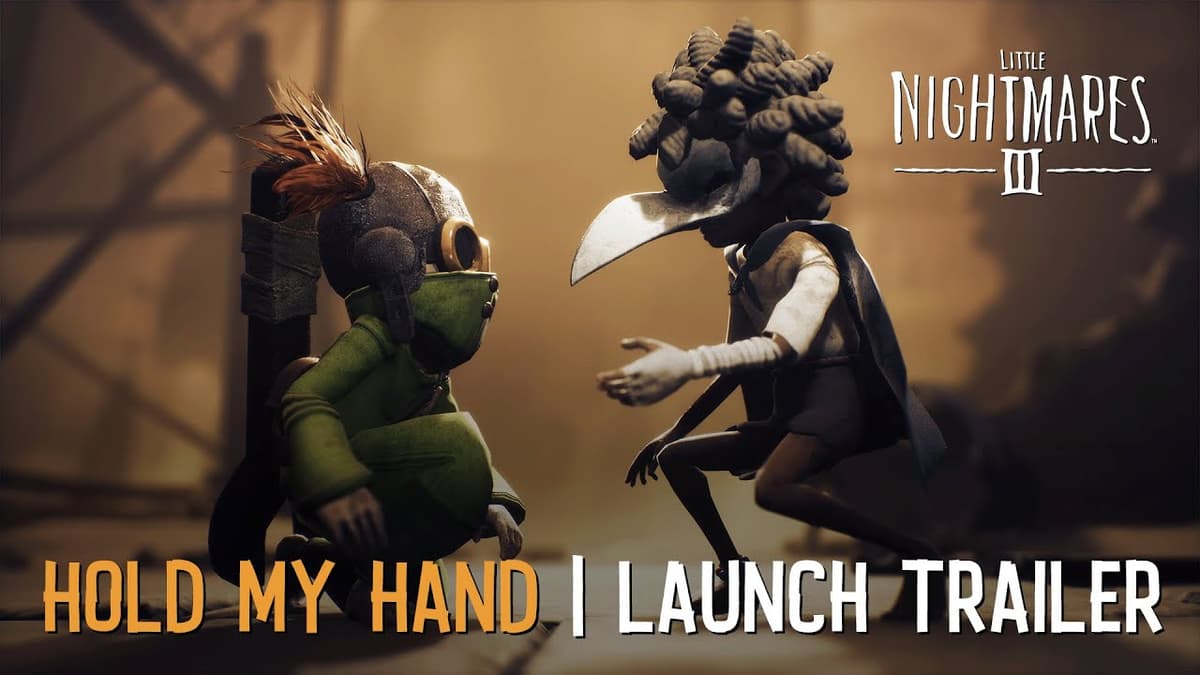
The headline feature is online co-op, and I was ready for Hazelight-style dependency—puzzle designs that only work when both players think laterally together. Little Nightmares III doesn’t go that far. The duo—Low with his bow and infinite arrows, Alone with her wrench—feature in a steady rhythm of “you do your thing, I’ll do mine” interactions. Low anchors ropes, snipes switches, and can distract threats at range. Alone breaks brittle barriers, finishes stunned creatures, and cranks mechanisms like a stubborn dock worker. When the game braids these actions so they overlap on a timer—one of you keeps a crank from snapping back while the other scrambles through—co-op pops.
But there are long stretches where “co-op” means trading moments rather than weaving them. It’s still a good time with a friend—especially during chase sequences where shouting “shoot the rope!” or “kick the grate!” becomes a comedy of panic—but it seldom demands that energy. And if you play solo, the AI partner is capable enough to keep things moving, sometimes too capable. I lost count of the times the AI stood exactly where the solution lived or ran to a lever before I’d connected the dots, which deflates the satisfaction of discovery. I really wish there were an option to slow or disable those nudges.
Puzzles, chases, and the series’ signature die-and-retry
Back-to-back, the game settles into a classic sequence: explore a spiky diorama, clock the moving parts, solve a self-contained puzzle (often with one “right” answer), then endure a sprint where one mistake means a soft reset. This is the die-and-retry DNA the series wears proudly, and it’s still effective. When a grotesque thing slams its palm down one frame faster than you expect, it’s a fair lesson—until an animation snap eats a footstep and you clip a table corner. I died 14 times on one fairground chase because I clipped a crate shadow while diving under a bench. On attempt 15, I instinctively cut a slightly wider line around a peeling poster and cleared it. It’s frustrating until it’s elating, and then you go again.
Where the puzzles click, they do it with staging more than complexity. One of my favorite bits had Low shoot a frayed rope above a swaying cage while I, as Alone, braced a crank against a surging wind—timing the arrow to the arc so the cage swung through a doorway felt good, not because I needed a spreadsheet, but because the room’s layout made the logic legible under stress. Less exciting: a handful of recycled patterns (push the crate, wedge the door with a broken plank, lure the patrolling threat around a loop) that brush up against rote. At their best, these games make you feel like you’re reading the room; at their most average, you’re pushing what the room obviously wants pushed.
Level highlights: the candy factory and the miserable fairground
Little Nightmares games live and die by spaces you feel in your stomach. Two chapters here are standouts. The candy factory is comically sinister: syrupy pipes, vats that gurgle like clogged throats, conveyor belts feeding gummy shapes into steel mouths. It’s glossy, sticky horror, and it asks you to treat sweetness like a poison. There’s a section where you stuff a chute to jam a rhythm, and the moment the machinery coughs, you realize how the whole room’s timing has been messing with your perception of safety. It’s deliciously nasty.
The fairground is the opposite kind of terror: sterile lights cutting through fog, animatronic cheer that teeters on anxious hysteria, and the feeling that the place wants to perform you into pieces. A stealth section where you duck between photo booths while a mascot’s dead grin sweeps the aisles with a flashlight is peak Little Nightmares—tense, readable, and just silly enough to make you smirk when you finally slip past. Both spaces understand the series’ sweet spot: toy-like scale against industrial malice. They also expose how middling the opener feels by comparison.
Weapons that aren’t really weapons, and why that works
Low’s bow might sound like a power-up, but it’s not a combat upgrade in the usual sense; it’s more like a way to poke the diorama. Same with Alone’s wrench—it’s a key, a lever, and occasionally a last-resort thwack that buys you half a second. I appreciated that restraint. When I tried to play aggressively, the game swatted my hand, which kept the tone in that vulnerable space the series thrives in. The best interactions are the ones that compress time: you hold something together with the wrench while your partner dashes across, or you fish an arrow into a rickety pulley as the floor threatens to vanish. The less interesting beats are procedural: break the brittle wall, again, and again.
Story and worldbuilding: whispers, mirrors, and a coy ending
The narrative sticks to the series’ grammar: no dialog, no text, all implication. It gestures at the Spiral and a liminal world that eats children’s fears, and it keeps its cards glued to the table. Mirrors show up enough to form a motif—reflection, inversion, the idea that seeing yourself is a threat—but the game refuses to say anything out loud, even by environmental storytelling standards. I like a coy story, but this one sometimes feels guarded more than elegant. The ending leaves a lot in the air, and the promise of more answers in next year’s expansion pass doesn’t thrill me. If your most interesting hints are paywalled behind a deluxe upgrade, that’s less mystique and more marketing.
Control feel and little annoyances you only notice after 6 hours
On PS5, movement is smooth and readable, with a nice bit of momentum on drops and vaults. There’s that Little Nightmares wobble where your character’s tiny legs overcommit to diagonal sprints, and it’s part of the charm and part of the reason you faceplant when a chase tries to thread you through foreground debris. Context prompts are restrained: a small symbol when a boost is possible, a subtle cue when an object can be grabbed. I rarely fought the camera, but I did fight depth a few times; a few staircases and beams sit just forward of the plane you think you’re on, and you’ll whiff a jump because your brain thinks 2.5D is flatter than it is. It’s not constant, but when it hits during a one-shot chase, it stings.
Performance, visuals, and audio on PS5 Pro
Flip to Performance mode. The 60fps cadence makes the chases feel honest and the input feel crisp. Quality mode’s prettier shadows and slightly denser fog don’t offset the 30fps mush in a game where timing decides whether you get swallowed by something with teeth in the wrong places. I noticed minimal hitching—just one half-second stutter on a loading transition when an elevator door opened into a larger atrium—and no crashes in my time. The DualSense support is restrained to basic rumbles and the occasional tension on a crank. It feels like a missed opportunity—imagine the patter of rain mapped to the haptics or the sickly thrum of a machine in the triggers—but it’s not a deal-breaker.
Visually, the art direction still carries. This world is a junk drawer of childhood anxieties: oversized fixtures, fabrics that look damp forever, plastics that squeak when they shouldn’t. The lighting team understands silhouette horror—halos that make thin necks and wrong elbows into threats before you ever see a face. Some interiors do blend into each other (elevator shafts, surprise surprise), but the showpiece chapters are gorgeous in a rotten way. This is a game where you’re grateful you can’t smell anything.
The audio is the unspoken MVP. Headphones turned the factory into a living thing—you hear valves groan like tired lungs and you time your moves to groans and wheezes. The score sits back, letting room tone and percussive jolts do the heavy lifting. I wish there were a single hummable motif to hold the experience together; instead, it’s more textural. Still, the mix sells presence. More than once, I froze because a distant clatter sounded like it came from my actual kitchen. That’s the dream for a game like this.
The AI partner is both helpful and in the way
In solo play, the partner behaves well enough not to become a liability. They keep up, they don’t magnetic-clip into death zones, and they occasionally point at what matters with perfect stage actor timing. That last bit is the rub. If you’re the kind of player who likes walking a space clockwise, testing seams, and letting a spark of recognition land on its own, the AI’s eagerness can be an annoyance. It’s not a game-ruining problem, but if you’re debating solo versus co-op and have the option, pick co-op. A human partner who shouts the wrong idea is way more fun than an AI who silently knows the right one.
What works, what doesn’t—based on my time
- Works: Mood. The production design and audio are laser-precise. When the game wants you to feel small and cornered, it nails it.
- Works: Co-op setpieces that overlap abilities under pressure. A few late-game rooms sing when timing and trust matter.
- Works: The candy factory and fairground chapters are up there with the series’ best spaces—playful, awful, and coherent.
- Doesn’t: The opening chapter is limp, visually and mechanically. It undersells what the game can do.
- Doesn’t: Puzzles are often single-solution and occasionally recycled. You feel the rails under your feet.
- Doesn’t: No local co-op or cross-play. Friend Pass helps, but this screams for a couch mode.
- Mixed: Solo AI. Competent but a little too eager to solve for you.
- Mixed: DualSense support. Fine, but conservative; there was room for more tactility.
- Mixed: The story’s coyness feels calculated, especially with teased answers in a future expansion.
Who should play this
If you loved the first two Little Nightmares games for their atmosphere, micro-puzzles, and brisk running time, this is an easy recommendation. It’s familiar in a comforting way, and when the new co-op systems click, the panic you share becomes the point. If you’re hungry for a reinvention—a wholesale redesign of how a two-character puzzle-platformer thinks—temper expectations. This isn’t It Takes Two with a horror coat of paint; it’s Little Nightmares with a friend option.
If you’re new to the series, you can jump in here without a lore primer. The game is self-contained, and the way it communicates rules is readable. Just know you’re signing up for trial-and-error sequences that can be punishing until they teach you to read the space the way it wants. If that sounds like a rhythm you hate, this won’t convert you.
My personal turning point
Somewhere around hour three, in a room where a crank threatened to unwind a bridge into a pit, I swapped roles and stopped trying to be the hero. I anchored the mechanism with Alone’s wrench and trusted my friend to make three clean jumps and shoot a swinging target on the far side. He missed twice. We were both laughing by attempt three, not because the game was funny, but because we were finally doing the thing co-op horror does best: making failure communal. That was the moment I stopped judging what the co-op wasn’t and enjoyed what it was—a way to share dread.
Bottom line and score
Little Nightmares III is a confident continuation with a handful of sharp peaks and one very flat valley at the start. It’s moody, exacting, and sometimes too proud of sticking to the formula. The online-only co-op is welcome even if it’s undercooked; the absence of couch co-op stings; the AI partner can be too helpful; and the promise of more answers in an expansion makes the ending feel like a held breath. But when the game leans into its best instincts—puncturing silence with a sudden gasp, staging a room so you can feel clever under duress, letting two kids feel tiny against an uncaring machine—it’s exactly the kind of nightmare I want to revisit.
Rating: 8/10. A strong, safe sequel with terrific mood, standout chapters, and co-op that’s better with a friend than with ambition.
TL;DR
- Haunting atmosphere and top-tier audio set the tone.
- Online co-op adds tension but isn’t deeply interdependent.
- Opening chapter underwhelms; later chapters, especially the candy factory and fairground, are excellent.
- Puzzles mostly have one solution; expect gentle repetition and classic die-and-retry chases.
- Performance mode at 60fps is the way to go on PS5; DualSense support is light.
- No local co-op or cross-play at launch; Friend Pass softens the blow.
- Story stays coy; more answers teased in a future expansion.
- Finished solo in about five hours; replayed sections in co-op for another hour-ish.
FinalBoss // Gear
Level up your setup
01Top-rated gaming headsetson Amazon→02High-refresh gaming monitorson Amazon→03Gaming chairson Amazon→04Discounted game keyson Kinguin→Affiliate links · As an Amazon Associate, FinalBoss earns from qualifying purchases.
Want to Level Up Your Gaming?
Get access to exclusive strategies, hidden tips, and pro-level insights that we don't share publicly.
Ultimate Reviews Strategy Guide + Weekly Pro Tips