
Table of Contents (12)
A soundbar for people who are secretly hi‑fi nerds
I didn’t buy the Nubert nuPro XS-8500 RC because I needed “just another soundbar.” I bought it because I’d hit my breaking point with plasticky TV audio and boom‑happy bars that make every explosion sound like wet cardboard. I wanted something that could replace a proper stereo setup, not just fake surround for Netflix.
After a few weeks with the nuPro XS-8500 RC under my 65‑inch OLED, running everything from PS5 and PC games to 4K Blu-rays and Spotify, I can say this much: this isn’t a soundbar in the usual sense. It’s a horizontally packed hi‑fi system that happens to fit under a TV.
If what you want is wall‑shaking, overblown “cinema demo” sound, there are easier (and cheaper) options. But if you care about midrange detail, honest bass that reaches down to roughly 30 Hz without a subwoofer, and the kind of natural tuning you’d expect from good stereo speakers, the XS-8500 RC suddenly gets very interesting.
First impression: this “bar” is an actual piece of furniture
The first thing that hit me wasn’t the sound. It was the weight.
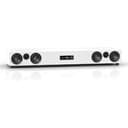
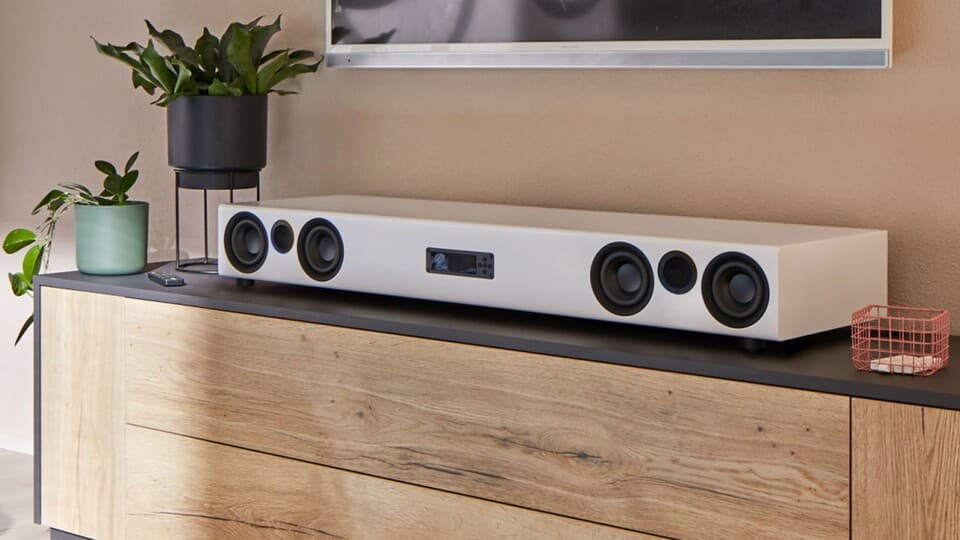
The nuPro XS-8500 RC is around 120 cm wide, roughly 17 cm high, and about 40 cm deep. On paper that’s “big soundbar.” In reality, when you lift nearly 30 kg of MDF and drivers out of the box, it feels closer to a compact floorstanding speaker laid on its side.
I had to reinforce my low TV bench and slide it into position like a mini fridge. Nubert claims it can carry a TV up to 100 kg on top, and honestly, I believe them. The cabinet feels dense and non‑resonant in a way you rarely get in typical soundbars.
Design-wise it’s more “serious hi‑fi” than “living room toy.” Sharp but clean edges, matte finish, a magnetic grille that snaps on with a satisfying click, and a simple display behind the front fabric. No RGB, no weird gamer angles, nothing yelling for attention. With the grille on, it just looks like a very grown‑up TV base.
Under the hood, there’s an unapologetically hi‑fi layout: a 3.5‑way system with two tweeters, four 119 mm mid/bass drivers, and two additional bass membranes. Each pair of drivers gets its own dedicated Class‑D amp, adding up to around 580-600 watts continuous power with peaks up to roughly 820 W depending on which sheet you read. Whatever the exact number, it’s far beyond what my old “premium” soundbar could muster, and it shows the moment you start pushing volume.
Setup, HDMI reality check, and X‑Room Calibration
My setup: XS-8500 RC on a low board, 65″ TV on top, PS5 and PC hooked to the TV, audio down via HDMI eARC. From box opening to sound took maybe 15 minutes, but there are some quirks you need to be okay with.
The back panel gives you:
- 1× HDMI eARC (with CEC)
- 1× HDMI input (for a direct source)
- 2× optical, 1× coaxial digital
- 1× analog RCA in
- USB‑A (for playback, not a full media streamer)
- Bluetooth 5.0 with aptX HD/LL, AAC, and SBC
- Subwoofer out and wireless ports for expansion
That single HDMI input is probably the biggest “modern convenience” compromise here. If you like daisy‑chaining consoles and streaming boxes through your soundbar, the Nubert isn’t built for that. The intended setup is simple: plug everything into the TV, send audio back over eARC, done. If your TV’s HDMI handling sucks, this may annoy you.
Once cables were in place, I fired up Nubert’s X‑Remote app and went straight for X‑Room Calibration. This is Nubert’s room correction system that measures your room and adjusts the low‑frequency response, which matters a lot when you’re trying to pull down to ~30 Hz without a sub.
On iPhone it’s almost suspiciously easy: hit calibrate, the bar plays sweeps, and the phone’s mic does the rest. On Android, you need an additional calibration interface from Nubert to do the same fully automatic process; without it, you’re basically limited to manual EQ and presets.
In my 22 m² living room with a nasty bass bump around 50 Hz near the couch, the before/after difference was clear. Pre‑calibration, some explosions in Dune and low synth notes in electronic tracks had that one‑note “room boom.” After calibration, the bass settled down. It didn’t get weaker; it just stopped smearing everything else. You still feel sub‑bass in your chest in big moments, but dialog and subtle background effects stay crisp.
On top of X‑Room there’s a 5‑band parametric EQ, separate bass/treble, Voice+ for speech emphasis, an adaptive loudness option, and different profiles for Music and Movie. I ended up with:
- Movie mode, mild Voice+ for late‑night Netflix
- Music mode, X‑Room on, adaptive loudness off, EQ almost flat
The app itself works, but it’s not the slickest thing I’ve ever used. Sometimes it takes a second to reconnect, and the UI looks more “engineer‑designed” than consumer‑polished. Function over form, basically.
How it actually sounds with games, movies, and music
Specs are fun, but the reason you drop this kind of money is because you want to feel something. So here’s how it handled different use cases over a few weeks.
Gaming: finally hearing the midrange no one talks about
Most gaming sound demos focus on explosions and surround whooshes. The XS-8500 RC does that, sure, but what really stood out to me was how it deals with the midrange – voices, footsteps, weapon reloads, environmental sounds.
In Cyberpunk 2077 (PS5), Night City suddenly sounded like an actual dense place rather than a wall of noise. The chatter from NPCs, background radios, the hiss of passing cars – all of that sat in the mix without being drowned by the soundtrack. Dialog was clear without me needing to crank a “voice enhancer” to silly levels.
In Helldivers 2, I could pinpoint distant gunfire and bug screeches more easily than on my old bar. Not because the Nubert is brighter, but because it doesn’t smear the midrange with overcooked bass. There’s weight when a dropship slams down, but it doesn’t turn the next 10 seconds into a muddy rumble.
The bar’s claimed frequency response down to roughly 30–32 Hz is believable in practice. In Returnal, some of the low‑end effects you normally only feel with a subwoofer were present and physical. You don’t get the room‑shaking insanity of a huge dedicated sub, but you do get surprisingly deep, tight bass from a single cabinet. Most of the bars I’ve tried with separate wireless subs go louder in the lows, but far less cleanly.
Latency over HDMI and eARC wasn’t an issue; games felt snappy, and lip sync was dead on by default on my TV. Bluetooth with aptX Low Latency was usable for casual play, but I still stuck to HDMI for anything where timing mattered.
Movies: controlled thunder instead of cheap boom
Switching to movies, I ran my usual torture tests: Blade Runner 2049, Dune (the first Villeneuve one), and some Dolby Atmos demo clips. The headline is simple: the XS-8500 RC sounds like a good pair of hi‑fi speakers in front of you, with a wide soundstage and real bass weight, rather than the super‑processed, hollow sound of some home‑cinema‑first bars.
When the bass drops in the Blade Runner 2049 intro, the room fills with pressure, but the synth layers on top remain distinct. In Dune, the ornithopter scenes have that mechanical bite in the midrange without turning into a harsh mess when you crank the volume.
It’s telling that I never once felt the need to switch on any “Extra Bass” or “Cinema Mega” preset. The tuning is on the natural side: not dull, but not hyped. If you’re used to soundbars that push treble and bass to “wow” you in a store demo, the Nubert might initially feel a bit restrained. Give it an evening; your ears adjust, and you realize how much detail you were missing before.
Music: where it really shows its hi‑fi roots
Most bars are fine for background playlists and absolutely fall apart when you sit down and really listen. The XS-8500 RC is the opposite: it’s overkill for casual YouTube, but as soon as you throw on a lossless stream or a good recording, it behaves like decent stereo monitors.
Music: where it really shows its hi‑fi roots
Most bars are fine for background playlists and absolutely fall apart when you sit down and really listen. The XS-8500 RC is the opposite: it’s overkill for casual YouTube, but as soon as you throw on a lossless stream or a good recording, it behaves like decent stereo monitors.
🎮 Get This Game at the Best Price
Compare prices instantly and save up to 80% on Steam keys with Kinguin — trusted by 15+ million gamers worldwide.
*Affiliate link — supports our independent coverage at no extra cost to you

Simpler, vocal‑focused tracks like Agnes Obel or Phoebe Bridgers sounded natural and intimate. No shouty upper mids, no sibilance spike. Guitars and pianos had body without turning thick.
On more complex material – think dense metal mixes or layered electronic – the bar kept instruments separated better than I expected from a single chassis. Imaging is obviously locked to the front; this isn’t magic. But left/right placement and depth are convincing enough that I stopped missing my old bookshelf speakers, which I honestly wasn’t expecting to say about a “soundbar.”
Atmos and surround: clever virtualization, real expansion if you want it
The nuPro XS-8500 RC supports Dolby Atmos, DTS:X, and high‑res PCM up to 192 kHz / 24‑bit over HDMI. Out of the box, with just the bar, you’re getting a virtual 3D soundstage – no upfiring drivers, no rears, just DSP trickery and the wide front array.
In practice, the virtual height effects are more “subtle extra space” than “whoa, that flew above my head.” Front width is strong and there’s real layering front‑to‑back, but if you’re expecting full bubble‑around‑your‑head Atmos from a single box, you’re still up against physics.
Where Nubert goes all‑in is expandability. Using their X‑Connect Surround ecosystem, you can wirelessly add up to eight additional speakers plus a subwoofer, building anything up to a 7.1.4 layout. The bar acts as the brain and front stage; everything else syncs over a low‑latency wireless link (around 30 ms, according to Nubert).
I only had a pair of X‑Connect‑capable rears to test with, not a full 7.1.4 stack, but even that two‑speaker add‑on made a big difference. Suddenly Atmos soundtracks had discrete rear activity instead of just front‑focused reverb. Game audio in titles like Call of Duty felt more tactical, with clearer cues when things were happening behind me.
Important caveat: the XS-8500 RC is fully satisfying as a solo unit, but if your main goal is maximum surround bubble per euro, a classic 5.1 set (like the budget Teufel Consono or a decent AVR + bookshelf combo) might be better value. What you’re buying here is the blend of hi‑fi‑grade stereo front stage and the option to scale up later, without filling your living room with cables.
Daily use quirks: remote, app, and “smart” features (or lack thereof)
Living with the XS-8500 RC day to day is mostly painless, but there are a few rough edges you should know about before you commit.
Remote & controls: You get a solid, conventional IR remote and a control pad on the top of the bar. Nothing fancy, nothing terrible. It does the job, but it feels a bit old‑school next to the price tag. Thankfully, HDMI‑CEC worked well with my TV: volume and standby were synced, so I rarely used the Nubert remote after initial setup.
App: The X‑Remote app is functional, not pretty. It exposes all the important stuff – inputs, profiles, EQ, X‑Room, Voice+, etc. – but it’s clearly designed by audio people, not UX designers. Occasionally it took a second or two to find the bar again after my phone had been away for a while. Once connected, it was stable, but it never felt as slick as what you get from some mainstream brands.
Streaming & “smarts”: Here’s a key point: the nuPro XS-8500 RC doesn’t try to be a Sonos or a TV box. There’s no built‑in Spotify Connect, no Chromecast, no AirPlay. You feed it audio from a TV, a console, a streamer, or via Bluetooth, and that’s it. If you want a multiroom ecosystem or an all‑in‑one smart speaker vibe, this isn’t that device.
Personally, I’m okay with this tradeoff. I use an Apple TV and a PC for streaming anyway, so I’d rather Nubert spend their budget on amps and drivers than on half‑baked streaming software that’ll feel old in three years. But it’s absolutely something to factor in if you’ve grown used to tapping a cast button on your phone and calling it a day.
Weight & size: It’s huge and heavy. You need real furniture under it. If you’re in a tiny room with a flimsy IKEA TV stand, you might have to rethink your layout. On the plus side, that mass is part of why it sounds as composed as it does at higher volumes.
Who the Nubert nuPro XS-8500 RC is (and isn’t) for
After living with the XS-8500 RC, it’s clear Nubert wasn’t chasing the average “soundbar shopper” with this thing. It sits in that weird space between a classic hi‑fi system and a home‑cinema toy, and that’s both its biggest strength and its biggest filter.
You’ll probably love it if:
- You’ve considered proper bookshelf or floorstanding speakers, but hate the visual clutter.
- You care more about natural, detailed sound than about “showroom wow” bass.
- You want something that can do justice to music and games and movies from a single front box.
- You like the idea of optional wireless surround later, but want a great front stage right now.
It’s probably not for you if:
- You want built‑in streaming services and full “smart speaker” behavior.
- You need multiple HDMI inputs acting as a mini AVR.
- You’re in a tiny room where 30 Hz extension is overkill and you’ll never play loud.
- You primarily want maximum slam for action movies, and don’t care if the bass is a bit bloated.
At around €1,900–2,000 (prices jump around), this is not a casual purchase. For similar money you can grab a very competent AVR plus a 5.1 or 5.1.2 speaker set, or competitive one‑box “flagships” like Sennheiser’s Ambeo line. The difference is in the philosophy: the Nubert feels like a hi‑fi stereo system first, cinema gadget second.
FinalBoss // Gear
Level up your setup
01Top-rated gaming headsetson Amazon→02High-refresh gaming monitorson Amazon→03Gaming chairson Amazon→04Discounted game keyson Kinguin→Affiliate links · As an Amazon Associate, FinalBoss earns from qualifying purchases.
Want to Level Up Your Gaming?
Get access to exclusive strategies, hidden tips, and pro-level insights that we don't share publicly.
Ultimate Reviews Strategy Guide + Weekly Pro Tips