
Table of Contents (18)
My First Impressions of the Logitech G515 Rapid TKL
My honest first reaction to the Logitech G515 Rapid TKL was, “Okay, another thin Logitech keyboard… what’s actually new here?” At a glance it just looks like a very slim, very normal tenkeyless board. No crazy gamer angles, no huge wrist rest, no detachable numpad drama.
Then I started reading the spec sheet: low-profile magnetic analog switches, per-key adjustable actuation from 0.1mm to 2.5mm, Rapid Trigger, multi-point actions. That’s when it clicked. This isn’t just Logitech making a prettier office keyboard with RGB. This is Logitech taking a swing at Wooting, SteelSeries Apex Pro, and Razer’s Huntsman analog boards – but in a chassis that’s barely taller than some laptop keyboards.
If you’ve ever looked at a chunky analog board and thought, “I want the speed, not the brick,” the G515 Rapid TKL is very clearly aimed at you.
Specifications
What Actually Makes the G515 Rapid TKL Interesting
Plenty of keyboards claim to be “fast.” Most of them just throw in a 1000Hz polling rate and a marketing blurb and call it a day. The G515 Rapid TKL is different because it stacks multiple genuinely performance-oriented features:
First, those magnetic analog switches. Instead of a simple yes/no contact like a normal Cherry-style switch, each key can report how far it’s been pressed. Logitech lets you use that in a couple of ways: ultra-early actuation, deeper actuation to avoid fat-fingers, and multi-point actions on a single key.
Second, Rapid Trigger. This is the big one for competitive players. The key doesn’t wait to bounce back to a fixed reset point. The moment you start lifting your finger, the switch can reset and re-trigger. In games, that can turn jittery strafes and peeks into something that feels almost analog-smooth.
Combine that with 1000Hz polling, a low-profile 22mm chassis, and a build that doesn’t feel like a flexible plastic toy, and the G515 starts to look less like a gimmick and more like Logitech’s answer to serious esports-focused boards… just in a much slimmer shell.
Design, Build, and Everyday Comfort
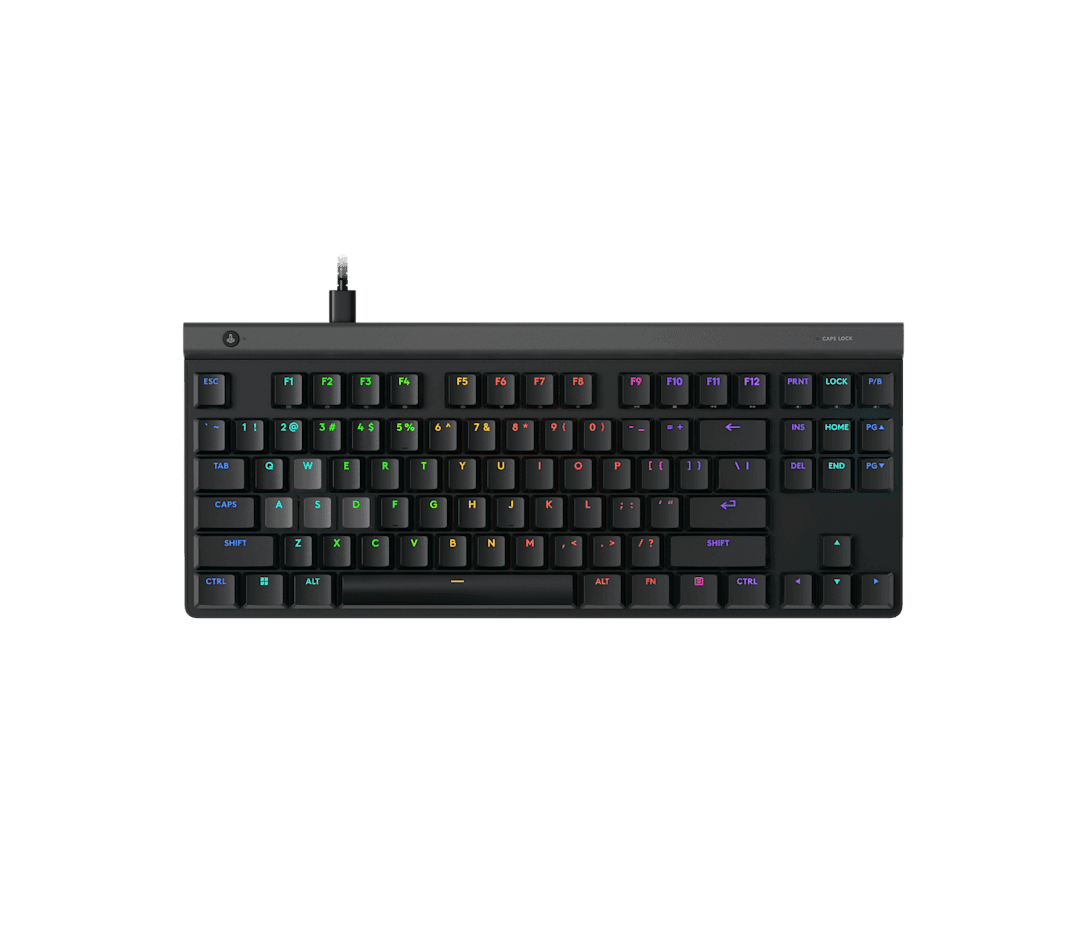
The G515 Rapid TKL is a tenkeyless board, but the first thing you notice isn’t what’s missing (the numpad), it’s how thin this thing is. At just about 22mm tall (0.86 inches), it sits so low on the desk that you can absolutely get away without a wrist rest. That’s not a small thing if you’re used to brick-like gaming boards that basically demand an external pad to avoid wrecking your wrists.
The footprint – 354.75mm x 146mm – is compact without being cramped. It gives you that classic TKL sweet spot: full F-row, arrow keys, navigational cluster, but plenty of room to whip your mouse around at low DPI in shooters. My own setup leans toward lower sensitivities in games like Valorant and Apex, so TKL is where I live; full-size always feels like I’m stretching to reach my mouse.
Build-wise, Logitech didn’t cheap out. You get a stainless-steel top plate with a multi-layer dampening stack underneath. The result is a board that doesn’t flex, doesn’t ping, and doesn’t rattle. This matters a lot more on low-profile boards than people realize. With shorter switches and a thin chassis, any hollowness or resonance gets amplified. Here, key presses land with a short, dense sound rather than that thin clacky echo you get on cheaper low-profile boards.
Underneath, there are rubber grips and two-stage flip-out feet so you can tweak typing angle. The whole thing weighs around 800g, which is right in the sweet spot: enough mass to hold its ground while you mash WASD, but not so heavy that moving it out of the way is a workout.
Aesthetically, it’s understated. Logitech went for a no-frills layout: standard TKL with per-key RGB, but no gimmicky macro columns, no huge dedicated media deck, no spaceship curves. It can absolutely sit in an office without screaming “I drop hot-swap stabilizers in my free time.” If you like your desk clean and minimal, this fits right in.
The only downside of that restraint is you don’t get much in the way of extras. No wrist rest, no alternate keycaps, no spare switches (they’re not hot-swap anyway). For a premium-priced wired board, a simple wrist rest in the box would’ve gone a long way.
Switch Technology: Magnetic, Analog, and Genuinely Different
It took me a while to appreciate why magnetic analog switches on a low-profile chassis are a big deal. I’m used to analog switches meaning chunky housings, deep travel, and tall boards. The moment it clicked was when I realized the G515 Rapid TKL gives you all the analog toys inside a keyboard that feels more like a high-end laptop deck height-wise.
Magnetic Analog Basics
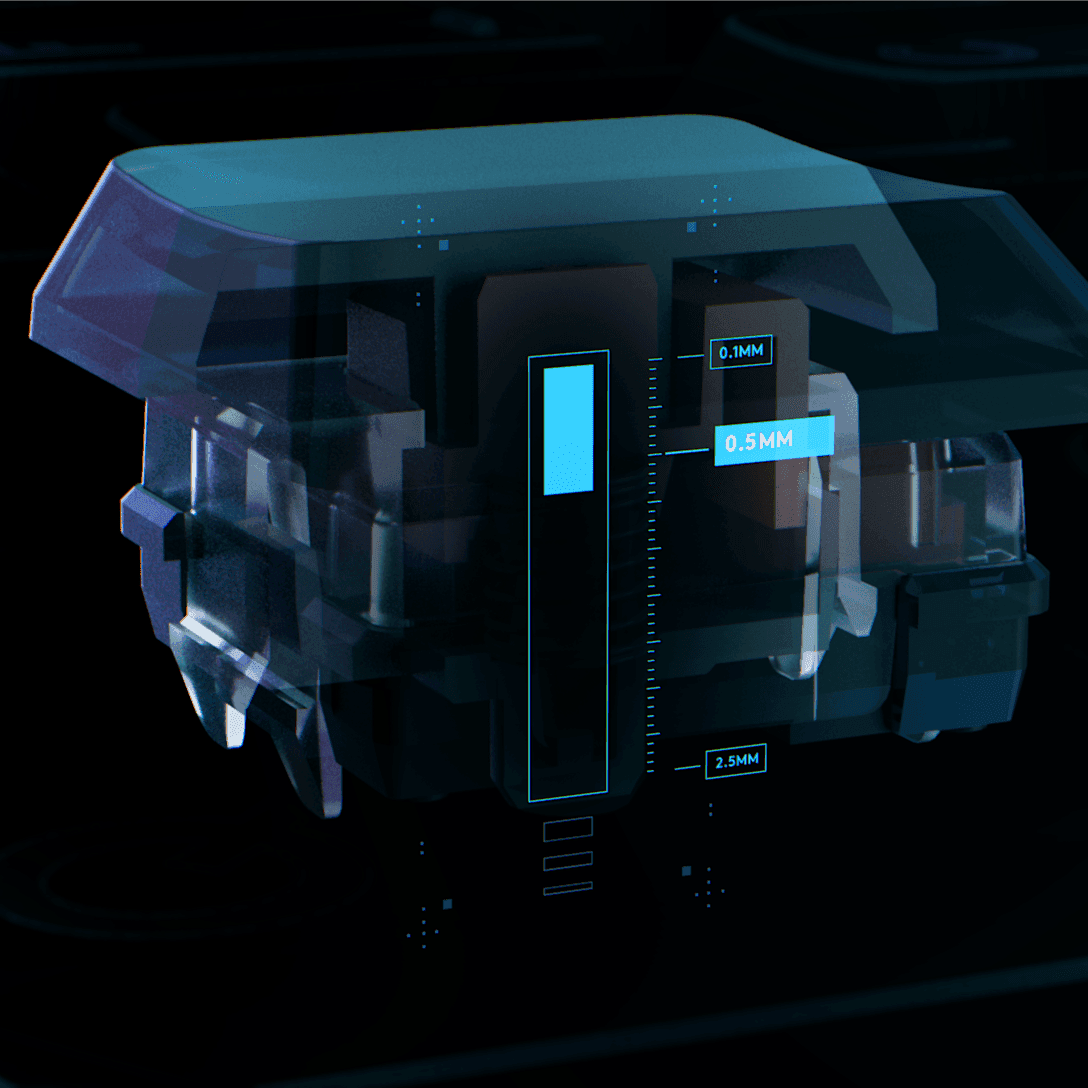
The switches in the G515 Rapid TKL use a magnetic sensor to figure out where the stem is along its travel. Instead of “not pressed” vs “pressed,” each key can report continuous positions between about 0.1mm and 2.5mm of travel.
Logitech exposes that as:
- Adjustable actuation point: set the depth where the key fires, anywhere from a hair-trigger 0.1mm to a more deliberate 2.5mm.
- Multi-point action: shallow press does Action A, deeper press does Action B, on the same physical key.
The default setup is a 1.5mm actuation at around 35g of force. In practice, that feels light and very responsive without being silly sensitive. If you’re used to regular Cherry MX Reds (about 2.0mm actuation), it feels snappier, but not alien.

Because the sensing is magnetic rather than electrical contact-based, there’s no “chatter,” and there’s very little of the scratchiness that plagues cheap mechanical switches. Multiple reviewers have described the feel as “short, precise, and calming,” and that lines up perfectly with what you’d expect from a well-dampened, low-travel analog switch.
Rapid Trigger in Real Games
Rapid Trigger is where things get spicy. Normally, a key actuates at one depth (say, 1.5mm) and doesn’t reset until it crosses another, slightly higher point on the way up. With Rapid Trigger, that reset point is effectively dynamic – the key can re-arm itself as soon as you start lifting your finger.
Translated into gameplay, that means things like:
- Smoother, faster strafing in shooters – you can oscillate A and D with tiny finger movements rather than full up/down taps.
- More controlled counter-strafing – you can stop and start on a dime because the key no longer has to travel that full reset distance.
- Cleaner jiggle peeks – you can repeatedly peek and un-peek with much finer control over timing.
Reviewers who dropped this into FPS titles reported very clear differences: better reaction times, easier micro-adjusts, and generally more responsive movement. One reviewer even called out a specific session of Call of Duty and Battlefield where they felt they “won that game” purely off how responsive the movement felt with Rapid Trigger enabled. That might be a bit dramatic, but if you live in ranked lobbies, it’s exactly the kind of edge you’re buying this board for.
Per-Key Adjustable Actuation: Not Just a Gimmick
The per-key adjustable actuation was the feature I thought would be “cool to have, never use.” I was wrong.
Being able to set, say, 0.1mm actuation on WASD for instant movement, but 2.5mm on your ultimate or grenade keys so you don’t fat-finger them under pressure, is huge. It solves a real, practical problem: accidental presses during chaotic moments.
Some concrete setups I’d use on this board:
- WASD, space, shift, ctrl: 0.1–0.2mm for maximum responsiveness in shooters.
- Numbers 1–4 (abilities/skills): 2.0–2.5mm to force a deliberate press.
- R (reload), F (interact): mid-range 1.5mm so they’re fast but not hair-trigger.
- Function keys: deeper actuation since they’re mostly used out of combat.
This kind of tuning sounds obsessive until you actually live with it. Then going back to a “one-size-fits-all” switch suddenly feels a bit crude.
Multi-Point Action and (Limited) True Analog
The G515 Rapid TKL also supports multi-point action, where you can bind different actions based on how far you press a key. A shallow press could be crouch; a full press could be prone. Or a light tap walks; a deeper press sprints.
Here’s the honest part: this is the power-user playground. It’s awesome for people who love custom keybinding and macro tinkering, but more casual players may never fully exploit it. It takes time to design bindings that feel natural, and not every game plays nicely with advanced input trickery.
On the true analog side (like gradual movement speeds or steering in racers), support is still hit-or-miss across PC titles. That’s not Logitech’s fault – it’s just where the ecosystem is right now. You can set up cool configs for certain games, but most gamers will be using analog depth more for tunable actuation and Rapid Trigger than full-on analog movement.
Latency, Polling Rate, and Competitive Performance
The raw numbers side is straightforward: the G515 Rapid TKL runs at a 1000Hz polling rate, so it reports its state to your PC 1000 times per second. That’s the current baseline for “serious” competitive boards, and anything higher is diminishing returns territory for nearly everyone.
Independent testing (like RTINGS-style latency breakdowns) has shown that the G515 Rapid TKL delivers excellent latency across the board:
- Single-key latency: extremely low, perfectly suitable for top-tier FPS and rhythm games.
- Multi-key and chord latency: consistent, which matters a lot in games where you’re holding 3–5 keys at once.
- Split-chord performance: also very strong, so complex combinations don’t trip it up.
You don’t feel any “stagger” when you’re, say, holding W + Shift + Space while tapping 1 and R in quick bursts. The board keeps up without ghosting or odd delays.
And here’s the key part: latency numbers alone don’t tell the whole story. It’s the combination of low latency, low actuation distance, and Rapid Trigger that makes this feel “snappier” than a generic 1000Hz board. Those milliseconds you shave off each movement cycle add up across a match.
Noise Profile and Typing Experience
One of my biggest issues with a lot of gaming keyboards is simple: they’re loud. Not just “I like clicky switches” loud – more “everyone in the apartment knows when I joined a match” loud.
The G515 Rapid TKL is different. The magnetic switches, short travel, and that multi-layer dampening stack make it surprisingly quiet for a gaming keyboard. Reviewers have called it “short, precise, and calming,” and that’s a rare combo for anything with per-key RGB.
If you’re sharing a room, streaming with an open mic, or just easily annoyed by reverb and plate ping, this matters. The sound signature is more of a muted “thock-tap” than the usual “clack-click-clack” of taller switches.
Typing feel is interesting. The travel is very short compared to traditional boards. Some people will adore that – especially if you’re coming from a good laptop keyboard and want something similar but better. Others, particularly heavy typists who like to really bottom out, might find it fatiguing until they adjust, because there just isn’t much vertical cushion.
Multiple reviewers have said that writing on it became “a joy” once they got used to the shorter throw. I can see that: the light 35g force and quick reset make fast typing feel effortless, as long as you’re not wedded to deep-travel keyfeel.
Software: Logitech G HUB Power and Friction
Like most of Logitech’s modern gaming lineup, the G515 Rapid TKL runs through Logitech G HUB. That’s both a good and a mildly annoying thing.
On the plus side, G HUB does give you:
- Full key remapping – remap any key to any other key, function, or macro.
- Macro creation – record complex sequences for MMOs, productivity, or creative apps.
- Per-key RGB control – layers, effects, static colors, the usual rainbow soup.
- Profile management – create game-specific profiles and save them to onboard memory.
- Analog configuration – adjust actuation depth per key, enable Rapid Trigger, configure multi-point actions.
- Game Mode configuration – choose which keys get disabled when you toggle Game Mode (beyond just the Windows key).
The analog configuration is where G HUB actually shines. Being able to graphically set actuation thresholds per key and visualize what’s happening under your fingers makes the feature much less intimidating. You’re not just typing numbers into a config file and hoping it feels right.
The friction point is Onboard Memory Mode. To edit custom profiles, you need to disable Onboard Memory Mode, make your changes, then save and re-enable it. That’s an extra mental step every time you want to tweak something. Not the end of the world, but it feels like the kind of UX wart Logitech should’ve sanded down by now.
There’s also the usual G HUB baggage: it’s a big, somewhat heavy app. It’s more stable than it used to be, but it’s not exactly lightweight. The good news is once you’ve dialed things in, you can toss everything onto onboard memory and mostly forget the software exists.
Wired-Only in a Wireless World
Here’s the elephant in the room: the G515 Rapid TKL is wired-only. No Lightspeed wireless, no Bluetooth. Just a detachable USB-A to USB-C cable.
On the one hand, this is the purest way to do a competitive keyboard. You get:
- Zero wireless latency concerns.
- No batteries to charge, no sleep states to wake from.
- Absolute reliability – no RF interference, no dongle drama.
On the other hand, in 2024/2025, a premium Logitech keyboard that doesn’t do wireless feels… odd. Logitech practically built their recent gaming identity on “Lightspeed everywhere,” so the decision to keep this one wired will definitely split opinions.
If your setup is a fixed desk and you care more about consistency than cable-free aesthetics, this won’t bother you. If you’ve gone all-in on wireless and love the clean desk look, the cable will feel like a step backward – especially at this price bracket.
Accessibility and Who This Board Really Helps
One aspect that doesn’t get enough attention with boards like this is accessibility. The G515 Rapid TKL is extremely interesting for anyone with physical limitations, repetitive strain issues, or cramped hand mobility.
Why? Because you can:
- Lower actuation force and distance on keys that are hard for you to press.
- Raise actuation on keys you frequently hit by accident.
- Use multi-point actions to map two functions onto one easy-to-reach key.
- Enjoy a low-profile board that doesn’t require as steep a wrist angle.
One reviewer even highlighted that, despite cognitive disabilities and cramped hands, they saw noticeable improvements in reaction time and control once they tuned the board to their needs. That’s the kind of flexibility that standard “linear red” boards simply can’t match.
Of course, it’s not a magic bullet. You still need to invest time into configuration, and the very short travel won’t suit everyone. But as a platform for making the keyboard work for you instead of against you, the G515 Rapid TKL is genuinely compelling.
✓ PROS
+
Ultra-low-profile, rock-solid build that’s comfortable without a wrist rest
+
Magnetic analog switches with per-key actuation tuning
+
Rapid Trigger genuinely improves strafing and peeking in FPS games
+
Excellent latency and 1000Hz polling suitable for high-level competitive play
+
Quiet operation compared to most mechanical gaming boards
+
Deep G HUB customization plus onboard memory
+
Strong accessibility potential thanks to low force and configurable sensitivity
✗ CONS
–
Wired-only at a price point where many expect wireless
–
No included wrist rest or notable extras in the box
–
Short travel can feel harsh for heavy typists who like deep presses
–
You need to invest time to tune actuation and Rapid Trigger to really benefit
–
G HUB remains bloated and profile editing is fussier than it should be (Onboard Memory Mode toggle)
–
True analog movement support in games is still limited, so some features feel underutilized
How It Stacks Up Against Other “Fast” Keyboards
Context matters here. The G515 Rapid TKL doesn’t exist in a vacuum – it’s entering a space already occupied by heavy hitters like the SteelSeries Apex Pro, Razer Huntsman analog boards, and Wooting’s 60HE/Two HE.
Compared to those, the G515 Rapid TKL’s main differentiator is form factor. It’s noticeably slimmer and lower-profile than most analog competitors. If you’ve always wanted Wooting-style control but hate tall, chunky boards, the G515 is going to immediately feel more natural.
Versus something like an Apex Pro TKL or Huntsman V3 Pro TKL, you’re getting broadly similar headline features – adjustable actuation, Rapid Trigger-style behavior, per-key tuning – but in a different physical package and with Logitech’s particular software ecosystem. If you’re already in the Logitech ecosystem with a G mouse and headset, G HUB integration might tip the scales.
The flip side: those competing boards often bring wireless options, dedicated media controls, or hot-swap switch sockets into the equation. The G515 Rapid TKL is much more opinionated: thin, wired, analog, quiet, minimal. It’s not trying to be the Swiss army knife of keyboards.
If you don’t care about analog or Rapid Trigger at all and just want a great gaming keyboard, there are far cheaper, simpler boards that will make you just as happy. That’s the crucial distinction: the G515 Rapid TKL only really makes sense if you’re going to actively use its advanced switch tech.
So, Who Should Actually Buy the G515 Rapid TKL?
After digging through all the specs, reviews, and real-world implications, here’s where I land.
The G515 Rapid TKL does not make sense as a “my first gaming keyboard” purchase. You’d be paying a premium for technology you may never touch beyond the default profile.
It absolutely does make sense if:
- You play a lot of competitive FPS and care about every tiny edge in movement and peeking.
- You like low-profile keyboards but refuse to compromise on gaming performance.
- You enjoy tinkering with per-key actuation, custom bindings, and multi-point actions.
- You have accessibility needs that would benefit from highly tunable key sensitivity.
If you’re a content creator, programmer, or writer who also games, the G515 Rapid TKL sits in an interesting spot. The quiet switches and low profile are great for long typing sessions, but whether it’s “worth it” depends on how much you value that analog feature set on top.
To put it bluntly: this is a specialist tool masquerading as a mainstream gaming keyboard. If you’re the kind of person who dials in DPI to the single digit and spends an evening configuring crosshair gaps, you’ll feel right at home here. If that sounds exhausting, you might be happier (and richer) with something simpler.
8.7/10
VERDICT
The Logitech G515 Rapid TKL is a razor-focused, low-profile, wired gaming keyboard built around magnetic analog switches, Rapid Trigger, and ultra-low latency. It’s incredibly fast, impressively quiet, and thoughtfully engineered, but its premium price is only justified if you’ll actually lean into its advanced features and don’t mind living with a wire.
FinalBoss // Gear
Level up your setup
01Top-rated gaming headsetson Amazon→02High-refresh gaming monitorson Amazon→03Gaming chairson Amazon→04Discounted game keyson Kinguin→Affiliate links · As an Amazon Associate, FinalBoss earns from qualifying purchases.
Want to Level Up Your Gaming?
Get access to exclusive strategies, hidden tips, and pro-level insights that we don't share publicly.
Ultimate Tech Strategy Guide + Weekly Pro Tips