
Table of Contents (8)
When the relic grid finally clicked, the game was already over
On my twelfth run of Lost in Random: The Eternal Die, something quietly broke my brain in the best way. I’d stacked a line of red relics boosting weapon damage, snuck a yellow one into the corner to juice my cards, and grabbed a weird little trinket that said, “Gain massive crit chance after rolling a 3 with Fortune.”
Two rooms later, it all came together. I rolled Fortune straight into the ankles of a hulking clockwork brute, landed that magical 3, popped a frost spear card with a perfect-timed release, and watched homing icicles explode across the arena. Every shard that hit something triggered yet another relic, which juiced my next card, which buffed my next dice throw, which turned my next hammer swing into a guaranteed crit. For about ten glorious seconds, the whole game felt like a self-playing Rube Goldberg machine made of numbers, colors, and very dead puppets.
About an hour later, I beat the final boss on the next difficulty tier, saw the “secondary” ending, and realized: that was basically it. After just under 21 hours, I’d seen almost everything The Eternal Die had to offer.
Instead of feeling shortchanged, I sat back and thought, “Yeah. That was exactly the right length.” For a roguelike that looks like Hades fell into a Tim Burton snow globe, that’s not what I expected at all.
A lean return to Random: same dice, very different priorities
The Eternal Die is technically a follow-up to the original Lost in Random, but in practice it’s a spin-off that’s thrown almost everything overboard except the dice, the tone, and the art direction. Gone are the wandering, dialogue-heavy story segments and long detours through storybook streets. What’s left is a compact, repeatable action roguelike with four regions, a boss at the end of each, and a base you pop back to between attempts.
The aesthetic remains unmistakable: crooked houses, stitched-together enemies, and that slightly askew stop-motion feel. It’s still very “Burton-esque” in a way most games gesture at but don’t quite nail. Everything looks like it was carved out of painted wood and left too long in the rain, then reassembled by a toymaker who doesn’t fully understand human anatomy. If you loved the original’s art, the shift to a tighter, arena-driven structure doesn’t change that magic.
Where things diverge hard is in focus. The Eternal Die is not here to tell you a long, winding fairy tale. It’s here to see how far it can push you with layered systems in runs that rarely last more than 30-40 minutes once you’ve found your footing. If the first game flirted with action, this one marries it and invites deckbuilding, relic-drafting, and a very opinionated dice to the reception.
Your constant companion is Fortune, the sentient die who fights alongside you. You’ll sprint through rooms, carve up enemies with melee or ranged weapons, then literally hurl Fortune into the fray to trigger rolls, damage, and card effects. The narrative justification is thin this time, but as a mechanical backbone, it’s rock solid.
Dice, cards, and a relic grid that rewards obsession
The barebones elevator pitch is “Hades with cards and a weird relic grid,” but that undersells how tightly these pieces interlock.
You start each run by picking a weapon. There’s the expected spread: a reliable sword, a bruiser hammer, a ranged option, and later some spicier variants with different “forms” that tweak reach, speed, or special attacks. On their own, they’d be fairly standard action roguelike fare – satisfying enough, with a good sense of impact and a dodge that feels appropriately generous once you learn enemy tells.
The real sauce is in what you layer on top of them. Throughout a run, you’ll earn and draft cards, each essentially a spell or modifier you can trigger by spending energy from combat. One card might spawn a poison flask that breaks into cluster bombs. Another might call in a bouncing storm of ice that ricochets around the arena. A favorite of mine laid down a circular time-slow field that turned frantic fights into careful dissections.
Every card has a “perfect” timing window: hold the cast button, watch the ring shrink, and release on the mark to amp up the effect. Nail it, and your poison spreads further, your icicles pierce more targets, your tempest hits harder. Flub it, and you still get the base effect, but The Eternal Die is constantly whispering in your ear, “You could be doing more if you played better.”
Layer three is Fortune himself. You can lob him like a grenade; the face he lands on modifies the outcome. A high roll can chunk enemies all by itself, but in most of my good runs it was less about raw damage and more about leveraging relics that care what number came up. Relics that want a 1, or reward an even number, or turn any 4 into the start of a crit chain – those little conditional hooks are where the builds start to tangle into something beautiful.
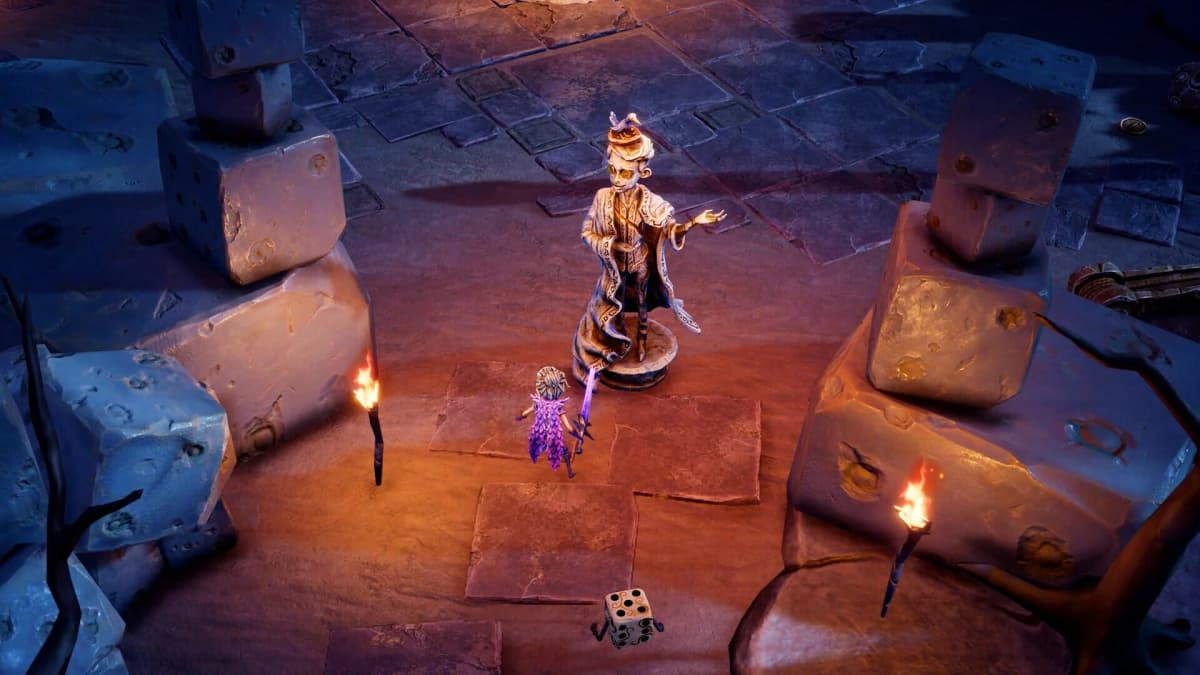
Which brings us to the relic grid – the part that made me lose track of time between rooms and start theorycrafting instead of moving on.
Relics are drafted from a choice of three, Hades-style. Once picked, they go into a grid at your base. Each relic takes up one or more tiles and comes color-coded: red, yellow, green, purple, sometimes with multiple colors around its border. Slot three of the same color in a line and you activate a powerful passive bonus associated with that hue. Red pumps your direct weapon damage, yellow boosts the strength of cards, green tends to favor crit chance or sustain, and purple focuses on conjurations – all the weird spawned things your build throws into the arena.
The tension is immediate. Do you grab the relic that perfectly complements your current build but would break a beautiful line of reds you’ve been nurturing? Or do you take the less sexy effect because its green and yellow borders complete a double match that suddenly supercharges both your crits and your spell damage?
This decision space kept me on the hook far more than I expected. On one run, I built into a full purple grid, leaning on turrets, traps, and lingering fields of damage, barely swinging my weapon at all. On another, I went almost pure red and discovered a relic combo where every crit chained into a dice roll that made my next card free, which then automatically turned my next attack into a crit. It felt busted in the best “I can’t wait to see how this eventually collapses” way.
The smartest thing The Eternal Die does is tie its systems together so tightly that every relic choice nudges your actual playstyle. I wasn’t just grabbing “+5% damage” nonsense. I was taking things that said, “After using a card, your first weapon hit is a guaranteed crit,” or “Rolling Fortune creates an ice patch that chills enemies, and you deal bonus damage to anything chilled.” Suddenly I cared about the order in which I cast spells, swung my weapon, and rolled my dice. The flow of combat became a puzzle I was solving on the fly.
Combat and bosses: sharp, readable, and tougher than they look
I’ve played enough action roguelikes where the systems are fantastic on paper but the moment-to-moment fighting feels floaty or imprecise. The Eternal Die mostly avoids that trap. Attacks have weight, hitboxes feel fair, and enemy telegraphs are readable even when the arena gets busy with card effects and relic nonsense.
Your basic kit is simple: light and heavy attacks, a dodge, a context-sensitive special depending on weapon form, and your deck of cards on a cooldown-style rotation. Enemies mix melee bruisers, projectile pests, and mobility threats that will happily chase you out of your comfort zone. The pacing is closer to Hades than to pure bullet hell – there’s a lot of dashing through gaps and punishing windows, less weaving through a thousand tiny pellets.
Where the combat really sings is in the boss fights. Each of the four regions has its own big bad, and they’re all memorable in their own way. One fight in particular has you dodging sweeping arena attacks while juggling a dice-based minigame mid-battle, forcing you to choose between safety and feeding your build’s engine. It felt like the game taking everything I’d learned about its systems and saying, “Okay, now do it under pressure.”
I won’t pretend they’re impossibly punishing – this isn’t a Souls-like – but they are tight. I’d put the base versions of these bosses at least on par with the early bosses from Hades 1 and 2 in terms of how much they demand situational awareness and build knowledge. By the time I cleared the higher difficulty tiers, I was no longer just dodging patterns; I was planning, “Use this card to create an opening, roll Fortune here to try for a high number, cash in my relic buffs with a heavy attack before the window closes.”
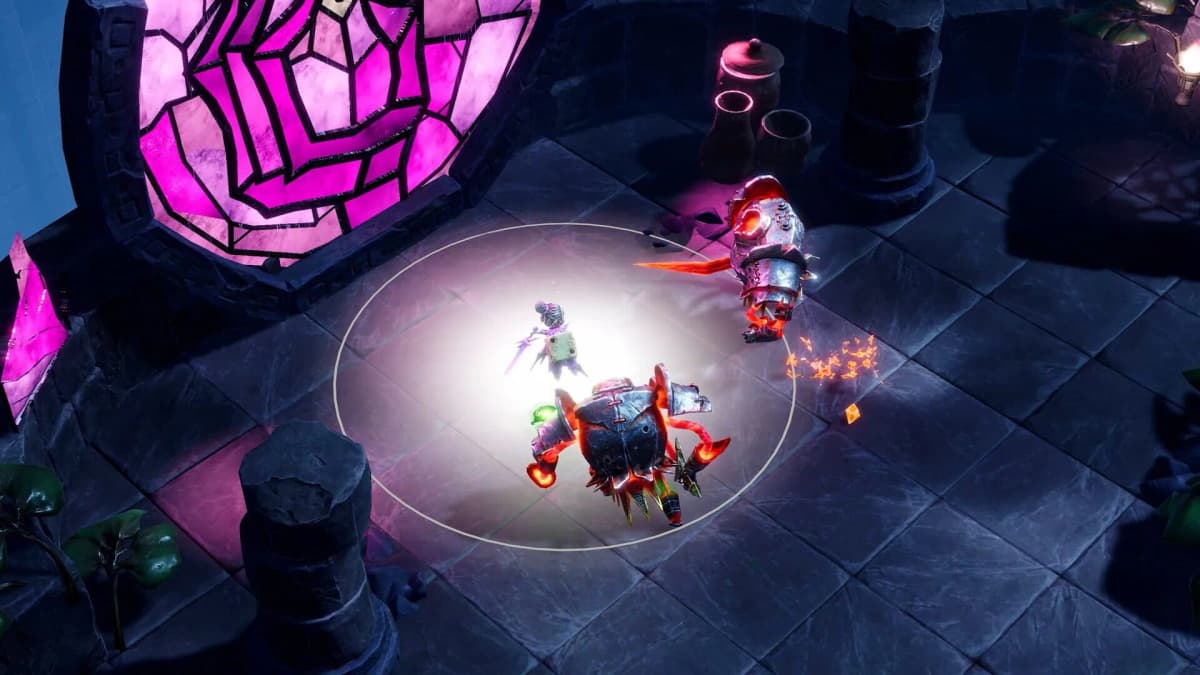
Level layout between bosses is a series of interconnected rooms rather than pure linear corridors. You’ll see combat arenas, short traversal beats, and the occasional minigame that leans into dice randomness – roll high, get a better reward; roll low, accept a harder fight. It’s not as sprawling or choice-heavy as something like Slay the Spire 2’s maps, but it gives just enough branching to keep runs from feeling on rails.
Short, sweet, and surprisingly complete
Here’s the part that might raise eyebrows if you’re used to roguelikes that want to eat your life: Lost in Random: The Eternal Die is brief, especially by genre standards.
My final save sits at just shy of 21 hours. In that time, I cleared all four regions, pushed through the higher difficulty settings, unlocked almost every meta upgrade, saw a secondary ending, and only left a couple of achievements and late-game upgrades on the table. I didn’t touch every single possible build permutation – that would take forever – but in terms of “meaningful things to work toward,” I was basically done.
As someone who’s 50+ hours deep into Hades 2 and still finding new wrinkles, I expected to feel a little empty when the credits rolled in The Eternal Die. I didn’t. If anything, I appreciated a roguelike that respected my time while still giving me room to obsess over builds.
Runs are fast. Once you’ve internalized enemy patterns and gotten a few meta upgrades under your belt, you’re looking at half-hour attempts that don’t drag. The meta progression – shops, NPCs returning to base, unlockable relics and cards – is paced so that every couple of runs, something interesting shakes loose. It’s front-loaded enough that even if you bounce off before a clear, you’ll have seen the core of what makes the game tick.
For me, the sweet spot was hitting that secondary ending and a couple of tougher boss variants. At that point, the systems had fully unfolded, my relic grid looked like a multicolored crime scene, and I’d had a few magical “everything clicks” runs. Could I dive back in and chase uber-optimized builds for another 20 hours? Sure. Do I feel compelled to? Not really – and that’s fine. The experience feels complete without demanding a hundred-hour commitment.
Where the dice land awkwardly
Cutting away most of Lost in Random’s storytelling pays off for the pacing, but there’s no getting around the fact that the narrative here is a shadow of the original. You still get snippets of world flavor, a handful of quirky NPCs to bring back to your base, and some light framing for why you’re chucking a living die at people’s heads, but it’s nowhere near the “storybook come to life” feeling the first game had.
If you’re coming in purely for the systems, this won’t bother you. If you adored the original for its characters and tone-led narrative, The Eternal Die is very much “side story, emphasis on side.” I occasionally wished for a bit more context or character growth between difficulty tiers – something to make the repeat clears feel like chapters in a story rather than just higher stakes versions of the same gauntlet.
There are also moments where the randomness can tip from “interesting constraint” into “mildly frustrating.” The relic grid is wonderful, but it’s possible to have runs where you don’t quite see the pieces needed to support that weird concept you’re chasing. That’s part of the genre, of course, but when the entire game is built around interconnected systems, a streak of slightly off-synergy relics can leave a run feeling bland.
Room variety is good but not endless. After a dozen-plus runs, I started recognizing some arena layouts and encounter compositions. The game tries to keep things fresh with mutators and dice-based events, but the tighter, shorter structure means you’ll see its full bag of tricks sooner than in sprawling, years-updated roguelikes.
On the interface side, the relic grid UI could stand a bit more clarity when it comes to previewing what a new piece will actually do to your color matches. You can work it out with a bit of squinting and memory, but given how central that grid is, I’d love slightly clearer visual feedback or a ghost placement preview that shows which lines will activate or break.
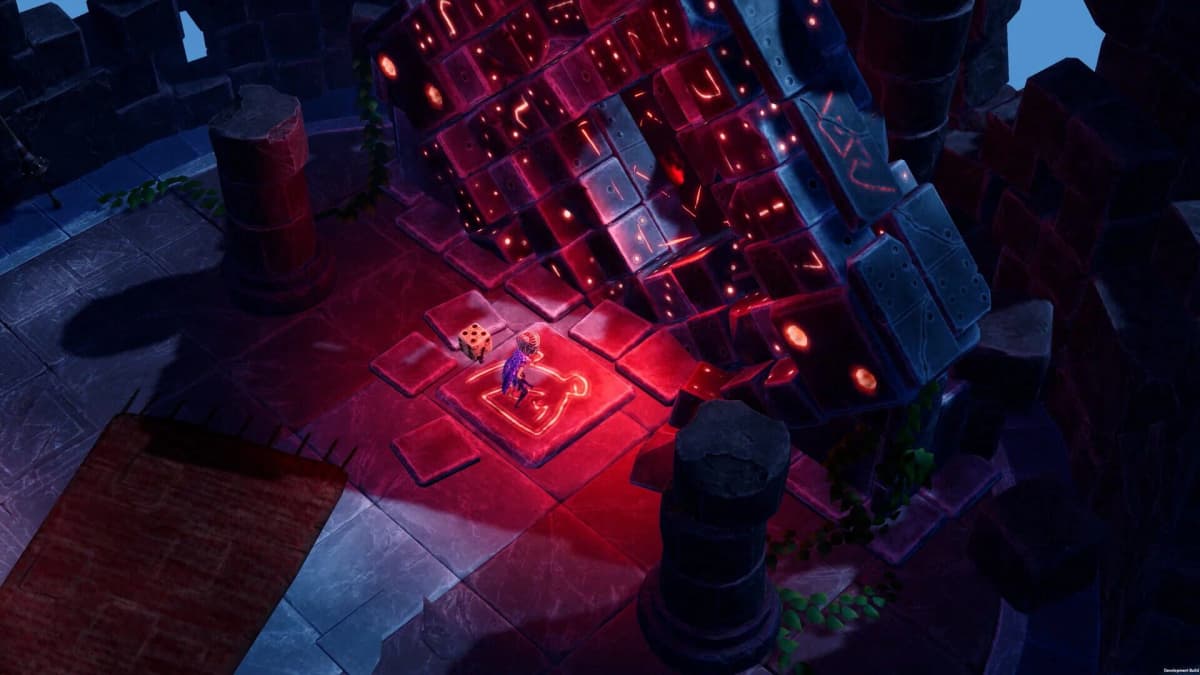
None of these issues are dealbreakers, but they’re worth knowing going in: this is a game that went all-in on mechanical density and run-level pacing, and some of the softer edges you might expect from a story-forward predecessor have been sanded off.
Performance and PC experience
I played Lost in Random: The Eternal Die on PC via Steam, on a mid-range rig (RTX 3060, Ryzen 5, 16GB RAM), and performance was largely a non-issue. The art style leans into stylization over ultra-high fidelity, which helps; even when fights got busy with particle effects from cards, relic flashes, and swarms of enemies, I didn’t see meaningful dips from a smooth 60fps target.
Load times between rooms and regions were brief, and I never hit a crash or progress-blocking bug during my runs. Input felt responsive on both controller and mouse-keyboard, though I gravitated to a gamepad – the dodge timing and analog movement just sit better in my hands for this kind of game.
At the time of writing, the game’s on Steam and included in PC Game Pass, and it’s part of the Steam Spring Sale at 45% off. There’s also a demo, which is a smart fit for a game so defined by “how it feels to play.” If you’re even mildly roguelike-curious, that demo is enough to show you whether the dice-card-relic stew is your thing.
Who should actually roll on this
If you live for buildcrafting – the kind of player who will pause in Slay the Spire 2 for five minutes over a single card pick, or who treats Hades boons like ingredients in a personal cookbook – The Eternal Die is squarely aimed at you. It’s dense with synergies, and it rewards people who enjoy nudging systems until they collapse into beautiful, cascading nonsense.
If, on the other hand, your favorite thing about the original Lost in Random was the narrative, or you want a roguelike that you can just zone out to for hundreds of hours without ever feeling “done,” this might feel too streamlined. The story’s lighter, and the pool of content, while well-crafted, is deliberately compact.
For me, it slotted perfectly into the gap between bigger, more demanding games. Over a week or so, I chipped away at runs, experimented with relic grids, and enjoyed myself without feeling like I was adding another forever-game to the pile. In a landscape full of sprawling roguelikes that want to be your main hobby, Lost in Random: The Eternal Die is content to be a tightly curated weekend obsession.
FinalBoss // Gear
Level up your setup
01Top-rated gaming headsetson Amazon→02High-refresh gaming monitorson Amazon→03Gaming chairson Amazon→04Discounted game keyson Kinguin→Affiliate links · As an Amazon Associate, FinalBoss earns from qualifying purchases.
Want to Level Up Your Gaming?
Get access to exclusive strategies, hidden tips, and pro-level insights that we don't share publicly.
Ultimate Reviews Strategy Guide + Weekly Pro Tips