

Lunar Strike Trades Guns for Ethics and Oxygen — The Hard Sci‑Fi Moon Game That Might Actually Hit
Game intel
Lunar Strike
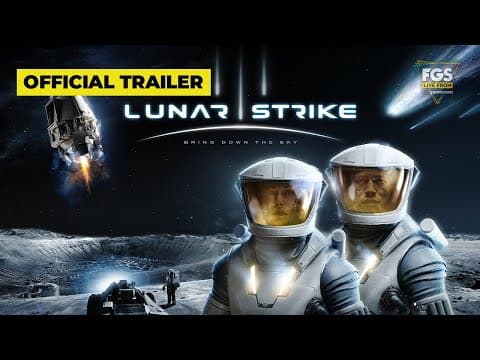
Lunar Strike blends speculative fiction with a game world grounded in hard science. The game focuses on compelling survival and character-driven storytelling o…
Why Lunar Strike Caught My Eye
Future Games Show reveals can blur together, but Lunar Strike made me sit up. A no-combat, hard sci‑fi survival adventure set at the Moon’s south pole where you play a junior archivist trying to preserve humanity’s legacy after sabotage? That’s a bold pitch. It’s targeting 2026 on PS5, Xbox Series X|S and PC, and it immediately slots into that rare lane of science-first space games that care more about oxygen budgets than boss fights.
This caught my attention because we’ve had excellent narrative sci‑fi without guns before-Tacoma’s AR reconstructions, Observation’s unsettling station mystery, Deliver Us The Moon’s grounded engineering drama-but Lunar Strike centers the act of archiving itself. You’re not a hero soldier. You’re the person deciding which lab notes, family recordings, and cultural artifacts survive. That’s a fascinating, very human kind of pressure we don’t often get in games.
Key Takeaways
- No combat-survival is about oxygen, power, and habitat integrity, not shooting.
- Scanning and archiving drive the loop; your triage choices shape the story and endings.
- Hard sci‑fi claims need to translate into systems (1/6 g, power windows, dust, comms, thermal).
- Success hinges on pacing, interface, and whether investigations feel like meaningful sleuthing rather than busywork.
Breaking Down the Announcement
On paper, Cognition Europe is blending narrative exploration with systemic survival. You manage oxygen and suit power, patch up a failing habitat, and plan EVAs under low gravity. Instead of looting crates, you carry scanners—think 3D capture and photogrammetry—to recover scientific data, personal archives, and damaged equipment logs. The forensic angle is key: piecing together sabotage through artifacts and environmental evidence should be the game’s “combat encounter,” the thing that spikes tension and demands attention to detail.
What differentiates it from Tacoma or Observation is the triage. As conditions worsen, you reportedly can’t save everything. Do you divert limited power to a cryovault of seed genomes or keep the greenhouse online for the last remaining crew? Do you upload a complete research dataset at lower fidelity, or a small slice at archival-grade quality? If those choices ripple through the plot and not just the epilogue slides, there’s real replayability here.
The setting choice matters too. The south pole isn’t random: near-constant light ridgelines and deep, always-dark craters give you natural “safe” and “danger” zones. If Lunar Strike models eclipse windows, comms blackouts behind terrain, battery inefficiency in the cold, and lunar dust wreaking havoc on seals and optics, your run planning becomes as strategic as any roguelike.
Why This Matters Now
There’s a growing audience for games that dial up tension without defaulting to violence. Hardspace: Shipbreaker proved meticulous, systems-driven labor can be thrilling when the physics and stakes are right. Citizen Sleeper showed how ethics and scarcity can carry a sci‑fi story. Lunar Strike aims for that crossroads: grounded engineering plus moral weight.
If it lands, we get a fresh fantasy: being the caretaker of culture at the end of the world. Picture EVA route planning along “peaks of eternal light” to keep line-of-sight for power, deciding whether to cannibalize a rover’s battery to stabilize the archive, or triaging between a breakthrough propulsion dataset and a colony’s oral histories. Those are choices that stick with you long after the credits.
Want to Level Up Your Gaming?
Get access to exclusive strategies, hidden tips, and pro-level insights that we don't share publicly.
Ultimate Gaming Strategy Guide + Weekly Pro Tips
Red Flags and Open Questions
- Is archiving actually fun minute to minute? Scanning can devolve into hold-to-scan tedium. The forensic reconstruction needs Return of the Obra Dinn-style “aha” moments, not checklist chores.
- What’s the friction without combat? Time pressure, environmental hazards, and system failures can carry a game—if tuned right. Oxygen shouldn’t feel like a simplistic countdown clock.
- How deep do choices go? Do triage decisions gate entire questlines and areas, or just tweak a final montage?
- Interface and controls: complex scanning and resource panels must feel great on a controller, not just mouse-keyboard dashboards.
- Performance and readability: low-g traversal and interior navigation can induce motion sickness if FOV and camera drift aren’t handled; accessibility options will matter.
- Length and pacing: a dense 8-12 hours with meaningful branches beats a bloated 25-hour scan-a-thon. Let players toggle assistance for forensics, not grind for batteries.
What I’ll Be Watching For
Hands-on previews will make or break this. I want to see if 1/6 g traversal changes how you plan routes and carry items, whether power budgeting is a true system (load shedding, battery degradation, solar incidence angles) rather than flavor text, and if the archival triage gates content in interesting ways. Strong writing and VO are non-negotiable—if you’re asking me to care about a colony’s legacy, those personal logs need to hit.
On the tech side, show me responsive UI with quick context readouts (O₂, suit temp, power draw), robust save options for a failure-prone loop, and solid console performance modes. Bonus points for a post-credits free-roam “curator” mode to finish archiving what you missed. If you loved Tacoma, Observation, Deliver Us The Moon, or you just want a sci‑fi game that respects your brain, keep Lunar Strike on your radar as we head toward 2026.
TL;DR
Lunar Strike ditches guns for scanners and ethics, aiming for tense, hard sci‑fi survival on the Moon. The concept rules; execution will hinge on smart systems, meaningful triage, and zero busywork. If Cognition Europe nails the loop, this could be 2026’s standout non‑violent sci‑fi adventure.