

Marathon feels like a game that would rather lose half its players than sand down a single sharp edge.
After 30 hours on PlayStation 5, I’m still not sure whether that’s stubborn brilliance or slow-motion self-sabotage. What I am sure of is this: beneath the noise about Bungie, Sony’s live-service strategy, and the “death of extraction shooters,” there’s a fiercely focused PvP experience here, built for people who enjoy pressure, punishment, and min-maxing under fire.
If you come in expecting “Destiny but Tarkov,” you’re going to get chewed up. Marathon is leaner, meaner, and far less interested in keeping you comfortable.
Table of Contents (10)
This isn’t Destiny, and it doesn’t care if you bounce off
My first hour with Marathon was rough enough that I put the controller down and seriously considered uninstalling. The tutorial is functionally misleading. It drops you into a contained mission where you shoot some robots, follow waypoints, and evac in a way that feels suspiciously like any other co-op shooter. It quietly suggests “Don’t worry, you’ve done this before.”
Then the real game opens up and kicks you in the teeth.
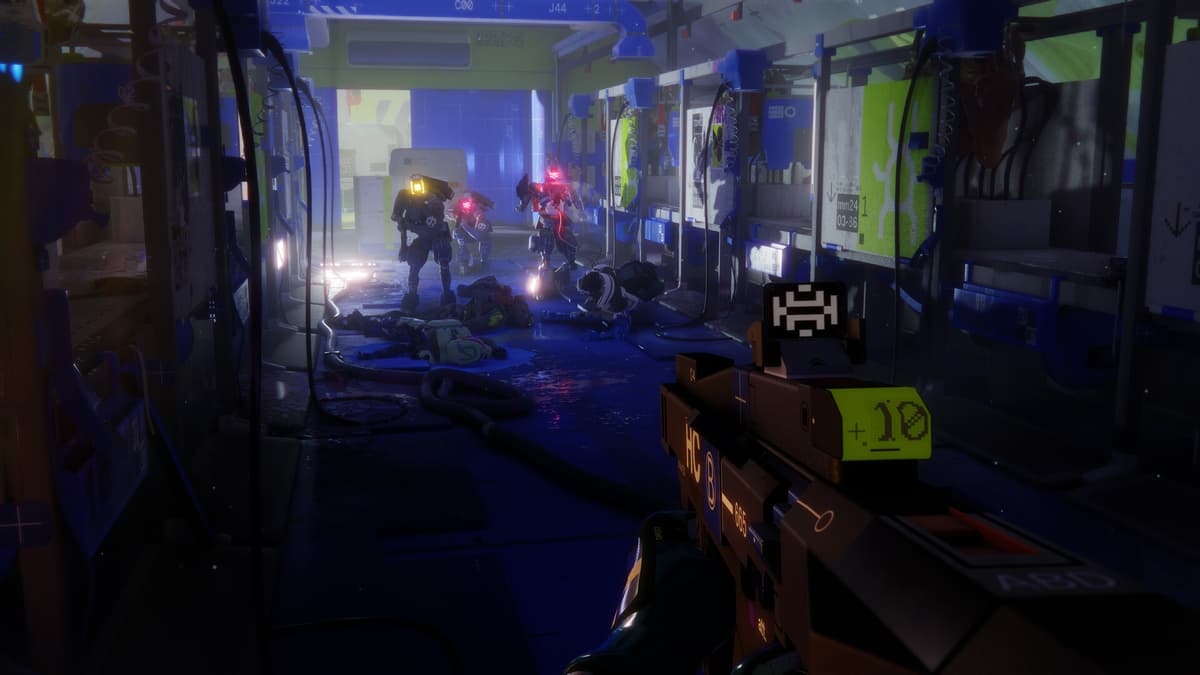
The actual loop is a 20-25 minute PvPvE extraction run. You and up to two squadmates are dropped at a random spawn on one of a handful of sprawling maps. You have a finite backpack, finite ammo, and a clock that never stops. Roaming AI patrols, environmental hazards, and, of course, other squads all want the same loot you do. Anything you pick up is on the line: die, and it’s gone. Escape, and it goes into your vault for future runs or crafting.
In those opening hours, I died a lot. To everything. To bots I underestimated. To a trio that heard my firefight and third-partied me from a rooftop. To a misjudged reload in a stairwell when I didn’t realize there was a side entrance. That short time-to-kill Bungie is famous for? It cuts both ways here. Landing shots feels razor-clean; getting deleted by a burst you never saw coming is just as quick.
And the tutorial barely explains the parts that matter: sound propagation, sightlines, evac timing, loot triage. It teaches you how to click on heads, not how to survive the psychology of a map where every open street feels like a dare.
For a lot of people, that’s going to be a hard stop. For me, it was weirdly refreshing. Marathon isn’t trying to be that one shooter you and your casual friends can all enjoy on a Friday night. It’s a selective filter. If you keep going after those first few demoralizing runs, you’re its target audience.
When the loop finally clicks: learning to stop panicking
Around the 6-8 hour mark, something shifted. I stopped sprinting straight at every gunshot. I started leaving half-open chests as bait. I learned that extraction isn’t “the end,” it’s a decision: do I risk another block with this almost-full bag, or bank what I’ve got and reset?
The real hook isn’t one perfect run, it’s the gradual shaping of your options between runs. Every successful evac feeds your vault, and that vault is your long-term backbone. It’s not massive, so you can’t just hoard forever; you’re constantly deciding what to dismantle for materials, what to equip, what to risk on the next dive.
Early on, I had a streak where I lost three purple-tier weapons back-to-back because I got cocky. Those guns were a noticeable power spike, and losing them hurt. But that sting is precisely what makes Marathon’s core loop hum. The tension between greed and caution is palpable. Heading to extraction with a bag stuffed with rare salvage, hearing footsteps in the next alley, is one of the more stressful FPS feelings I’ve had since my first matches in Hunt: Showdown.
And yet, it never quite feels unfair. The game is extremely punishing, but rarely random. When you die, you almost always know what you did wrong: made too much noise, overstayed, tunneled on loot while ignoring your angles, rotated late. It’s the kind of design where death isn’t just a reset, it’s a feedback loop.
Shells, abilities, and the joy of finely tuned chaos
What separates Marathon from the more grounded, military-flavored extraction shooters is its cast of Shells – essentially class-based exosuits with hero-shooter style abilities. They’re not just cosmetic; they define your risk profile and your role in a fight.
Over 30 hours, I spent the most time as Triage, the medic-adjacent Shell. Being able to tag a downed squadmate with a long-range defib shot through a window, then toss a healing drone onto their landing spot, turned otherwise doomed fights into scrappy comebacks. You can feel enemy teams shifting focus the second they realize there’s a Triage on the field; you become high-value prey.
By contrast, Vandal is a hyper-aggressive brawler, with a repulsor blast and a speed burst that turns tight corridors into murder funnels. Destroyer can pop a front-facing shield and shoulder rockets, which sounds overbearing until you realize how many angles these maps offer; you’re a tank, but you’re also a big obvious problem to solve.
Recon’s seeker drones, Assassin’s invisibility and smoke, Thief’s hookshot and scout drone – each Shell can radically reshape how your trio moves through the map. A Thief zipping up to a balcony to flank while Recon pings an entire courtyard feels almost unfair when it works. When it doesn’t, you’re three bodies sprawled in the street because you got too clever and overextended.
The key is that Bungie balances these power fantasies with extremely low time-to-kill and limited resources. Abilities are impactful, but they don’t override positioning or aim. You’re never so tanky or invisible that you can ignore basics like cover and noise discipline. In practice, that creates this constant, twitchy push and pull between hero moments and brutal reality.
It also creates a fairly high skill floor. Marathon is not kind to people who want to casually swap Shells every few games. You have to commit, learn the rhythms, and tune your weapon choices and implants around that identity. When it comes together – when your Triage build keeps a greedy Vandal alive just long enough to clean up a third party and vacuum their loot – it’s electric.
Factions, contracts, and the meta-game grind
Outside of the drop zone, Marathon runs on factions and their contract systems. You’re technically a disposable digital asset working for several competing interests, and they all have shopping lists.
Each faction offers contracts – “kill X Runners in this sector,” “extract Y units of rare salvage,” “interact with this anomaly” – that overlay onto your runs. Complete them, and you gain reputation, credits, and the occasional pre-built gear reward. Level those factions up, and you unlock skill trees that add passive bonuses: faster container looting, extra currency for specific salvage types, access to higher-tier gear in their stores.
Each faction offers contracts – “kill X Runners in this sector,” “extract Y units of rare salvage,” “interact with this anomaly” – that overlay onto your runs. Complete them, and you gain reputation, credits, and the occasional pre-built gear reward. Level those factions up, and you unlock skill trees that add passive bonuses: faster container looting, extra currency for specific salvage types, access to higher-tier gear in their stores.
🎮 Get This Game at the Best Price
Compare prices instantly and save up to 80% on Steam keys with Kinguin — trusted by 15+ million gamers worldwide.
*Affiliate link — supports our independent coverage at no extra cost to you
It’s a smart structure, because it gives your early, doomed runs a purpose beyond just “get better.” Even if you extract empty-handed, you might have ticked a contract or two, nudging a faction level forward and unlocking, say, a more forgiving primary weapon for next time.
That said, the contract design gets repetitive faster than I’d like. By the mid-teens of my playtime, I was seeing the same “fetch this, kill that” beats repeat across different factions with slightly different flavor text. The rewards are meaningful, but the wrapper sometimes feels like busywork – especially when you’re juggling three different reps and the UI makes it weirdly easy to forget what you even pinned before queuing.
Meta-progression is where Marathon brushes against classic live-service fatigue. The underlying systems are strong: the vault, the crafting, the skill unlocks. But too often, they’re buried under menus that feel bespoke for the sake of it, not because they’re clear. Sorting gear, comparing implants, and parsing tiny text descriptions mid-session feels like fighting a second game, and not a fun one.
Cold plastic, hot lead: worldbuilding and art direction
Where Marathon absolutely nails its identity is in its worldbuilding. The setting – New Cascadia on Tau Ceti IV, after a catastrophic event – is minimalist in terms of cutscenes, but maximalist in vibes.
Runs are framed as corporate salvage operations. You’re not a hero, you’re a digital mercenary consciousness that gets spun up into a synthetic body, thrown at a hostile planet, and then calmly rebooted when you die. There’s something chilling about how casually the game treats your deaths; you’re just a line item in someone’s cost-benefit spreadsheet.
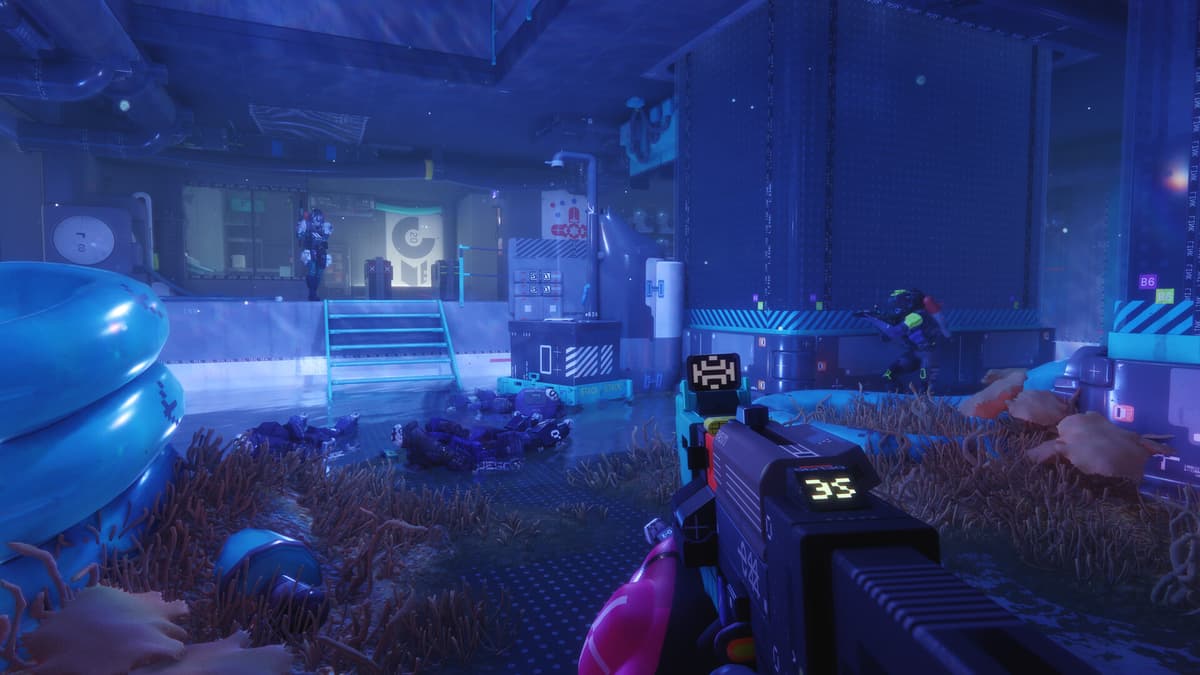
That detachment bleeds into the art direction. Cities and facilities are a clash of sterile corporate architecture and gaudy synthetic excess: neon-soaked signage, plastic foliage, glitching holograms, manikin-smooth NPC representations. It all feels intentionally fake, as if the colony was built more as a showroom than a home before everything went to hell.
It’s also a sharp contrast to the brutality of the combat. Gunfights bring a sudden, messy violence into this sculpted, artificial world. Watching bright, almost fashion-runway armor crumple in a hail of bullets drives home the game’s themes: everything is disposable, even the cool plastic bodies you spawn into.
Narrative delivery leans heavily on text logs, environmental hints, and a codex that you’ll either obsess over or ignore completely. I fall somewhere in the middle; the lore is intriguing and there are nods to the original ‘90s Marathon trilogy, but in the middle of a sweaty extraction match, story is the last thing on my mind. The game seems fine with that – it’s less a movie you watch and more a mood that hangs over every run.
Live-service strings: monetization, battle pass, and the bad taste
Here’s where the whole package stumbles hard.
Marathon’s actual moment-to-moment gameplay feels tight and intentional. Its monetization feels like it was bolted on from a completely different, worse game. The battle pass at launch is thin: an underwhelming drip of cosmetics, currencies, and boosters that rarely feel exciting. Most levels feel like filler, and the few interesting items are spread far enough apart that progression never gives that little dopamine pop you want from a pass.
The premium store is even more grating. Skins lean into the game’s “synthetic fashion victim” aesthetic, which fits thematically, but the pricing is out of step with the actual value. We’re talking premium tags for what often amount to modest palette shifts, minor pattern tweaks, or armor coatings that only look distinct when you’re staring at them in a static menu.
Because the game itself is so unapologetically hardcore, this layer of aggressive, insecure monetization feels especially jarring. It’s like watching a razor-sharp indie horror movie repeatedly pause to sell you Funko Pops of the monster. You can ignore it, but it’s always there, a background hum of “engagement” that doesn’t match the focused brutality of the actual matches.
To Bungie’s credit, none of this is pay-to-win. I never felt outgunned because someone swiped a card. But I did feel nickel-and-dimed in how often the game invites you to care about a cosmetic economy that just isn’t compelling enough yet.
Performance, matchmaking, and the PS5 experience
On PS5, my experience was mostly smooth. Matchmaking times hovered between 30 seconds and a couple of minutes during launch week, and I only had a handful of server hiccups – a rubber-band here, a desync there – across 30 hours. Nothing ruined a run outright, but in a game where a single misstep costs you your kit, even small spikes are extra unnerving.
Visually, Marathon leans into clarity more than spectacle during matches, which I appreciate. Silhouettes are distinct, abilities read cleanly even in noisy firefights, and the UI, while cluttered in menus, does at least communicate the essentials clearly mid-gunfight: ammo, health, cooldowns.
Audio is a mixed bag. Weapon feedback is excellent – sharp, punchy reports with enough differentiation that you can usually tell what someone is firing at you. Directional cues are OK, but not as laser-precise as in top-tier tactical shooters; there were a few times I got pushed from what sounded like my right, only for the killcam to show someone slightly behind me. Footsteps can also get lost in the mix when the environment is loud, which matters a lot in a game where sound is supposed to be a primary info source.
Who Marathon is really for, and where it stands now
Marathon is aimed squarely at a very specific slice of players: people who like extraction stakes, class-based mind games, and the feeling of slowly bending a hostile system to their will. If you’re looking for a chill shooter or a broad social hub à la Destiny, you will bounce off this steel wall fast.
For that target audience, though, there’s a lot to love already. The gunplay is crisp, the Shells meaningfully change how you think, and the faction/vault loop gives your suffering a satisfying arc. Hitting that mid-game equilibrium – where you’re no longer broke and scared every run, but not so rich that you stop caring – is incredibly satisfying.
At the same time, there’s a nagging tension at the heart of Marathon. It’s a refined, high-skill, relatively niche PvP experience being asked to carry heavy live-service expectations, complete with battle passes, premium shops, and a long tail of content demands. Its design decisions feel almost hostile to mass-market retention, while its business model screams mass market.
Right now, the craft wins out. I’m giving Marathon a 7.5 out of 10: a brutal, elegant extraction shooter that hooked me once I pushed through its awful onboarding, but one that’s already straining against a monetization framework it doesn’t seem built for. Whether it grows into a long-term staple or becomes a cult favorite with a fiercely loyal but small playerbase is the question that hangs over every run.
TL;DR – Marathon in one glance
- Harsh learning curve: A misleading tutorial and punishing early runs make the first few hours genuinely rough.
- Superb gunfeel: Classic Bungie precision with low TTK and high lethality on both sides.
- Shell classes matter: Distinct abilities like Triage’s remote revive or Thief’s hookshot reshape how you approach each map.
- Factions & vault loop: Contracts and meta-progression give your losses meaning and your wins weight, once you settle in.
- Striking sci-fi vibe: Clinical corporate horror and plastic excess make for a memorable, unsettling world.
- Messy monetization: Weak battle pass and overpriced cosmetics clash hard with the game’s otherwise sharp identity.
- For a niche, not everyone: Competitive extraction fans will thrive; casual shooter fans will likely bounce.
- Verdict: 7.5/10 – a demanding, rewarding PvP extraction shooter wrestling with the expectations of a live-service era.
FinalBoss // Gear
Level up your setup
01Top-rated gaming headsetson Amazon→02High-refresh gaming monitorson Amazon→03Gaming chairson Amazon→04Discounted game keyson Kinguin→Affiliate links · As an Amazon Associate, FinalBoss earns from qualifying purchases.
Want to Level Up Your Gaming?
Get access to exclusive strategies, hidden tips, and pro-level insights that we don't share publicly.
Ultimate Reviews Strategy Guide + Weekly Pro Tips