
After sinking a few hundred hours into Marvel Rivals’ ranked mode across multiple seasons, I went through every possible emotion: hard-stuck in Gold, yo-yoing between Diamond and Grandmaster, and eventually stabilizing in Eternity. The breakthrough came when I stopped treating ranked as a mystery and actually learned how the ladder, points, decay, and rewards really work.
This guide breaks down the entire Marvel Rivals ranked ecosystem for Season 6.5 – ranks, distribution, competitive rules, decay, and rewards – and then gives you a practical climb plan you can follow week by week.
Table of Contents (18)
Marvel Rivals ranks in order (and how they really work)
Marvel Rivals uses a nine-rank ladder with three tiers per rank up to Celestial, and a points-based system on top of that.
All Marvel Rivals ranks in order
- Bronze (Tier III → II → I)
- Silver (Tier III → II → I)
- Gold (Tier III → II → I)
- Platinum (Tier III → II → I)
- Diamond (Tier III → II → I)
- Grandmaster (Tier III → II → I)
- Celestial (Tier III → II → I)
- Eternity (no tiers, points only)
- One Above All (Top 500 players)
From Bronze through Celestial, each tier requires 100 ranked points to clear. That means:
- 100 points → move from, say, Gold III to Gold II
- 300 points → full jump from Gold III to Platinum III
Once you hit Celestial, you keep gaining points within that rank until you cross the threshold into Eternity. From there, it’s pure points and decay management – the very top 500 players at the end of the season earn the prestigious One Above All title.
Ranked points and promotions in practice
The exact points you gain or lose per match shift with your rank and performance, but the logic stays the same all season:
- Base points: Every win grants a base chunk of points; every loss subtracts a chunk.
- Performance weighting: As you climb, your personal performance (impact, ult usage, objective play) matters more, so stomps on off-meta heroes can feel extra rewarding.
- Loss buffers: Chrono Shield (more on this below) softens your first losses in each rank.
- Decay: At Celestial and above, inactivity slowly bleeds points over time.
Example math just to visualize the system (numbers here are illustrative, not exact):
- Step → Action → Result: You’re at 40 points in Gold II, and you win two games at +20 each → You jump to 80 points in Gold II, then a third win pushes you to 0 points in Gold I.
- Step → Action → Result: You’re at 10 points in Diamond III and lose three games at -18 each → You drop to 0 points, then fall back to Platinum I if you had no Chrono Shield left.
When I was first climbing, I treated every single loss like the end of the world. Once I focused on the bigger picture (300 points per full rank, season length of 6–8 weeks, ~200–300 games per serious climb), the day-to-day swings felt much less tilting.
Marvel Rivals rank distribution (February 2026 snapshot)
Looking at the rank distribution is the fastest way to sanity-check how “good” your rank really is. For February 2026, with players under five competitive matches excluded, the distribution looks like this:
- Bronze: 25.4%
- Silver: 10%
- Gold: 12.6%
- Platinum: 13.7%
- Diamond: 15.4%
- Grandmaster: 15%
- Celestial: 6.4%
- Eternity + One Above All: 1.5%
This snapshot is a bit top-heavy because it excludes low-commitment accounts (those with fewer than five competitive matches). When you include everyone, the overall curve usually looks more like this over a full season:

- Bronze + Silver: roughly 45–55% of the playerbase
- Gold + Platinum: around 25–35%
- Celestial and above: only about 3–5%
- One Above All (Top 500): under 0.1% of players
In other words, if you’re in Diamond, you’re already well above average. If you’re in Grandmaster, you’re bumping up against the top few percent. And Eternity plus One Above All are genuinely elite – expect roughly 300–500 hours of focused ranked play to reliably reach Eternity if you’re improving along the way.
Marvel Rivals competitive mode rules explained
Basic requirements and matchmaking
- Account level requirement: You must reach Level 10 before you can queue for ranked. This ensures you’ve at least learned the basics.
- Matchmaking rating (MMR): Under the hood, MMR tries to predict your skill and match you accordingly. Your visible rank tends to follow your MMR over dozens of games, not a handful.
- Season length: A typical season runs about 6–8 weeks, with a mid-season 0.5 update like Season 6.5 adding new rewards or tweaks.
Step → Play 10–20 serious matches → Result: Your visible rank starts to “lock in” closer to your true skill, and wild swings calm down.
Chrono Shield: your built-in safety net
Chrono Shield is Marvel Rivals’ loss-protection mechanic. It keeps early losses in a rank from instantly deleting your progress.
- What it does: Chrono Shield protects your first three losses per season per rank from deducting points.
- Where it applies: Each time you reach a new rank band (Bronze, Silver, Gold, etc.), you get a set of shielded losses for that rank for the season.
- What you see: A small shield icon that “breaks” when a loss is absorbed instead of costing points.
Step → Hit a new rank (e.g., promote into Diamond III) and lose a couple of games → Result: Your Chrono Shield absorbs up to three of those early losses, letting you settle into your new level before you risk demotion.
Don’t make my early mistake of “saving” your shield by dodging games. Use those protected losses to learn new comps and heroes that fit your new rank’s tempo.

Hero bans from Diamond III and up
Once you reach higher ranks, the draft phase starts to matter almost as much as the match itself.
- Unlock point: At Diamond III, each team can ban two heroes per game.
- Purpose: To keep blatantly overpowered picks from dominating and force deeper hero pools.
- Impact: “One-trick” strategies become far riskier; flexible players climb more consistently.
Step → Build a pool of 3–5 heroes per role before Diamond → Result: You’re never hard-countered or banned out of usefulness once bans turn on.
Queue restrictions by rank
Rank disparity rules keep matches competitive and prevent extreme boosting.
- Gold and below: You can queue with any of your friends, regardless of their rank.
- Gold I to Celestial: Your party members must be within three divisions of each other (e.g., Gold I can play with up to Plat I, but not Diamond II).
- Eternity & One Above All: You can queue solo or as a duo only. Duos can include Celestial II players within 200 points of your rating.
Step → Hit high Diamond/Grandmaster with a big rank gap stack → Result: You’ll find you can’t queue together until your lower-ranked friends catch up or you play on alts.
Inactivity decay at Celestial and Eternity
From Celestial onward, the game starts caring not just about your peak, but whether you’re keeping it up.
- Decay start: If you don’t queue for ranked for a set period at Celestial+, your rank points start to decay.
- Eternity decay rate: Expect roughly 10–20 points per day of inactivity.
- Goal: Encourage consistent play and keep the top of the ladder active.
Step → Hit Eternity, then take a full week off ranked → Result: You’ll come back noticeably lower on points and potentially slip out of One Above All contention if you’re near the 500 cutoff.
Season 6.5 ranked rewards – full list
Season 6.5 continues Marvel Rivals’ trend of offering a headline skin plus layered cosmetic rewards as you climb. Rewards are cumulative – hitting a higher rank gives you everything from the tiers below.
- Gold or higher: Elsa Bloodstone’s Apex Huntress costume
- Platinum III or higher: Gold+ rewards plus the Gaze of the Dragon frame
- Diamond III or higher: Platinum III+ rewards plus the Might of the Dragon nameplate frame
- Grandmaster III or higher: Diamond III+ rewards plus the Grandmaster Crest of Honor
- Celestial III or higher: Diamond III+ rewards plus the Celestial Crest of Honor
- Eternity or higher: Diamond III+ rewards plus the Eternity & One Above All Crest of Honor
- Top 500 (One Above All): Diamond III+ rewards plus the exclusive Top 500 Crest of Honor
Past seasons have introduced a long line of limited skins (Golden Moonlight Moon Knight, Blood Shield Invisible Woman, Blood Blaze Human Torch, Golden Diamond Emma Frost, Golden Ultron, Emerald Flames Phoenix, Emerald Blade Blade, Silver Angela, Shenloong’s Creed Daredevil, Sacrificial Pawn Gambit, Queen Defense Rogue, Workwear Woes Deadpool, and more). Season 6.5 continues that pattern with Apex Huntress Elsa as the chase cosmetic.
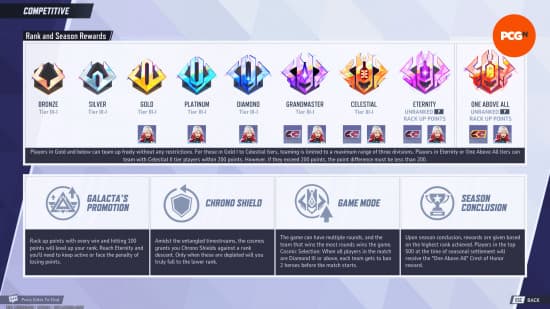
Step → Hit Gold this season → Result: You lock in a season-exclusive Elsa Bloodstone skin that won’t be easy to get later, plus all lower-rank rewards.
Season resets and the 7-division drop
Every season, Marvel Rivals partially resets the ladder to keep things competitive and give returning players a chance to re-climb.
- Reset amount: At the start of a new season, players are typically dropped by seven divisions.
- Example: Grandmaster II at the end of a season might start the new season around Platinum III.
- Effect: Early-season ranked is more volatile, with strong players condensed into mid ranks.
Step → Log in early in a new season and grind hard → Result: You can rocket through compressed mid-ranks while many strong players are still re-climbing from their reset.
Step-by-step climb plan for Season 6.5
Here’s the climb structure I wish I’d followed from day one. Assume you can play ~10–12 focused hours of ranked per week.
Phase 1 – Bronze to Gold (Difficulty: Easy–Medium, 1–2 weeks)
- Step → Lock 2 roles you enjoy → Result: You learn faster by seeing the same situations repeatedly instead of bouncing between everything.
- Step → Main 3–5 heroes total → Result: Your mechanics and ult timings become consistent, which is enough to crush Bronze/Silver.
- Step → Focus on basics (positioning, not dying first, staying on objective) → Result: You win a disproportionate number of fights just by not throwing.
- Step → Queue during your region’s peak hours → Result: Better teammates and fairer opponents speed up your climb.
Phase 2 – Gold to Diamond (Difficulty: Medium, 2–3 weeks)
- Step → Add 1–2 backup heroes for likely bans/counters → Result: You avoid games where you’re useless because your one main gets shut down.
- Step → Start tracking your deaths per game → Result: Cutting even one unnecessary death per map often flips close games.
- Step → Communicate 3 things: enemy cooldowns, ult tracking, and focus targets → Result: Your team’s fights become coordinated instead of 5 solo plays.
- Step → Review one loss per session (just the first 5 minutes) → Result: You catch repeat bad habits (over-peeking, late rotations, etc.) much faster.
Phase 3 – Diamond to Eternity (Difficulty: Hard, 3+ weeks)
- Step → Build a real hero pool per role (3–5 heroes you can play confidently) → Result: Bans at Diamond III+ can’t take you out of the game.
- Step → Learn 2–3 strong meta comps and your role in each → Result: You stop “just picking your main” and start drafting lineups that actually win.
- Step → Limit yourself to 2–3 ranked blocks per day (3–5 games each) → Result: You minimize tilted marathons that erase progress.
- Step → Track weekly goals (e.g., +200 points) instead of daily outcomes → Result: Short-term swings matter less; you focus on steady climb.
- Step → At Celestial+, schedule 3 ranked sessions per week minimum → Result: You stay ahead of decay and keep your momentum.
Based on the current ladder, reaching Eternity usually takes around 300–500 hours of serious competitive play for improving players. Pushing into One Above All typically demands something like a 65% win rate over 200+ games in that season – absolutely doable for top players, but not something you casually stumble into.
Common ranked mistakes (and how to fix them)
- Playing everything, mastering nothing
Step → Hard-limit yourself to a small hero pool for 2 weeks → Result: Your mechanics stabilize, you stop misplaying basic combos, and your impact spikes. - Ignoring draft and bans
Step → Before lock-in, ask “What does our comp need?” (frontline, peel, burst, sustain) → Result: Your team’s comp becomes coherent instead of five solo carries. - Queueing while tilted
Step → After two back-to-back tilt losses, force a 20-minute break → Result: You protect your MMR and stop five-game death spirals. - Only playing when stacked with weakly coordinated friends
Step → Mix solo/duo queues into your schedule → Result: You learn to shotcall and adapt without relying on a premade’s chaos. - Ignoring decay at high ranks
Step → Once in Celestial+, set specific “maintenance days” (even 2–3 games) → Result: You stay ahead of decay and avoid sudden point drops.
TL;DR – Marvel Rivals ranks & Season 6.5 at a glance
- Ranks: Nine total – Bronze, Silver, Gold, Platinum, Diamond, Grandmaster, Celestial (all with III–I tiers), then Eternity and One Above All (Top 500).
- Points: 100 points per tier, 300 per full rank; Celestial and Eternity are pure points, with inactivity decay kicking in at Celestial+.
- Distribution (Feb 2026, 5+ games): Bronze 25.4%, Silver 10%, Gold 12.6%, Plat 13.7%, Diamond 15.4%, GM 15%, Celestial 6.4%, Eternity+OAA 1.5%.
- Requirements: Account Level 10 to queue; season length around 6–8 weeks, with a 7-division reset between seasons.
- Chrono Shield: Protects your first three losses per season per rank, acting as a safety net against instant demotion.
- High-rank rules: Two hero bans per team from Diamond III; stricter queue rules and inactivity decay for Celestial, Eternity, and One Above All.
- Season 6.5 rewards: Apex Huntress Elsa at Gold+, progressively fancier frames and crests up through Top 500.
- Climb expectations: Bronze→Gold in 1–2 weeks, Gold→Diamond in ~2–3 weeks, Diamond→Eternity in 3+ weeks with disciplined play and ~300–500 total hours for most dedicated players.
If you treat ranked like a long-term project instead of a nightly coin flip, Marvel Rivals’ ladder becomes far less intimidating. Understand how points, decay, bans, and rewards fit together, stick to a realistic climb plan, and Season 6.5 can easily be the season you break out of your old plateau.
FinalBoss // Gear
Level up your setup
01Top-rated gaming headsetson Amazon→02High-refresh gaming monitorson Amazon→03Gaming chairson Amazon→04Discounted game keyson Kinguin→Affiliate links · As an Amazon Associate, FinalBoss earns from qualifying purchases.
Want to Level Up Your Gaming?
Get access to exclusive strategies, hidden tips, and pro-level insights that we don't share publicly.
Ultimate Guide Strategy Guide + Weekly Pro Tips