

Insomniac Games arrives at Marvel’s Wolverine with a difficult legacy to escape. Its Spider-Man titles made speed, movement, and open-city freedom central to their appeal; their cited Metacritic scores sit between 85 and 90. Wolverine moves in the opposite direction. This is a narrower, darker, mission-led action game that trades swinging across a city for a string of brutal close-quarters confrontations.
That structural change is the entire story behind its 77-78 Metacritic range. Marvel’s Wolverine has the sharp character focus, polished presentation, and blood-soaked impact expected from a major PlayStation production. It also turns too often into a guided corridor brawler whose strongest mechanic does not evolve quickly enough across a roughly 15-hour campaign. I find it good, focused, and frequently satisfying, but too mechanically conservative to stand alongside Insomniac’s best work.
Table of Contents (7)
What the 77-78 score is telling you
- The combat has a real identity. Logan’s Rage grows through attacks, kills, and parries, unlocking stronger attacks and higher damage output during fast melee encounters.
- The campaign is compact rather than sprawling. Its roughly 15-hour length suits a direct character story, though repetition becomes harder to ignore as similar fights accumulate.
- Linearity is deliberate, but restrictive. Guided platforming, invisible walls, fade-to-black boundaries, and heavily scripted encounters limit exploration and alternative approaches.
- Character work carries the narrative. Liam McIntyre’s Logan and Troy Baker’s Nathaniel Essex anchor a Team X story that also includes Jean Grey, Sabretooth, Mystique, Lady Deathstrike, and Bolivar Trask.
- The PS5 presentation is a major strength. Lighting, facial animation, gore effects, ray tracing, destructible environments, and PS5 Pro PSSR support give the game a premium visual foundation.
Rage gives the brawler its best idea
Wolverine needs combat that feels immediate, ugly, and relentless, and Insomniac gets the fundamentals right. The claws land with force, the animations sell Logan’s viciousness, and Rage provides an effective rhythm to each battle. Building the meter through aggression and well-timed parries turns momentum into power: a successful sequence earns harder-hitting attacks and a more dangerous version of Logan. That loop suits the character far better than a cooldown-heavy superhero toolkit ever could.
The best encounters make direct aggression feel earned rather than mindless. Enemies pressure Logan from multiple directions, takedowns punctuate the action, and the game’s visual violence gives even routine exchanges a weight that the studio’s previous Marvel work never sought. The combat is also accessible in a useful way. Responsive inputs and a clear offensive focus make the core loop easy to understand without stripping away its momentum.
Its limitation is that Rage changes intensity more than it changes decision-making. Most fights remain built around arena waves or corridor clashes, and the enemy tactics and move pools do not offer enough new problems over the full campaign. Wolverine keeps gaining abilities and claw upgrades, yet those additions rarely reshape the basic routine of closing distance, cutting through groups, parrying, healing, and repeating. A combat system can survive repetition when its encounters become more demanding or surprising; here, the escalation is too often cosmetic.
Progression compounds that issue. Whiskey bottles and caches feed into costume and gear systems, while costumes and materials increase Logan’s maximum health. Those rewards provide a reason to comb through the available spaces, but they do not create much strategic expression. Choosing an outfit does not become a meaningful build decision, and collecting materials does not open the kind of dramatic playstyle split that this brawler needs. The result is progression that helps Logan become tougher without making him substantially more interesting to control.
The rails are the real compromise
A linear action game does not need an open world to feel expansive. It needs varied spaces, escalating combat problems, and enough freedom within individual sequences to make the player’s choices matter. Marvel’s Wolverine reaches for cinematic momentum instead. It moves Logan through Tokyo, the Team X headquarters area in Canada, and Madripoor in a globe-trotting chain of set-pieces, cutscenes, platforming routes, and combat arenas.

The locations give the adventure visual range, but their gameplay role is often too narrow. Platforming is mostly guided, with restrictive navigation and hard boundaries that reveal themselves through invisible walls or a fade to black when Logan strays beyond the intended path. The game wants forward motion at all times. That makes it brisk in short bursts, yet it also makes the world feel more like a sequence of dressed sets than a place where Wolverine can meaningfully hunt, improvise, or investigate.
There is a difference between authorial control and over-direction. The strongest linear action games use their fixed structure to constantly introduce a fresh tactical wrinkle, a new navigational idea, or a more dramatic encounter. Here, the loop too often settles into corridor fight, cutscene, platforming stretch, and another corridor fight. The cinematic spectacle gives those transitions flair, but semi-interactive sequences cannot substitute for deeper interaction with the environment.
Boss placement exposes the pacing issue. Boss encounters are limited in number, and many arrive in the final third. That leaves too much of the middle relying on standard groups of enemies, exactly where the combat’s limited variety becomes most visible. The campaign is short enough to avoid becoming exhausting, but the structural fatigue is real. A 15-hour game can still feel padded when its central challenge stops changing.
Logan is stronger than the plot around him
The narrative fares better whenever it stays close to Logan. Liam McIntyre gives the character a forceful, conflicted presence, while Troy Baker gives Nathaniel Essex a memorable counterweight. Jean Grey, Sabretooth, Mystique, Lady Deathstrike, and Bolivar Trask give the Team X framework a suitably large Marvel canvas without taking attention away from Logan’s personal conflicts.
That focus matters because the game understands the tonal shift required for Wolverine. The story is darker and more grounded than Insomniac’s Spider-Man work, with less room for lightness and more interest in violence, trauma, and a man who has spent too long being used as a weapon. Cutscenes, facial animation, and character art give those moments genuine presence. Logan works because the game treats him as a damaged person before treating him as a claw delivery system.
The plot does not always match that performance quality. Major turns are too clearly signposted, relationship development is thin in places, and the player has little agency in the story or its relationships. The campaign tells a fixed tale rather than inviting players to shape it. That is not automatically a flaw, but the lack of narrative interaction makes the rushed emotional beats more noticeable. When the writing lands, it is because Logan and the cast sell the scene; when it misses, the game has few systems beyond cutscenes to deepen the connection.
PS5 spectacle cannot solve a design problem
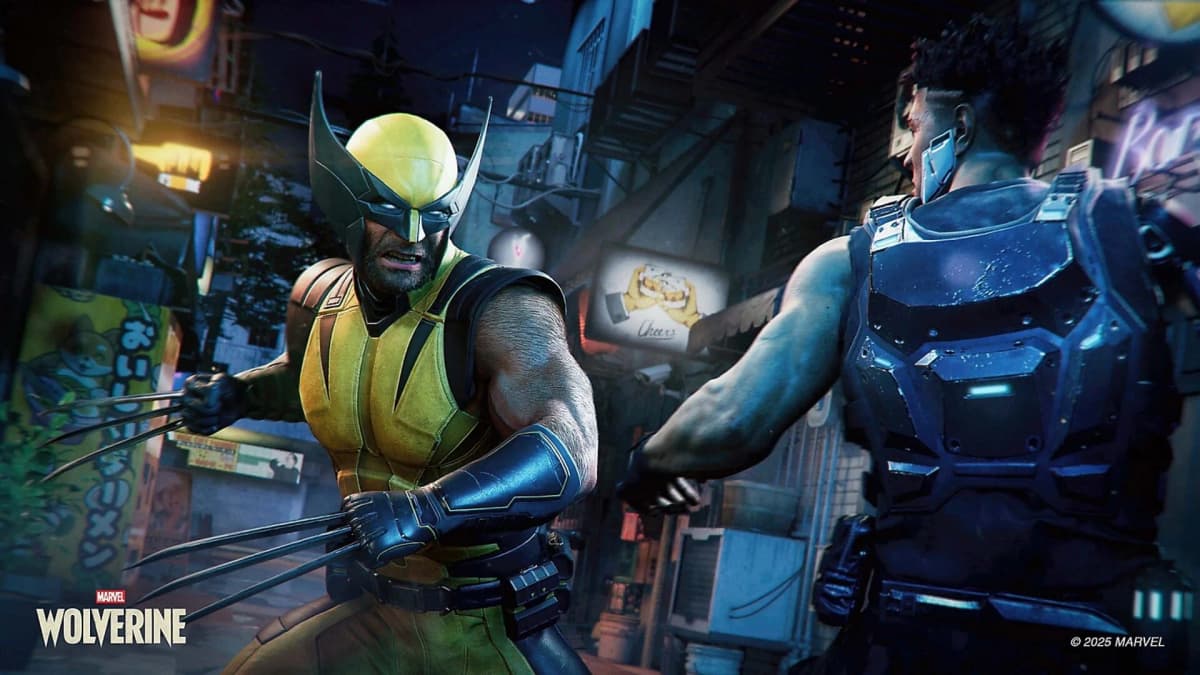
Presentation is where the production value remains beyond dispute. Wolverine’s character model, the facial work across the cast, lighting, gore effects, ray tracing, and destructible environments create a game that looks built for PlayStation 5. The action benefits from vertical spaces and polished animation, while PS5 Pro support adds PSSR for players using that hardware.
That polish is important because it preserves the physicality of the combat. A claw strike needs to look painful. Logan’s healing and Rage states need to communicate his changing condition instantly. The game succeeds at those visual tasks, and its best set-pieces have the scale and finish expected from Insomniac. Still, stronger lighting and sharper character models cannot make a guided route feel less guided. The core problem is design repetition, not a major technical breakdown.
Who should buy Marvel’s Wolverine at launch
I recommend Marvel’s Wolverine at launch to PS5 players who want a direct, violent, single-player action game built around Logan rather than an open-world superhero playground. Rage-driven claw combat, strong performances, stylish cutscenes, and a focused roughly 15-hour run make this a worthwhile choice for anyone comfortable with a directed campaign. The $69.99 USD / £69.99 GBP Standard Edition makes the most sense for that audience; the Digital Deluxe Edition costs $79.99 USD / £79.99 GBP.
Players expecting the freedom, mission variety, and structural ambition associated with Insomniac’s Spider-Man titles should wait. Marvel’s Wolverine is PS5-only at launch, with no PS4 release or PC version announced, and it asks full price for a campaign whose replay value depends heavily on how much enjoyment you get from its combat loop. If guided platforming, sparse exploration, and repeated arena battles wear thin quickly, a sale is the smarter route.
Bottom line
Marvel’s Wolverine understands Logan’s brutality, his anger, and the appeal of letting both explode through a well-animated melee system. Insomniac Games also gives him a polished PS5 showcase and a cast capable of carrying the darker material. Yet the same game repeatedly narrows its own potential through on-rails level design, shallow progression, limited boss presence, and encounters that overstay their welcome. It is a good Wolverine character piece trapped inside a merely competent action-game structure. 7/10.
FinalBoss // Gear
Level up your setup
01Top-rated gaming headsetson Amazon→02High-refresh gaming monitorson Amazon→03Gaming chairson Amazon→04Discounted game keyson Kinguin→
Affiliate links · As an Amazon Associate, FinalBoss earns from qualifying purchases.
Want to Level Up Your Gaming?
Get access to exclusive strategies, hidden tips, and pro-level insights that we don't share publicly.
Ultimate Reviews Strategy Guide + Weekly Pro Tips