
Table of Contents (11)
My Preview Trip to Codavia: Media Circus First Impressions
I have a weird soft spot for games that turn boring-sounding jobs into existential horror. Papers, Please, Not For Broadcast, Headliner – anything that asks, “What if pushing paperwork could quietly wreck a country?” is my jam. So when I stumbled onto Media Circus, a satirical news management sim where you run a newspaper in a world of cartoon animals, my radar lit up immediately.
Quick reality check before we go further: at the time of writing, Media Circus is still in development, aiming at a 2027 PC release. I haven’t had my hands on a public build yet. These impressions come from extended gameplay showings, dev breakdowns, and design deep-dives the team has shared at events. So think of this as a grounded, experience-focused preview review rather than a verdict on the final game.
Even with that caveat, it’s already clear there’s something interesting here. Papercoda Games – a women-led indie studio with an actual journalism background – is basically turning a newsroom into a morality-and-money strategy puzzle. You’re the editor-in-chief of a Codavian newspaper, juggling headlines, reporters, political factions, ad money, and your own conscience while a whole animal city shifts in response.
The very first time I watched the front page come together – stories sliding around a modular layout, headlines ballooning to dominate the page, ad blocks muscling in from the margins – it hit me: this isn’t a “cute tycoon.” This is a pressure cooker in the shape of a broadsheet.
Front Pages as Puzzles: How Running the Paper Actually Feels
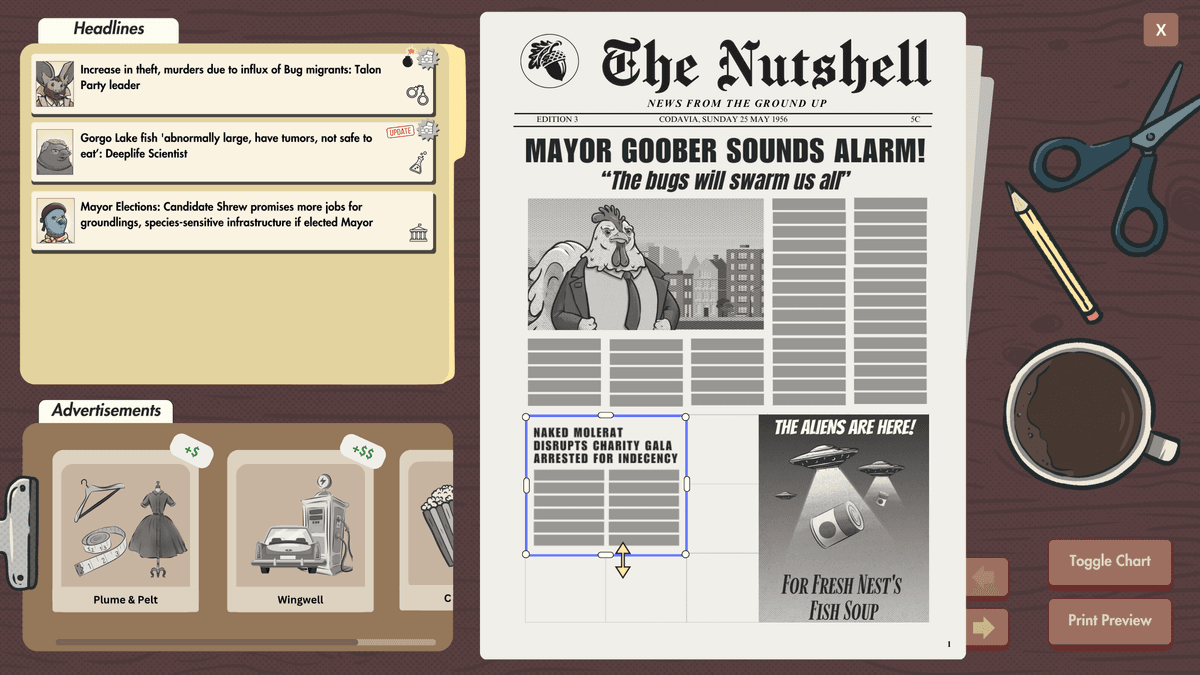
The core loop of Media Circus is deceptively simple: you’re building a newspaper issue, page by page, block by block. On screen, that looks like a grid where each tile can be a news article, an ad, or sometimes a big honking banner that screams a headline across the whole thing.
Every issue feels like solving a moral Tetris. You’ve only got so much space:
- Make a story larger, and its influence on the city of Codavia grows.
- Pack in more ads, and your bank account breathes easier, but your credibility takes a hit.
- Bury a story and certain factions will remember. Loudly.
The standout mechanic for me is the “blow up headline for impact” option the devs keep highlighting. When you decide that one article is going to define the news cycle, you can literally blow its headline up so it dominates the page. Visually, it’s almost comical – the title stretches, font size surges, everything else shrinks away – but under the hood, that’s the game quietly cranking up the story’s effect on Codavia’s politics, public mood, and faction relationships.
Watching that in motion, you can feel the temptation. Do you nuke the page with a sensationalist take because you need to crush a rival paper this week? Or keep it measured and risk readers drifting to the competition’s louder spin?
What I like is that this isn’t just a “numbers go up” economy. It’s a web of tradeoffs. Ad-heavy pages might keep the lights on, but your audience starts seeing you as a sellout. Most management sims stop there; Media Circus keeps digging, tying that loss of trust into elections, protests, and how future stories land with the public.
Reporters, Bias, and the Office Drama You Can’t Ignore
On top of page layout, there’s the people side: managing your reporters. Each one has their own skills, beats, and baked-in biases, and that matters way more than it first looks.
Instead of just picking “best stat go brr,” your assignments shape the tone of your coverage. Send your idealistic investigative ferret to cover a corporate scandal, and you’re probably getting an outraged exposé. Throw your jaded, advertiser-friendly fox on the same story, and suddenly it’s a “nuanced look” that weirdly reads like PR. The game leans into that difference rather than smoothing it out.
You’re also managing morale and deadlines. From what the devs have shown, reporters can burn out, refuse certain assignments, or clash with your editorial line. Push them too hard to parrot a faction’s talking points, and that might solve a short-term political problem but damage their trust in you. Ignore their ethical red lines long enough and you might lose them altogether – not just as a worker, but as a narrative voice in your newsroom.
I really like this angle because it mirrors how real journalism works: news isn’t just “you” speaking, it’s a whole messy chorus of personalities behind the bylines. Strategy games often reduce workers to production units; here they’re closer to party members in a story-heavy RPG, but plugged into a simulation about spin and truth.
Factions, Elections, and a City That Bends Around Your Coverage
The part that sold me hardest on Media Circus is how reactive Codavia seems. Every editorial choice feeds into the city’s politics: elections, protests, public sentiment, and the ongoing tug-of-war between different animal factions.
Different groups – political parties, corporations, activist movements – aren’t just flavor text. They’re constantly sniffing around your office, lobbying for coverage, threatening ad boycotts, or promising exclusive scoops. You’re never just choosing which story to print; you’re choosing which relationships to sacrifice.
Push too hard on corruption in a powerful bloc, and maybe you help swing an election… but you also risk losing the ad contracts that paid last month’s salaries. Soft-pedal those same stories, and watch activists turn on you in the streets. The devs describe a modular narrative system that lets the world react in surprisingly granular ways to your coverage – not just “you supported Faction A, so you get Ending A,” but a messy, layered sequence of consequences.
Multiple endings are baked in, and they’re not just “good journalist / bad journalist.” From what’s been teased, you can lean towards:
- Hardline truth-teller: financially unstable, morally unbent.
- Partisan attack dog: wildly influential, ethically cooked.
- Corporate lapdog: profitable, but loathed or irrelevant.
- Chaotic centrist: trying to please no one and somehow pleasing even fewer.
Because the simulation tracks elections and public opinion, the same editorial strategy can land differently across runs. Maybe this time your shock-jock coverage sparks a populist wave; next time, the same playbook fizzles because you sold out too many times before. That kind of replayable “alternate history of your newsroom” is what has me genuinely curious about doing multiple playthroughs rather than calling it a one-and-done narrative game.
Satirical Animal World: Cute Coat, Sharp Teeth
The animal setting could’ve easily been a gimmick – slap a few punny names on political parties and call it a day. What reassures me is that Papercoda’s team actually comes from journalism. The satire in their previews feels more like pointed allegory than cheap “lol politics” memes.
Codavia’s factions are exaggerated enough to be funny, but recognizable enough that you instantly get who they’re riffing on. You’re not dealing with “Party A” and “Party B”; you’re wrangling thinly veiled stand-ins for populist demagogues, legacy elites, tech moguls, and grassroots activists – all reimagined as animals with just enough distance that it stings without turning into a lecture.
Tonally, it reminds me a bit of Not For Broadcast mixed with the deadpan animal world of something like BoJack Horseman. There are jokes – headlines that are so blunt they made me snort during a demo clip, visual gags in character designs – but the humor’s there to make the heavy stuff digestible, not to shrug it off. The fact you’re playing with media ethics in a city of raccoons and hippos is exactly what lets the game approach modern journalism without feeling like a homework assignment.
The big win of this setting is accessibility: people who’d never touch a “serious” political sim may happily dive into Codavia because it looks like an offbeat Saturday morning cartoon – and then slowly realize they’re stress-editing a front page that might decide an election.
Interface, Complexity, and the Learning Curve
Management sims live or die on their interfaces, and from what’s publicly shown, Media Circus is aiming for “simple on the surface, nasty underneath.”
You’ve got a few main layers:
- A front page layout view with draggable story and ad blocks.
- A reporter management screen, where you see stats, moods, and biases.
- A city/faction overview that tracks elections, approval ratings, and key events.
- Dialogue and narrative screens where you negotiate with sources, lobbyists, and staff.
The devs describe menus that “hide deep strategic and narrative complexity,” and that tracks with what’s been shown so far. At a glance, it’s approachable: big cards for stories, color-coded factions, readable fonts, not an Excel sheet in sight. But every click seems to expose another layer of consequences. Approving a headline isn’t just +readers; it might nudge a poll, shift an ally’s trust, or unlock a new branch of a character’s arc.
My one concern watching all this is cognitive overload. When a game tries to model ethics, politics, relationships, and economics all at once, it’s frighteningly easy to bury players in indicators and warnings. The promise of a “modular narrative system” is exciting, but it also means a lot of things can change at once if you’re not careful.
If Papercoda nails pacing – giving you a couple of big levers to worry about early, then slowly turning the heat up – this could end up in that sweet spot where every issue feels manageable but meaningful. If they don’t, late-game newspapers could turn into paralyzing flowcharts where every headline feels like a trap.
Potential Weak Spots: Where This Could All Go Sideways
Because the game isn’t out yet, it’s only fair to talk in terms of risks rather than “cons.” A few stand out from what I’ve seen and from experience with similar games.
- Analysis paralysis: When every choice is morally loaded and mechanically dense, some players freeze. If the game constantly screams “this will have HUGE consequences,” the fun can slip into anxiety.
- Repetition of dilemmas: Ethical choices are powerful in moderation. If every single issue is a “sell out or go broke” binary, the impact dulls fast. The promise of branching storylines suggests variety, but it’s something I’ll be watching for.
- Text-heavy fatigue: This is a journalism sim; of course it’s wordy. But even I, as someone who inhales visual novels, have a threshold. The writing will need to be sharp enough to justify the reading load.
- Late-game snowballing: Strategy games often hit a point where you’re either unstoppable or doomed, and you’re just clicking through motions to reach an ending you already know. The dynamic world design here might fight that, but it’s not guaranteed.
None of these are fatal flaws on their own. They’re just the usual potholes in this genre. The upside of a 2027 target is that Papercoda has time to iterate based on event feedback, tuning where the game is punishing and where it lets you breathe.
How Media Circus Compares to Other News Sims
On paper, Media Circus sits in the same neighborhood as News Tower, Headliner: NoviNews, and Not For Broadcast, but it’s coming at the idea from a slightly different angle.
- Versus News Tower: News Tower leans more into historical newsroom tycoon vibes with a 1930s NYC aesthetic. Its ethics systems exist, but they’re less granular. Media Circus looks more reactive and politically alive, especially with factions and elections reshaping the board.
- Versus Headliner: Headliner is very much “choose which stories run today” in a more linear narrative. Media Circus expands that into full layout control, ad balance, staff management, and a more systemic city simulation.
- Versus Not For Broadcast: Not For Broadcast is all about real-time chaos in a TV control room – visceral, hilarious, occasionally nightmarish. Media Circus looks slower and more cerebral: less button-mashing panic, more “sit with this decision and its fallout.”
If you like the idea of shaping public opinion but bounced off fast-twitch gameplay or simplistic moral curves, this might land in that “hard-thinking but not hand-cramping” sweet spot.
Who This Game Is Really For
Based on everything shown so far, Media Circus feels aimed at a pretty specific cross-section of players. You’ll probably click with it if:
- You enjoy narrative-heavy strategy games where choices actually hurt a little.
- You’re fascinated (or at least curious) about how media, money, and politics tangle together.
- You liked the vibes of Not For Broadcast or Headliner but wanted more systemic depth.
- You don’t mind reading – a lot. This is not a vibes-only idle sim.
- You appreciate satire that’s smart but not preachy.
If you mainly want a chill tycoon where you watch bars slowly fill and only occasionally tap a “+10% revenue” upgrade, this probably isn’t for you. Media Circus is shaping up to be closer to a role-playing game where your class is “editor-in-chief” and your weapons are ethics, leverage, and page real estate.
Bottom Line: A Newsroom I Actually Want to Lose Sleep In
Even at this early stage, Media Circus feels like it understands something about journalism games that a lot of titles miss: the real drama isn’t just in chasing stories, it’s in choosing what not to print, who you’re willing to upset, and how much of your soul you’re ready to trade for another month of solvency.
The satirical animal world makes it approachable; the women-led, journalist-founded team gives me confidence the satire will have teeth; the modular narrative and faction systems suggest real replay value instead of “one moral path per run.” My worries are all about execution – pacing, interface clarity, late-game balance – not about the core concept.
Since the game’s still in development, I’m not comfortable pretending this is a final scored review. But if I had to put a number on my excitement based on what I’ve seen so far, I’d call it a provisional 8.5/10 on the “this could be special” meter. If Papercoda sticks the landing on complexity and keeps the writing sharp, Media Circus has a real shot at becoming the go-to “media ethics” sim people recommend for years.
TL;DR
- What it is: A narrative-strategy management game where you run a satirical animal newspaper in the city of Codavia.
- Core loop: Design front pages, balance news vs. ads, assign biased reporters, and juggle political factions and finances.
- Why it stands out: The “blown-up” headline system, deeply reactive factions and elections, and a modular narrative that tracks your editorial choices across multiple endings.
- Vibes: Think Not For Broadcast and Headliner had a slow-burn, strategy-focused cousin with a newsroom instead of a TV studio.
- Biggest risks: Potential analysis paralysis, text fatigue, and the usual strategy-game snowball problems if late-game balance isn’t tuned carefully.
- Who should watch it: Players who like morally messy strategy games, care about media and politics, and don’t mind reading a lot of sharp, satirical writing.
- Provisional score: 8.5/10 anticipation – not a final verdict, but high on my “most-wanted indie sims” list for the next few years.
FinalBoss // Gear
Level up your setup
01Top-rated gaming headsetson Amazon→02High-refresh gaming monitorson Amazon→03Gaming chairson Amazon→04Discounted game keyson Kinguin→Affiliate links · As an Amazon Associate, FinalBoss earns from qualifying purchases.
Want to Level Up Your Gaming?
Get access to exclusive strategies, hidden tips, and pro-level insights that we don't share publicly.
Ultimate Reviews Strategy Guide + Weekly Pro Tips