
Table of Contents (12)
A DS-era Mega Man I’d mostly written off just became my favorite spin-off
When Mega Man Star Force first came out on the Nintendo DS, I basically ignored it. I was still riding high on Battle Network, and Star Force looked like the awkward kid brother in weird 3D, with card battles that felt like a half-step sideways instead of forward. Reviews at the time didn’t help; the general vibe was “lesser Battle Network” and “talky, slow RPG.” So I quietly let the trilogy pass me by.
The Mega Man Star Force Legacy Collection is the first time I’ve actually sat down and lived with these games properly, front to back, as a connected trilogy. And that context matters. Playing them as one long arc instead of three isolated DS cartridges completely reframed what this subseries is doing – both narratively and mechanically.
Capcom has bundled all three Star Force games and their multiple versions into a single package, then wrapped it in enough modern quality-of-life options that the rough DS edges mostly turn into charming quirks instead of dealbreakers. Underneath that remaster sheen is a surprisingly grounded story about grief and connection, and a card-based, semi-real-time combat system that finally feels like its own thing rather than “Battle Network but worse.”
By the time the credits rolled on Star Force 3, Geo Stelar and Omega-Xis (“Mega”) had quietly slipped into the same mental shelf where I keep my favorite JRPG duos. Not because the games are flawless – they aren’t – but because the Legacy Collection gives them the right stage and tools to actually shine.
What you actually get in Mega Man Star Force Legacy Collection
The collection pulls together the full DS-era line-up:
- Mega Man Star Force 1 – three versions (Pegasus, Leo, Dragon)
- Mega Man Star Force 2 – two versions (Zerker x Saurian / Zerker x Ninja)
- Mega Man Star Force 3 – two versions (Black Ace / Red Joker)
Like the old Battle Network releases, the version differences are mostly about forms, cards, and small mechanical twists rather than huge story changes. In the Legacy Collection, swapping between them is painless compared to tracking down physical carts. It’s all here, fully intact, including event-only cards and bonuses that used to be locked to real-world promotions. That alone makes this feel definitive.
On top of that, the collection layers in new features:
- Auto-save (a quiet lifesaver for a random-encounter-heavy RPG)
- Speed, damage, and encounter-rate sliders for fine-tuning pace and difficulty
- Battle performance tweaks if you want a breezier run without grinding
- Screen layout options to simulate the DS double-screen setup in a way that actually works on a single display
- Visual filters so you can choose clean pixels or smoothed edges
- Original or newly arranged soundtrack at a toggle
- Online versus modes with ranked and casual options
- A huge art gallery with over a thousand pieces of artwork, card art, and design sketches
None of this rewrites the core of Star Force – this is still the same DS trilogy under the hood – but it removes a lot of the “you had to be there in 2007” friction. The bumps that remain feel like design choices, not hardware limitations.
Geo Stelar’s arc: Mega Man as a story about grief, not just heroics
I’d always heard “the kid in Star Force is kind of moody,” which massively undersold how the series actually handles Geo Stelar. Right out of the gate in Star Force 1, he isn’t just shy – he’s properly withdrawn. His dad’s disappearance in a space accident has frozen his life in place. He doesn’t go to school, avoids his classmates, and basically uses isolation as a shield. And the game sits in that headspace longer than I expected for something with “Mega Man” on the box.
What surprised me is how naturally his growth plays out across all three games. The series doesn’t reset his personality each time. Star Force 1 is almost claustrophobic: small town, tight cast, problems that are personal and local, even as EM-wave aliens are trying to hijack tech around the city. Geo’s merge with Omega-Xis, the loud, abrasive, alien “partner” who turns him into Mega Man, is as much therapy as it is superhero origin.
Omega-Xis is the perfect foil: brash, sarcastic, borderline rude, but never mean-spirited. Their back-and-forth sells the fantasy in a way that a lot of silent-protagonist Mega Man games don’t. It’s not clean or sentimental – Geo’s still hesitant, still annoyed, still anxious – but the two push and pull on each other until you really buy that this kid could step up for people he keeps insisting he doesn’t need.
Star Force 2 and 3 widen the scope without losing that thread. Instead of tossing Geo into completely disconnected adventures, both sequels treat the first game as emotional canon:
- Classmates who were side characters in 1 get proper focus and payoff in 2.
- Adults react differently to Mega Man once he becomes visibly real to the public.
- Geo’s relationship with his mum and his father’s legacy quietly evolves rather than being reset.
- The world’s tech culture changes – EM wave partners (Wizards) become normalized tools in everyday life by 3.
By the time the Satella Police and the bigger, more abstract threats of Star Force 3 arrive, Geo isn’t some magical new hero archetype. He’s the same kid from the first game who’s gradually learned to lean on his friends, literally and mechanically, through Brother Bands – a whole in-universe system about building emotional and practical connections.
The writing isn’t subtle – we’re still in the territory of kids’ sci-fi anime – and yes, some of the dialogue has that mid-2000s cheese. But the emotional spine is handled with more care than I ever saw in the old marketing. Star Force 1, in particular, hit harder than I expected; it’s one of those games where you can look back at the opening hours and actually feel how far the protagonist has come.
If I had to rank them purely on story and character work: 1 is the standout, 3 is a satisfying escalation, and 2 is the slightly awkward middle child that still benefits from being part of the arc.
The combat finally makes sense: cards, lanes, and real-time pressure
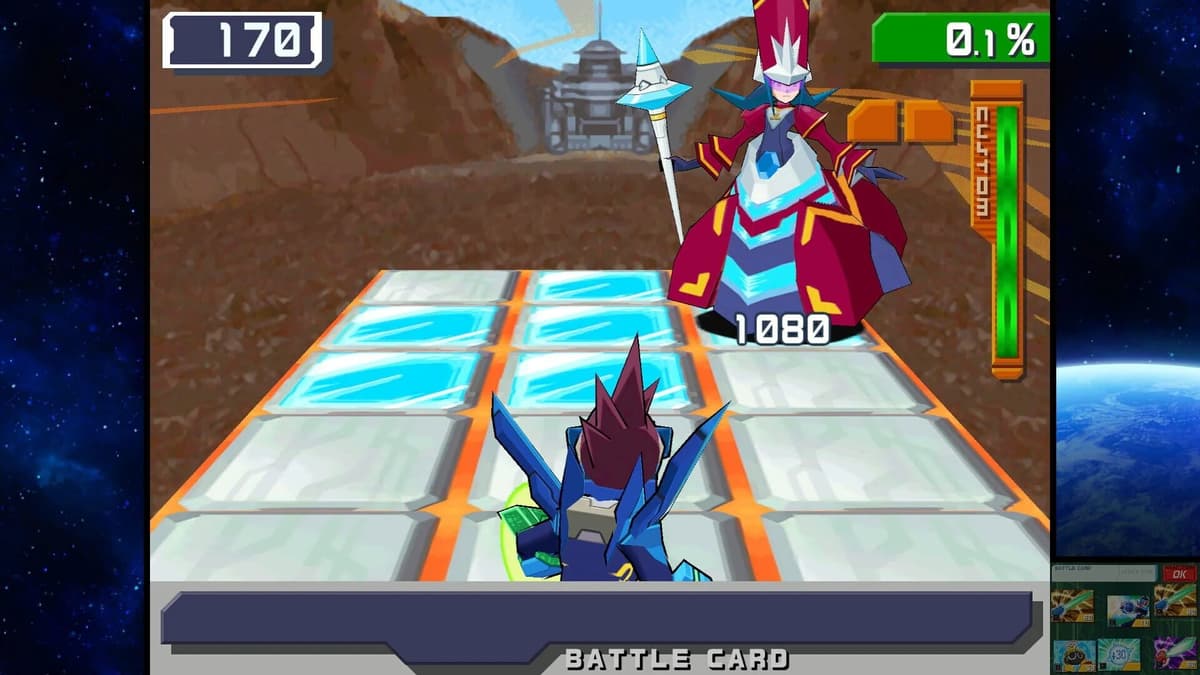
The thing that always put me off Star Force footage back in the DS days was that battle camera. After years of Battle Network’s side-on, 3×3 grid duels, suddenly Mega Man is at the front of the screen looking toward the enemies, stuck on three panels in a line. It looked constrained, almost like a downgrade.
Playing it now, with the Legacy Collection’s cleaner resolution and UI, the design clicks in a way trailers never sold. Encounters are still semi real-time, card-based battles on a grid, but the shift to a first-person-ish perspective changes the vibe from dueling to dodging and timing under pressure.
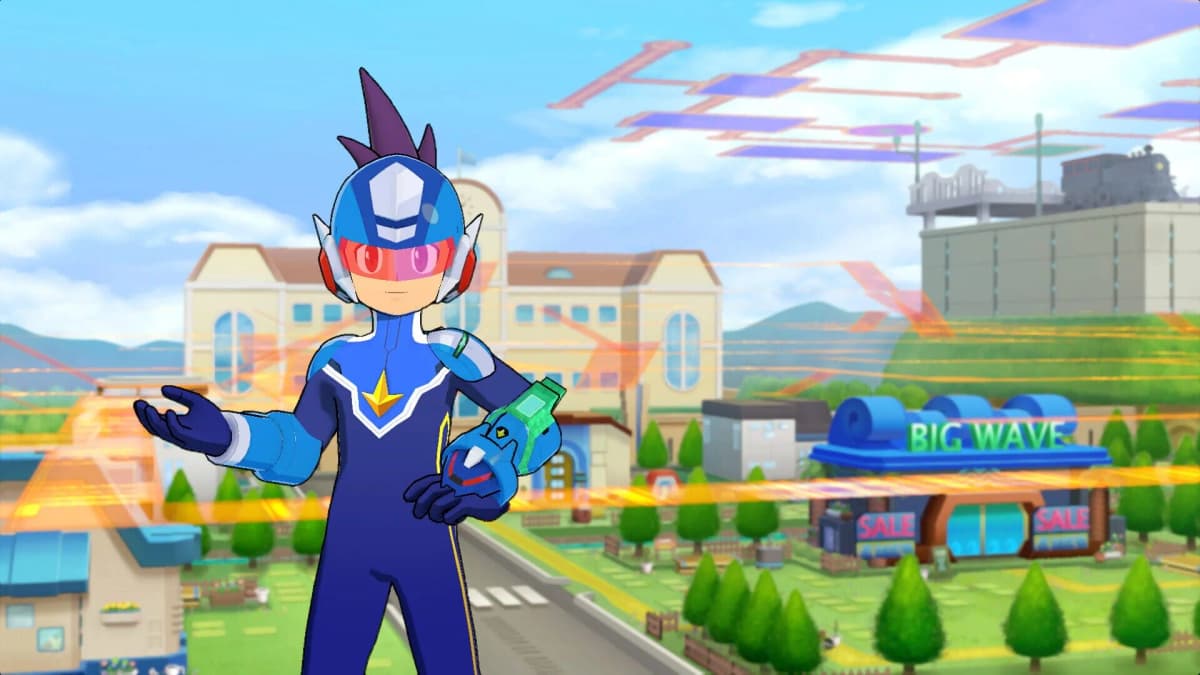
Here’s the basic flow, which stays consistent across all three games:
- You move Mega Man left and right across three panels on your “back row.”
- Enemies occupy columns across from you, telegraphing attacks, projectiles, and area-of-effect hits.
- Your default Mega Buster can be fired freely between card volleys to chip away at HP.
- Every few seconds, your card selection pops up, and you choose a small handful from a random draw of your current deck.
- Cards are your big tools: swords, wide shots, status effects, summons, field modifiers.
- Well-timed hits during an enemy’s attack animation trigger counters, stunning them and often opening room for higher damage.
The key difference from Battle Network is that you’re almost always reacting from the back. You’re not weaving into enemy territory as much as you’re managing lanes – sliding between panels to line up shots while avoiding carpets of damage. That makes guarding way more important; you can’t simply dodge everything, especially in multi-enemy fights, so learning what to block versus what to strafe around becomes half the fun.
What I ended up loving is how this system rewards deck planning and on-the-fly improvisation equally. You’re still building loadouts tailored to bosses, stacking synergies and multi-hit setups, but the real joy is clearing a chaotic screen with a perfectly timed combo you absolutely didn’t script out beforehand. Those “I can actually pull this off” moments hit regularly once you understand how the card draw and counters interplay.
The collection’s battle speed and damage sliders help here. If you want the system to feel more tactical, you can slow things down and keep damage closer to the original tuning. If, like me, you’re revisiting as an older fan who doesn’t have DS-era reflexes and homework-free afternoons anymore, bumping damage or slightly speeding the pace takes the edge off grinding without killing the satisfaction of a clean fight.
How combat and systems evolve from 1 to 3
Mechanically, the trilogy is more iterative than revolutionary, but each entry stamps its own identity on the same basic card-grid foundation.
Star Force 1 – simple, clean, and surprisingly tight
The first game is the purest version of the combat. You build one deck, you fight with that deck, and the most complicated layer is figuring out positioning and counters. It’s refreshingly straightforward once you acclimate to the perspective shift.
Where it hooks you is the balance between exploration, optional quests, and battle power. Just wandering around town, hopping onto EM wave roads, and poking into devices rewards you with new cards, HP upgrades, and items that clearly matter. Star Force 1 is also where the random encounter rate feels the most reasonable if you play at default settings; I didn’t feel the need to touch the encounter slider much until very late-game cleanup.
Star Force 2 – more forms, more systems, less focus
Star Force 2 is the one that wobbles. On paper, the headlining mechanic is Tribe On, which lets Mega Man transform into different forms depending on version and in-game conditions. These forms tweak your abilities and can feel great once you’re set up, but they also add an extra layer of fiddliness to a system that was already juggling deck composition, positioning, and counters.
It’s not bad – just a little busier without always feeling deeper. The story beats that spotlight the side cast are appreciated, and there are smart individual dungeon ideas, but 2 is the only game in the trilogy where I caught myself thinking, “Okay, let’s move this along.” That’s also where the collection’s speed toggles start to feel like a soft recommendation rather than a luxury.
Star Force 3 – the systems finally lock into place
Then 3 arrives and pulls elements of 1’s focus and 2’s experimentation together into something that finally feels complete. This is where modern tech culture in the story shifts as well: Wizards are everywhere, the Satella Police are a visible force, and Mega Man can transform in the “real world” without hunting for specific transformation points. That freedom matters.
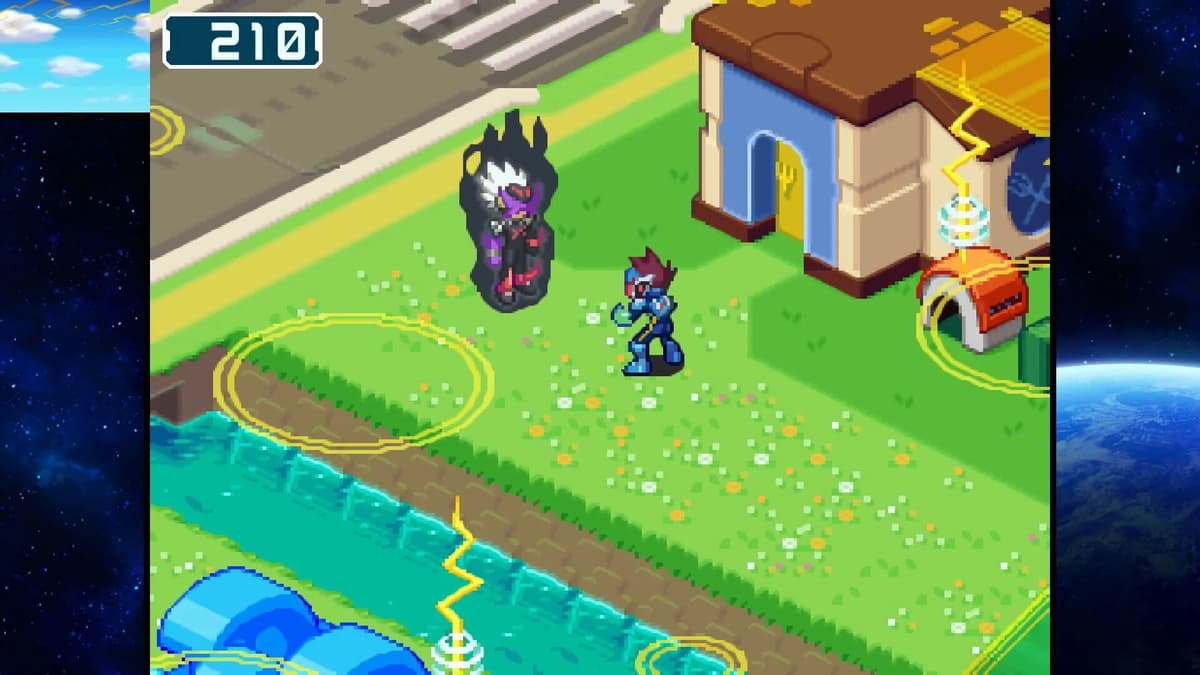
Mechanically, 3 folds in advanced systems like Noise and Big Bang attacks, rewarding aggressive, stylish play. It’s also where I felt the combat curve was at its best: bosses ask you to genuinely understand their patterns, use your deck intelligently, and respect damage values. I touched the assist sliders less here than in 2 because the tuning already felt sharper.
Playing all three in a row really lights up how they’re meant to be read: 1 lays the emotional and mechanical foundation, 2 experiments and stumbles a bit, and 3 lands the plane with bigger stakes and a refined battle flow. The Legacy Collection makes that arc obvious in a way scattered DS playthroughs never would have.
Sidequests and dungeons: clever ideas with a few very 2007 annoyances
The Star Force games sit in that era of JRPG design where sidequests are worth doing but the way they’re tracked and presented makes you roll your eyes every now and then.
The core issue across all three games: you can only have one sidequest active at a time. You accept a task, it gets logged in your in-game email, and you work through it. That’s it. No stacking errands, no batch clearing. If you’re the type who likes to hoover up every quest in a new area and then clear them in one efficient loop, this limitation feels like being forced to stand in line at the same kiosk over and over.
The quests themselves are usually fine – small character beats, little mysteries, fetch quests that are at least tied to named NPCs you’ll see again – but the constant back-and-forth of picking them up one by one feels artificially restrictive in 2026. The Legacy Collection doesn’t really solve that; it can’t without fundamentally rewriting how the games structure flags and progression.
Then there’s the occasional vagueness. For the most part, Star Force does a better job than some of its contemporaries at pointing you in the right direction, but there are still moments where the hint boils down to something like “maybe talk to people” or “search around that place we mentioned once.” Combined with the random encounter rate, that’s where I felt the age the most.
The flipside is that the dungeon-style areas – the EM wave spaces inside gadgets, networks, and weird conceptual spaces – held up better than I expected. Each area tends to revolve around one central mechanic:
- flipping Mega Man’s polarity to cross certain paths,
- using radar-style tools to uncover hidden items or routes,
- manipulating moving platforms or signal paths in a specific order,
- reconfiguring parts of the map to create new wave roads.
Most of these gimmicks land. The ones that don’t are usually just stretched a little too thin, not outright bad concepts. Being able to pan the camera freely around a dungeon in the Legacy Collection helps more than I expected; line-of-sight puzzles that might have been irritating on the DS screens become much easier to parse when you can swing the camera around and clearly see where roads lead.
When dungeons, sidequests, and the battle system are all playing nice together, Star Force slips into a cozy loop: explore, solve a gimmick, get into a fast-feeling fight, earn a new card or HP boost, and feel directly stronger for your curiosity. The few stretches where vague hints or padded puzzle rooms take over are noticeable precisely because the baseline is so comfortable.
Quality-of-life: the little switches that make this the right way to play
Legacy collections live or die on the stuff wrapped around the original games. Capcom’s been on a roll with these Mega Man anthologies, and Star Force is no exception. A lot of the changes here sound minor on paper but add up to something that feels tailored rather than lazy.
Auto-save is the unsung hero. Star Force loves random encounters and text-heavy story scenes. Being able to put the game down without hunting for a save point, and knowing that a random unlucky fight isn’t going to cost you twenty unskippable minutes of exposition, just makes the whole trilogy feel more respectful of your time.
The speed, damage, and encounter-rate sliders are where the collection quietly modernizes the experience. Instead of a binary “cheats on/off” setup, you can tune things to taste:
- Hate grinding? Turn down encounters or bump up damage taken by enemies.
- Want to enjoy the combat but blast through repeated trash fights? Speed up battle flow.
- Playing with a younger or newer player? Nudge things in the opposite direction.
It doesn’t feel like you’re “breaking” the games; it feels like moving the difficulty slider in a modern RPG. Purists can leave everything at default and get the DS-authentic experience. I toggled things differently between each game: mostly default in 1, a bit more aggressive assist in 2 when the pacing sagged, then somewhere in between for 3.
The display options are handled smarter than I expected, too. These were originally dual-screen DS titles, but the collection uses clean layouts that keep the important information on one screen while letting you pull up the secondary display when needed. Holding a trigger to swap focus between them feels natural after a few minutes; I never found myself fighting the interface.
On the audiovisual side, the new arranged soundtrack is a nice touch. I bounced between the original tracks and the arrangements, and while I ended up preferring the crunchy DS sound for pure nostalgia in some battle themes, the updated versions give key story moments extra punch. Being able to flip back and forth mid-playthrough is exactly the kind of indulgent toggle a collection like this should have.
Online play is there for people who want to keep digging into the battle system after the credits. Ranked and casual matches, plus the full complement of cards (including the old event-locked ones), mean you’re not stuck with incomplete tools. It’s not going to become the next big competitive scene, but it’s a thoughtful inclusion that rounds the package out.
And I have to mention the gallery. If you’ve ever fallen down a wiki hole looking at old Mega Man concept art, this collection’s thousand-plus illustrations feel like a curated art book you can scroll through on your couch. Character sheets, promotional pieces, card art – it turns the compilation into more of a historical archive, not just a ROM dump.
Even the title screen banter ends up charming. Like the Battle Network collections, Star Force’s main menu has voiced dialogue between key characters. It’s novelty, sure, but after hours of knowing these people as text boxes and battle grunts, hearing them riff a little sells the idea that this is a celebration of the subseries, not a contractual obligation.
Who this collection is actually for
By the end of the trilogy, I realized Star Force Legacy Collection sits in a strangely broad sweet spot:
- Battle Network fans get a familiar hybrid of RPG overworld, card battles, and digital-world dungeons, but with a fresh camera angle and stronger central protagonist.
- JRPG players who bounced off mainline Mega Man’s pure action might find Star Force’s mix of dialogue-heavy storytelling and tactical real-time battles more approachable.
- Younger players can absolutely enjoy the flashy transformations and EM-world gimmicks, especially with the difficulty sliders turned in their favor.
- Lapsed Mega Man fans who wrote this era off (like I did) get a chance to re-evaluate a subseries that was quietly doing more interesting narrative work than it was ever credited for.
The main people I wouldn’t recommend it to are those who cannot stand random encounters or text-forward pacing. The quality-of-life tools sand down those edges, but they can’t erase the DS DNA entirely. You’re still going to spend a lot of time talking to NPCs, wandering wave roads, and triggering battles that last a few seconds each. If that loop makes you itch, this collection won’t magically convert you.
TL;DR – An overlooked Mega Man era finally gets the respect it deserves
Mega Man Star Force Legacy Collection took a trilogy I’d mentally filed under “lesser spin-offs” and turned it into one of the most cohesive Mega Man experiences I’ve played. Not because Capcom radically changed anything – these are faithful ports – but because the package finally gives the games the breathing room and comfort they always needed.
- Geo Stelar’s character arc across all three games is genuinely affecting, rooted in grief, isolation, and slowly opening up to other people.
- The card-based, semi-real-time combat clicks once you adapt to the new perspective, delivering a satisfying mix of planning, reflex, and lane management.
- Star Force 1 and 3 are the clear highlights – 1 for its emotional focus, 3 for its mechanical refinement and scope – with 2 as the uneven but interesting middle.
- Sidequest structure and occasional vagueness feel dated, and the one-quest-at-a-time rule is the single most annoying relic of the DS design.
- Modern quality-of-life features (auto-save, sliders, filters, layout options, arranged OST, restored bonus content, online play, big gallery) elevate the whole package.
What this collection really does is give Mega Man Star Force a fair shot at the audience it never quite reached the first time. Taken together, the trilogy tells a cohesive, emotionally grounded story and iterates on a combat system that deserves to stand alongside Battle Network, not behind it.
Final verdict: 9/10. A thoughtful, feature-rich resurrection of a misunderstood DS-era trilogy that now feels like essential Mega Man history instead of a curious footnote.
FinalBoss // Gear
Level up your setup
01Top-rated gaming headsetson Amazon→02High-refresh gaming monitorson Amazon→03Gaming chairson Amazon→04Discounted game keyson Kinguin→Affiliate links · As an Amazon Associate, FinalBoss earns from qualifying purchases.
Want to Level Up Your Gaming?
Get access to exclusive strategies, hidden tips, and pro-level insights that we don't share publicly.
Ultimate Reviews Strategy Guide + Weekly Pro Tips