
Table of Contents (13)
Returning to a Mega Man timeline I mostly ignored
I skipped Mega Man Star Force when it was new. I’d burned through all six Battle Network games on GBA, loved them, and by the time Star Force hit DS, I was in the “I’m too cool for kids’ RPGs” phase of my life. I tried the first Star Force for a couple of hours on a friend’s cartridge, bounced off the weird over-the-shoulder combat, and never went back.
Fast forward to 2026. Capcom has quietly built a killer streak with the Mega Man Legacy and Battle Network collections, so when Mega Man Star Force: Legacy Collection dropped on Switch, it felt like my second chance with the weird cousin of Battle Network. I’ve now finished Star Force 1, cleared the main story and a chunk of post-game in Star Force 3, and I’m about halfway through Star Force 2. I’ve played mostly in handheld on an OLED Switch with a bit of docked time, plus a few nights of getting absolutely humbled in online battles.
This collection doesn’t magically turn the whole trilogy into all-timers, but it absolutely reframes the series. With the cleaner presentation, online play, and flexible difficulty options, Star Force 3 in particular finally feels like the confident RPG it always wanted to be, while the first two games land closer to “interesting curios with caveats”.
What this collection actually does for Star Force
On paper, Mega Man Star Force: Legacy Collection is simple: all three DS entries (and their version variants) on one Switch cartridge, HD-upscaled art, a unified front-end, optional filters, and some extras. In practice, it feels more curated than that.
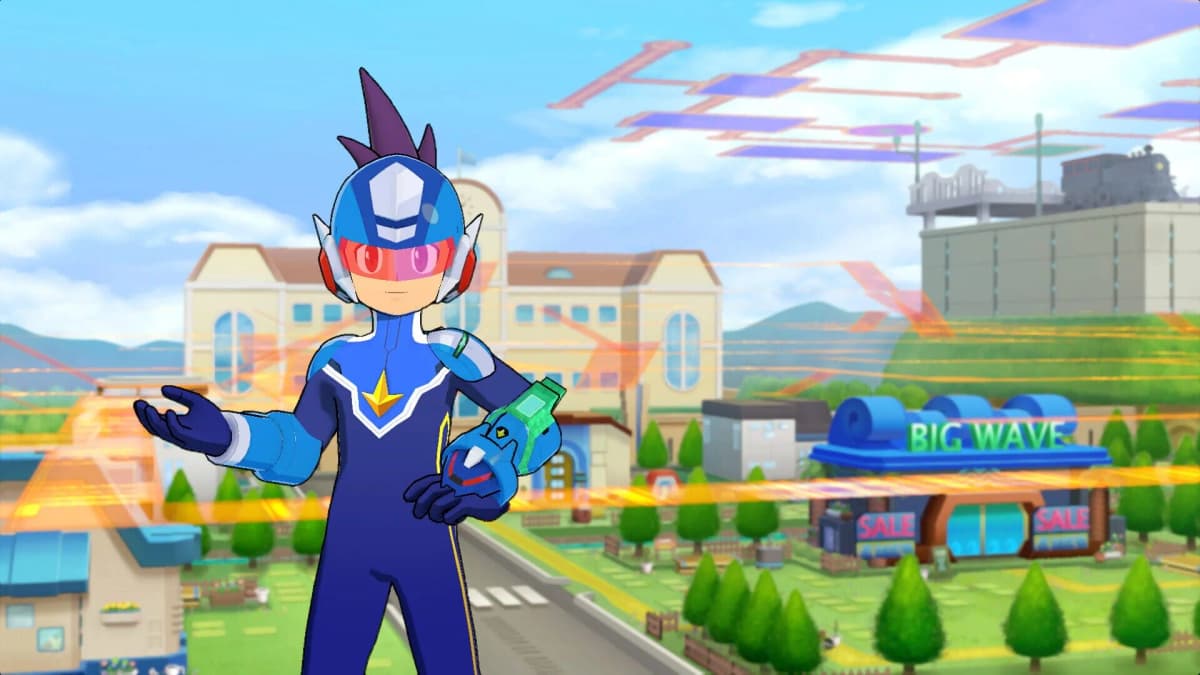
When you boot the collection, you land on a slick menu with a 3D model of Star Force Mega Man front and center. Each game sits in its own “slot” with clear labeling of the version (Leo, Pegasus, Dragon; Zerker x Ninja, Zerker x Saurian; Black Ace, Red Joker). Swapping between them is fast, and save management is handled per game just like the Battle Network collection – no fiddling, no weird virtual DS UI to fight against.
The big structural work is in how Capcom adapts DS-era stuff to a single Switch screen. You still see both “screens” at once, but laid out in a way that makes sense on a modern display, and you can tweak layouts in the options. The touch-based menus are mapped to buttons and stick control, which feels surprisingly natural after a few minutes. I didn’t miss the stylus once, which is probably the nicest thing I can say about a DS conversion.
The other major pillar is the new “cheats” and difficulty sliders. Capcom doesn’t call it a difficulty mode outright, but that’s effectively what it is. From a dedicated menu you can:
- Crank random encounter rates down (or up, if you’re a masochist)
- Adjust how much damage you take and deal
- Toggle things like auto-busting weaker fights
- Turn on some optional “helper” boosts if you just want the story
It’s granular enough that you can replicate the original DS intensity or smooth off specific pain points. For me, that mostly meant dialing the encounter rates down a notch in 1 and 2 and leaving 3 pretty close to vanilla. Nothing feels locked behind these options, but they make the older design decisions way easier to live with in 2026.
Living in Geo’s world: story, vibe, and pacing
Star Force is set a couple hundred years after Battle Network, in a future where the internet has shifted from PET-based networks to EM Waves. You play as Geo Stelar, a sullen elementary school kid still grieving his astronaut dad who vanished in a space incident. One night he bumps into Omega-Xis (Omega for short), a snarky alien made of EM waves, and the two literally fuse to become the new Mega Man.
If that sounds extremely shonen anime, that’s because it is. Across the three games you watch Geo go from antisocial shut-in to someone slowly dragged out of his shell by friends, enemies-turned-allies, and interstellar nonsense. Bud, Sonia, Luna, Solo – it’s a mix of endearing and melodramatic, but it works much more often than it doesn’t. The series leans hard into themes about connection, loneliness, and found family, and sometimes hits them with more honesty than I expected from a kid-focused RPG.
The basic loop is familiar if you played Battle Network: walk around town and dungeons as Geo, put on the Visualizer to see the invisible “wave road” that overlays the real world, then transform into Mega Man to dive into EM Wave spaces, clear viruses, and mop up boss schemes. That rhythm of flipping between everyday life and digital heroics is still compelling. By the time I was deep into Star Force 3, I was doing that one-more-errand thing, bouncing between sidequests and story beats until 2AM.
That said, the trilogy is uneven. Star Force 1 has a strong emotional hook but leans heavily on formula. Star Force 2 experiments structurally but fumbles its pacing and random encounter rates. Star Force 3 feels like the team finally locked in who Geo is, what this world should feel like, and how to balance the combat.
The combat: Battle Network DNA with a weird 3D twist
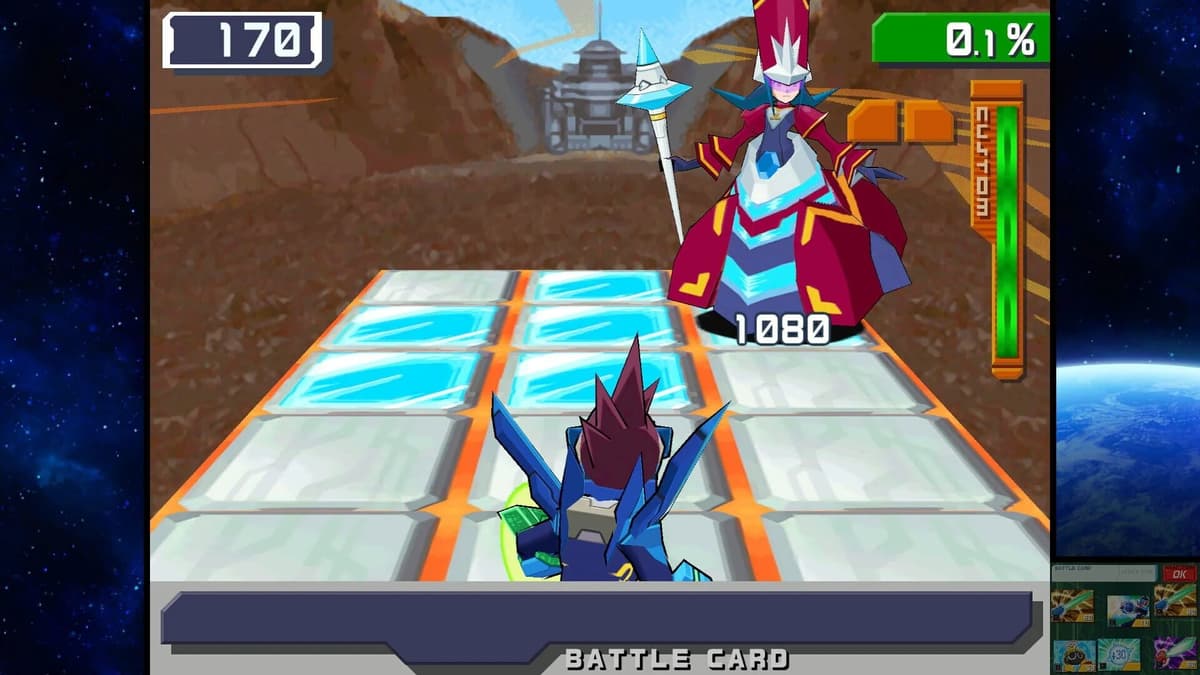
Here’s where things get divisive. Under the hood, Star Force inherits Battle Network’s “real-time tactics on a grid using cards” formula, but tilts the camera up behind Mega Man and shrinks your movement options.
Instead of a 3×3 grid for you and 3×3 for the enemy, Mega Man stands on a single three-column row at the front, and enemies occupy lanes on the 3×5 field in front of you. You can slide left and right between those three columns, fire your basic buster, and use your cards in real time while dodging patterns. The catch is you can only move on your row; no dancing forward and back like in Battle Network.
I’ll be blunt: I hated this at first. Coming from Battle Network, it felt like my feet were nailed to the floor. Attacks that would’ve been trivial to dodge in the GBA games suddenly tagged me in Star Force because I misjudged depth from the over-the-shoulder angle.
But about five hours into Star Force 1, something clicked. With less room to move, the game leans harder on pattern recognition and pre-planning your turns. Each “round” of combat still starts with a random draw of battle cards from your folder. You pick a handful based on compatibility rules – some can chain together, some require certain columns – and then real-time begins. The buster covers chip downtime, and a dedicated shield button lets you block a surprising number of attacks if your timing is good.
By the time I built my first real folder in Star Force 3 – a mess of paralyzing shots, column-wide slashes, and a couple of clutch heals – I started to appreciate the design. It’s less about dancing around the grid and more about sculpting the flow of each round: stun an enemy here, break a shield there, line everyone up, then detonate your big pattern-wide card for a high-rank finish.
Is it better than Battle Network? Not for me. The limited lateral movement never stops feeling slightly stiff, and the 3D presentation occasionally makes hitboxes harder to parse than they should be. But it grew into a combat system I genuinely enjoyed, especially once I took it online against another human who could punish lazy folder building.
Online battles: where the system finally shows its teeth
Capcom did the sensible thing and brought back online battles, including ranked and casual options, friend matches, and “rental” folders if you don’t want to theorycraft. Connecting was painless during launch week, and I never waited more than a minute or two for a match in Star Force 3. Star Force 1 and 2 were a bit quieter, but I still found games during evening hours.
This is also where I realized how much the AI in the campaigns pulls its punches. Fighting a real person who knows how to bait your shield, lane trap you, and chain stuns into high-damage combos makes the whole 3D grid concept suddenly feel more intentional. Positioning, card order, and risk management matter a lot more when you’re staring at the “defeat” screen because you got greedy with a charge shot instead of just shielding.
I won’t pretend Star Force’s online is going to become some big competitive scene, but as an extra mode in a collection, it’s surprisingly sticky. I kept hopping back into matches between story chapters just to test new folders, and it made grinding for cards feel more meaningful.
The elephant in the room: encounter rates and pacing
Let’s address the part that aged the worst: encounter rates. These games love to throw viruses at you. Sometimes every few steps. Sometimes when you’re one tile away from the NPC you need to talk to. On DS in 2007, that was tolerable. In 2026, with a backlog the size of Geo’s emotional trauma, it’s a tougher sell.
Star Force 1 is fine. It’s a little heavy-handed in a few dungeons, but the novelty of the system and the relatively short length keep it mostly pleasant. Star Force 2 is where it crosses the line. Several areas in that game feel like you’re wading through knee-deep viruses just to get from point A to point B, and it absolutely kills the pacing if you’re playing purely “authentic”.
Star Force 1 is fine. It’s a little heavy-handed in a few dungeons, but the novelty of the system and the relatively short length keep it mostly pleasant. Star Force 2 is where it crosses the line. Several areas in that game feel like you’re wading through knee-deep viruses just to get from point A to point B, and it absolutely kills the pacing if you’re playing purely “authentic”.
🎮 Get This Game at the Best Price
Compare prices instantly and save up to 80% on Steam keys with Kinguin — trusted by 15+ million gamers worldwide.
*Affiliate link — supports our independent coverage at no extra cost to you
This is exactly why the collection’s adjustable encounter toggle matters so much. The moment I hit the infamous mid-game dungeons in Star Force 2, I nudged encounters down one setting and instantly had a better time. Battles were still frequent enough to keep me engaged in folder tinkering, but not so suffocating that I dreaded every new map screen.
Star Force 3, meanwhile, feels like it was designed by a team that finally realized “hey, maybe people don’t want six fights per corridor”. It’s still an old-school RPG at heart, but the default encounter pacing feels much closer to reasonable, and I rarely felt the itch to change the slider.
How each game holds up in 2026
After living with all three, here’s how they struck me in the collection context:
Star Force 1: The awkward first step
The first Mega Man Star Force has two jobs: introduce a new combat system and make people care about Geo and his whole EM Wave reality. It mostly nails the second and only partially succeeds at the first.
I enjoyed Geo’s early arc a lot more than I expected. Watching this sullen kid slowly make human connections through his life as Mega Man, while still processing his dad’s disappearance, gives the game more emotional weight than the Saturday morning cartoon art style suggests. The supporting cast is sketchy at first but grows on you, and some late-game scenes hit authentically heartfelt notes.
The problem is that the dungeons and fight design feel cautious. Enemy patterns are simple, bosses are mostly pushovers if you build even a halfway decent folder, and some scenario structures lean hard on “go talk to this person three times while we throw viruses at you.” It never becomes bad, just safe and a little forgettable once the novelty wears off.
Star Force 2: Systems improve, pacing regresses
The second game feels like a design team trying to respond to feedback. Combat gets more interesting cards and forms, Geo’s relationships deepen in meaningful ways, and the overall structure is a bit more ambitious. The Moment of Truth scenes – where Geo has to emotionally connect with someone to resolve a situation – are sometimes cheesy but often charming.
But it’s also the worst-paced of the trilogy. The story meanders, hopping between plot threads that don’t always feel urgent, and the encounter rate goes from “slightly high” to “actively annoying” in a few late-game dungeons. Without the collection’s encounter slider, I probably would’ve stalled out here, just like I did back on DS.
In the Legacy Collection context, though, it becomes “the messy middle chapter you power through” because you know Star Force 3 is waiting – and because you can surgically remove the worst of its grind.
Star Force 3: The reason to buy this collection
Star Force 3 is the one that made me nod and go, “Okay, now I get what this series was aiming for.” Almost every piece of feedback I mentally had for the first two games feels addressed here. Battle flow is snappier, card design is more inventive, bosses hit that sweet spot between pattern memorization and on-the-fly improvisation, and the story feels like a real culmination instead of another episodic romp.
The narrative leans deeper into cosmic stakes without losing Geo’s personal journey, the supporting cast gets better resolution, and the post-game content actually tests your mastery of the combat system instead of just inflating health bars. It’s also the game that benefits the most from the collection’s online battles; people clearly gravitate to it for PvP, so the ecosystem of folders and strategies is more active.
If you told me you were considering this collection solely for Star Force 3, I’d say that’s a completely reasonable plan. The other two become extended prologues that make its payoff richer, but 3 is the one that stands tall next to the Battle Network trilogy’s best entries.
Presentation, performance, and extras
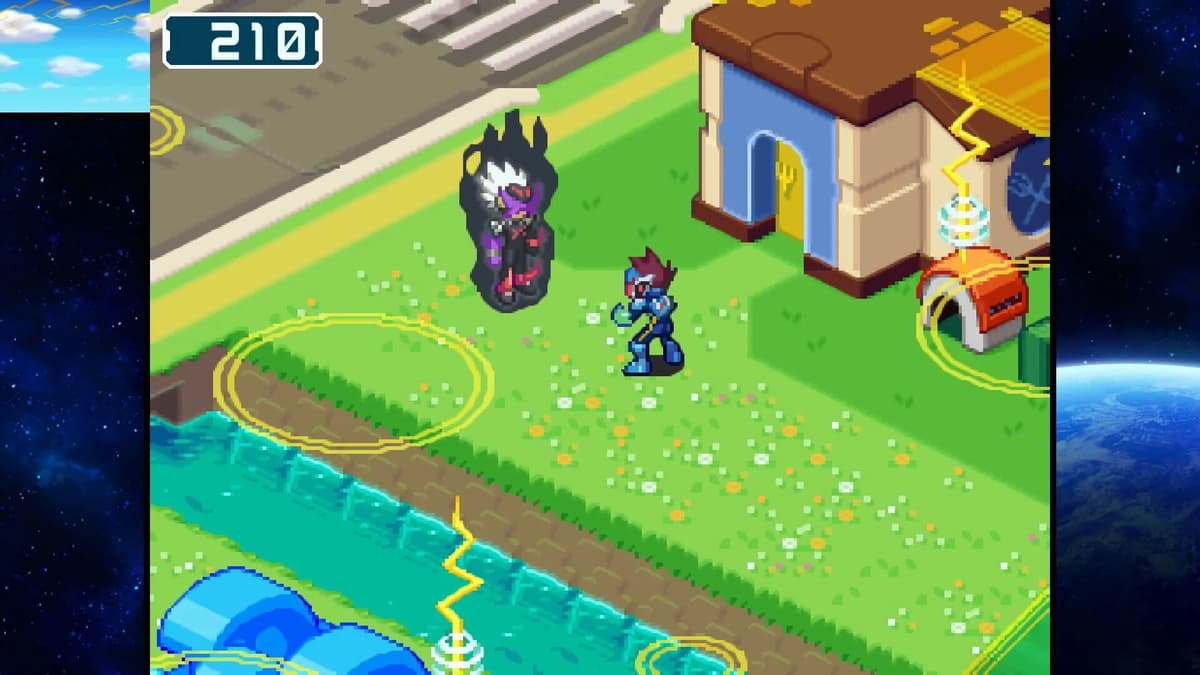
Visually, the collection threads a nice needle: it doesn’t try to “modernize” the look, just present the original assets cleanly. The isometric towns and dungeons still have that early-2000s vision of a “near-future internet,” with lots of bright colors and rounded tech. Character sprites are chunky but expressive, and the HD-cleaned portraits do a lot of heavy lifting for emotion during dialogues.
You can apply a smoothing filter if you want, but like with the Battle Network collection, I ended up turning it off. The lightly blurred pixels gave everything a slightly plastic look that didn’t feel right. Raw pixels fit these games better, and on a Switch OLED in handheld, they look comfortably crisp.
The 3D battle models upscale surprisingly well. You’re not suddenly looking at modern Mega Man quality, but they’re sharper and cleaner than I expected from DS assets, and the UI has been reworked enough that it doesn’t feel cramped or stretched. Performance was rock solid in both docked and handheld; I didn’t hit a single hitch or crash across all three games.
The Gallery mode is more than just a checkbox. There’s a generous spread of concept art, character sheets, box art from the different regional releases, and old promotional illustrations. For a series that quietly died after three entries, it’s oddly touching to see Capcom treat its history with respect instead of burying it.
Who this collection is actually for
This isn’t a one-size-fits-all recommendation, even if I came away pretty positive overall.
If you loved the Mega Man Battle Network Legacy Collection and you’re hungry for more grid-based, card-driven action RPGs, this is an easy pickup. Expect a slightly clunkier combat system, but also a surprisingly earnest story and some great late-series payoffs.
If you’re Mega Man-curious but bounced off Battle Network’s busier grid, Star Force might actually be easier to learn. The movement is simpler, the over-the-shoulder angle is closer to a traditional action RPG, and the optional difficulty tweaks mean you can turn it into a mostly-chill story RPG if you want.
If you have no nostalgia for DS-era design or patience for random encounters at all, even reduced ones, you might still find this too old-school. The encounter slider helps, but it doesn’t magically turn these into short, modern-paced action RPGs. You’re signing up for dozens of hours and some repetitive dungeon layouts.
FinalBoss // Gear
Level up your setup
01Top-rated gaming headsetson Amazon→02High-refresh gaming monitorson Amazon→03Gaming chairson Amazon→04Discounted game keyson Kinguin→Affiliate links · As an Amazon Associate, FinalBoss earns from qualifying purchases.
Want to Level Up Your Gaming?
Get access to exclusive strategies, hidden tips, and pro-level insights that we don't share publicly.
Ultimate Reviews Strategy Guide + Weekly Pro Tips