
Table of Contents (7)
A cheesy DS relic that secretly had great ideas
Within 20 minutes of starting Mega Man Star Force Legacy Collection, I hit a line of dialogue about “the power of bonds” so corny I actually paused the game and stared at the screen. This was the stuff that wrecked me emotionally in middle school? Really?
But then something familiar happened. I started messing with my Folder, pulled a clutch counter into a Big Bang finisher on Taurus Fire, and that old battle jingle burrowed back into my brain. The writing might be stuck in early-2000s anime hell, but under all the friendship speeches and gelled hair is a card-battle system that still feels weirdly fresh in 2026. And this Legacy Collection is the best version of it by a mile.
I played the collection on Switch with about 40+ hours spread across all three games, finishing the main stories and dipping into post-game and online fights. What struck me is how much thoughtful sanding-down went into this package. It doesn’t rewrite Mega Man Star Force’s DS-era weirdness, but it absolutely makes the trilogy easier to appreciate now than it ever was back then.
Friendship, cringe, and a surprisingly cohesive trilogy
On paper, the overarching setup is still solid: Geo Stelar, a kid who shuts himself off from the world after his dad disappears in space, fuses with an alien called Omega-Xis (Mega) to become Mega Man and fight off other alien invaders. The first game uses that simple premise to walk Geo from “I’d rather stare at the sky alone” to building real relationships, and it still works.
What hasn’t aged as gracefully is the dialogue. Villains literally yell things like “who needs friends when you have power?” and the script repeats its “bonds” theme like it’s afraid you might forget it between cutscenes. Playing this as a thirty-something instead of a kid, I winced more than once.
But when I zoomed out and treated the three games as a single arc, I ended up liking it more than I expected:
- Star Force 1 is the heart. It’s very “monster of the week,” but that structure lets classmates like Luna and Sonia work through family pressure, fame burnout, and garden-variety school drama while Geo slowly learns he isn’t actually alone.
- Star Force 2 is the awkward middle child. The ancient-civilization plot and new rival Solo have potential, but most of the bosses are tied to throwaway side characters, so the emotional punch just isn’t there.
- Star Force 3 is the payoff. The meteor threat is corny, but the themes of purpose and shared goals land better, and the villains – especially Tia and Jack – get actual arcs instead of just one-note evil speeches.
What really helps the trilogy stand apart from Battle Network is its aesthetic: bosses based on constellations like Cancer, Taurus, Gemini, and the whole “wave world” vibe give Star Force its own flavor. Even after replaying the X and Battle Network collections, I didn’t feel like I was just going through another retread – this is still its own weird little branch of Mega Man history.
The Legacy Collection doesn’t rewrite any of this narrative, and I’m glad it doesn’t. Instead, it adds context around the edges: redrawn card art that makes you actually notice some of the designs, and a surprisingly robust gallery of concept art and scrapped ideas that reminded me how ambitious Capcom was with this spin-off. It’s nostalgia, but framed thoughtfully rather than just dumped in your lap.
Card-battle chaos on a three-lane highway
If you bounced off the Mega Man Battle Network collection because the grid-based combat felt clunky, Star Force’s spin on the formula might land better. The basics are the same – real-time dodging and shooting while you queue up cards when your Custom Gauge fills – but shrinking Mega Man’s movement to just three lanes, viewed from behind, changes the feel more than you’d think.
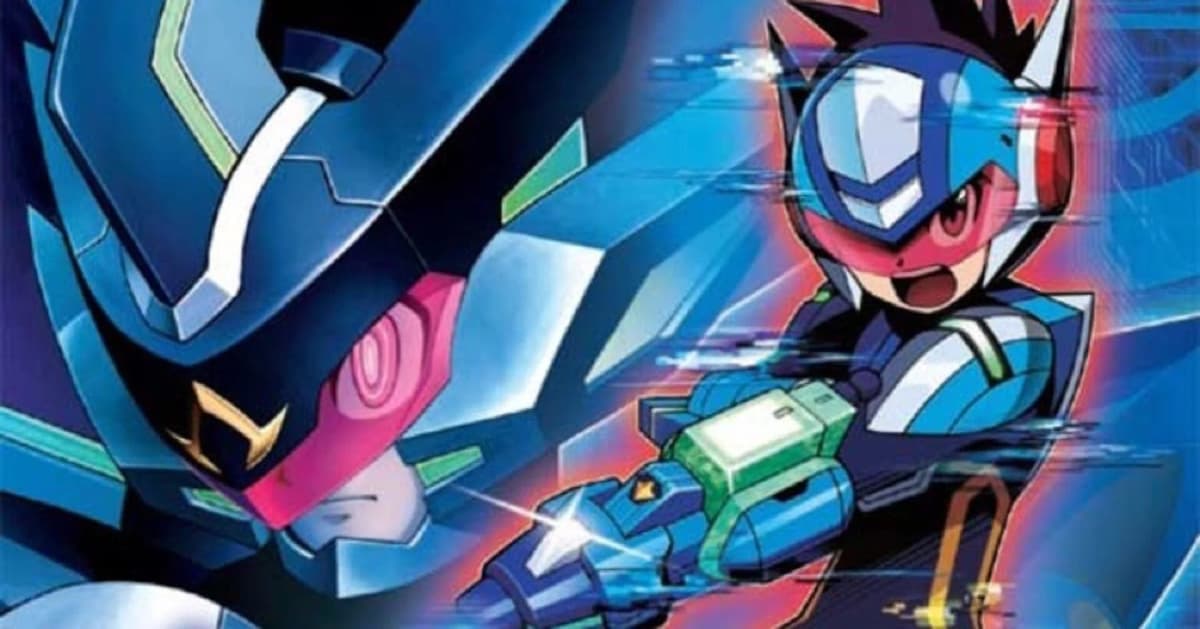
Every battle starts with that familiar pause: your Custom Gauge fills, the game freezes, and you get a hand of Battle Cards. You can only select cards that are identical or line up in the same column. That restriction seems harsh at first, but after a few hours I was building my Folder around it, slotting in similar cards specifically to chain big combos on the turns where the stars aligned.
The Folder rules are simple on paper – 30 cards, a limited number of powerful Mega-class and Giga-class options – but in practice, tinkering is dangerously addictive. I lost a solid hour in Star Force 3 just refining a paralysis-focused build around electric cards and counters, trying to squeeze in one more support card without messing up my column coverage.
Two things still make this combat system sing today:
- Counter timing. Tagging an enemy right as they attack gives you a counter, extra cards, and in transformed states a chance at a Big Bang super move. Landing these consistently is a little like hitting perfect parries in an action game – your heart rate jumps a bit every time.
- Transformation depth. Each game layers more complexity onto how Mega Man changes forms in battle, which keeps combat from going stale across three full RPGs.
Star Force 3 goes hardest here with its Noise system. Filling up your Noise percentage by overkilling enemies unlocks mutations into different forms based on previous bosses, each with unique perks. Hit 100%, you start getting illegal, souped-up cards as rewards. Push it to 200%, and suddenly you’re in Finalized Noise form – Red Joker or Black Ace depending on your version – with three turns of pure, ridiculous power.
The first time I pulled off a 200% Noise Finalization in a boss fight, I actually laughed. The gauge had been creeping just under the line for most of the game, and then one perfect card chain blew it past the threshold. Three turns later, the boss went from full health to “did that just happen?” That kind of payoff is exactly what long-form RPG card systems need, and very few games still do it this well.
The first time I pulled off a 200% Noise Finalization in a boss fight, I actually laughed. The gauge had been creeping just under the line for most of the game, and then one perfect card chain blew it past the threshold. Three turns later, the boss went from full health to “did that just happen?” That kind of payoff is exactly what long-form RPG card systems need, and very few games still do it this well.
🎮 Get This Game at the Best Price
Compare prices instantly and save up to 80% on Steam keys with Kinguin — trusted by 15+ million gamers worldwide.
*Affiliate link — supports our independent coverage at no extra cost to you
The Legacy Collection doesn’t change the fundamentals of these systems, but the new quality-of-life options make experimenting far less painful. You can toggle reduced incoming damage, crank up Mega’s Buster strength, and generally smooth out the grindier stretches without trivializing everything. For the post-game superbosses, I switched those assists off and went back into full “DS-era cruelty” mode, but during the second game’s weaker filler arcs, I had no problem toning things down just to keep the story moving.
Version gimmicks and the joy of Noise tinkering
Like Pokémon, each Star Force entry comes in multiple flavors. On DS, that meant triple-dipping if you wanted to see every exclusive boss and transformation. The Legacy Collection wisely makes that less obnoxious.
In Star Force 1, the Pegasus / Leo / Dragon split is mostly cosmetic: different elemental focus, a unique Big Bang, and a version-specific boss. Fun, but not essential. The far more interesting stuff kicks in with the sequels:
- Star Force 2 introduces Zerker, Ninja, and Saurian forms for Mega Man, and lets you fuse them. Pulling off the triple fusion into Tribe King – with its absurd three-turn limit and screen-wiping Big Bang – is still one of the best “I broke the game, didn’t I?” moments in the trilogy.
- Star Force 3’s Noise forms feel like a love letter to Battle Network 2 and 3’s Style system, but with way more granularity. Ten base forms, the ability to combine them, and a Noise percentage that constantly tempts you to play aggressively so you don’t lose progress – it’s a great loop.
The Legacy Collection keeps the multiplayer hook that lets you “borrow” friends’ versions for extra transformations. I jumped online with a friend running the opposite version, and within a few minutes we’d unlocked each other’s forms for use in single-player. It’s a small thing, but it turns what used to be a wallet-draining gimmick into a social bonus.
The downside is that there’s no crossplay. If your friends are on another platform, those links and battles are walled off. For a trilogy that won’t shut up about human connections, it’s a pretty ironic limitation.
What the Legacy Collection actually fixes
Mechanically, this isn’t some radical remake – it’s very much the DS games, just running at higher resolution with some modern conveniences wrapped around them. But the specific choices Capcom made here matter.
- Dual-screen adaptation. DS UI elements – things like Email, Brother Bands, and some maps – now live in a smaller side screen, and you can swap which screen is “primary” with a quick button press. I was worried this would feel cramped, but after about an hour, it just felt natural.
- Difficulty smoothing. Optional toggles to reduce damage and beef up Mega’s Buster let you trim back random-encounter grind without gutting boss fights. I used them like a dimmer switch rather than a full-on easy mode.
- Restored and rearranged content. Event-style extras and cards that were awkward or region-limited on DS are simply there now. The rearranged soundtrack is hit or miss – sometimes it adds welcome punch, other times I instantly swapped back to the original – but the choice is appreciated.
- Online play and card trading. I never had the chance to properly use these systems on DS; now I can queue up a couple of matches on my lunch break. Latency was occasionally noticeable during busier animations, but never enough to wreck a battle.
- Presentation polish. Redrawn card art and crisp battle effects do more heavy lifting than you’d expect. These games were always stylish, but the sharper lines make a lot of designs pop in a way the DS screens couldn’t.
Compared to the Battle Network Legacy Collection, it feels like Capcom actually listened this time. Little annoyances like stiff filter options or missing extras have been cleaned up, and the overall package feels more cohesive. It still doesn’t go as far as, say, rebalancing the weakest story chapters in Star Force 2, but nothing in here feels lazy.
Who this is really for
If your only exposure to Mega Man is running-and-gunning through the classic games, this trilogy is a weird detour. It’s half Saturday-morning anime, half experimental card-battle RPG, and it absolutely expects you to care about kids talking through their feelings between dungeon crawls.
But if any of this sounds like your thing, or you bounced off Battle Network but liked the idea of a deck-driven Mega Man, Star Force Legacy Collection is easy to recommend:
- People who grew up with the DS originals get the definitive way to replay them without wrestling with old hardware.
- Card-game fans get a fast-paced, timing-heavy system that feels distinct from slower modern hits like Slay the Spire.
- JRPG enjoyers who can tolerate some dated writing get a surprisingly warm, earnest trilogy with a clear emotional throughline.
The only group I’d really warn off are folks who absolutely cannot stand cheesy dialogue or episodic “school problem of the week” structures. No amount of quality-of-life work can change the fact that these are very, very 2000s in how they tell their stories.
FinalBoss // Gear
Level up your setup
01Top-rated gaming headsetson Amazon→02High-refresh gaming monitorson Amazon→03Gaming chairson Amazon→04Discounted game keyson Kinguin→Affiliate links · As an Amazon Associate, FinalBoss earns from qualifying purchases.
Want to Level Up Your Gaming?
Get access to exclusive strategies, hidden tips, and pro-level insights that we don't share publicly.
Ultimate Reviews Strategy Guide + Weekly Pro Tips