
Table of Contents (10)
A DS-era “kid’s Mega Man” that refuses to stay in the past
Mega Man Star Force always lived in this weird blind spot for me. I adored Battle Network on GBA, but by the time Star Force hit DS in 2006, I’d dismissed it as the “even more kiddie” spin-off with chunky 3D models and Saturday-morning-anime vibes. I actually popped the first game into a DS years ago, got bogged down by slow pacing and nonstop chatter, and shelved it for good.
Fast-forward to now: Mega Man Star Force Legacy Collection, freshly out on Switch (and also available on PlayStation, Xbox, and PC), bundles every DS release—three versions of Star Force 1, two of 2, and two of 3—into one package that finally respects your time. As someone who circled around the trilogy without ever jumping in fully, I split my playthrough across all seven games, clocking most hours in Star Force 1 and 3, and sampling 2 enough to see how it bridges the gaps. The verdict? This might be Capcom’s best “museum” release yet.
I tested the collection handheld on Switch, toggling encounter rates, speed-ups, dual-screen layouts, and other QoL tweaks Capcom tucked in. The core experience remains intact, warts and all, but the friction is gone: no lag, no emulator quirks, just seamless jabs of nostalgia mixed with surprisingly modern gameplay.
A modern surprise: why Star Force feels fresh
The moment Star Force finally clicked for me was a random fight in Amaken. I’d been autopiloting with my buster and let my guard down, only to get creamed by fast enemies flanking me. That mix of irritation and curiosity—“Wait, I got outplayed by a DS kids’ game?”—was exactly the spark I needed. Beneath the corny FM-ian cameos and fishing-for-friendship speeches lies a legitimately sharp action-RPG system that feels more modern than most indie twin-stick shooters.
Star Force sheds Battle Network’s two-screen grid for a single three-panel line, but the real shift is timing: dodge, line up, fire, then drop a Battle Card when the moment’s right. That loop hooks you in ways even the GBA network series couldn’t match, and once you get the rhythm—sliding between panels, reading enemy tells, chaining counters—it’s hard not to stick around for just one more battle.
Card-based combat: Battle Network’s sideways evolution
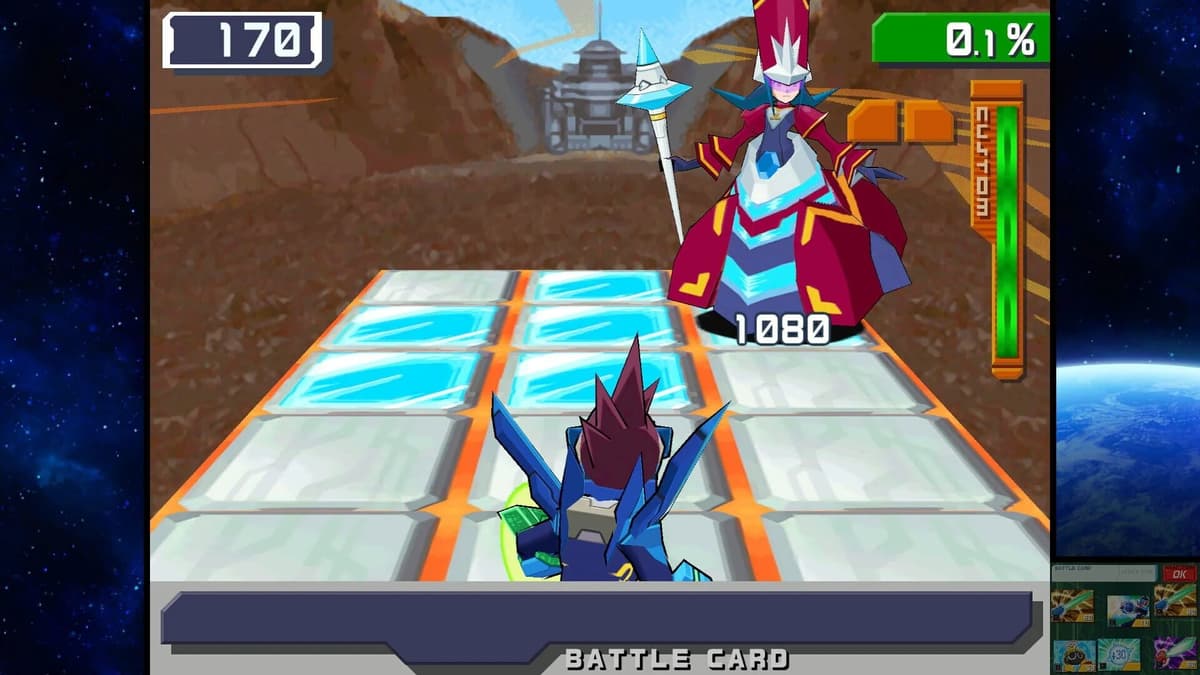
On paper, Star Force’s battles look like stripped-down Battle Network. Battle Network fans know about the 3×3 grids; here you’re locked to a single row facing a 3×5 enemy array. The trade-off? A more shooter-like feel. You control Geo’s movement in real time, firing his Mega Buster while nailing custom-gauge builds to unleash cards.
The card system adds surprising depth. Instead of matching letters freely, your options are shaped by a matrix that reminds me of a little puzzle within each fight. Early on, it feels restrictive—you’re tempted to hoard high-power chips—but lean into synergies and you start cooking up homing shots to corral skittery foes, then follow up with beam attacks when they’re boxed in. Nail a counter with your strongest card and you get that dopamine hit Battle Network veterans know well.
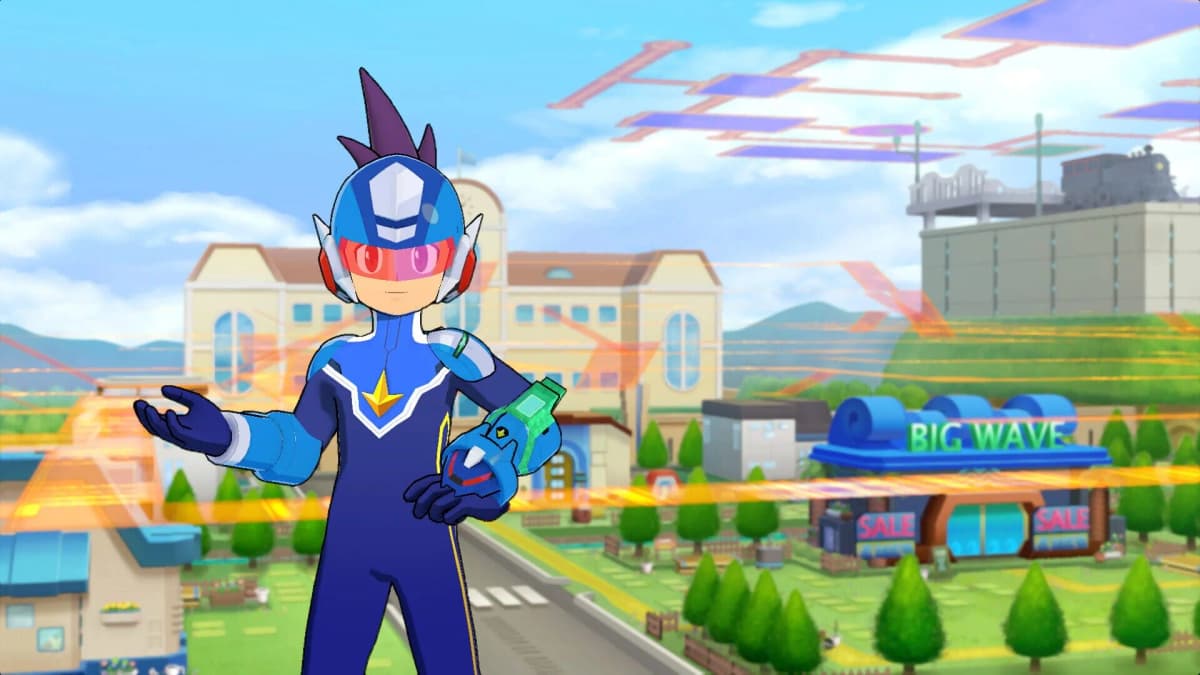
Progressing through the trilogy, you see Capcom loosening the reins. Star Force 1’s deck-building is rigid and its transformation system clunky. By Star Force 2, there’s more variety (and a few balance hiccups). When you hit Star Force 3, the rules feel fully baked: flexible builds, meaningful rewards for aggressive play, and encounter variety that actually keeps you on your toes. The Legacy Collection preserves all of it and layers on quality-of-life fixes—zero input lag, crisp framerate, seamless audio—that make every card play feel intentional.
Snappy or sluggish? Pacing and QoL tweaks
I’ll be honest: if you’ve tasted modern RPGs with nip-and-tuck pacing, the Star Force trilogy can feel glacial at first. These titles were built for 20-minute DS bursts—lots of bite-sized story beats, frequent interruptions, and walls of early-2000s anime cheese dialogue. Geo’s arc—from sulky shut-in to functional hero—is actually quite sweet, but you’ll spend more time listening to FM-ians and NPC gossip than you will battling.
This is where the collection’s QoL arsenal really shines. Speed up Geo’s walking speed—what seems like a tiny tweak cuts ten-minute map treks into three-minute jaunts. Dial down or eliminate random encounters when you just want to breeze through dungeons. I re-learned the basics of Star Force 1 at normal rates, then throttled them back in 2 just to see the story and mechanics on display. By game three, I’d found my sweet spot: slightly reduced encounters, boosted movement, and a sense that every fight mattered, not just padded my playtime.
Capcom stopped short of rewriting the scripts, so there’s still tons of talking, NPC rambling, and vague objectives lodged under exit-screen terabytes of text. But the speed and encounter sliders, plus auto-save, let you cruise straight to what you actually came for: running, gunning, and deck-tweaking.
Dual screens done right on a single display
One of the biggest headaches in a DS port is juggling two screens on one. The Legacy Collection nails it. On Switch handheld, I stuck with a vertical stack—overworld and battles above, menus and status below—just like the DS but crystal-clear. Docked, side-by-side feels like two mini-CRTs chilling on your TV. You can scale, shift, or shrink whichever screen you like, and there are smoothing filters if you want to blur the jaggies. I left them off—these sprites are charmingly chunky—but it’s nice to have options.
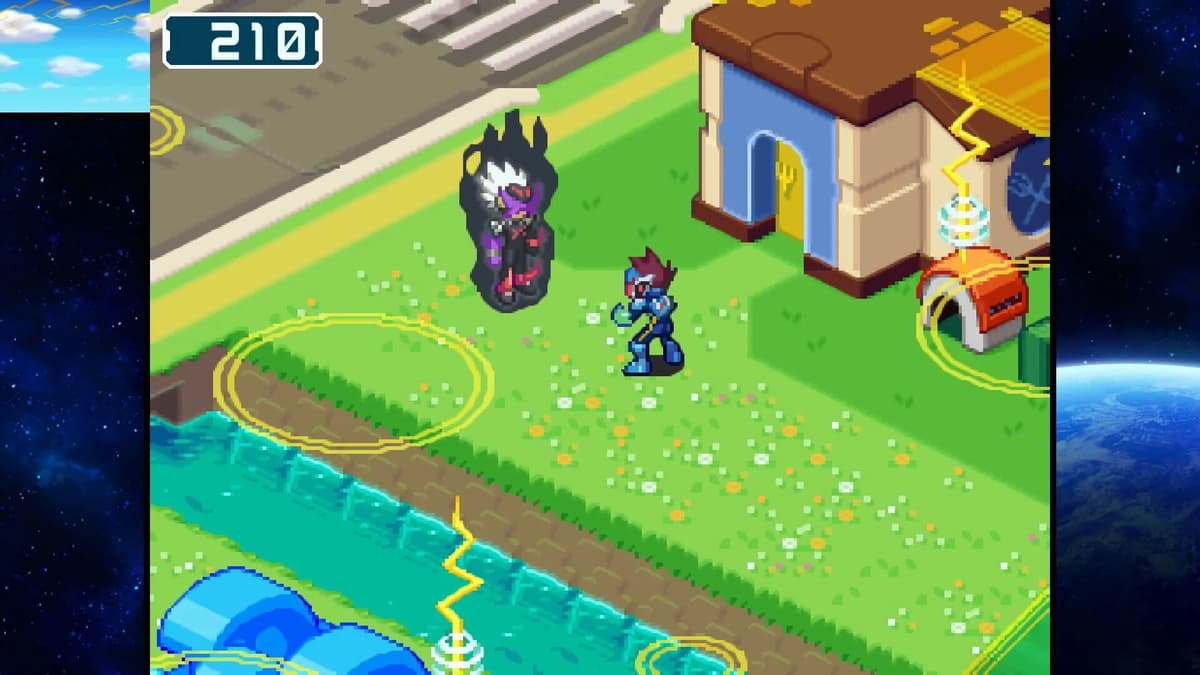
Performance is rock-solid: no hit-and-miss frame drops in frantic battles, no audio glitches mid-swap, no phantom touchscreen tricks. The UI feels native, too—cleaned up just enough so you believe you’re playing a current-gen launch instead of a DS emulator hack.
Museum mode: extras, art gallery, and more
Capcom’s recent legacy releases have set a high bar, and Star Force steps right over it. Every version split is here, link-exclusive cards intact, all accessible from a slick hub menu that encourages hopping between titles. Auto-save, encounter toggles, power-up sliders, difficulty options—these make the trilogy approachable for anyone who just wants to enjoy the story (or blast through every boss).
The real treasure is the extras suite. You get a massive art gallery full of concept sketches, unused designs, and promo art that never left Japan. I lost half an hour geek-spazzing over early Geo renders and Omega-Xis color tests. The complete soundtrack for each game lives in a simple player—perfect for letting crunchy DS-era guitar loops swirl while you grind NPC side quests. And yes, there’s online support for trading cards and PvP if you feel like reminding a friend that you still know how to combo counters.
Limitations: DS-era design quirks that remain
No matter how much modern polish you slather on, some DS bones are still rattling in the closet. These games talk. A lot. Geo’s internal monologues, Omega-Xis’ hot takes, citizens gabbing through Transer devices—it’s nostalgia-dripping, but you’ll smash the confirm button just to get back to the action. Dungeons are still a mixed bag: your mileage may vary between “I love this simple switch puzzle” and “Why am I bumping into invisible walls?”
Side quests remain hidden behind NPC chatter with zero quest log. If you’re the type to natter with every sprite in town, you’ll unearth loose tasks just fine. If you want breadcrumb guidance, expect some blind backtracking. And the tone? Pure kids’ anime sci-fi about saving the world via radio waves and friendship speeches. I warmed to it by the third game, but if you bounce off that energy early, no QoL tweak will save you.
Who it’s for (and who should skip)
If Battle Network is your jam and you’re curious about its DS spin-off, this collection feels tailor-made. Star Force isn’t BN7 on a fancy grid—it’s a parallel evolution with timing-based dodging, a tighter card matrix, and a heavier focus on character drama. The depth’s there if you want it; the power-ups and difficulty sliders are there if you don’t.
Newcomers get the best possible introduction to Geo Stelar and Omega-Xis. The accessibility toggles let you treat these as light, story-first RPGs. When you’re ready, peel back the training wheels for more meat. Ditto for returning fans who never had a smooth way to experience all seven DS releases without emulation headaches.
On the flip side, if low-octane pacing, rapid-fire dialogue, or earnest anime melodrama aren’t your thing, the Legacy Collection can’t rewrite fifteen-year-old scripts. You’ll still be playing 2006 DS code—you’ll just be doing it faster and on a sharper screen.
Conclusion
Mega Man Star Force Legacy Collection nails what a modern remaster should: full fidelity to the originals, rock-steady performance, and a suite of QoL options that let you tailor the experience. The active, card-centric combat still punches above its weight, especially in Star Force 3, while the extras gallery and soundtrack player spoil longtime fans. Yes, it’s chatty, and the DS design quirks linger, but this is the definitive way to meet Geo and Omega-Xis in 2026.
Whether you’re a BN veteran or a curious newcomer, this collection proves that sometimes a “kid’s” spin-off has teeth after all.
TL;DR
- The good: Engaging timing-based card combat; Star Force 3 shines brightest.
- Collection quality: Seamless performance, flexible dual-screen layouts, autosaves, encounter and speed controls, and a robust gallery/soundtrack hub.
- Accessibility: Power boosts and difficulty toggles let you tailor the trilogy from chill story-run to min-max deep dive.
- The dated bits: Slow, talk-heavy pacing; some vague objectives; relic-sidequest design.
- Buy if: You love Battle Network-style action-RPGs and don’t mind anime flair.
- Skip if: You have zero patience for DS-era storytelling or heavy dialogue.
FinalBoss // Gear
Level up your setup
01Top-rated gaming headsetson Amazon→02High-refresh gaming monitorson Amazon→03Gaming chairson Amazon→04Discounted game keyson Kinguin→Affiliate links · As an Amazon Associate, FinalBoss earns from qualifying purchases.
Want to Level Up Your Gaming?
Get access to exclusive strategies, hidden tips, and pro-level insights that we don't share publicly.
Ultimate Reviews Strategy Guide + Weekly Pro Tips