
Table of Contents (11)
Mewgenics Review – When Cat Breeding Becomes a Tactical Obsession
Around the 30-hour mark of Mewgenics, I was deep in a fleshy nightmare of a cave, dragging my exhausted squad of cats toward what I thought was the end of a brutal quest chain. We’d just felled Guillotina – a gigantic zombie house-boss that kept invading my home – for the third time. The price of chasing that victory? Every attempt made future runs harder, and now the cat carrying the key quest item had to be sacrificed on an altar made of veins and meat.
That cat had carried half my campaign. Watching them dissolve into the altar, only for the rest of the team to be shredded in the gauntlet afterward, was the kind of defeat that makes your stomach drop. I stared at the “Game Over” screen, completely deflated… and then remembered I still had a dozen other cats back home: a lightning specialist, a lifesteal brawler, a chaos mage with a Hadouken-style fireball, and a few absolute monsters with bizarre mutations.
So, naturally, I queued up “one more run.”
Mewgenics, from Edmund McMillen and Tyler Glaiel (of The Binding of Isaac and The End Is Nigh fame), is one of the strangest, deepest roguelites I’ve played in years. It mashes up a cat-breeding management sim with isometric, turn-based tactical combat and a heavy dose of chaotic RNG. It’s overwhelming, cruel, often hilarious, and occasionally touching. And if you like systems you can lose yourself in, it’s dangerously easy to sink tens of hours into it.
Key Takeaways
- A hybrid of cat-breeding management sim and turn-based tactical roguelite, with runs built around squads of up to four cats.
- Deep genetic inheritance, class systems, mutations, and disorders combine into wild, emergent builds and synergies.
- RNG is both exhilarating and brutal: chain reactions, status effects, and environment can nuke a two-hour run in seconds.
- Onboarding and UI are weak early on; crucial breeding info is hidden, and managing 30+ cats becomes chaotic to track.
- Macabre humor, grotesque-cute art, and irreverent treatment of conditions may not sit well with everyone.
- For min-maxers and roguelite sickos, it’s near-essential; for players who hate randomness and long runs, it’ll be misery.
- My verdict after ~30+ hours: 9/10 – a near-purrfect design if you’re willing to embrace its cruelty and complexity.
What Exactly Is Mewgenics?
At its core, Mewgenics is about two things: raising cats at home, and then sending them out to die heroically in endlessly hostile worlds.
Each “day,” you assemble a squad of up to four cats from your growing clowder and send them through a sequence of isometric, tile-based encounters. These zones are peppered with combat, random events, shops, and bosses. You’re positioning units, managing cooldowns, juggling status effects, and praying the next room doesn’t have something that hard-counters your build.
When the day ends, any cat that survives that run is officially retired. They can’t be taken on regular adventures anymore. That sounds harsh, but it’s the backbone of the game’s long-term meta: retired cats (and sometimes those less fortunate) become the genetic foundation for your next generation of fighters.
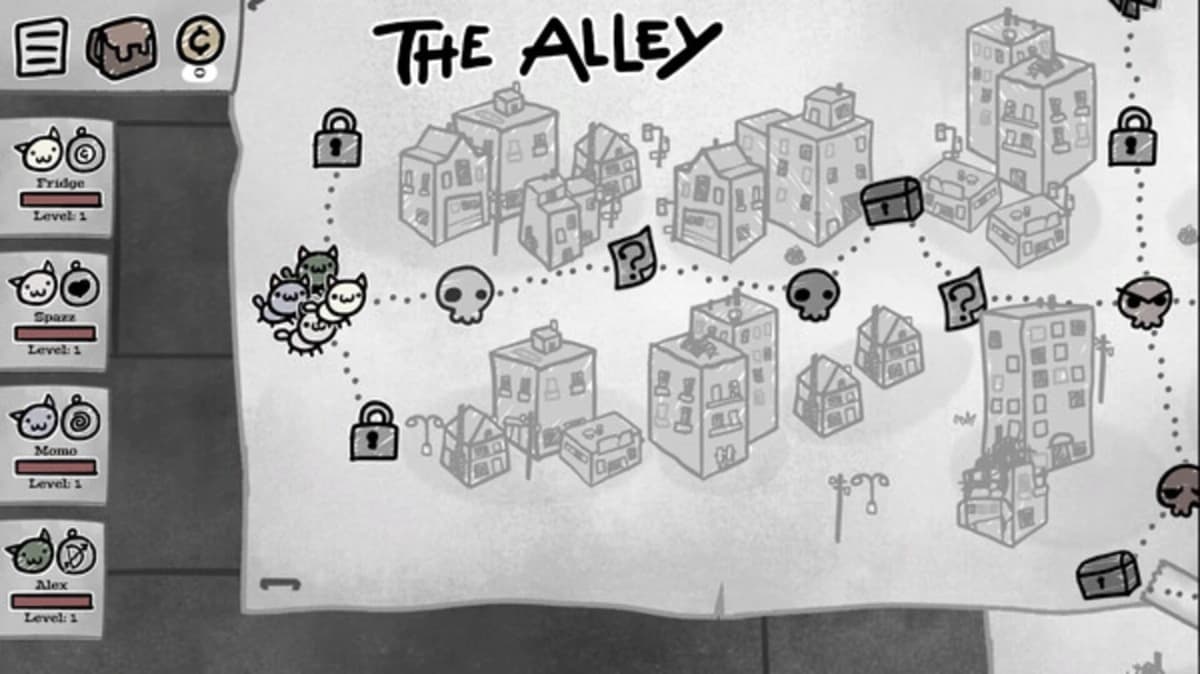
Runs are structured into three big acts, with sub-branches, secret areas, and extra zones unlocked via special quests like the recurring “house boss” invasions. A single successful clear of an act took me around two to three hours on average. Several failed attempts lasted just as long, only to end in some catastrophic chain reaction near the finish line.
This is not a “quick 20-minute run before bed” kind of roguelite. It’s closer to committing to a small campaign every time you leave the house.
Living With a House Full of Murder Cats
Before you’re theorycrafting endgame builds, you’re just trying to keep your house in order. Your home starts as a single cluttered room where your cats sleep, eat, fight, flirt, and occasionally maul each other. You “donate” cats to various NPCs via a sewer pipe (accompanied by a satisfyingly wet “ka-flump”), and those donations fund permanent upgrades: new rooms, furniture, and fixtures that provide buffs and new mechanics.
This home-building aspect is persistent across runs. No matter how many squads you send to their doom, your house keeps getting more functional and more unhinged. Comfort, health, relationships, and even sexual orientation all factor into who will mate with whom and how happy they’ll be about it. A bonded couple might be living their best life, only for a rival to show up and start a fight that leaves one of them dead. Sometimes two cats try to hook up and it just… does not go well, in very funny and slightly sad ways.
As someone who “lives with” nine real cats, this part hit closer to home than I expected. The chaos, the weird grudges, the zoomies – Mewgenics nails that barely-contained domestic anarchy. But while the vibe is spot-on, the actual systems are confusing at first.
For the first several hours, the game tells you very little about what your cats actually like, whom they’re attracted to, or whether they’re inbred. You eventually unlock an NPC who analyzes litters of kittens and gradually reveals their preferences, sexual orientation, genetic quirks, and even lets you tag them with icons. Until then, I genuinely thought I was doing something wrong. Cats were fighting for no apparent reason, mating attempts kept failing, and I had no idea why some pairings were impossible.
Given that breeding is absolutely central to progression, being forced to stumble around with almost no information for those early hours was exasperating. The UI also starts to buckle once you have 30-plus cats sprinting in circles, meowing nonstop. Keeping track of who is who, what their traits are, and where they came from becomes a juggling act the game doesn’t help you manage as well as it should.
Breeding, Classes, and Mutations: The Real Meta Game
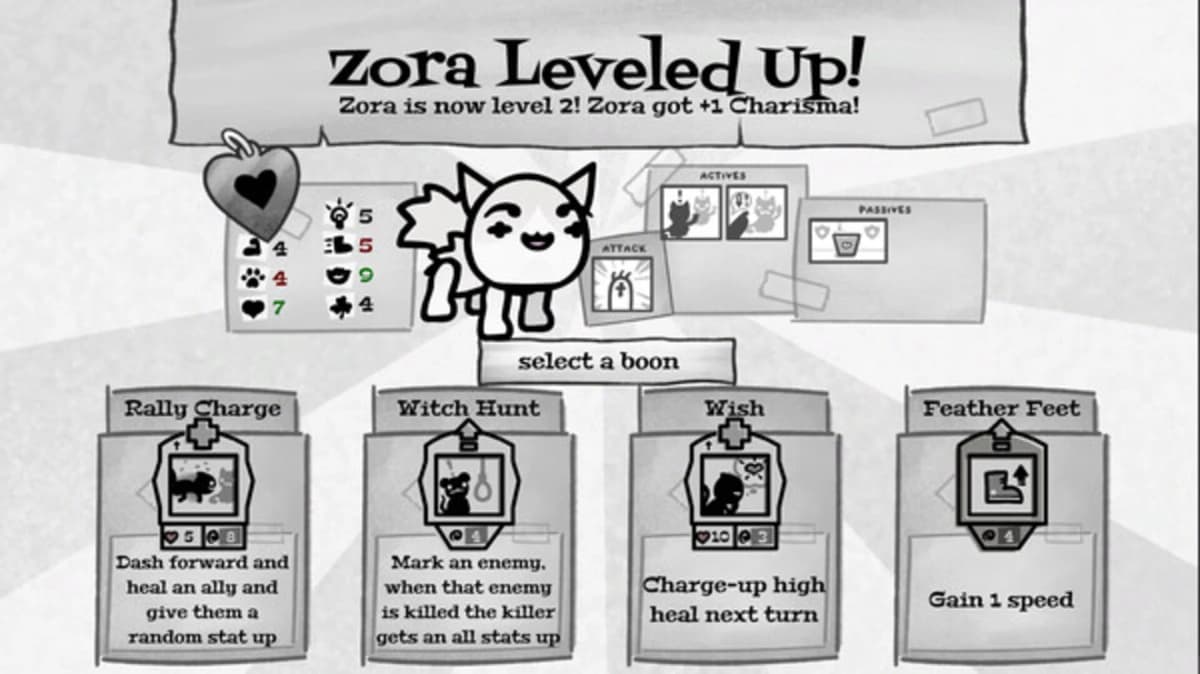
The real hook of Mewgenics lives in its overlapping systems: classes, gear, traits, genetics, and mutations. Collars determine a cat’s class, unlocking unique skills and archetypes. You get the usual suspects – a tanky frontliner, a ranged hunter, a mage – but later acts add much stranger options.
The Butcher, for instance, feels like a love letter to Diablo’s iconic boss: they drag enemies toward them with a meathook and thrive on carnage. The Jester is a chaos build in class form, randomly rolling abilities from other archetypes and turning into a multiclass wild card. Necromancers, status specialists, and various oddball variants all layer on top of that.
On their own, each class already fills a distinct role. But the breeding system takes that tactical layer and stretches it across generations. Cats can pass their stats, skills, and sometimes mutations to their offspring, meaning you can breed kittens who are born with high-value abilities or grotesque advantages right out of the gate.
Mutations and disorders add another axis. You’ll see cats with massive heads, extra heads, razor claws, rat tails, porcupine quills, and thicker fur. Sometimes these are straight boons, sometimes double-edged. A cat might become a monster in combat but inherit a debilitating trait that changes how you play around them.
By hour 10, I’d stopped just “picking my favorites” and had started tracing family trees like a deranged feline genealogist. By hour 15, I had a spreadsheet tracking which pairings produced the best offspring and which traits I wanted to lock in. By hour 20, I wasn’t just building squads – I was sculpting bloodlines, selectively breeding for high stats, rare skills, and juicy mutations, then using those to unlock even more home upgrades.
Some of my favorite moments came from completely busted synergies that felt like I’d broken the game… right up until the game broke me back.
In one run, I combined a Necromancer with a Butcher and stacked gear that turned food pickups into critters. Every time something died or dropped food, flies and leeches flooded the field, nibbling away at anything that moved. The battlefield turned into a churning cloud of friendly vermin that did most of the work for me.
In another, I bred a Mage who had a spell that healed them while encasing them in ice, functionally making them invulnerable for a turn – very reminiscent of World of Warcraft’s Ice Block. Then I paired that with a passive that copied the last spell cast to teammates. Suddenly, everyone on the squad could pop a self-heal + invulnerability at will. It felt completely busted and incredibly satisfying.
Moments like these are where Mewgenics shines: when a build you’ve been carefully engineering across multiple generations finally clicks and the game lets you feel like a genius… until the next act finds a new way to annihilate you.
Combat and Roguelite Structure: Long Runs, Hard Losses
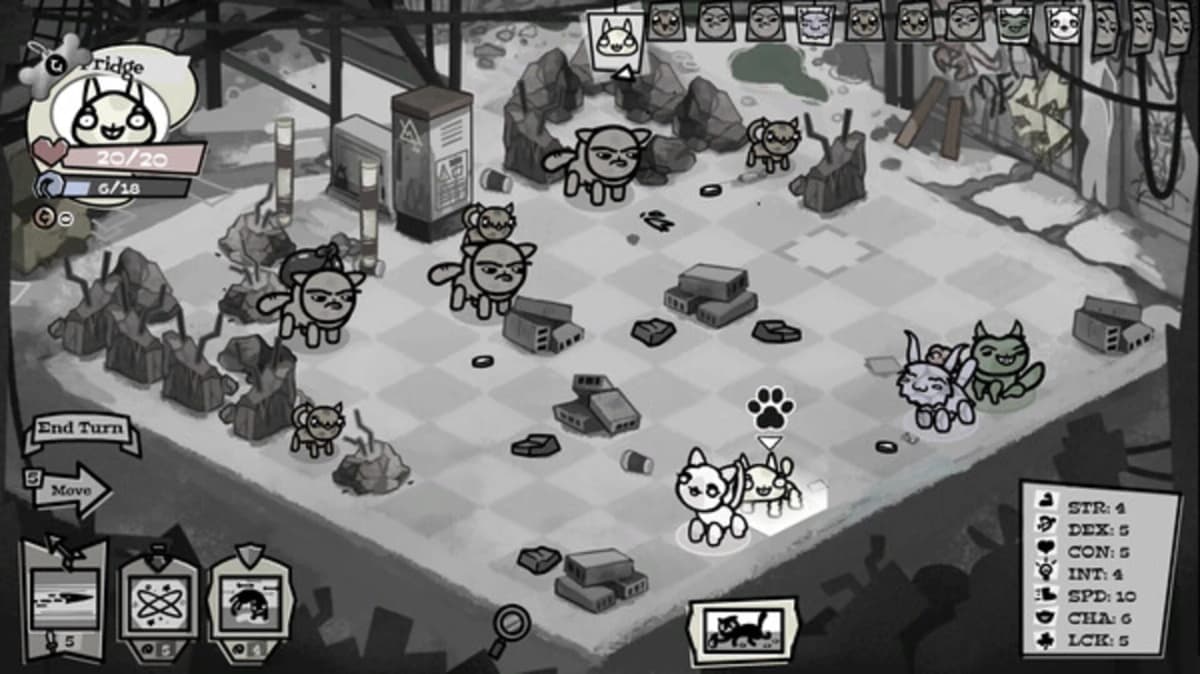
Combat plays out on compact, isometric, tile-based maps. Think tactics-style positioning, but with an Isaac-style appetite for chaos. You’re constantly weighing risk: push that enemy into a hazard and risk a chain reaction, or play it safe and drag the fight out?
Enemy variety is excellent. Across my runs I fought giant blobs, mad scientists, assassins, aliens, carnivorous plants, cultists, dinosaurs, fascist robots – if it’s a pulpy trope, Mewgenics probably finds a way to make a gross, cartoonish version of it. Bosses are the real standouts, each built around a distinct gimmick that forces you to adapt rather than just rely on raw stats.
One boss, a Desperado-type gunslinger named Zodiac, fires at anything that moves. The fight becomes a cover shooter in tactics form: dash between safe tiles, bait his shots, and only move when he’s reloading. Another, the Stacy Clone, has you literally choosing which buffs the boss gets before the fight – elemental bonuses, extra damage, defensive boons – with the catch that refusing those options injures or even kills your own cats beforehand.
Then there are the house bosses. Every few in-game days, some enormous horror shows up at your doorstep and trashes your home. Fights against Guillotina and other “kaiju” scale dramatically in difficulty and complexity. At one point, I was stuck between two gigantic monsters that were busy mauling each other while I just tried not to get obliterated by collateral damage, all to the sound of a faux-Godzilla movie theme blaring in the background. These encounters use only your high-level retired cats, turning them into glorious, last-hurrah showcases of your bloodlines’ power.
The downside to all this spectacle is how punishing failure feels. Since acts are long, losing near the end can be soul-crushing. I had one run where a single knockback triggered a horrible chain: one cat slammed into another, who ricocheted into an explosive hazard, which then pushed yet another cat off the map. I watched my seemingly unstoppable team pinball into bloody chunks in a single, disastrous turn.
Being a roguelite, Mewgenics does soften the blow slightly. You retain some items and, crucially, your home upgrades and breeding progress persist. Fully clearing an act grants class-specific legendary items and skills that encourage you to bring different archetypes all the way to the end. It’s a smart incentive structure: “Yes, this is hell, but imagine how busted your next Necromancer will be if you push through.”
The game even pokes fun at you for trying to avoid the pain. At one point, after I instinctively reloaded a save to undo a bad move, an NPC called me out for “save-scumming” and warned of consequences if I kept doing it. Even your failures are folded back into the tone and systems.
Tone, Humor, and Presentation
If you’ve played The Binding of Isaac, the aesthetic here will feel instantly familiar: a blend of cutesy and disgusting, slapstick and deeply morbid. The cats, NPCs, and enemies are all slightly off – big heads, lumpy limbs, soulless eyes, and lots of bodily fluids. Injured cats limp around covered in blood. Mutated ones can look so deformed it’s genuinely unnerving.
The disorders and traits walk a deliberate line between dark humor and discomfort. They’re often mechanically clever and thematically messed up:
- Scatological cats will happily sprint off to eat the nearest poop on the map, whether that’s tactically wise or not.
- Schizophrenia creates a hallucination that only targets the afflicted cat, turning their own mind into a hazard.
- Triskaidekaphobia means the cat automatically dies – and their body is destroyed – upon casting their 13th spell.
- ADHD forces you to complete that cat’s turn in about five seconds before they act on their own.
- Dyslexia scrambles ability names and descriptions so thoroughly that you have to reread everything to decode what’s actually happening.
Mechanically, these traits are brilliant little wrenches thrown into your plans. Emotionally, they can be pretty rough, especially when they show up on a cat you’re attached to. I had several moments where a beloved veteran finally died of old age, and it hit harder than I expected precisely because they’d been the backbone of my squads for multiple acts. It inevitably made me think about my own pets who’ve “crossed the rainbow bridge.”
The sound design leans into that same mix of absurdity and cruelty: constant meowing, wet impact noises, gross little squelches, and dramatic musical cues during house invasions and boss fights. It’s not pretty in a conventional way, but it’s cohesive. The whole package feels like a fever dream you slowly learn to navigate.
Where Mewgenics Stumbles
For all its brilliance, Mewgenics has some clear pain points – and they’re not just the obvious “this game is hard” ones.
The first big issue is information. The breeding system is central to everything, yet critical details about your cats – their likes and dislikes, orientations, whether they’re inbred, and how they’ll behave socially – are hidden behind an NPC you only meaningfully engage with after funneling multiple litters through them. Until then, you’re playing relationship roulette. When your core meta revolves around pairing and planning lineages, that opacity feels less like mystery and more like friction.
The second is the UI and general management once your home fills up. Juggling dozens of cats with overlapping traits, similar sprites, and constantly shifting positions in your rooms is just messy. The tagging system you eventually unlock helps, but not enough. I often found myself hunting for specific cats or traits in a way that felt more like wrestling the interface than making strategic decisions.
The third – and probably the most divisive – is how aggressive the randomness can be. Of course, RNG is the point; this is from the Isaac lineage, after all. But here, the number of overlapping random elements is staggering: status effects, tile hazards, knockbacks, environmental objects, enemy spawn patterns, initiative order, hidden traits. One small misplay or unlucky proc can cascade into a spectacular, unrecoverable disaster.
There were runs where I felt like my careful breeding and build-crafting truly paid off, and others where a perfect storm of random factors turned a great squad into paste before I could meaningfully respond. I generally love punishing roguelites, and even I found myself occasionally wishing for a little more predictability in how some systems stacked.
None of this ruins the game, but it narrows the audience. If you already dislike “I died because the game decided to be a jerk today” moments, Mewgenics will push all your wrong buttons.
Who Will Love Mewgenics (and Who Absolutely Won’t)
After living with it for dozens of hours, it’s pretty clear who Mewgenics is aimed at.
- Roguelite enthusiasts and Binding of Isaac fans will feel right at home with the dark humor, wild synergies, and gleeful cruelty.
- Tactics and strategy players who enjoy systems-heavy games and can tolerate – or even relish – chaos will find a ton to chew on here.
- Min-maxers and spreadsheet enjoyers will lose themselves in genetic planning, trait hunting, and clever buildcraft over generations.
- Cat lovers with a strong stomach will appreciate the bizarre, affectionate-yet-cruel portrayal of feline chaos, assuming they’re okay with some genuinely messed-up imagery.
On the other hand:
- If you hate long runs and huge time investment per attempt, the two-to-three-hour acts will feel exhausting.
- If you prefer clean, transparent systems and low RNG, the sheer number of random interactions will drive you up the wall.
- If you’re uncomfortable with irreverent depictions of mental disorders and bodily functions as mechanics, the humor here will probably miss for you.
- If you want a chill pet simulator, this is absolutely not that – it’s more like raising a paramilitary cat cult inside a meat grinder.
The Bottom Line
Mewgenics started out, for me, as “that weird cat-breeding roguelite” and quietly turned into one of the most engrossing tactics-adjacent games I’ve played in recent years. The first few hours were rough: information was scarce, the interface felt hostile, and the sheer density of systems was intimidating. But once the pieces clicked – once I stopped treating runs as isolated stories and started thinking in bloodlines and generations – it became dangerously compelling.
The combination of breeding, multiclassing, mutations, and long-form progression creates a sense of ownership over your squads that most roguelites can’t match. When an old veteran finally dies, or gets sacrificed on some horrible altar, you feel it. When a new kitten inherits exactly the skills and traits you were aiming for, it’s exhilarating. When a ridiculous combo build absolutely steamrolls a boss that’s been giving you trouble for days, it’s pure catharsis.
All of that lives inside a world that’s intentionally ugly, crude, and abrasive – and often very funny. It’s not subtle, but it is consistently inventive.
Taking everything into account – the incredible systemic depth, the clunky onboarding, the brutal RNG, and the sheer staying power of its ideas – I land on a 9 out of 10. It’s not going to be for everyone, but for the kind of player it’s targeting, it’s frighteningly close to perfect.
TL;DR
- What it is: A grotesque, funny, and deeply complex roguelite that fuses cat-breeding management with turn-based tactical combat.
- Why it’s special: Multi-generational builds, mutations, and class synergies create endless, genuinely surprising team compositions.
- Biggest strengths: Wild emergent gameplay, meaningful long-term progression, memorable bosses, and a unique, cohesive tone.
- Biggest weaknesses: Poor early-game information, messy UI once your house fills up, and RNG that can feel brutally unfair.
- Play if you: Love roguelites, enjoy min-maxing across generations, and don’t mind dark, bodily-fluid-heavy humor.
- Avoid if you: Dislike long runs, hate high-variance randomness, or want a gentle, wholesome pet simulator.
- Final verdict: 9/10 – a near-purrfect, endlessly replayable nightmare for players who enjoy suffering with a side of meows.
FinalBoss // Gear
Level up your setup
01Top-rated gaming headsetson Amazon→02High-refresh gaming monitorson Amazon→03Gaming chairson Amazon→04Discounted game keyson Kinguin→Affiliate links · As an Amazon Associate, FinalBoss earns from qualifying purchases.
Want to Level Up Your Gaming?
Get access to exclusive strategies, hidden tips, and pro-level insights that we don't share publicly.
Ultimate Reviews Strategy Guide + Weekly Pro Tips