
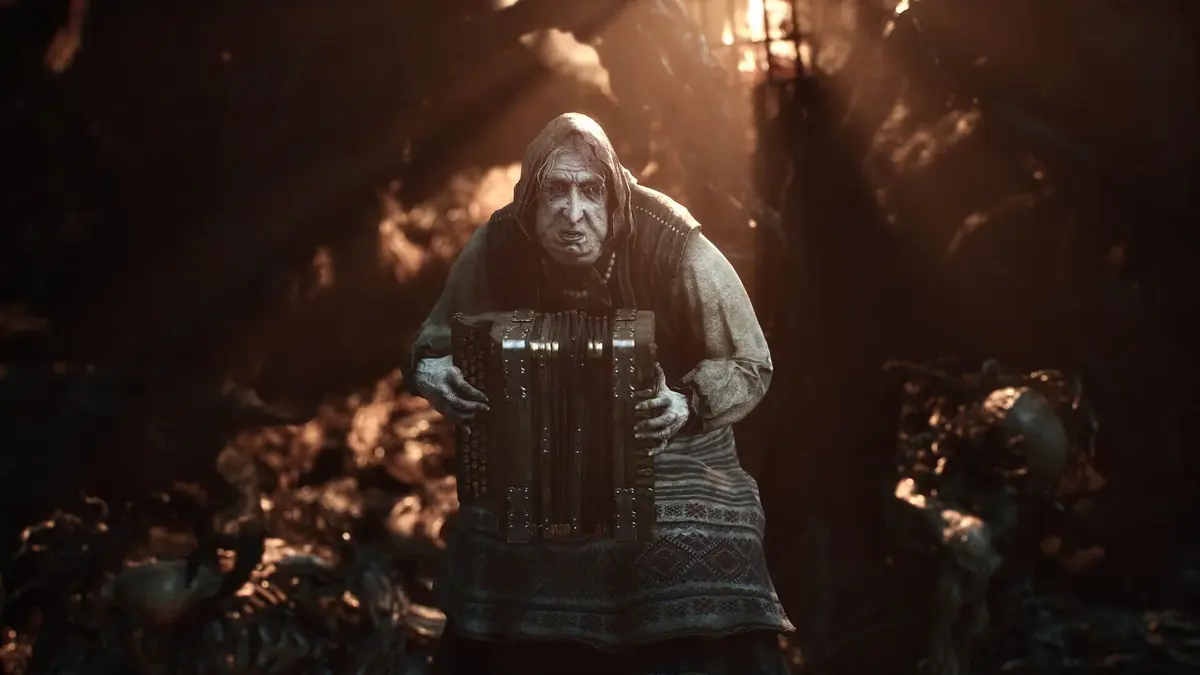
Cold Symmetry is thirty people. It was fifteen when they made the first Mortal Shell in 2020, a game with good bones, no polish and a genuinely bad final act. The studio has doubled in size exactly once. Keep that number in mind, because Mortal Shell 2 is a 25-to-30-hour Unreal Engine 5 action RPG with eight character classes, eight melee weapons, eight sidearms and a hidden collectible system deep enough to break the game, built by a team that would fit in a coach.
Table of Contents (6)
Killing the stamina bar was the right call
There is no stamina in Mortal Shell 2. You can dodge forever, sprint into a jump attack, keep swinging, deflect and swing again, and nothing on screen tells you to stop except the enemy. That should collapse the genre’s tension. It doesn’t, because what limits you isn’t a bar, it’s Resolve, and Resolve only fills when your melee hits land.
Every sidearm shot and every shell ability spends Resolve, and there is no ammo system at all. So the crossbow, the shotgun, the submachine gun and the truly deranged trebuchet axe never become the crutch ranged options usually are here, because you can’t use them from twenty feet back until you’ve earned it at arm’s length. The rhythm that falls out of it is one the genre doesn’t normally have: pile in, parry, build the break meter, cash a finisher, step out, decide whether the meter goes on a shotgun blast or on freezing time, then dive back in. The downtime other Soulslikes spend circling and healing is spent here on a spending decision, and it’s the smartest thing in the game. Underneath, the fundamentals are conventional and just as good — weighty hits, a generous parry window, enemies that stagger, and a unique finisher animation for every single enemy and boss in the game.
The shells are classes, and they’re the reason to play
Eight shells. Each is a dead hero you climb into, and each is a class in everything but name, with its own health pool, active abilities and skill tree. You don’t allocate stats — levelling raises them for you — and you get shell points instead, spent on a tree that changes what you actually do.
Teal turns invisible and backstabs, and depending on where the points go that backstab crits, lands ten stacks of poison, or gets skipped entirely so a perfect dodge damages and leaves a clone that detonates in poison. Proxima yanks enemies in with a lightning grapple and calls down bolts. Smert is the one everyone will talk about: freeze time, beat on a boss with your fists while your own health drains as the cost, stack chaos, then unfreeze and watch every stack go off at once. There’s a tank who shoulder-charges and another who superheats his armour until it bursts into fire. Aredrim feeds a ranged build, with Resolve passives strong enough to finish the game barely touching a melee combo.
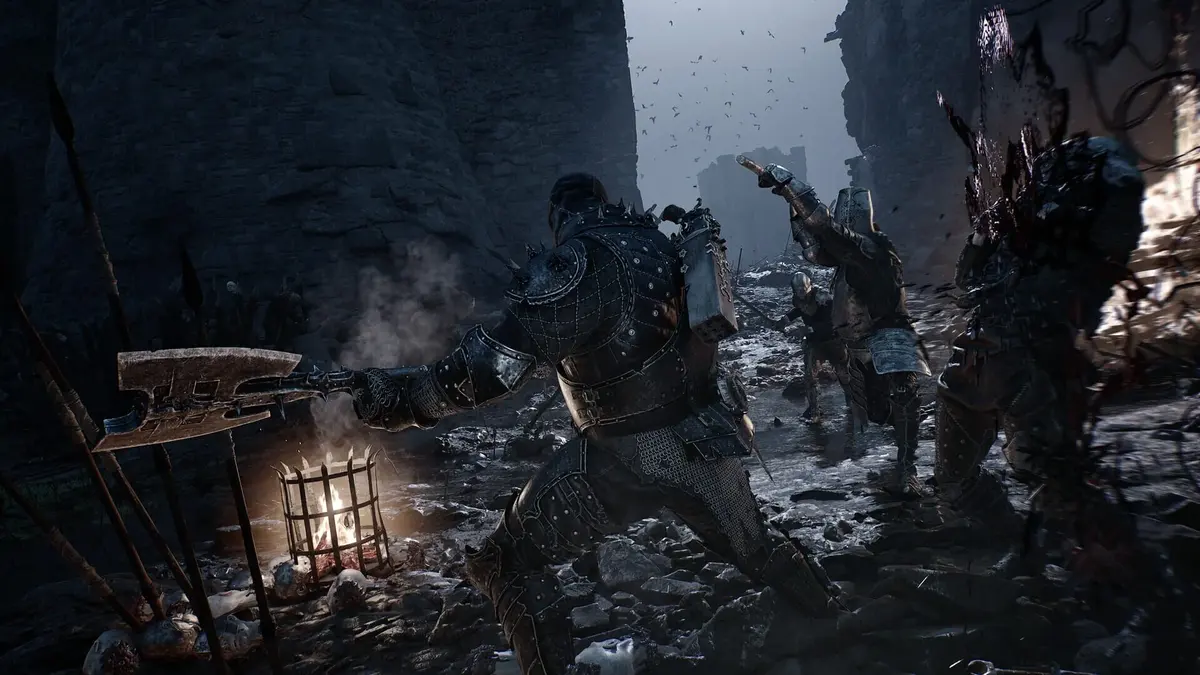
The shell is also your extra life: lose it and you continue in a naked, fragile form, and win it back by dealing damage. Recovery through aggression, same as everything else here. The weapons show the same restraint — eight melee options rather than a rack of greatswords, each with a distinct moveset, including an axe-and-dagger pair and dual katanas that snap into a two-handed axe on the heavy. Then the tar stones: roughly ten slots of hidden equippables handing out weapon abilities, crit and stagger passives, and elemental coatings that cost Resolve instead of being consumables. They level through use, and some change outright at max — a poison coating that stops expiring, a warped stone that tethers your projectile so a launched trebuchet axe orbits an enemy and grinds it to nothing.
The one progression rule I’d change tomorrow
Shells level through bonding, and bonding costs glimpse. Glimpse comes from cleansing beacons and a few world pickups, it is strictly one-time, and you cannot farm it. A full playthrough holds enough to max exactly two shells, and the second doesn’t come online until near the end, by which point your weapons and tar stones are married to the first. Points reshuffle freely within a shell. Glimpse never comes back out.
This is the one thing that works against the game’s own best idea: the pitch is eight wildly different classes, and the economy lets you meaningfully try one and a half. It’s a number, not a structure, and Cold Symmetry moves numbers — the gloom cost to strip materials out of an upgraded late-tier weapon started around 25,000 and got cut to something sane in a patch. Make glimpse refundable and the complaint disappears.
The world is the game’s best feature, not its worst
This is where opinions split hardest, so I’ll plant a flag: the exploration is the second-best thing here and the criticism of it is overstated. Yes, it’s fragmented — self-contained islands stitched together with bridges and warp gates rather than one folded, continuous Lordran, and more linear than the open-world framing suggests once you clock how sharply enemy difficulty gates the intended route. You can feel the team size there.
But it’s still the richest Soulslike world to poke at since Elden Ring, and the reason is the beacon dungeons. Beacons are the bonfires, and every beacon opens its own dungeon — imagine that in Dark Souls. Some are a cave with a note from whoever died there, some are a boss arena, one is a puzzle box of fake walls and paired archways that shuffle you between two versions of the same room. And the collectibles are the point: the map will pin shells and weapons for you if you pay for it, but tar stones are never marked and you only get them by looking. Some islands are barren, and the beacons are stingy enough that you can cross a whole one without finding a checkpoint, which means either a clean run or a lot of repeated walking. Comb every one anyway.
The bosses are the problem
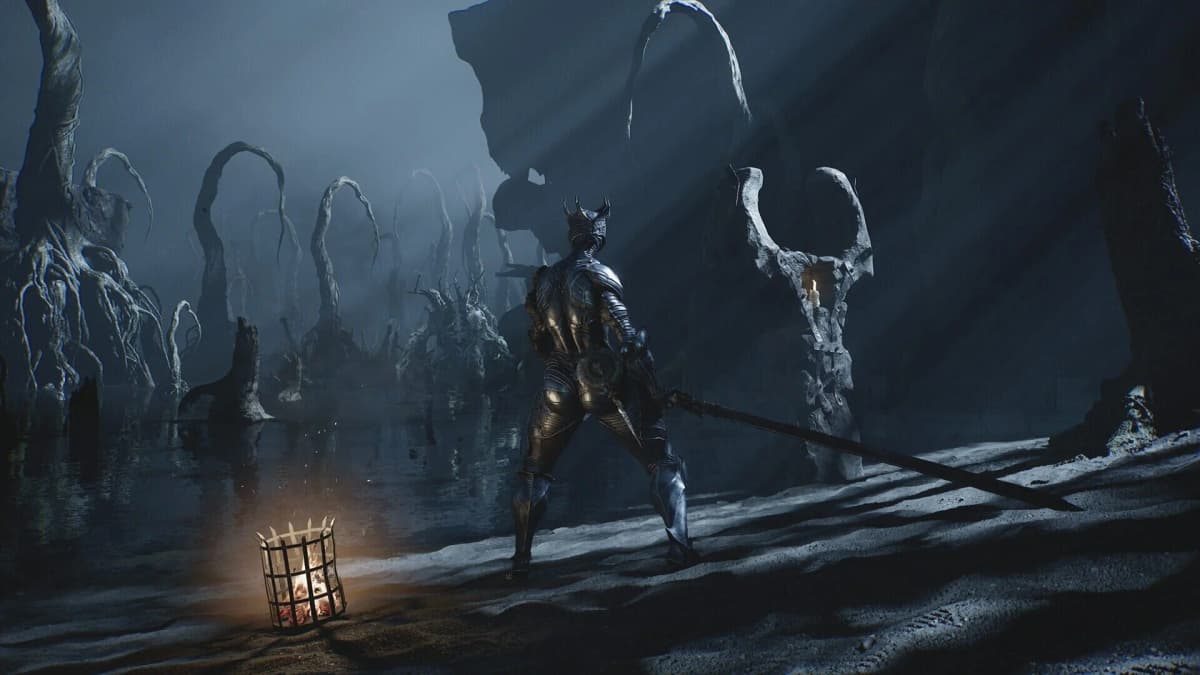
Here’s what nobody expects from a game this grim-looking: it’s easy. Not uniformly — trash mobs will two-shot you, every command grab is effectively an instant kill, and normal encounters stay tense. The bosses are what fold. Major ones go down in one or two attempts on an unadjusted build, because their movesets are short and predictable while infinite dodging, a wide parry window and the buildcraft all pull your way at once. The tuning is inverted: the regular enemies are harder than the things guarding the doors.
The dungeon bosses repeat badly too. You’ll fight roughly ten Grishas across the run — a normal enemy scaled up with one extra attack and a lot more health — and by the fourth it’s a chore. That feeds a wider variety problem: the opening region has a strong roster, the second hands you the same enemies with extra armour bolted on or a recolour, and the middle adds nothing new. Late game mixes it up again, but a big chunk of the run is spent fighting things you’d already solved, which is why New Game Plus is a harder sell than it should be.
To Cold Symmetry’s credit, difficulty lives inside the fiction rather than a menu. An NPC brings on an eternal night that opens new areas and vendors and raises rewards while enemies hit harder and hazards appear, toggleable whenever. It doesn’t fix the bosses, because it changes their numbers and not their movesets. Going the other way, the Slayer Seal is one of four equippable parry types: it trades your parry for a charged strike doing massive break damage, makes ranged attacks build break by default, and makes finishers heal you. It kills achievements, and it’s the most graceful easy mode I’ve seen in this genre.
It runs well, and it’s still a bit janky
On PC this is one of the better-optimised UE5 games. An RTX 4080 Super at 1440p ultra, ray tracing on, no DLSS or frame generation, holds above 60fps; DLSS on balanced pushes past 90, and a laptop at 1440p high with DLSS balanced averages 60. Some areas tank harder than others, there’s a jitter unless V-Sync is on, and you get the usual UE5 tax of micro-stutter and ghosting. Worth it: the persistent murky fog does more for the atmosphere than any single asset, even though the locations are genre greatest hits — derelict castles, red foliage, a poison swamp, some Giger-adjacent interiors.
The jank is real but survivable. Hitboxes wobble, the invisible backstab whiffs constantly, and a few boss moves simply can’t connect. Buttons unmap themselves after NPC conversations, audio loops endlessly until you quit to the main menu, and you can fall clean through the floor after killing a boss. A dozen bugs and a couple of crashes per playthrough is a fair expectation — none game-breaking, and this team is clearly patching.
The story is fine and not much more: a vessel crashes out of the sky, people crack open its eggs, the corruption inside mutates the land, and you — hatched from the one egg it didn’t touch — go to collect the rest, without ever much caring why. The exception is the shell memories, unlocked by bonding, comfortably the best writing here. The soundtrack has the opposite problem: one track is reused across so many optional bosses you start clocking it.
The 8 stands because Mortal Shell 2 gets combat and buildcraft more right than almost anything in this genre outside FromSoftware, and loses a point for bosses that never make you use any of it.
Mortal Shell II
Cold Symmetry took the stamina bar out, replaced it with Resolve, and built eight real character classes on top of it, and the result is the most inventive buildcraft in the genre outside FromSoftware. Thirty people made this. What they didn’t build is a set of bosses worth pointing all of that at, and until the tenth Grisha stops showing up and the major fights stop dying in two attempts, it’s an 8 rather than a 9.
- No stamina, and Resolve makes aggression the economy
- Eight shells that are genuinely different classes
- Tar stones hide the game’s most broken ideas
- Every beacon opens its own dungeon
- A unique finisher animation for every enemy
- Major bosses die in one or two attempts
- Roughly ten Grisha repeats across the run
- Glimpse can’t be refunded, so you commit early
- Enemy variety flatlines through the middle
- Hitbox wobble, audio loops, fall-through-floor bugs
Buy it for the systems. If you have never touched a Soulslike, this is the easiest door into the genre that still feels like the real thing. If you came for the boss that takes you four hours, turn on the eternal night and manage your expectations.
FinalBoss // Gear
Level up your setup
01Top-rated gaming headsetson Amazon→02High-refresh gaming monitorson Amazon→03Gaming chairson Amazon→04Discounted game keyson Kinguin→Affiliate links · As an Amazon Associate, FinalBoss earns from qualifying purchases.
Want to Level Up Your Gaming?
Get access to exclusive strategies, hidden tips, and pro-level insights that we don't share publicly.
Ultimate Reviews Strategy Guide + Weekly Pro Tips