
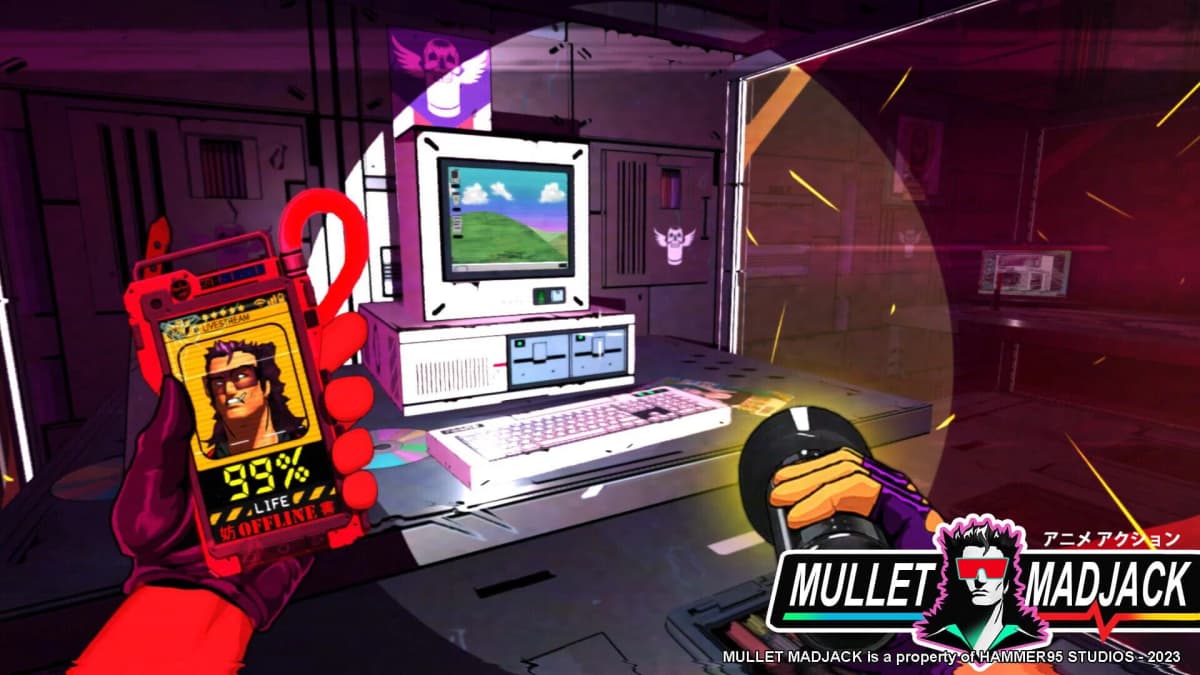
Speed has become a marketing word in shooters. Plenty of games promise momentum, then quietly reward the same old habits: hug a wall, peek a corner, reload, repeat. Taken together, the current spread of Mullet MadJack reviews suggests this one is built differently. Its headline mechanic is brutally simple: you have roughly 10 seconds to live, and every kill buys more time. That is not a flashy side idea pasted onto a familiar FPS. It is the whole machine. Every floor, every weapon pickup, every aggressive move exists under that clock.
That clarity is why the game has landed so well across platforms and publications. Mullet MadJack is a loud, hyper-stylized roguelite FPS with a strong identity, a genuinely sharp central hook, and enough run-to-run variation to keep the pressure exciting for a good while. Its weak spots are real and easy to name: the structure can start showing its seams, boss fights do not seem to eclipse the regular combat, and the game’s full-throttle intensity will bounce some players clean off. Even so, the broad critical picture is easy to read. This is an 8.5/10 shooter for people who want motion, pressure, and personality more than they want caution, realism, or tactical breathing room.
Table of Contents (11)
Key takeaways
- Mullet MadJack lives and dies by its 10-second timer, and that mechanic appears to reshape the entire FPS loop in smart ways.
- The strongest consensus in reviews is the presentation: neon anime chaos, retro-cyberpunk attitude, and a soundtrack people keep singling out.
- The main complaints are repetition, uneven boss encounters, and an intensity level that can feel exhausting instead of thrilling.
- It suits players who like aggressive FPS design, short rerunnable runs, and arcade pressure.
- Final verdict: 8.5/10.
A shooter built around panic, not patience
The best thing about Mullet MadJack is that its core idea is instantly readable. You enter a floor. The clock is against you. Enemies are not just threats; they are oxygen tanks with guns. Kill fast enough and the run continues. Hesitate, circle too long, or try to play it like a cautious corridor shooter, and the game punishes you for thinking in the wrong genre language.
That is why the timer works. A lesser game would use a countdown as seasoning, a little bit of artificial stress sprinkled over ordinary combat. Here, the timer seems to change your priorities at a structural level. Reviews repeatedly point to how movement, melee, weapon grabs, and environmental takedowns all feed the same appetite for forward momentum. The goal is not clean room-clearing in the old-school boomer shooter sense. It is chain-building. Momentum is health. Aggression is defense. Standing still is a slow form of dying.
That design puts Mullet MadJack in interesting company. It has some of the relentless push of modern DOOM, some of the arcade-score pressure of something like Post Void, and a bit of the “keep moving or the whole illusion collapses” philosophy that makes speed-centric shooters feel so intoxicating when they click. The difference is that Mullet MadJack appears to frame all of that through short roguelite floors and upgrade picks, so the pace stays spiky rather than sprawling.
That last part matters. Current reviews describe a flow where each stretch of action is compact, then briefly interrupted by a choice: a new weapon, a buff, some angle that nudges the next few floors in a slightly different direction. That is enough variation to keep the loop from becoming pure muscle memory, but not so much that the game turns into build homework. For players who love shooters and tolerate roguelites but do not want to spend half their run reading perk text, that sounds like exactly the right amount of friction.
Just as important, the reported control set seems intentionally lean. Run, shoot, kick, finish, swap, keep going. The praise is less about complexity and more about responsiveness. That usually tells you something important about an action game’s priorities. Skill expression is coming from tempo, target selection, route choice, and how cleanly you can improvise under pressure, not from memorizing an encyclopedic system. For this concept, that is the right call. A 10-second timer would suffocate under fussy mechanics.
The art and audio are not decoration; they sell the whole fantasy
Read enough Mullet MadJack reviews and one pattern becomes impossible to miss: the presentation is not merely well liked, it is part of why the game feels memorable at all. Reviewers keep circling the same cluster of praise points-its anime-inflected visual style, retro-futurist neon palette, vaporwave and cyberpunk flavor, and a soundtrack with enough bite to keep the sprint from feeling mechanically dry.
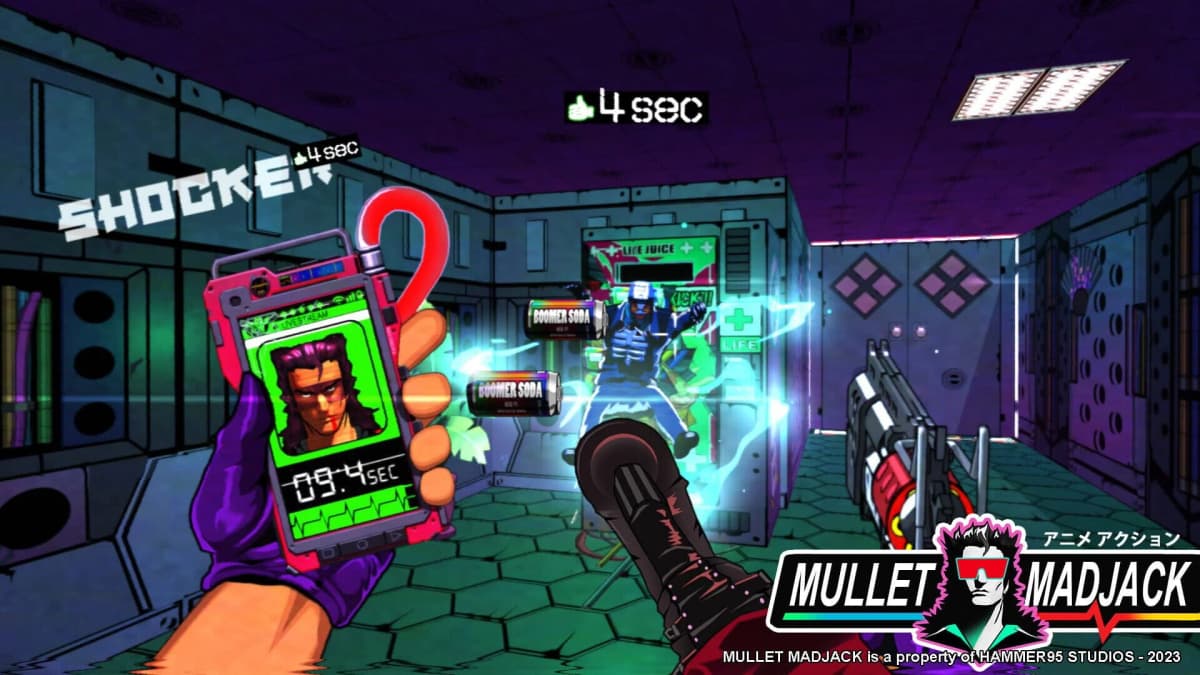
That kind of audiovisual identity can be overrated in games that do not have the systems to back it up. Here, it seems to do real work. A shooter this fast needs a strong surface language. It needs to make chaos feel legible and absurdity feel intentional. The exaggerated art direction helps turn every run into a cartoonishly violent sprint rather than a muddled blur of hallways and muzzle flashes. The music matters for the same reason. In a timer-based FPS, rhythm is not an accessory. Rhythm is part of the player’s mental state, and a strong soundtrack can keep the adrenaline feeling playful instead of merely stressful.
That is also where Mullet MadJack separates itself from a lot of competent indie shooters. Plenty of games can produce a good loop. Far fewer can make that loop feel like it belongs to a specific world with a specific attitude. Everything reported about this game suggests a style-first sensibility that actually understands restraint beneath the noise. It is loud, yes, but it is loud with purpose. The game knows the fantasy it is selling: anime-trash futurism, arcade violence, and zero patience for defensive play.
That focus gives the game a real identity advantage. Even players who eventually tire of the structure are likely to remember the look, the sound, and the sensation of being shoved through another floor by a ticking clock and a sneering aesthetic. In an overcrowded action market, memorability counts for a lot.
The weak spots are visible, and they are the kind that matter differently to different players
The most useful thing about the current critical consensus is that the praise does not hide the limitations. Mullet MadJack appears to be a very focused game, and focused games always run this risk: when the central trick hits, everything sings; when it does not, the repetition becomes impossible to ignore. Several reviews point toward exactly that tradeoff.
The first issue is structural repetition. Floor-based progression, upgrade selection, periodic bosses, repeat. That loop can be compulsive for the right audience, especially when a run is short and the action remains sharp. It can also start to feel formulaic once the initial rush of style and speed settles down. This is not a game that seems interested in disguising its structure with sprawling mission variety or large-scale objective changes. It trusts the loop. For many players, that trust will be rewarded. For others, the seams will show faster than expected.
The second weak point is boss design. One of the more consistent reservations in coverage is that boss fights are not the main reason to show up. That matters because the surrounding combat sounds strong enough to create real expectations for a big payoff. When standard floors ask for split-second movement, violent improvisation, and clever use of whatever tools are at hand, a flatter boss encounter can feel less like a climax and more like a brief interruption in the flow. That is not fatal, but it is a genuine knock against a game built so heavily on momentum.
The third issue is simply intensity. Some players hear “kill every 10 seconds or die” and immediately understand why the game is exciting. Others hear the same sentence and feel their shoulders tense up. Both reactions are valid. This is not a shooter that seems interested in letting you settle in, study the space, and advance methodically. Its design pushes you to commit, keep moving, and accept messy success over controlled caution. If that sounds exhilarating, Mullet MadJack is speaking your language. If that sounds exhausting, the art style will not save it.
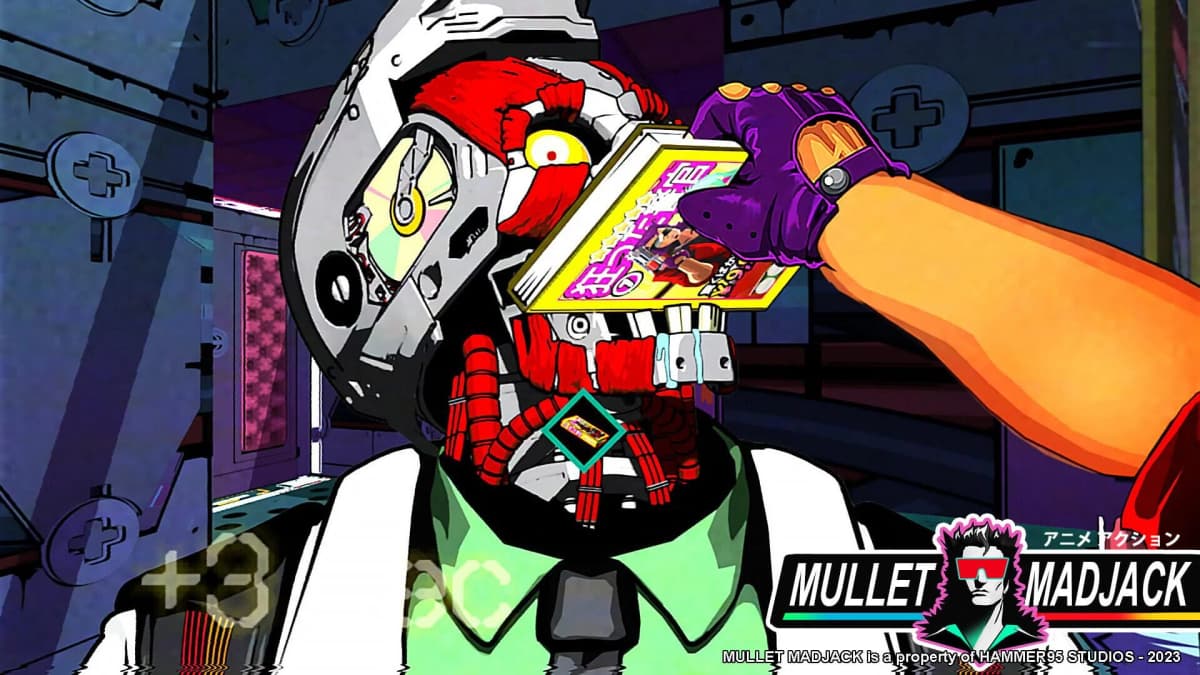
That narrowness is worth stressing because it is easy to mistake the game’s colorful presentation for broad appeal. The opposite is probably true. The look is welcoming. The design is selective. This is a game for people who enjoy being pressured.
Why the format makes sense on portable and short-session play
One of the more encouraging notes across platform coverage is how naturally the game seems to fit short bursts. Reviews of the PC and Steam Deck version have been especially positive about that matchup, and later coverage around the Switch release reinforces the same basic idea: this is a run-based FPS that makes sense when played in compact sessions. That is more important than it sounds.
A game this visually loud and mechanically urgent can become numbing in marathon stretches. In smaller doses, the structure starts to look smart rather than repetitive. A few runs, a few upgrades, maybe one more attempt after a bad death, then out. That arcade cadence flatters the design. It also means Mullet MadJack can appeal to players who want a skill game that respects fragmented playtime, which is not something every modern shooter understands. The one caution is obvious: in a game built on speed and responsiveness, technical roughness matters more than usual. Even positive platform impressions should be read with that in mind.
Who this suits, and who should probably steer elsewhere
Audience fit is unusually clear here, which makes buying advice refreshingly simple.
Play it if
- You like aggressive FPS design where movement and killing are part of the same survival loop.
- You enjoy roguelites in short, replayable runs more than giant progression webs.
- You care about style, soundtrack, and a game having a visual identity that is impossible to confuse with anything else.
- You enjoy optimizing routes, reacting under pressure, and getting a little better each run.
Think twice if
- You prefer slower, more methodical shooters that reward cover use and careful room-by-room planning.
- You want boss fights to be the centerpiece rather than the connective tissue.
- You need a lot of mission variety or deep buildcraft to stay invested.
- You find countdown pressure stressful in a bad way instead of thrilling in a good way.
Why Mullet MadJack reviews have been so consistently upbeat
There is a specific kind of game criticism that sounds almost accidental: reviewers from different places use different words, but they all end up describing the same feeling. That is what seems to be happening with Mullet MadJack. The details vary, yet the underlying conclusion stays stable. The game knows exactly what it wants to be, and that certainty carries a lot of weight.
That confidence matters because the modern action space is crowded with games trying to be everything at once: campaign shooter, loot treadmill, roguelite, narrative sandbox, live-service habit, creator platform, endless roadmap. Mullet MadJack sounds far less bloated than that. It has a clean pitch, a clean rhythm, and a clean understanding of its target player. The result is not universal appeal. It is something better for the right audience: a game that seems committed to its own weird, caffeinated identity. That is why the best Mullet MadJack reviews read enthusiastic rather than merely respectful.
Bottom line
Mullet MadJack looks like a joke, sounds like a sugar rush, and plays-based on the current body of reviews-like a surprisingly disciplined action design wrapped in anime chaos. The 10-second survival timer is the star because it transforms every encounter into a decision about speed, positioning, and nerve. The roguelite layer adds enough variety to keep runs lively without burying the shooter under menus. The presentation does heavy lifting, and in this case that is a compliment.
The downsides are not small, but they are easy to account for. Repetition is part of the bargain. Bosses are not the selling point. The intensity is relentless enough that some players will admire the game more than they enjoy it. Even with those caveats, the recommendation stands firm. If you like your FPS games fast, stylish, and unapologetically aggressive, this is one of the more interesting modern riffs on the format. If you want tactical breathing room or broad systemic depth, this is the wrong party.
TL;DR
- Mullet MadJack is a fast roguelite FPS built around a 10-second life timer that forces constant aggression.
- Its biggest strengths are the core loop, the anime-splashed retro-cyberpunk presentation, and a soundtrack that helps the action stick in your head.
- Its biggest weaknesses are repetition, underwhelming boss encounters, and a pressure level that will not suit every shooter fan.
- Best for players who want short, rerunnable, high-intensity FPS runs.
- Final verdict: 8.5/10.
FinalBoss // Gear
Level up your setup
01Top-rated gaming headsetson Amazon→02High-refresh gaming monitorson Amazon→03Gaming chairson Amazon→04Discounted game keyson Kinguin→
Affiliate links · As an Amazon Associate, FinalBoss earns from qualifying purchases.
Want to Level Up Your Gaming?
Get access to exclusive strategies, hidden tips, and pro-level insights that we don't share publicly.
Ultimate Reviews Strategy Guide + Weekly Pro Tips