
Table of Contents (7)
I want the Neo Geo AES+ to be great, and I still hate the way this debate is being framed
The Neo Geo has always been one of those machines that lived in my head long before it lived anywhere near my hands. I grew up staring at screenshots of Garou: Mark of the Wolves, Metal Slug, Samurai Shodown II, and King of Fighters ’98 like they came from some forbidden luxury tier of gaming. The original AES wasn’t just expensive. It was absurd. It was the console equivalent of a glass display case, something you admired from a distance unless you had serious money or a very specific obsession.
That’s why I have mixed feelings about the Neo Geo AES+. A modern cartridge-compatible Neo Geo that isn’t just another cheap mini console or a compromised plug-and-play box sounds fantastic on paper. Part of me loves that this thing exists at all. I love dedicated hardware. I love overbuilt nonsense when it serves a real purpose. I love the idea of SNK’s old monster getting a second life that doesn’t feel like a toy.
But the minute the conversation turns into “AES+ isn’t emulation, unlike MiSTer,” my patience disappears. That shorthand is lazy at best and marketing sludge at worst. I care about this because I’m not coming at Neo Geo as a shelf collector first. I’m coming at it as someone who actually plays these games, especially fighters, where timing, audio behavior, and controller response matter more than the romance of the shell. If something feels off in KOF ’98, I notice it fast. If the hitstop or rhythm is weird in Last Blade 2, I don’t need a spec sheet to tell me. I can feel it in my hands.
So when the AES+ versus MiSTer argument gets flattened into “real hardware versus emulation,” I think it does a disservice to the actual technology and to the people who have spent years making FPGA preservation more accurate than this hobby used to think possible. Worse, it lets companies sell purity as if purity were a hardware feature. It isn’t. It’s a story people tell themselves when they want a purchase to feel holier than it really is.
The first thing people get wrong is what MiSTer actually is
MiSTer is not “just emulation” in the way most gamers use that phrase. When people say emulation casually, they usually mean software running on a general-purpose CPU, translating one system’s behavior through code and hoping the result feels close enough. MiSTer uses an FPGA approach instead, recreating hardware logic at the silicon level in a way that aims for cycle accuracy. That difference matters, especially for machines like the Neo Geo where timing and hardware behavior are part of the game feel.
- MiSTer’s Neo Geo implementation has been verified across the complete 148-game Neo Geo library.
- The same core now covers AES, MVS, and Neo Geo CD functionality in one unified setup.
- Neo Geo CD support includes fast loading, CDZ support, and Unibios compatibility.
- That means CD exclusives like Puzzle Bobble, Ironclad, and Crossed Swords II are in the picture too.
That is not a toy solution. That is a serious preservation and play platform. It is also, frankly, the reason the whole “MiSTer is lesser” vibe annoys me so much. People love to talk as if MiSTer were some bargain-bin compromise for those who can’t afford the fancy box. In reality, MiSTer earned its reputation by being brutally good. It became the standard because people obsessed over getting things right.
There are still nuances. MiSTer’s image can look slightly cleaner and sharper than original hardware because it doesn’t carry the same analog interference and grime. Some observers have also noted tiny differences in behavior compared to classic Neo Geo hardware, including marginal timing discrepancies in certain cases. That doesn’t magically disqualify it. It just means accuracy is a spectrum, not a religion. Every serious retro setup lives somewhere on that spectrum unless it is literally untouched original hardware connected the original way, flaws and all.
MiSTer won my trust the same way good hardware always does: by getting out of the way
I didn’t come around on MiSTer because someone handed me a white paper. I came around because I played the games. I spent time with SNK fighters and action games on setups that were supposed to be “close enough,” and close enough has a smell to it after a while. Audio hiccups. Strange latency. Slightly wrong pacing. Tiny visual tells that stack up into a feeling that the machine is impersonating the game instead of becoming it.
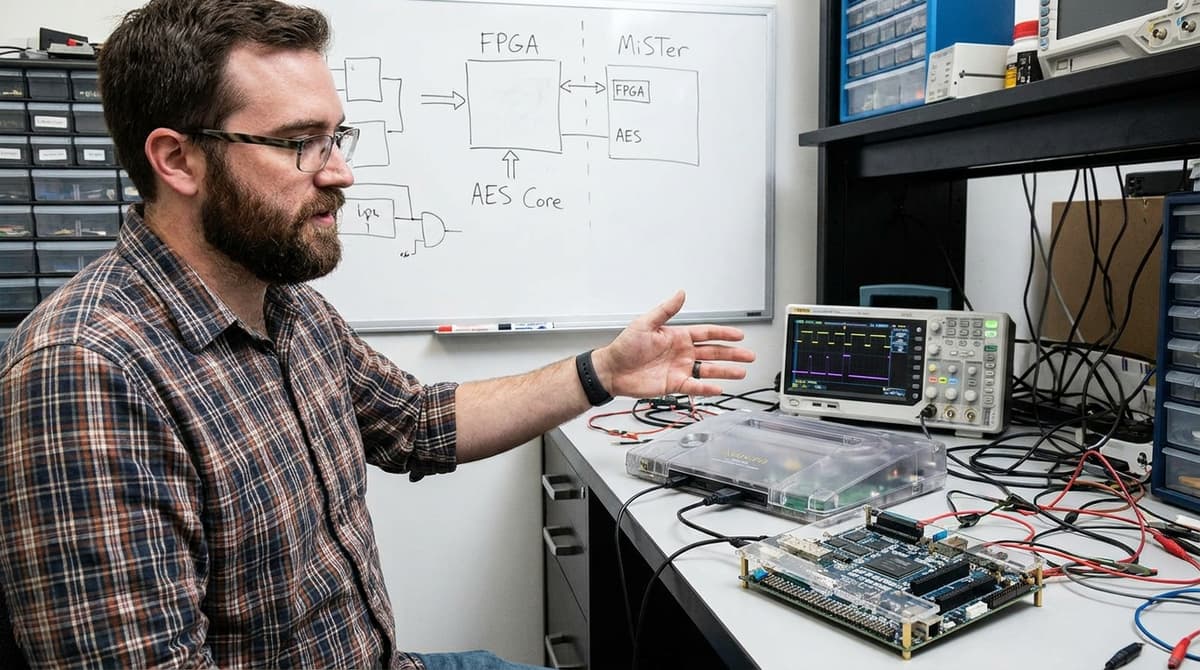
MiSTer got past that for me. Once I had a solid controller setup and a display chain I trusted, the Neo Geo core stopped being the topic and the games became the topic again. That’s the point. I wasn’t thinking about abstraction layers while blasting through Metal Slug X. I wasn’t mentally grading the hardware while getting dragged through my own bad habits in Garou. I was just playing. When a platform disappears and leaves only the game behind, that’s usually the highest compliment I can give it.
And MiSTer’s big advantage in the Neo Geo AES+ vs MiSTer discussion is brutally simple: access. I can explore the whole history of SNK’s platform without hunting cartridges that cost more than some modern consoles. I can move between AES behavior, MVS behavior, and Neo Geo CD-era weirdness in one ecosystem. That matters because the Neo Geo story was never only about the famous home cartridges. The CD library, the arcade lineage, the BIOS differences, and the long preservation tail are part of the real story too.
Yes, if someone specifically wants to use original AES cartridges on a MiSTer setup, that’s not the straightforward path. It requires the right hardware chain and adapters, not the elegant slot-in ritual collectors want. That is a legitimate drawback. I won’t pretend otherwise. But from a play-and-preserve standpoint, MiSTer’s convenience and completeness are miles ahead of most nostalgia hardware, and that’s why it remains the baseline I compare everything else against.
The AES+ still has something MiSTer can’t fake, and I think that matters more than some purists admit
This is the part where I refuse to be fake-neutral in the opposite direction. The Neo Geo AES+ is not pointless. It is not automatically a vanity scam just because MiSTer exists. Dedicated hardware has a value that multifunction devices often can’t reproduce, even when the underlying experience is excellent. There is a tactile, ritualistic pleasure to taking a real cartridge, slotting it into a machine built for that exact format, grabbing a proper stick, and booting into a game without a menu system reminding me I’m browsing a museum.
If someone already owns AES cartridges, or simply wants a modern Neo Geo-centric box with current video conveniences and a format-faithful identity, the AES+ makes emotional sense immediately. In a hobby drowning in all-in-one devices, there is still something beautiful about a machine that does one thing and commits to it. I understand the pull. I really do.
There is also a practical point people miss when the argument gets too romantic: AES and MVS cartridges contain the same game code. The differences are mainly down to BIOS behavior and home-versus-arcade presentation, not some mystical gameplay gulf. That means the value of AES+ is not that it unlocks a secret, superior version of SNK history. Its value is format authenticity, cartridge compatibility, and the experience of using a Neo Geo-like machine as a Neo Geo-like machine.
That’s a real advantage. It just isn’t the same thing as proving some kind of transcendent hardware purity over MiSTer. And that distinction is exactly where the conversation keeps getting muddy on purpose.
This is where the “not emulation” line starts smelling like marketing perfume
Recent reporting around the AES+ pulled in commentary from FPGA developers arguing that the system is, in effect, “basically the MiSTer core” broken out into separate chips. That claim deserves caution because, at least from the public information available right now, there still isn’t enough official technical documentation to settle every detail cleanly. I’m not going to state speculation as settled fact. That would be sloppy.
Still, if that claim is even broadly true, then the implication is fascinating. It would mean the AES+ is not some holy relic descended directly from untouched 1990 silicon. It would be a modern hardware recreation built on the same class of engineering work that made MiSTer so respected in the first place, only translated into a fixed ASIC-based product. And honestly, that would not make the AES+ worse. It would make the attempt to frame MiSTer as second-rate look ridiculous.
That’s the part I keep coming back to. If a company benefits from the legitimacy and accuracy that FPGA-based recreation proved, and then turns around and sells “not emulation” as a purity badge, it feels like rhetorical sleight of hand. The average buyer hears “not emulation” and imagines some massive ontological gap between the boxes. In reality, the debate is much narrower and much nerdier than that. It’s about implementation, updateability, and form factor. It’s about fixed silicon versus reconfigurable logic. It’s about whether preserving a machine means preserving its quirks or preserving its function. Those are real distinctions. But they are not the same as saying one side is fake and the other is authentic.
There’s also a catch that almost never gets the spotlight it deserves: fixed ASIC designs are not inherently superior for retro preservation just because they sound more “hardware-like.” One of MiSTer’s great strengths is that it can be updated and corrected. Bugs get found. Behavior gets refined. Features expand. Neo Geo CD support becoming more fully integrated is a perfect example of why that flexibility matters. A fixed design may feel more product-ready and appliance-like, but if something is wrong or incomplete, flexibility suddenly stops looking like a weakness and starts looking like the smartest decision in the room.
The uncomfortable truth is that MiSTer is still the better Neo Geo machine for most actual players
I know that sentence will irritate some collectors, but I believe it. For most people who love Neo Geo games more than they love the status attached to Neo Geo ownership, MiSTer remains the more compelling choice. It gives broad access, excellent accuracy, multiple system modes, CD support, and a proven track record without forcing anyone into the financial weirdness of original cartridge collecting. It also does all of that while living alongside countless other classic systems, which matters in the real world where most of us have limits on space, money, and patience.
That doesn’t make AES+ a scam. It makes AES+ a niche luxury object with legitimate appeal. There is a difference. I’m actually glad it exists for the people who want that exact thing. I just refuse to pretend it changes the hierarchy for everyone else. If someone’s priority is playing the Neo Geo library accurately and comprehensively, MiSTer is the obvious answer. If someone’s priority is using real cartridges in a dedicated Neo Geo-like box, then AES+ becomes more attractive. Those are different priorities, and the second one is far more about ritual and ownership than raw play value.
Maybe that sounds harsher than it needs to, but retro gaming already has enough mythology layered on top of it. The Neo Geo especially is a machine people love to mythologize because it was always expensive, always elite, always slightly out of reach. That history makes people vulnerable to language about authenticity, legitimacy, and “real” hardware. Companies know it. Collectors know it. Everyone plays along because the fantasy is part of the fun.
I’m still drawn to the AES+, and that’s exactly why I don’t want the truth sanded down
Here’s the conflicted part I can’t shake. Even after all that criticism, I still get the appeal on a gut level. A dedicated modern Neo Geo machine with proper cartridge support scratches a very specific itch that MiSTer, for all its brilliance, does not fully scratch. MiSTer is the sensible answer. The AES+ is the romantic one. I’ve been gaming long enough to know those two things are rarely the same, and I’m not immune to romance just because I can spot the sales pitch.
So I’m not rooting for the AES+ to fail. I’m rooting for the people behind it to be honest about what it is. If it launches and turns out to be a fantastic, low-latency, cartridge-faithful Neo Geo for the living room, that will be worth celebrating. If the engineering owes a debt to the same FPGA logic work that made MiSTer so respected, that should also be celebrated, not buried under a smug “not emulation” label designed to flatter buyers who want to feel above everyone else.
Because that’s really the tension sitting underneath this whole Neo Geo AES+ vs MiSTer debate. It isn’t just about which box plays SNK games better. It’s about whether retro gaming still values technical honesty more than collector-friendly mythology. I love the dream of a reborn Neo Geo. I just don’t love the idea that the dream only works if we pretend MiSTer didn’t already prove how good modern hardware recreation can be. And if that pretense becomes the main selling point, then the machine starts feeling less like preservation and more like a luxury story people buy to make nostalgia feel exclusive again.
FinalBoss // Gear
Level up your setup
01Top-rated gaming headsetson Amazon→02High-refresh gaming monitorson Amazon→03Gaming chairson Amazon→04Discounted game keyson Kinguin→Affiliate links · As an Amazon Associate, FinalBoss earns from qualifying purchases.
Want to Level Up Your Gaming?
Get access to exclusive strategies, hidden tips, and pro-level insights that we don't share publicly.
Ultimate Editor's Pick Strategy Guide + Weekly Pro Tips